
- Quick Answer
- The Trial-Dose Table: What Researchers Actually Gave
- The Saponin Maths: Milligrams × Percentage Is the Dose
- Why the Percentage Itself Is Slippery: Total Saponins ≠ Protodioscin
- How the Trials Actually Took It: Food, Splits and Timing
- Cycling: What Is Practice, What Is Evidence
- How Long It Takes: the Trial Measurement Windows
- The Testomore Dose-Honesty Box
- Three Labels, Audited Step by Step
- Does Taking More Change the Side-Effect Picture?
- Tribulus in Blends: Where the Dose Disappears Entirely
- A Stronger Alternative in This Category
- Frequently Asked Questions
- How much tribulus should I take per day?
- What does "40% saponins" actually mean?
- Is 90% saponins better than 40%?
- Should I take tribulus with food?
- How long does tribulus take to work?
- Do I need to cycle tribulus?
- Is powder as good as extract?
- Does body weight change the dose?
- Can I just take more to get the trial results?
- What if my label doesn't state a saponin percentage?
- Is one big dose in the morning as good as split doses?
- What is Tribestan, and is it different from ordinary tribulus capsules?
- Read This Next
Disclosure: This article contains affiliate links. If you buy through them, we may earn a commission at no extra cost to you. It never changes our conclusions.
Quick Answer
The human trials used 450 to 1,500 mg of tribulus extract a day — but that range is meaningless until you add the second number every honest label should print: the saponin standardisation. 400 mg at 40% saponins delivers 160 mg of saponins; the largest trial delivered about 675 mg. Trials dosed split across the day, with food, and measured outcomes at 4 to 12 weeks — claims of effects in 3–4 days have no trial behind them. Cycling advice (4–8 weeks, or 8–12 on with 2–4 off) is retail practice, not trial protocol; the trials simply ran their course and stopped. And a fact that should sit over every dosage discussion: at every dose in that range, testosterone did not change (our companion verdict article covers the full trial record). This guide exists so you can audit any label — including Testomore's 400 mg at 40% — against what researchers actually gave people. Best for: label-readers who want the worked maths, not the marketing range.
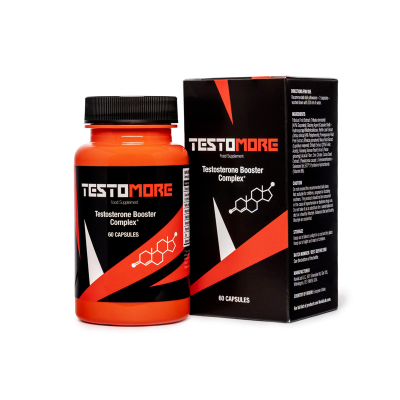
Our Recommendation — Testomore
Score: 6.0/10 · Best for: men who want to audit the label themselves — 400 mg of tribulus at 40% saponins is 160 mg of saponins, and every other amount is printed, nothing hidden in a proprietary blend Main caution: tribulus alone is a well-populated null for testosterone, and the Tesnor™ sits at half its trial dose (200 mg against 400 mg) — the printed numbers are honest; the doses they print are the caveat Fair trial: a 12-week judgement costs $53.99 a bottle (bundles lower) and the maker publishes no money-back guarantee, so the trial is funded by the buyer.
The Trial-Dose Table: What Researchers Actually Gave
| Trial | Population | Dose & standardisation | Duration | Outcome |
|---|---|---|---|---|
| Neychev & Mitev 2005 | 21–22 young men, 20–36 | 10 or 20 mg/kg/day (≈750–1,500 mg for most adults), Bulgarian extract at 60% saponins | 4 weeks | No change in testosterone, androstenedione or LH |
| Rogerson et al. 2007 | 22 elite rugby league players | 450 mg/day | 5 weeks | No strength, fat-free-mass or testosterone difference; T:E ratio unchanged |
| Fernandez-Lazaro et al. 2021 | 30 CrossFit athletes | 770 mg/day | 6 weeks | Null for testosterone and performance |
| Santos et al. 2014 | 30 men, 40+ | 800 mg/day | 30 days | Both arms improved; no difference vs placebo |
| Kamenov et al. 2017 | 180 men, mild–moderate ED | 1,500 mg/day Tribestan — 250 mg × 6 tablets, each ≥112.5 mg furostanol saponins (≥45%), ≈675 mg saponins/day | 12 weeks | Erectile-function scores improved; testosterone unchanged |
Three lessons hide in that table. First, the floor: 450 mg/day is the lowest dose any recognisable trial used, and it was used in elite athletes, null. Second, the weight-based study: Neychev and Mitev dosed by body weight — 10 or 20 mg per kilogram — which for a 75 kg man is 750–1,500 mg of a 60%-saponin extract, and for a 100 kg man up to 2,000 mg. Weight-based dosing is how pharmacology normally works and how supplements never do; a fixed 400 mg capsule gives a 60 kg man and a 110 kg man the same exposure, and gives both less than the weight-based trial gave anyone. Third, the only positive outcome in the table — Kamenov's erectile-function improvement — sits at the very top of the dose range, on a pharmacopoeial standardised extract, at a saponin exposure (≈675 mg/day) that no mainstream label approaches. Dose is not a detail in this literature. Dose is most of the story.
A note on a number you will meet elsewhere: Kamenov's trial is widely cited at "750 mg/day". That is a different study — Roaiah et al. 2016, a smaller pilot. The error survives because 750 mg is a comfortable, label-sized number and 1,500 mg of a six-tablet protocol is not. When a dosage guide quotes Kamenov at 750, it has usually copied another guide rather than the paper — a reliable tell for the whole page.
The Saponin Maths: Milligrams × Percentage Is the Dose
An extract's dose is two numbers multiplied. The grid below is the whole argument of this article in one table — find your product's row and column and you have its saponin exposure, the only figure comparable across brands.
| Extract per day | At 40% saponins | At 60% saponins | At 90% saponins |
|---|---|---|---|
| 400 mg | 160 mg | 240 mg | 360 mg |
| 750 mg | 300 mg | 450 mg | 675 mg |
| 1,000 mg | 400 mg | 600 mg | 900 mg |
| 1,500 mg | 600 mg | 900 mg | 1,350 mg |
Read it against the trials. Kamenov's ≈675 mg of saponins a day can be reached by 1,500 mg at ~45% (his actual protocol) or, arithmetically, by 750 mg at 90% — but note that the 90% column is an extrapolation, not a trial: no human study has used a 90%-saponin extract, so the grid shows exposure equivalence, not proven-effect equivalence. Neychev's young men received roughly 450–900 mg of saponins a day (750–1,500 mg at 60%) and their hormones did not move — the single most under-quoted dosage fact in this category, because it forecloses the "you just need a stronger extract" defence for testosterone. And the bottom-left cell is where the commercial market actually lives: 400 mg at 40% = 160 mg of saponins, roughly a quarter of Kamenov's exposure and below every trial's saponin delivery. That is not an argument that low doses are dangerous or useless for every purpose — it is the arithmetic you are owed before paying for a trial's reputation at a fraction of its dose.
Why the Percentage Itself Is Slippery: Total Saponins ≠ Protodioscin
Even the grid above flatters the labels, because "saponins" is a family, not a compound. The testosterone story names one molecule — protodioscin — the saponin credited with the rodent LH effect. A standardisation percentage measures total saponins, all of them summed, by an assay method the label does not disclose. Three consequences follow, and honest pages state all three.
No trial standardised to protodioscin. Not one human study dosed by protodioscin content or reported it as the exposure variable. The molecule at the centre of the marketing has never been the measured variable in a human trial. There is no validated, agreed assay for protodioscin in commercial extracts, and the common total-saponin methods (gravimetric and UV-based assays especially) can return very different percentages for identical material — which is why a "90%" claim from one brand and "45%" from another may describe similar extracts, and why the Bulgarian pharmacopoeial material (Tribestan) is specified in milligrams of furostanol saponins per tablet rather than front-label percentages. A high total-saponin percentage can coexist with negligible protodioscin. Extraction can concentrate the wrong saponins. So the percentage ladder that retail pages climb — 40% good, 60% better, 90% best — ranks a number that does not measure the claimed active, by methods that are not comparable, against trials that never used it. Plant part adds a final confound: saponin profiles differ between fruit, leaf and whole aerial parts, and labels that omit the part omit a variable the trial preparations specified.
None of this means standardisation is worthless — a printed percentage and a printed amount at least make a product auditable, which is why we credit makers who publish both. It means the percentage is an audit tool, not a potency score, and the only potency evidence that exists is the trial table at the top of this article.
How the Trials Actually Took It: Food, Splits and Timing
Trial protocols share a pattern that label directions often drop. Kamenov's Tribestan regimen — six 250 mg tablets a day — was necessarily split: two tablets three times a day, taken with meals in the Bulgarian protocol tradition. Neychev's weight-based dosing was likewise divided across the day. The pattern generalises: split the daily amount into two or three doses, take with food. The reasons are practical rather than magical. Tribulus's commonest side effects are gastrointestinal (our safety companion article covers the file), and food blunts them; split dosing keeps exposure steadier than a single bolus of a plant extract whose active-compound half-life nobody has properly characterised in humans. Retail advice to take tribulus "at noon or in the afternoon" or on an empty stomach for faster effect has no trial behind it — the trials fed people. If a label suggests a single morning capsule, it is describing its own convenience, not a studied protocol.
Form matters to the same arithmetic. Raw tribulus powder typically carries only about 1–5% saponins — a gram of powder may deliver 10–50 mg of saponins, an order of magnitude below any trial — which is why powder products dosed at "1 g a day" are not comparable to extract trials at all. Standardised extracts (40–60% in the trial tradition) are the only form in which the trial doses are physically reachable in capsules. When you compare products, compare extract-to-extract, in saponin milligrams, or do not compare.
Cycling: What Is Practice, What Is Evidence
Cycling — taking breaks between courses — is where supplement folklore is most confident and least evidenced. The versions in circulation: 4–8 week courses (the generic retail pattern, loosely mirroring trial durations), 8–12 weeks on with 2–4 weeks off (the more structured bodybuilding-community protocol), and one widely ranked French retail page's 20-day courses separated by 2 weeks, offered without rationale and matching no trial ever run. The honest appraisal: no study has tested whether cycling changes any outcome, for the simple reason that no study shows a testosterone outcome to preserve. Cycling's real function in the trial-shaped world is safety hygiene — the human safety record reaches about 90 days (see our safety article), so courses that end and restart respect the edge of the data in a way open-ended daily use does not. If you cycle, cycle because the evidence runs out at 12 weeks, not because a forum says receptors reset. And treat any page promising that effects begin "in 3 to 4 days" as marked: no human trial measured an outcome before week 4, and the erectile-function result took 12 weeks at the highest dose. A 3–4 day promise is a sales line, not a timeline.
How Long It Takes: the Trial Measurement Windows
Set expectations by the calendar the trials used. Hormone measurements were taken at 4 weeks (Neychev — null), 5 weeks (Rogerson — null) and across 6 weeks (Fernandez-Lazaro — null): if tribulus raised testosterone on any commercially relevant timescale, those windows would have caught it. The one positive functional outcome — erectile-function scores in Kamenov — was measured at 12 weeks, which is the honest minimum for judging tribulus for the purpose it might actually serve. Subjective "feel" arrives earlier for many users, as Santos 2014 demonstrates in the most useful way possible: his placebo group felt it too. Judge at 12 weeks, against something measurable (a validated symptom score, a blood test if hormones are the claim), or accept that you are measuring hope. Our category timeline guide — how long testosterone boosters take to work — applies the same discipline across ingredients.
The Testomore Dose-Honesty Box
Everything above, applied to the product this site reviews. Testomore provides 400 mg of tribulus fruit extract at 40% saponins = 160 mg of saponins a day. That is below the 450 mg lowest common trial dose of extract, about a quarter of Kamenov's saponin exposure, and roughly a fifth to a tenth of what Neychev's weight-based protocol delivered — for an ingredient whose testosterone result was null at all of those higher exposures. The tribulus is, on the numbers, a supporting line. What carries the formula's rationale is its headline branded blend, Tesnor™ (200 mg, with human trials at 200–400 mg — our pomegranate article in this series audits it dose by dose), plus plain zinc (10 mg) and selenium at sensible levels, all printed on a fully disclosed label by a maker who also prints his medication warnings. The maker publishes no money-back guarantee, so a 12-week judgement is funded by the buyer: $53.99 a bottle, bundles lower. Our full review scores it 6.0/10, and this dosage maths is a large part of why the score is neither higher nor lower.
Buy it if you have done this arithmetic and still want the overall formula — for its audited transparency and its Tesnor™ content — with your expectations set by the trial table rather than the tribulus folklore. Skip it if your plan was "tribulus, but properly dosed": no capsule in this product's class reaches the trial exposures, and the testosterone outcome was null even there. If tribulus itself is the goal, the trial-shaped version is a standardised extract at 750–1,500 mg/day split with food for up to 12 weeks — bought with the safety file open (statins, clopidogrel, blood-pressure and diabetes medication all change the answer; the maker's warning on exactly those last two is why we surface Testomore's label as the category's honesty benchmark).
Three Labels, Audited Step by Step
The method, applied the way you would apply it in a shop. Label A: "Tribulus powder, 1,000 mg capsules." No standardisation stated, form is powder. Raw powder runs roughly 1–5% saponins, so a gram delivers perhaps 10–50 mg of saponins — under a tenth of the lowest trial exposure, and not comparable to any study in the table. Verdict: a food-dose product borrowing extract-trial language. Label B: "Tribulus extract 750 mg, standardised to 45% saponins." 750 × 0.45 ≈ 338 mg of saponins a day. That is a real, mid-range extract dose — inside the trial band by extract weight, below Kamenov's saponin exposure, and honestly labelled. Verdict: a properly specified product whose ceiling is the ingredient's own trial record — null for testosterone, a possible erectile-function signal at twice the exposure. Label C: "Tribulus 500 mg, 90% saponins — maximum potency." 500 × 0.90 = 450 mg of total saponins, which sounds like the strongest of the three — until the protodioscin section applies: the 90% is a total-saponin assay figure, no trial used a 90% extract, and the protodioscin content is unknown and unknowable from the label. Verdict: the largest number, the least information. The pattern to internalise is that Label B — middling percentage, full specification — is the most scientifically literate of the three, because it states the two numbers (milligrams, standardisation) that let you place it against the trials. That is also the standard we apply in product reviews: Testomore prints both numbers for its tribulus (400 mg, 40%) and for every other ingredient on its panel, which is why its dose can be criticised precisely instead of vaguely suspected.
Does Taking More Change the Side-Effect Picture?
Dosage advice that ignores tolerability is incomplete, so briefly — the full file is our companion safety article, and this section only marks where dose and harm intersect. At trial doses the recurring effects are gastrointestinal and early. The serious case reports cluster at the extremes of exposure: the clearest kidney case involved a man who had self-escalated to 7.5 g a day, several times the top of the studied range, and the liver cases involved months of use. In other words, the studied band (450–1,500 mg/day) is also the band with the cleanest record, and "more" buys no demonstrated benefit — the testosterone outcome was null at 1,500 mg too — while moving you out of the exposure range anyone has actually observed. Dose escalation is the one strategy this literature rules out from both directions at once. Medication status changes the calculation independently of dose: statins, clopidogrel, and blood-pressure or diabetes medicines each carry their own interaction cautions at any dose, which is why the maker warning quoted in the safety article exists.
Tribulus in Blends: Where the Dose Disappears Entirely
Everything in this article assumes the label tells you the tribulus amount. In much of the market it does not: tribulus is a classic proprietary-blend passenger, listed inside a grouped total ("Testosterone Support Matrix: 1,200 mg") alongside five other botanicals, in descending-weight order that guarantees nothing about its individual share. A blend totalling 1,200 mg across six ingredients may deliver 50 mg of tribulus — a ninth of the lowest trial dose by extract weight, and perhaps 20 mg of saponins — while the front label borrows the whole trial literature by association. This is the single most common way the dosage gap hides, and the reason our product reviews treat full panel disclosure as a scoring criterion rather than a courtesy. It is also, in fairness, where Testomore separates itself from much of its shelf: its 400 mg tribulus line is stated outright, at a stated standardisation, where it can be — and in this article has been — audited and found low. A stated low dose is more useful to a buyer than an unstated one, because it converts suspicion into arithmetic. When you meet a blend that will not state its amounts, the correct dose assumption is the floor, not the trial.
One more specification the trials cared about and labels blur: plant part. The studied preparations were fruit and aerial-part extracts of defined (usually Bulgarian) origin. A label reading simply "tribulus extract" without the part has omitted a variable that changes the saponin profile before the percentage is even applied — fruit, leaf and root do not carry identical chemistry, and the dosage maths in this article belongs to the parts the trials used. Part, percentage, milligrams: a label needs all three before its dose can be placed on the trial table at all.
A Stronger Alternative in This Category
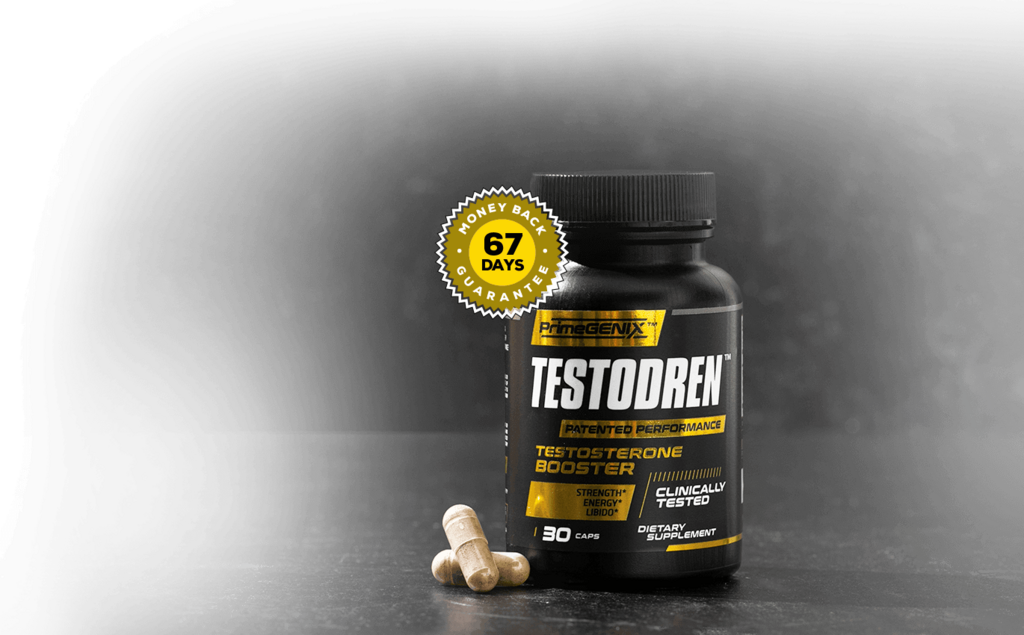
The stronger alternative: Testodren · 8.5/10One ingredient at a published 500 mg dose, with human studies behind the ingredient itself: Testodren is the testosterone formula we score highest in this catalogue.
Our Recommendation — Testomore
Score: 6.0/10 · Best for: men who want to audit the label themselves — 400 mg of tribulus at 40% saponins is 160 mg of saponins, and every other amount is printed, nothing hidden in a proprietary blend Main caution: tribulus alone is a well-populated null for testosterone, and the Tesnor™ sits at half its trial dose (200 mg against 400 mg) — the printed numbers are honest; the doses they print are the caveat Fair trial: a 12-week judgement costs $53.99 a bottle (bundles lower) and the maker publishes no money-back guarantee, so the trial is funded by the buyer.
Frequently Asked Questions
How much tribulus should I take per day?
The studied range is 450–1,500 mg/day of standardised extract — with the standardisation doing as much work as the milligrams. Below 450 mg of extract, you are outside every recognisable trial. Whether any dose is worth taking depends on the goal: for testosterone, the trials at all these doses were null.
What does "40% saponins" actually mean?
That 40% of the extract's weight is measured as total saponins by the maker's assay. It does not mean 40% protodioscin — the compound the testosterone story names — and no trial standardised to protodioscin. Multiply milligrams × percentage to get saponin exposure: 400 mg at 40% is 160 mg, versus about 675 mg/day in the largest trial.
Is 90% saponins better than 40%?
Unproven. No human trial used a 90% extract; the percentage measures total saponins by methods that vary between brands, and a high total can carry negligible protodioscin. The trial tradition is pharmacopoeial extracts around 45–60%, specified in milligrams of saponins — copy that, not the biggest percentage.
Should I take tribulus with food?
The trial protocols did — split doses with meals is the pattern (Tribestan: two tablets three times daily). Food also reduces the gastrointestinal effects that are tribulus's commonest complaint. Empty-stomach "fast absorption" advice has no trial behind it.
How long does tribulus take to work?
Judge at the trials' windows: hormones were measured (and unmoved) at 4–6 weeks; the erectile-function improvement was measured at 12 weeks at 1,500 mg/day. Claims of effects in 3–4 days appear in retail copy only — no study measured anything that early.
Do I need to cycle tribulus?
No study shows cycling changes outcomes. The defensible reason for courses of 8–12 weeks with breaks is that the human safety record itself only reaches about 90 days — cycling keeps you inside the studied exposure. The 20-day courses one retail site recommends match no trial and no stated rationale.
Is powder as good as extract?
Not for reaching trial doses. Raw powder runs roughly 1–5% saponins, so a gram delivers perhaps 10–50 mg of saponins — an order of magnitude below trial exposures of 450–675 mg. Extracts standardised to 40–60% are the only form in which the studied doses fit in capsules.
Does body weight change the dose?
One major trial thought so: Neychev and Mitev dosed 10–20 mg/kg/day, i.e. about 750–1,500 mg for a typical adult, more for heavier men — and still found no hormone change. Fixed-dose capsules ignore weight entirely, which is one more reason label doses sit below the research.
Can I just take more to get the trial results?
No — for two independent reasons. The testosterone result was null at the highest doses tested, so there is no demonstrated result to reach by escalating; and the serious side-effect reports cluster at extreme exposures (7.5 g/day in the clearest case). More tribulus buys more exposure to an unproven ingredient, not more effect.
What if my label doesn't state a saponin percentage?
Then the product cannot be audited, and you should assume the least flattering interpretation: unstandardised material, likely powder-strength (1–5% saponins if it is raw powder). Every trial in this article's table used a specified preparation. A maker who will not state the standardisation is asking you to skip the comparison this article exists to make.
Is one big dose in the morning as good as split doses?
It is not what the trials did. The protocols that produced the literature's data — including the only positive outcome — divided the daily amount across the day with meals. Nobody has compared the two schedules head-to-head, so the honest claim is narrow: split-with-food is the studied pattern, a single bolus is an untested convenience, and food at least reduces the gastrointestinal effects that are tribulus's commonest complaint.
What is Tribestan, and is it different from ordinary tribulus capsules?
Tribestan is the original Bulgarian pharmacopoeial preparation — a standardised tribulus extract in 250 mg tablets, specified by furostanol-saponin content per tablet (at least 112.5 mg, roughly 45%) — and it is the preparation behind the category's origin story and its largest modern trial (Kamenov 2017, six tablets a day). Most retail capsules are not Tribestan and do not match its specification; when a product's marketing leans on the Bulgarian tradition, the comparison to ask for is milligrams of saponins per day against Tribestan's roughly 675 mg.
Last reviewed: October 2026. This article is educational and is not medical advice.
