
- Quick Answer
- What the Trials Actually Used
- The Absorption Trap
- Timeline: What to Expect, Week by Week
- Safety and Who Should Be Careful
- An Honest Word About Turmeric Inside Blends
- Frequently Asked Questions
- How much turmeric should I take for joint pain?
- Is turmeric as good as ibuprofen?
- Can I just drink golden milk?
- How long should I try it?
- Read This Next
Disclosure: This article contains affiliate links. If you buy through them, we may earn a commission at no extra cost to you. It never changes our scores or conclusions.
Quick Answer
Turmeric's active compounds (curcuminoids, mainly curcumin) have a genuinely decent trial record for joint pain — but at doses most products do not deliver. Trials showing benefit used roughly 1,000 mg of curcuminoids per day in absorption-enhanced forms, with effects building over 4–8 weeks.
Turmeric powder is only ~2–5% curcuminoids and curcumin is absorbed very poorly on its own, so the label's curcuminoid milligrams — and the absorption technology — matter more than the turmeric milligrams.
What the Trials Actually Used
In a well-known randomised trial, a standardised turmeric extract performed comparably to ibuprofen for knee osteoarthritis pain, with fewer gastrointestinal side effects. Meta-analyses of arthritis trials converge on total daily curcuminoid doses around 1,000 mg, taken for 4–12 weeks, reducing pain and stiffness scores versus placebo.
These were extracts — often paired with piperine (black pepper extract) or formulated as phytosomes or nanoparticles — not spoonfuls of cooking turmeric and not 200 mg of root powder in a blend.
The Absorption Trap
Curcumin is fat-soluble, rapidly metabolised and poorly absorbed. Unformulated curcumin barely reaches the bloodstream. That is why delivery systems exist: piperine slows its breakdown (one classic study reported a ~20-fold increase in bioavailability), phytosome and micellar forms raise absorption by an order of magnitude in pharmacokinetic studies, and enhanced-bioavailability extracts (for example, clear dispersion formulations) aim at the same problem.
Practical rules:
- Read curcuminoid mg, not turmeric mg. A 500 mg capsule of root powder may contain ~15–25 mg of curcuminoids.
- Look for a named absorption system (piperine pairing, phytosome, micellar, nanoparticle) — and still compare the delivered curcuminoid dose against ~500–1,000 mg/day.
- Take it with a fat-containing meal unless the formulation says otherwise.
Timeline: What to Expect, Week by Week
- Weeks 1–2: usually nothing obvious. Curcumin is not an acute painkiller.
- Weeks 3–4: earliest consistent changes in trial symptom scores. Morning stiffness is often the first mover.
- Weeks 6–8: the typical point of clear judgement for pain and function.
- Weeks 8–12: full trial window. No benefit by now at a proper dose = it is not working for you.
Safety and Who Should Be Careful
Curcumin is generally well tolerated. The common effects are digestive (nausea, loose stool, reflux). The cautions that matter: it can increase bleeding tendency, so people on anticoagulants or heading for surgery should discuss it first and usually pause before operations. It stimulates bile flow, so gallbladder disease is a caution.
High-dose enhanced extracts have rare case reports of liver injury — stop and seek care for jaundice, dark urine or unusual fatigue. Piperine also slows the breakdown of some medicines, which can raise their levels. Cooking with turmeric is a different exposure entirely and raises none of these concerns at culinary amounts.
An Honest Word About Turmeric Inside Blends
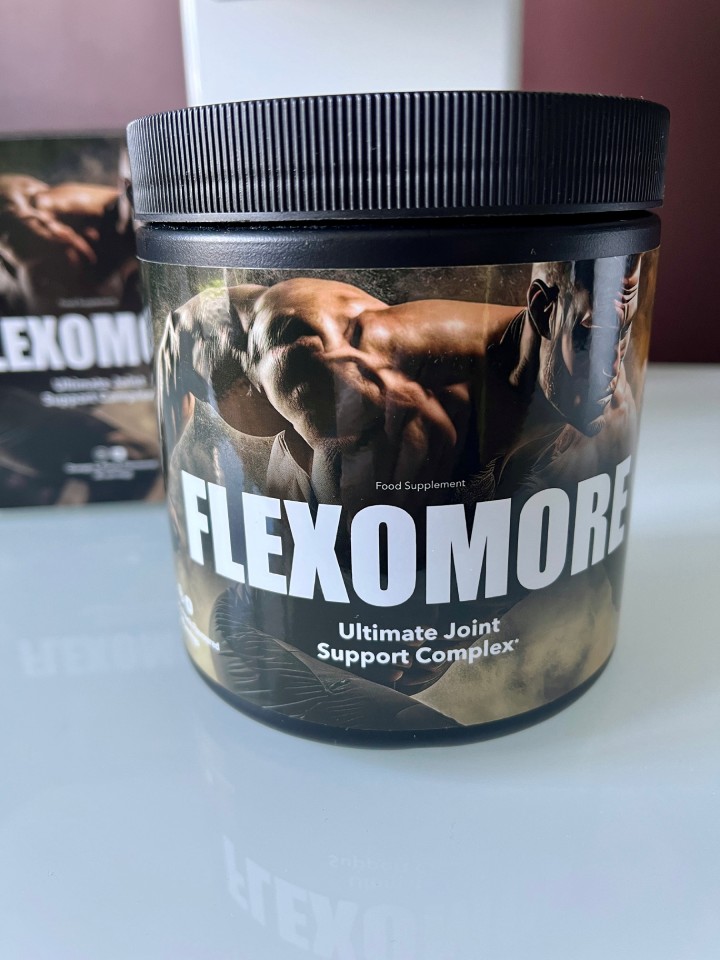
Many joint formulas include a small turmeric amount as a supporting ingredient. Flexomore, for instance, contains 200 mg of uC3 Clear turmeric extract standardised to 10% curcuminoids — that is 20 mg of curcuminoids per scoop, alongside a full dose of glucosamine, collagen peptides, MSM and boswellia. Twenty milligrams is roughly one-fiftieth of the dose turmeric trials used.
In that formula, turmeric plays a minor supporting role. The product stands or falls on its glucosamine and collagen. If your main goal is a genuine turmeric trial for joint pain, buy a dedicated enhanced-curcumin product at trial-level doses instead — and if a blend's marketing leads with turmeric while delivering 20 mg, you now know how to read it.
Frequently Asked Questions
How much turmeric should I take for joint pain?
Think in curcuminoids: the trial-supported range is roughly 500–1,000 mg of curcuminoids daily from an absorption-enhanced extract. Plain turmeric powder cannot realistically reach that.
Is turmeric as good as ibuprofen?
One trial found a turmeric extract comparable to ibuprofen for knee osteoarthritis pain over the study period, with fewer stomach effects. That is not a licence to swap prescribed medication without your clinician — and NSAIDs work within hours while curcumin takes weeks.
Can I just drink golden milk?
Enjoy it — but a mug provides tens of milligrams of curcuminoids at best with poor absorption. It is a pleasant ritual, not a trial-level intervention.
How long should I try it?
Eight weeks at a proper dose is a fair test. Twelve at the outside. Track pain and stiffness weekly so the decision is based on numbers, not impressions.
Last reviewed: October 2026. This article is educational and is not medical advice.
