
- Quick Answer: Three Jobs, Not One "Anti-Aging" Effect
- Job One: NAD+ Precursors — Refilling the Coenzyme
- Job Two: Senolytics — Deleting Stuck Cells
- Job Three: Autophagy — The Recycling Shift
- The Shelf, Mapped
- The Combined Shortcut — and the Older Single
- Stacking, Honestly
- Frequently Asked Questions
- The Map, in One Paragraph
Affiliate disclosure: This article contains affiliate links. If you buy through a link on this page, we may earn a commission paid by the manufacturer, at no extra cost to you. This page is a map of our own shelf: every product named is one we sell and have audited — NMN, NR, NMN+NR, NMNH, Fisetin, Quercetin, Spermidine, Resveratrol and Longevity+ — with our scores attached to each. A map drawn by the shopkeeper deserves that disclosure in the first paragraph. What it does not change is the geography: the three mechanisms below are genuinely different jobs, and the most expensive mistake in this category is treating them as interchangeable.
Quick Answer: Three Jobs, Not One "Anti-Aging" Effect
Longevity shelves blur three separate cellular jobs into one glow. Separated, they are: (1) NAD+ precursors — raw materials for refilling a coenzyme the body uses in energy and repair chemistry (NMN, NR, NMN+NR, NMNH). (2) Senolytics — compounds studied for deleting senescent "zombie" cells that have stopped dividing but refuse to die (Fisetin, Quercetin). (3) Autophagy support — nudging the cell's internal recycling system that clears worn components (Spermidine). A precursor does not clear zombie cells. A senolytic does not refill NAD+. An autophagy compound does neither of the other two. Every stack decision on this shelf starts from that separation — because stacking three products that all do job one is not a stack, it is a triplication, and no human trial has tested any combination of these jobs anyway.
Job One: NAD+ Precursors — Refilling the Coenzyme
NAD+ is a coenzyme involved in cellular energy production and repair processes, and its levels decline with age; precursors are molecules the body converts into it. Our shelf holds four, in descending order of human evidence. GenuinePurity NMN (7.5/10, $69) is the evidence-first entry: multiple published human trials of the molecule, a stated 96% purity, published batch reporting. GenuinePurity NR (6.0/10, $59) is the rival precursor — human trials exist, regulators frame its label dose at a 300 mg ceiling, and the maker's own pages conflict on both its purity (98% vs 99%) and what its 300 mg means; our dosage audit is NR Dosage. GenuinePurity NMN+NR (6.0/10, $59) puts 250 mg of each in one serving — a hedge, not a synergy: the pathways converge (NR converts into NMN en route), a 2026 head-to-head found the two comparably effective at raising NAD+, and no trial has tested the stack, as NMN + NR Together works through. GenuinePurity NMNH (5.5/10, $89) is NMN's reduced form: stronger in cell cultures, thinnest in humans, at the line's highest price, with a marketed 500 mg dose its own directions halve — the full comparison is NMNH vs NMN. One job, four bottles, four very different files: that spread is the information.
Job Two: Senolytics — Deleting Stuck Cells
Senescent cells are cells that have permanently stopped dividing but have not died; they accumulate with age and secrete an inflammatory mixture (SASP) that degrades the tissue around them. Senolytics aim to delete them — a removal job, which is why the field doses in intermittent pulses rather than daily top-ups, as Senolytics Explained lays out. Our shelf's pair: GenuinePurity Fisetin (6.0/10, $59), the flavonoid that topped a 2018 screen of ten flavonoids for senolytic potency (cell and animal work), at a published 150 mg a day — with the line's clearest transparency gap, no purity percentage published anywhere, and a dosing culture of monthly pulses versus its daily label that Fisetin Dosing examines without endorsing. And GenuinePurity Quercetin (6.0/10, $49), the original partner compound from the first senolytic research, at 500 mg a day — plain form, no purity figure, and a guarantee its own page states as both 97 and 90 days. The human evidence status for the whole job, stated once and applicable everywhere on this page: animal evidence strong, human outcome trials absent, fisetin's human trials still recruiting. The pair is compared head-to-head in Fisetin + Quercetin: The Senolytic Duo.
Job Three: Autophagy — The Recycling Shift
Autophagy is the cell's housekeeping: worn proteins and damaged components collected, broken down and recycled. It is a maintenance job, not a deletion job — the distinction from senolytics that this map exists to preserve. Our shelf's entry is GenuinePurity Spermidine (6.5/10, $59): a liposomal capsule delivering 8 mg a day at a stated 99% purity with published Certificates of Analysis — the best single-product paperwork among the newer singles — wrapped around the category's widest dose gap, because the best-known human trial used about 1 mg a day from wheat germ. That gap is the subject of Spermidine and Autophagy: The Dose Problem, and the food route to the trial-level dose is costed in How Much Spermidine Is in Food? Spermidine induces autophagy reliably in model organisms; in humans, the effect at any dose is inferred rather than measured, because no validated test tells a buyer whether their autophagy changed.
The Shelf, Mapped
| Product | Job | Score | Price | Evidence in one line |
| GenuinePurity NMN | NAD+ precursor | 7.5/10 | $69 | Multiple human trials of the molecule; 96% purity published |
| GenuinePurity NR | NAD+ precursor | 6.0/10 | $59 | Human trials at 1,000 mg+; label dose 300 mg; maker's pages conflict on purity and dose framing |
| GenuinePurity NMN+NR | NAD+ precursors, combined | 6.0/10 | $59 | No trial of the combination; pathways converge; purity not stated on the product page |
| GenuinePurity NMNH | NAD+ precursor (reduced form) | 5.5/10 | $89 | Preclinical data + one 2026 preprint; no human trial; marketed 500 mg vs directed 250 mg |
| GenuinePurity Fisetin | Senolytic | 6.0/10 | $59 | Top of the 2018 flavonoid screen (cells/animals); no purity % published; human trials recruiting |
| GenuinePurity Quercetin | Senolytic partner / antioxidant | 6.0/10 | $49 | Molecule-level evidence; plain form; guarantee stated two ways on one page |
| GenuinePurity Spermidine | Autophagy | 6.5/10 | $59 | Autophagy shown in model organisms; human trial anchor ~1 mg vs the 8 mg label; 99% purity, CoAs published |
| GenuinePurity Resveratrol | Shelf's earlier single (antioxidant) | 7.5/10 | $59 | Audited in the roundup below |
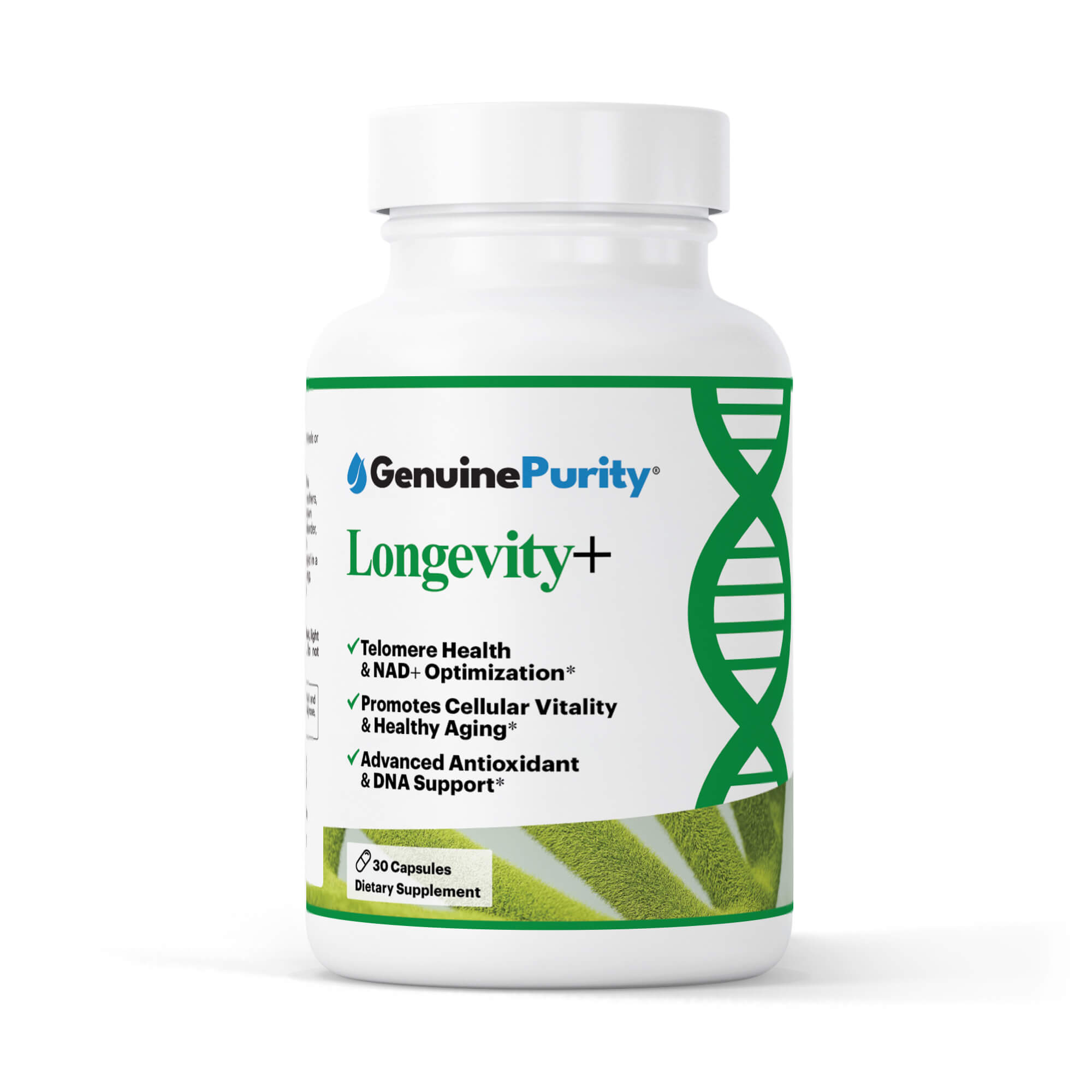
| GenuinePurity Longevity+ | Combined formula | 7.0/10 | $69 | The one-capsule combination of the line's longevity actives |
These statements have not been evaluated by the Food and Drug Administration. These products are not intended to diagnose, treat, cure, or prevent any disease. This article is educational and is not medical advice.
The Combined Shortcut — and the Older Single
Two shelf entries sit across the map rather than inside one job. GenuinePurity Longevity+ (7.0/10, $69) is the maker's combined formula — the choice for a buyer who wants the line's longevity actives in one capsule rather than a shelf of singles, bought with the standard combined-formula caveat: no trial of the combination exists, and a blend cannot be audited ingredient-by-ingredient the way a single can. GenuinePurity Resveratrol (7.5/10, $59) is the shelf's earlier established single, sitting alongside the precursor cluster in the category's history and scored in full in the roundup. Both are placed, compared and priced alongside everything above in Best Anti-Aging Supplements Compared — the page to read before buying any two of these at once.
Stacking, Honestly
The stacking question is real — sellers' FAQs field versions of "can I combine multiple longevity supplements?" and editorial stack builders publish schedules pairing, for example, quercetin with fisetin as an intermittent senolytic protocol. Here is the whole honest file on stacking these three jobs. No human trial has tested any stack on this map — not precursor-plus-senolytic, not the fisetin-quercetin duo at protocol doses, not the trio. The mechanisms are genuinely different, which makes stacking logically coherent in a way that doubling two precursors is not; but logical coherence is a property of diagrams, and bodies are not diagrams. The one structural rule the evidence does support is the senolytic one: those compounds are pulsed, not taken daily, in both the trial designs and the community protocols — stacking a daily precursor routine with an intermittent senolytic pulse is at least shaped like the research. Everything beyond shape is self-experimentation. Readers who stack anyway should do it with the paperwork open: one product's guarantee conflict, missing purity figure and safety silence do not cancel out in a stack — they add up. And anyone on prescription medication should treat the whole map as a clinician conversation, since several of these makers publish no interaction guidance at all.
Frequently Asked Questions
What is the difference between NAD+ precursors, senolytics and autophagy supplements?
Three different jobs. Precursors supply raw material to refill NAD+, a coenzyme used in energy and repair chemistry. Senolytics aim to delete senescent "zombie" cells that accumulate and inflame tissue. Autophagy support nudges the cell's recycling system for worn components. No product on this shelf does another job's work.
If I buy only one, which job has the best human evidence?
Job one, and within it NMN: multiple human trials of the molecule, a published purity figure and batch reporting — Our Score 7.5/10. Even there, trials show NAD+ rising more clearly than they show outcomes improving. Jobs two and three rest on animal and model-organism evidence with human outcome trials absent or recruiting.
Can I stack all three jobs?
No human trial has tested any such stack, so nobody can call it proven — the honest description is self-experimentation with logically distinct mechanisms. The research-shaped version keeps senolytics intermittent (pulses) rather than daily. Medication makes it a clinician question first.
Is Longevity+ the same as stacking the singles?
No. It is the maker's own combined formula in one capsule — a convenience choice with a combination's audit limits (no trial of the blend, less per-ingredient visibility). It is not equivalent to assembling the audited singles yourself, and it is scored separately (7.0/10).
Why do the scores cluster so low?
Because the rubric grades paperwork as well as promise: published doses, published purity, guarantees that agree with themselves, evidence measured in the species buying the product. This category's molecules are interesting and its documentation is young. The scores say exactly that, product by product.
The Map, in One Paragraph
One shelf, three jobs. For job one, NMN is the evidence-first buy and NMNH the novelty-first one, with NR and the combination between them and their conflicts in the open. For job two, Fisetin leads and Quercetin partners, both awaiting human outcome data. For job three, Spermidine stands alone with the shelf's best paperwork and its widest dose question. Choose by the job you are actually hiring for, grade by the file you can actually check — and let the full nine-product comparison in Best Anti-Aging Supplements Compared arbitrate the rest.
Disclaimer: This article is for general information only and is not medical advice. Always consult a qualified healthcare professional before starting any supplement, especially if you have a medical condition or take prescription medication.
Last reviewed: October 2026
