
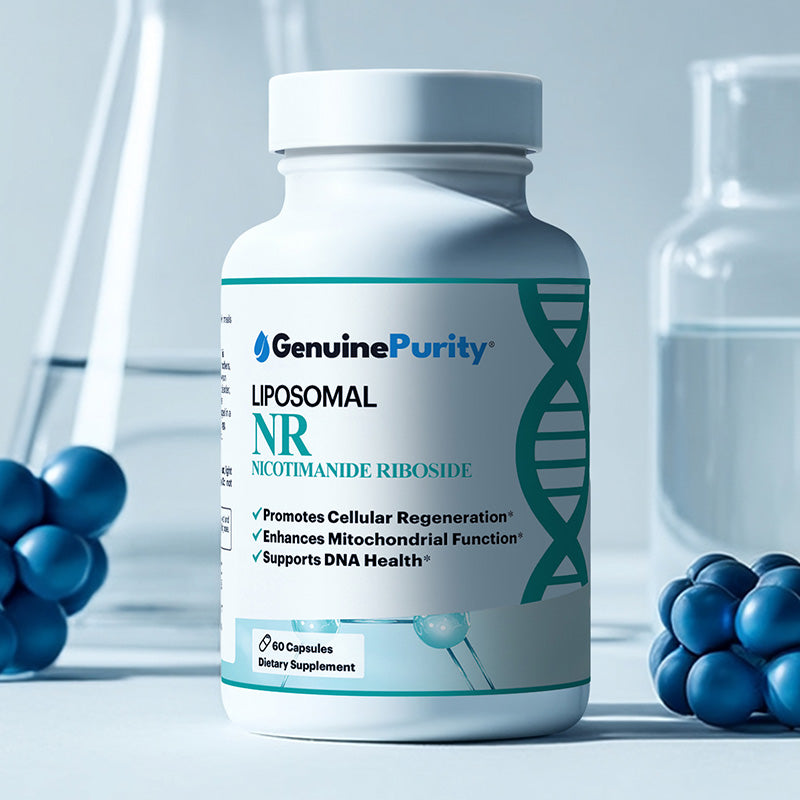
Affiliate disclosure: This article contains affiliate links. If you buy through a link on this page, we may earn a commission paid by the manufacturer, at no extra cost to you. We sell GenuinePurity NR (Our Score 6.0/10) — a 300 mg product, on some reading of its own label. That qualification is this article in miniature: NR dosage has three different numbers depending on who is counting (regulators, trialists, labels), and GenuinePurity's pages manage to straddle the third one so ambiguously that a buyer cannot tell whether the daily dose is 300 mg or 600 mg. Both stories are told below, from the maker's own pages and the published dosage discussion.
Quick Answer: Three Numbers, Three Different Jobs
300 mg is the regulatory number: the safe daily ceiling European food-safety assessment set for nicotinamide riboside, and the dose most labels consequently print. 1,000–2,000 mg is the research number: the range human trials have actually administered when testing whether NR does anything. And the label number — nominally 300 mg — is where products split the difference between what regulators bless and what trials used. The uncomfortable summary belongs to one dosage guide's phrasing of the field: typical intakes run "300–1,000 mg/day," with no clinical health benefits demonstrated yet. The dose question for NR is therefore not really "how much should I take?" It is "why does the sellable dose sit so far below the tested dose — and which one is in the bottle I am holding?" On our shelf, even that last question has two answers.
The Regulator's Number: 300 mg
When European regulators assessed NR as a novel food, the figure that came out of the process was a safe intake ceiling of 300 mg per day for adults. A ceiling like that is a safety judgement, not an efficacy finding: it says "at or below this, the safety file is acceptable," and says nothing at all about whether 300 mg does anything. But ceilings shape markets. A brand that wants to sell into regulated channels, and to print a dose a compliance department can sign off, lands on 300 mg — which is why that number recurs across labels from makers who agree on little else. It is also why the maker of our shelf product describes its 300 mg as a "clinically studied dose": the phrase borrows the authority of the trials (next section) for a number whose real pedigree is the regulatory file. Those are different pedigrees, and the distance between them is the subject of this article.
The Trials' Numbers: 1,000 mg and Up
When researchers test NR in people, they reach for considerably more. Human trials have commonly administered 1,000 mg a day, and dose-ranging work has gone to 2,000 mg a day — three to nearly seven times the regulatory ceiling and the standard label dose. The gap cuts in a specific direction that buyers rarely hear stated plainly: if NR's promise holds anywhere, the doses at which it has been looked for are mostly label-dose multiples — and even there, the demonstrated-benefit file is thin. The largest recent datapoint makes the point from the top of the range: a 2026 phase 3 trial (NOPARK) gave 410 people 1,000 mg a day for 52 weeks and reported no clinical benefit (reported via JAMA). A single trial in a specific patient population does not settle what NR might do in healthy people — we flag the context rather than import its conclusion — but it removes any comfortable assumption that the trial doses were shown to work and only the label doses are unproven. Neither tier has a demonstrated clinical benefit behind it. What the trials at 1,000 mg do establish is measurement: NAD+ rises in people at those doses. Whether the 300 mg on a label produces a proportionally smaller rise, a negligible one, or something in between is — remarkably, for a molecule this discussed — not a question with a settled public answer.
The Labels' Number: Splitting the Difference
So the market's standard NR product is a 300 mg capsule: the regulator's ceiling, sold with the trials' vocabulary. Dosage guides aimed at buyers describe the resulting landscape honestly — recommended intakes quoted as 300–1,000 mg/day, with the "no clinical health benefits demonstrated yet" caveat attached. Patient communities show the confusion this creates in the wild: on Mayo Clinic Connect, a user's NR post discusses "the 500 mg dose you mentioned" against a trial's 2 g a day — one buyer, three numbers (500, 300, 2,000), no map. That is the genuine state of NR dosage in 2026: a safety ceiling everyone prints, a research range nobody sells at, and a benefit that has not been demonstrated at either. Any article — this one included — that ends by recommending a personal dose from that material would be inventing a certainty the field does not have.
These statements have not been evaluated by the Food and Drug Administration. This product is not intended to diagnose, treat, cure, or prevent any disease. This article is educational and is not medical advice.
GenuinePurity's Own Split: 300 mg Per What?
Against that backdrop, the product on our shelf adds a documentation problem entirely of its own making. GenuinePurity's NR pages state the amount as 300 mg — and then frame it two incompatible ways. The product page lists "98% Pure Nicotinamide Riboside (NR) – 300mg" under the heading "Each capsule of Liposomal NR provides…" — which reads as 300 mg per capsule. The maker's landing-page FAQ states that "each daily serving of 2 capsules … contains a clinically studied dose of 300mg" — 300 mg per day. Both cannot be true: on the first reading, the directed two capsules a day deliver 600 mg; on the second, 300 mg. A twofold difference in the dose a buyer believes they are taking, unresolvable from the maker's own pages. The directions themselves (two capsules daily, preferably with food) are at least consistent across both pages.
The purity figure contradicts itself the same way. The product page and the landing headline state 98% pure; the landing-page FAQ twice states 99% pure. In a line where sibling products manage to print one purity and keep it — Spermidine holds 99% across three surfaces — NR's file cannot. Add the omissions: the capsule count per bottle is published nowhere, so the two-capsule routine's monthly cost cannot be verified from the page (the price is $59 a bottle; packs total $159 and $259); and no warnings, exclusions or side-effect statements are published on either maker page — the only caution-adjacent line asks buyers to "request a Certificate of Authenticity to validate dosage," which is a commercial instruction, not medical guidance. Even the testimonials printed on the NR product page praise the maker's NMN product, copied across. The guarantee, to be fair, is the line's standard and is stated consistently: 97 days, full refund for up to two opened bottles and any unopened ones.
What This Means for a Buyer
Three practical conclusions survive the audit. First, treat "300 mg, clinically studied" as two claims, not one: 300 mg is the regulator-blessed number; the clinical studies used 1,000 mg and up, and the largest of them found no clinical benefit. Second, a label dose is a safety statement wearing an efficacy costume — buying at 300 mg means buying the dose regulators cleared, not a dose anyone has shown to work. Third, on this specific product, establish which 300 mg you are getting before you pay: the maker's pages support both a 300 mg/day and a 600 mg/day reading, and the difference is not a rounding error. Our full audit, including the sub-scores behind the 6.0/10, is in the GenuinePurity NR review; where NR sits among the shelf's other precursors is mapped in Best Anti-Aging Supplements Compared.
Frequently Asked Questions
What is the recommended NR dosage?
There is no efficacy-based recommendation anyone can honestly print. Regulators set a safe ceiling of 300 mg/day; labels standardly print 300 mg; human trials used 1,000–2,000 mg/day. Which of those a given buyer "should" take is a question the published evidence does not answer — and a clinician question if medication or a condition is involved.
Why do trials use so much more NR than labels sell?
Trials are designed to detect an effect if one exists, so they dose high; labels are designed to stay inside the regulators' safety ceiling, so they dose at 300 mg. The gap is structural — and it means label doses inherit the trials' language without the trials' amounts.
How much NR is in GenuinePurity's product?
The maker's pages do not agree. The product page frames 300 mg as what each capsule provides; the landing-page FAQ frames 300 mg as the full two-capsule daily serving. The directed dose is two capsules a day — so the daily total is either 300 mg or 600 mg, and the maker does not resolve it.
Is GenuinePurity NR 98% or 99% pure?
Also unresolved on the maker's own pages: 98% on the product page and landing headline, 99% (stated twice) in the landing-page FAQ. We score the product on the lower, product-page figure and record the conflict.
Has NR been shown to work at 300 mg?
No clinical health benefit has been demonstrated at label doses — and the largest trial at 1,000 mg/day (410 people, 52 weeks, reported 2026) found no clinical benefit either. NR reliably raises NAD+ in human measurements at trial doses; what that rise delivers clinically is the unproven part, at any dose on this page.
The Bottom Line
NR dosage is a three-number story — 300 mg from the regulators, 1,000 mg and up from the trials, and labels parked on the first number while quoting the second's authority. GenuinePurity's entry (Our Score 6.0/10) then splits its own difference a second way, printing a 300 mg that its two pages define incompatibly, a purity that reads 98% in one place and 99% in another, and no capsule count at all. None of that makes the molecule uninteresting; all of it means the buyer's job on this product is verification, not trust. The audited file is our GenuinePurity NR review — conflicts stated as plainly there as the 97-day guarantee that is, to the maker's credit, printed consistently.
Disclaimer: This article is for general information only and is not medical advice. Always consult a qualified healthcare professional before starting any supplement, especially if you have a medical condition or take prescription medication.
Last reviewed: October 2026
