
- Quick Answer: Two Doses, Two Different Kinds of Evidence
- The Question the Forums Keep Asking
- The Label Dose: 100–150 mg a Day
- The Pulse: 20 mg/kg, Two Days, Then Stop
- Why Pulsing Exists at All
- What the Trials Actually Test
- The Arithmetic Nobody Puts on the Label
- Safety: The Honest Unknowns
- Frequently Asked Questions
- Where This Leaves the Buyer
Affiliate disclosure: This article contains affiliate links. If you buy through a link on this page, we may earn a commission paid by the manufacturer, at no extra cost to you. The product on our shelf is GenuinePurity Fisetin (Our Score 6.0/10) — a 150 mg daily capsule, which puts us on one side of the argument this page describes. The other side, the forum pulse, is not something any label we sell endorses, and nothing in this article is a dosing recommendation. Fisetin dosing is a live argument because two incompatible answers circulate at once; this page separates what each answer actually rests on.
Quick Answer: Two Doses, Two Different Kinds of Evidence
Fisetin is sold at 100–150 mg a day and discussed online at roughly 20 mg per kilogram of body weight, taken for two days and then stopped for weeks — for an average adult, a difference of about tenfold. The daily dose is a manufacturer's direction, carried on labels like GenuinePurity's. The pulse dose is a community custom, built by longevity-forum users from animal studies and early trial designs. Neither has been validated by a completed human trial: the human fisetin trials on registries are still at the recruiting and early stage, so there is no tested "right dose" for a healthy adult to copy — a fact both camps tend to skip.
The Question the Forums Keep Asking
The deepest fisetin discussion anywhere is the LongeCity thread "Fisetin: Senolytic!", which runs to dozens of pages of dosing argument. A representative post asks the community: "do you suggest adjusting the dose of Fisetin and Theaflavin based on weight? (I also ask since my weight is about half of your weight)… Fisetin seems dose dependent for senolytic effect. I might start at ~20mg/kg or 1500mg… I've gone as high as 40mg/kg (3000mg)." Seller FAQ pages circle the same question from the other side — "What is the recommended dosage of Fisetin for anti-aging?" — and answer it with the 100–150 mg label range. Between the thread and the FAQs sits the whole dispute: is fisetin a daily supplement that happens to have senolytic properties, or an intermittent intervention that labels are under-dosing by design?
The Label Dose: 100–150 mg a Day
The daily camp's paperwork is simple. GenuinePurity Fisetin directs one capsule a day, preferably with food — 150 mg of fisetin per capsule, full stop. Most rival labels cluster in the same 100–150 mg band, taken daily like a vitamin. What supports this dose? Mostly convention. Fisetin's one human-trial quotation on GenuinePurity's own page — an International Journal of Molecular Sciences report that fisetin supplements reduced inflammation markers over seven weeks — used 100 mg, a daily-style dose. But that trial was not testing senescent-cell clearance, and it was not testing this product. The label dose is best understood as the dose a maker can sell as a food supplement: modest, daily, and unproven for the purpose most buyers have in mind. Two further gaps belong on the record: GenuinePurity publishes no purity percentage for its fisetin — unlike its own Spermidine (99%), NR (98%), NMNH (98%) and NMN (96%) pages, which all state one — so "150 mg" cannot be converted into 150 mg of verified active; and the maker publishes no warnings section at all, at any dose.
The Pulse: 20 mg/kg, Two Days, Then Stop
The pulse camp's arithmetic is weight-based. Users take the per-kilogram doses used in mouse senolytic studies as their starting point and scale up: ~20 mg/kg works out to roughly 1,400 mg for a 70 kg adult, or 1,500–2,000 mg in the published community protocols, taken on two consecutive days, then nothing for the rest of the month. Some self-experimenters report going as high as 40 mg/kg (3,000 mg). Two widely read protocol write-ups — one from an APOE4 community member, one from a health Substack — publish exactly this pattern, and both pair the fisetin pulse with quercetin (see Fisetin + Quercetin: The Senolytic Duo). Read those numbers carefully: they are self-experiments reported by individuals, not regimens any clinician prescribed or any trial has completed. Nobody in those threads measured their senescent-cell burden before and after. The pulse is a hypothesis with a following.
Why Pulsing Exists at All
The pulse is not random — it follows the logic of how senolytics are supposed to work, which we lay out in Senolytics Explained. Senescent cells — the "zombie cells" that have stopped dividing but refuse to die — do not multiply, so the theory says they do not need daily suppression; a brief, sufficient exposure ("hit-and-run" dosing) should clear the accumulated cells, which then take weeks to build up again. That logic comes from the drug-development side of the field, where intermittent dosing is also how the early human trials are designed. It is a coherent theory. What it is not, yet, is a demonstrated outcome in healthy people taking supplements.
What the Trials Actually Test
Here is the part neither camp quotes. The human fisetin trials currently listed on trial registries — testing intermittent, high-dose fisetin in older adults and specific patient groups — are at the recruiting or early stage. None has published a completed result establishing that a given dose clears senescent cells in humans, improves any health outcome, or is safe as a repeated monthly practice. The strongest completed evidence remains preclinical: in the 2018 EBioMedicine screen of ten flavonoids, fisetin was the most potent senolytic in cell and animal work — the origin of both the maker's "most potent" headline and the forums' enthusiasm. So the trial record today supports a narrow statement: researchers consider the pulse hypothesis worth testing in humans. It does not support "20 mg/kg is the correct dose," and it does not support "150 mg daily clears senescent cells" either. Both retail answers run ahead of the same unfinished file.
The Arithmetic Nobody Puts on the Label
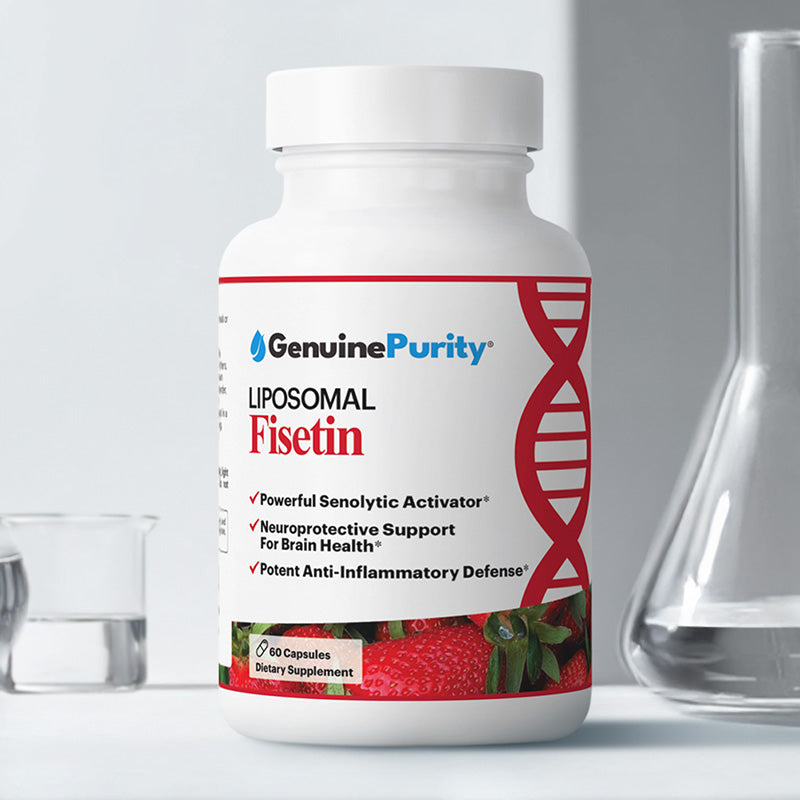
Run the pulse against the bottle on our shelf and the gap becomes concrete. A 20 mg/kg pulse for a 70 kg adult is ~1,400 mg — nine to ten GenuinePurity capsules a day, for two days, against a label direction of one. The maker's bottle image is labelled 60 capsules (a count the maker does not confirm in its page text), so a single monthly pulse at forum doses would consume roughly a third of a bottle, and the "daily" product becomes, in practice, a pulse ingredient sold in daily packaging. Price it the other way and the label dose costs $59 a bottle at one capsule a day. None of this arithmetic appears on any product page or in any protocol post, and it matters for a simple reason: the two camps are not choosing between two presentations of one regimen. They are buying different interventions that happen to share a molecule.
These statements have not been evaluated by the Food and Drug Administration. This product is not intended to diagnose, treat, cure, or prevent any disease. This article is educational and is not medical advice.
Safety: The Honest Unknowns
There is no established safe upper dose of fisetin in humans, no published interaction map, and no long-term data on repeated high-dose pulsing. GenuinePurity's page publishes no warnings, exclusions or side-effect statements whatsoever — nothing on pregnancy, medication or medical conditions — which is the maker's gap, but the wider point stands: at forum doses you are outside every tested envelope, including the supplement label's. Anyone taking prescription medication, managing a condition, or pregnant or nursing should treat both regimens as clinician questions, not internet ones.
Frequently Asked Questions
Should fisetin dose be adjusted for body weight?
That is the longevity forums' working assumption — the LongeCity thread's central question — because the animal studies they copy dosed per kilogram. No human trial has established weight-based fisetin dosing; labels ignore weight entirely and direct a flat 100–150 mg. Treat per-kilo dosing as community theory, not a finding.
What is the recommended dosage of fisetin for anti-aging?
There isn't one, in the sense the question wants. Makers recommend their label doses (GenuinePurity: 150 mg daily). No regulator, trial or medical body has published a recommended fisetin dose for aging, because the human evidence is still at the recruiting-trial stage.
Is 150 mg a day "enough" to clear senescent cells?
Nobody knows. The senolytic data behind fisetin's reputation comes from cell and animal work at far higher relative doses; whether a 150 mg daily capsule clears any senescent cells in a human has never been measured in a published trial.
Have the 20 mg/kg pulses been tested in a trial?
Not to completion. Trials testing intermittent high-dose fisetin in humans exist on registries and are recruiting; until one reports, every pulse protocol in circulation is an extrapolation from mice and from trial designs, not trial results.
Which approach does this store recommend?
We sell the label-dose product and we do not publish pulse instructions. If a reader chooses to experiment beyond a label, that is a decision to make with a clinician who can see their full medication list — not from a forum thread or a store page, ours included.
Where This Leaves the Buyer
Fisetin dosing is a choice between a manufacturer's daily direction with no senolytic evidence behind it and a community pulse with a coherent theory and no completed human trial behind it. The honest summary is that the molecule is genuinely interesting and the dosing question is genuinely open — anyone who tells you otherwise, at either dose, is selling something. Our shelf carries the daily version: GenuinePurity Fisetin, 150 mg a capsule at $59 with a 97-day guarantee, audited in full — including its missing purity figure — in our product review. Readers who want the mechanism before the milligrams should start with Senolytics Explained and Fisetin Absorption, where the delivery half of the dosing problem is examined.
Disclaimer: This article is for general information only and is not medical advice. Always consult a qualified healthcare professional before starting any supplement, especially if you have a medical condition or take prescription medication.
Last reviewed: October 2026
