
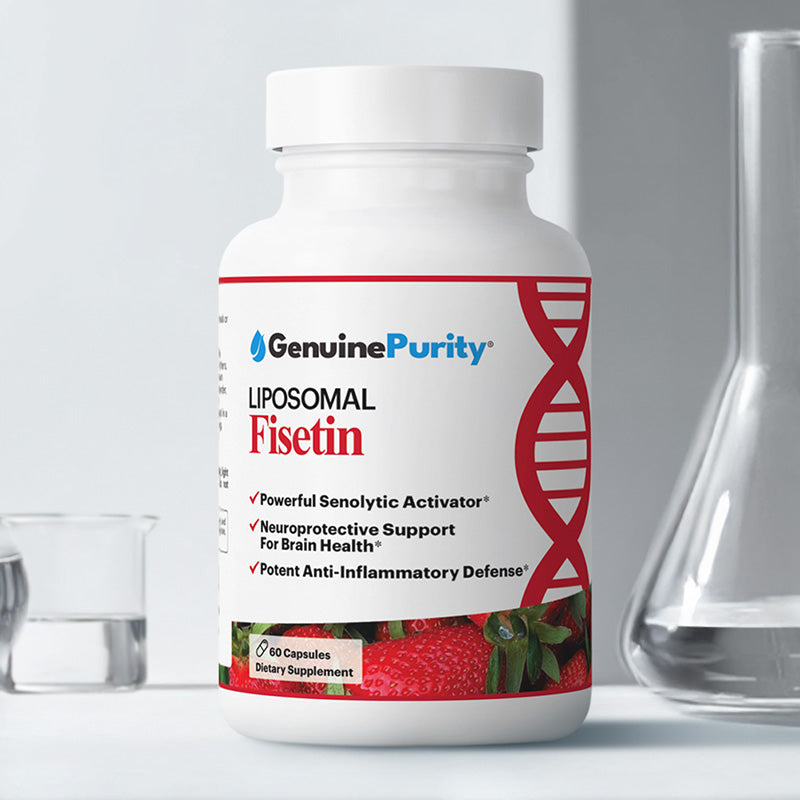
Affiliate disclosure: We sell both products in this comparison — GenuinePurity Fisetin and GenuinePurity Quercetin — through affiliate links, and earn a commission whichever you buy, at no extra cost to you. Both carry our audits and our scores (6.0/10 each). Every fact below comes from the maker's own pages, checked October 2026, including the facts that embarrass the maker: neither product publishes a purity percentage, and Quercetin's page states two different guarantees. Where this page discusses the community's high-dose pairing protocols, it reports them as published user behaviour — they are not recommendations, and neither label endorses them.
Quick Verdict: The Lead and the Partner
Fisetin and quercetin are paired so often that the longevity world treats them as one purchase, but on paper they play different positions. Fisetin is the lead senolytic: it finished first in the 2018 screen of ten flavonoids, and the community's dosing culture — the monthly pulses, the per-kilogram arithmetic — is built around it. Quercetin is the original partner: half of the first senolytic combination ever identified (alongside a prescription drug), a weaker senolytic alone, but a broader, cheaper, everyday flavonoid with a second life in the allergy-and-histamine conversation. GenuinePurity prices them $59 and $49 a bottle, doses them 150 mg daily and 500 mg daily respectively, and documents them to the same imperfect standard. If you buy one, the choice is about which job you are hiring for; if you buy both, you are following forum custom — published protocols pair them — not any completed human trial.
Fisetin + Quercetin at a Glance
| GenuinePurity Fisetin | GenuinePurity Quercetin | |
| Role in the pair | Lead senolytic — most potent of 10 flavonoids in the 2018 EBioMedicine screen (cell/animal work) | Partner senolytic — the flavonoid half of the original 2015 senolytic combination (with prescription dasatinib) |
| Daily dose (label) | 150 mg — 1 capsule daily, with food | 500 mg — 2 capsules of 250 mg daily, with food |
| Form | Liposomal capsule; phospholipid complex (sunflower lecithin, phosphatidylcholine) | Liposomal capsule; plain quercetin from Sophora japonica flower |
| Purity published? | No — no percentage stated anywhere for this product | No — "Ultra-Pure & High Potency" claimed, no figure printed |
| Bottle count | Not stated in page text (bottle image labelled 60 capsules) | 60 capsules published in the maker's FAQ — a 30-day supply |
| Price | $59; packs $159 / $259 (~$53 / ~$43 per bottle); no subscription in page copy | $49; packs $139 / $239 (~$46 / ~$40 per bottle); no subscription in page copy |
| Guarantee | 97 days, stated consistently on the page | In conflict on one page: 97 days in the header, 90 days (excluding shipping) in the guarantee section |
| Safety content | None published — no warnings at all | One FAQ line: consult a doctor if on medication; nothing further |
| Our score | 6.0/10 | 6.0/10 |
Why These Two Are Paired
The pairing has a research genealogy and a community one, and they are not the same thing. The research version: when senolytics were first identified in 2015, quercetin was one of the two compounds — its partner was dasatinib, a prescription leukaemia drug, not a supplement. Fisetin arrived in 2018 as the flavonoid screen's strongest performer. No published study tests fisetin plus quercetin as a supplement combination in humans. The community version fills that gap by custom: two widely read, independently published user protocols — an APOE4 community member's senolytic protocol and a health Substack's "2-Day Senolytic Pulse" — both run fisetin at 1,000–2,000 mg per day for two-day pulses, always with quercetin at 1,000 mg alongside, typically monthly. That is the entire basis of the "duo": two protocols, zero trials. We report the pattern because it is the demand this page answers, and we flag its dose level because it is roughly ten times the fisetin label and double the quercetin label — self-experimentation that neither maker endorses and this store does not present as a method. Our examination of where those numbers came from is in Fisetin Dosing: Daily 150 mg vs the 20 mg/kg Monthly Pulse.
The Two Formulas on Paper
As labelled products, the contrast is routine versus load. Fisetin asks for one capsule a day — the simplest routine in the maker's single-ingredient line — and its excipient list and liposomal phospholipid complex are published in full. Quercetin asks for two capsules a day totalling 500 mg of plain quercetin from a named botanical source, and it is the rare sibling that publishes its bottle count (60 capsules, a 30-day supply) in its own FAQ. Against those credits, the shared debit is identical: neither page prints a purity percentage, in a product line where Spermidine states 99%, NMNH and NR state 98%, and NMN states 96%. For a pair of products whose entire rationale is delivering a specific flavonoid, the absence of the active-fraction figure on both labels is the comparison's most important line — it means neither 150 mg nor 500 mg can be audited into milligrams of verified active.
Evidence Compared
Both files are molecule-level; neither contains a trial of the product. Fisetin's strongest card is the 2018 EBioMedicine screen — most potent senolytic of ten flavonoids tested, in cells and animals, with lifespan extension reported in mice — plus journal one-liners and one human-trial quotation at 100 mg (a dose its own label does not match, measuring inflammation markers rather than senescent-cell clearance). Quercetin's file, as its maker presents it, leans on a study in aging mice (presented with lifespan percentages) and a human-trial claim the page does not name and does not attribute to quercetin alone — the published research it resembles used quercetin in combination. Read symmetrically: fisetin's evidence is the better-organised of the two, and both are preclinical stories told about molecules, not results measured on these capsules. The mechanism framing behind both is laid out in Senolytics Explained.
These statements have not been evaluated by the Food and Drug Administration. This product is not intended to diagnose, treat, cure, or prevent any disease. This article is educational and is not medical advice.
The Paperwork Compared
Guarantees first, because this pair contains the line's cleanest and messiest pages side by side. Fisetin's 97-day guarantee is stated once, consistently, with the refund scope (up to two opened bottles plus any unopened ones) in writing. Quercetin's page contradicts itself: the header promises a 97-day money-back guarantee while its own guarantee section offers a 90-day satisfaction guarantee with refunds excluding shipping — and omits the opened-bottle scope its siblings print. Until the maker fixes it, a quercetin buyer does not know which promise they hold, and we score that as we find it. Safety paperwork is thin on both: fisetin's page publishes no warnings of any kind, and quercetin's entire safety file is one FAQ sentence advising a doctor consultation if you take medication — the better of the two, by a single sentence. On price, quercetin is the line's value entry ($49 a bottle, falling to ~$40 in the largest pack, a confirmed 30-day supply at label dose); fisetin at $59 with an image-labelled 60 capsules would work out cheaper per month if the count is as pictured — but the maker does not confirm it in text, and we do not upgrade a photograph into a specification.
Frequently Asked Questions
Can I take fisetin and quercetin together?
People do — the two published community protocols pair them — but no human trial has tested the combination as supplements, at label doses or at protocol doses. Both makers' pages are silent on combining. If you take medication, treat stacking two poorly documented flavonoids as a clinician question, not a default.
Which is the stronger senolytic?
Fisetin, on the only direct comparison that exists: the 2018 screen of ten flavonoids in cell and animal models, where fisetin ranked most potent. Quercetin's senolytic reputation comes from its role in the original 2015 drug combination, not from equivalent standalone potency.
Why do the protocols use such high doses?
Because they are extrapolated from per-kilogram animal dosing, not from these labels: 1,000–2,000 mg of fisetin against GenuinePurity's 150 mg capsule. That is the community's reasoning, reported for completeness — it is not evidence the label doses fail, nor that protocol doses are safe.
Which should I buy if I only buy one?
Fisetin if the senolytic question is the whole point — it is the category's lead molecule with the simplest routine. Quercetin if budget leads, or if you also value its wider antioxidant and allergy-side positioning — and accept its self-contradicting guarantee page as the trade.
Final Verdict
Choose GenuinePurity Fisetin if senolytic potency is the purchase: the screen's top flavonoid, one capsule a day, a guarantee page that agrees with itself — accepting the line's most conspicuous missing figure, a published purity percentage. Choose GenuinePurity Quercetin if value and versatility lead: the line's lowest price, a published dose and bottle count, the partner compound of the original senolytic research — accepting that its own page cannot decide between a 97-day and a 90-day guarantee. Choose both only with eyes open: the duo is a community custom documented in two user protocols, at doses far above these labels, with no combination trial behind it at any dose. Our shelf carries both — Fisetin and Quercetin, 6.0/10 each — audited to the same standard, which is why this page can show the pair's shared flaw (no purity figures) as plainly as their separate ones.
Disclaimer: This article is for general information only and is not medical advice. Always consult a qualified healthcare professional before starting any supplement, especially if you have a medical condition or take prescription medication.
Last reviewed: October 2026
