
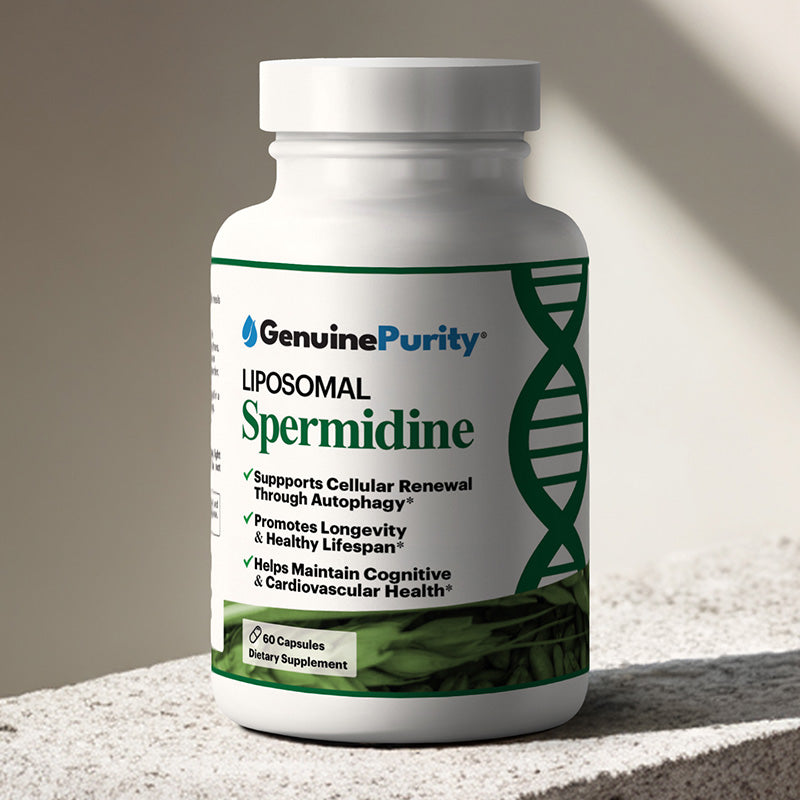
Affiliate disclosure: This article contains affiliate links. If you buy through a link on this page, we may earn a commission paid by the manufacturer, at no extra cost to you. We sell the capsule alternative — GenuinePurity Spermidine (Our Score 6.5/10), 8 mg a day at $59 a bottle — so this food table is published by a store that profits if you conclude food is too much work. Read it with that in mind, and note where it lands anyway: at the dose the human trial actually used, the food route is genuinely workable, and the table below shows the working.
Quick Answer: Rich Sources Exist — and Every Figure Is an Estimate
Spermidine concentrates in a short list of foods: wheat germ leads it, followed by aged cheeses, mushrooms and fermented foods (natto, sauerkraut, kimchi), with legumes and whole grains contributing background amounts. A daily tablespoon of wheat germ puts you in the territory of the only completed human trial dose — about 1 mg a day. What this table will not give you is a precise milligram-per-100-grams column, because no audited dataset behind it exists: spermidine content varies with variety, fermentation and storage, and the exact figures circulating online are estimates wearing lab coats. Below, the table is built from what can actually be anchored — relative richness, realistic servings, and calorie costs — with the estimates labelled as estimates and the one piece of precise arithmetic in the whole topic attributed to the forum member who calculated it.
Read This Table as Estimates
A note on method before the numbers, because in this topic the method is the finding. Spermidine is made by every living cell, so its concentration in any given food is a moving target: the same cheese at different ages, the same wheat germ from different milling, the same ferment at different stages will not match. Published per-100-gram tables exist elsewhere and disagree with each other; none of them measures your plate. The research file behind this store contains exactly two hard anchors. The first is the trial anchor: the SmartAge study's wheat-germ extract delivered roughly 0.9–1.2 mg of spermidine a day — the dose a serious human experiment chose to test. The second is a piece of community arithmetic, quoted verbatim in the source threads and labelled as what it is below. Everything else in the table is presented as what it honestly is: relative standing (which foods are rich, which are modest) and realistic serving shapes, so the comparison a reader actually needs — what does eating spermidine cost me, in effort and calories? — can be made without invented precision.
The Source Table
| Food | Spermidine standing | A realistic daily serving | The calorie cost |
| Wheat germ | The standout common source — the trial's own delivery vehicle | One heaping tablespoon daily (the longevity forums' standard advice), stirred into food | The smallest on this table: a spoonful's worth, folded into a meal you were eating anyway |
| Aged cheeses | Meaningful — spermidine accumulates as cheese matures | A portion of aged cheese (the worked example below uses cheddar) | The table's cautionary tale — see the forum calculation under this table |
| Mushrooms | A meaningful source | A handful or a side portion, cooked as part of a meal | Low — a side dish's worth, inside a meal rather than added to one |
| Fermented foods (natto, sauerkraut, kimchi) | Carried by their bacterial cultures | Condiment-to-side portions, eaten with other food | Low in quantity; the real cost is dietary fit — natto's flavour is an acquired taste many never acquire |
| Legumes & whole grains | Smaller amounts, spread across a normal diet | No special serving — background intake from eating ordinarily | Effectively zero marginal cost; also zero strategy — this is the floor every diet starts from |
The aged-cheese row deserves its arithmetic shown, because it is the best-known number in the food-spermidine conversation and the most often misquoted as audited fact. In the LongeCity sourcing threads, one forum member worked through the cheese route and concluded: "To get 25 mg of spermidine, you'd have to eat 120 grams of aged cheddar. Almost 500 calories." We print that as exactly what it is — one forum member's much-repeated calculation, not an audited figure — and its shape, not its precision, is the point: at label-level doses, the richest solid source bills you roughly 500 calories per 25 mg on that member's arithmetic, before variety and ageing move the true figure in either direction. Exact calorie-per-milligram arithmetic in auditable form exists for no other row of this table, which is why the other rows give you the realistic cost shape instead of a number we cannot stand behind.
Two Targets, Two Different Tables
The table reads completely differently depending on which dose you are aiming at — the split our companion piece, Spermidine From Food vs Capsules, works through in full. Aim at ~1 mg a day — the SmartAge trial level — and the table is a grocery list, not a regimen: the wheat-germ tablespoon, mushrooms or cheese in ordinary rotation, fermented foods you already like. An unoptimised varied diet is already contributing before you change anything. Aim at 8–10 mg a day — the label level — and the table becomes a scaling problem: every row multiplied several times over, daily, indefinitely, with the cheddar row's calorie bill as the emblem of why almost nobody sustains it. Food was never really competing with the capsule at that dose; it was competing with a second job. The honest framing is therefore not "food versus capsules" but "which target is yours" — and only one of the two targets has stood inside a human trial, as Spermidine and Autophagy: The Dose Problem sets out.
These statements have not been evaluated by the Food and Drug Administration. This product is not intended to diagnose, treat, cure, or prevent any disease. This article is educational and is not medical advice.
What the Capsule Costs Instead
The comparison is only fair with the capsule's own bill on the table. GenuinePurity's spermidine is — pointedly — the food route concentrated: derived from wheat germ extract, standardised to 8 mg a day (two capsules, with food), at a stated 99% purity held consistently across the maker's pages, with published third-party Certificates of Analysis. The price is $59 a bottle, or $39 a month on subscription. What that buys is certainty: a measured dose with no cooking, no calories and no fermentation lottery. What it does not buy is a proven outcome — no human trial has tested 8 mg — and its paperwork carries the line's familiar gaps: the capsule count per bottle is unpublished, so the routine's exact monthly cost cannot be verified from the page, and the guarantee reads 97 days on the product page against 90 in the maker's landing-page FAQ. One food consideration also survives the switch to capsules: a wheat-germ-derived capsule is still wheat, and the maker's pages publish no gluten or wheat-allergy note either way. The full audit is our GenuinePurity Spermidine review, and spermidine's place on the wider shelf is mapped in Best Anti-Aging Supplements Compared.
Frequently Asked Questions
Which food has the most spermidine?
Wheat germ is the standout common source — the reason a daily tablespoon is the longevity community's standard advice, and the vehicle the best-known human trial itself used. Aged cheeses, mushrooms and fermented foods follow. Any source quoting you an exact milligram figure for a given food is quoting an estimate: content varies with variety, fermentation and storage.
Can food alone reach a supplement-level dose?
To the trial level (~1 mg a day): yes, realistically, with the wheat-germ tablespoon as the anchor habit. To label levels (8–10 mg a day): only by scaling the richest sources several times over, every day — the forum's cheddar calculation (~500 calories per 25 mg, one member's arithmetic, not an audited figure) shows the cost shape of that project.
Why doesn't this table give exact mg per 100 g?
Because we cannot audit one. No dataset in the maker material or research file behind this store fixes spermidine content per food, and the figures published elsewhere are estimates that vary by batch and preparation. The table therefore gives relative standing, realistic servings and cost shapes — and labels its one precise figure as a forum member's calculation.
Does cooking or storage change the numbers?
That is exactly the problem: fermentation, ageing and storage all move spermidine content, which is why any fixed table is an estimate of a moving target. It is also the capsule's one clean advantage — a standardised, tested dose does not drift with your grocer's stock.
Is the capsule just expensive wheat germ?
In origin, close to literally: its spermidine is wheat-germ-derived. What the $59 buys is standardisation (8 mg measured, 99% purity stated, CoAs published) and zero daily effort. What it cannot buy is a proven benefit at that dose — the trial anchor remains ~1 mg, whichever route delivers it.
The Practical Verdict
Use the table at the resolution it can honestly support. If your target is the studied dose, eat first: a tablespoon of wheat germ, mushrooms and aged cheese in rotation, fermented foods you enjoy — trial-level spermidine for grocery money, with the calorie bill at its smallest. If your target is a measured daily dose with published purity and no kitchen work, the capsule is a legitimate convenience at $59, bought with its gaps noted in our GenuinePurity Spermidine review. And whichever route you choose, hold every exact-looking spermidine number you meet — on other tables, and on this page — to the standard applied here: anchored, attributed, or labelled an estimate. In this topic, the honest table is the one that tells you which of its figures it cannot prove.
Disclaimer: This article is for general information only and is not medical advice. Always consult a qualified healthcare professional before starting any supplement, especially if you have a medical condition or take prescription medication.
Last reviewed: October 2026
