
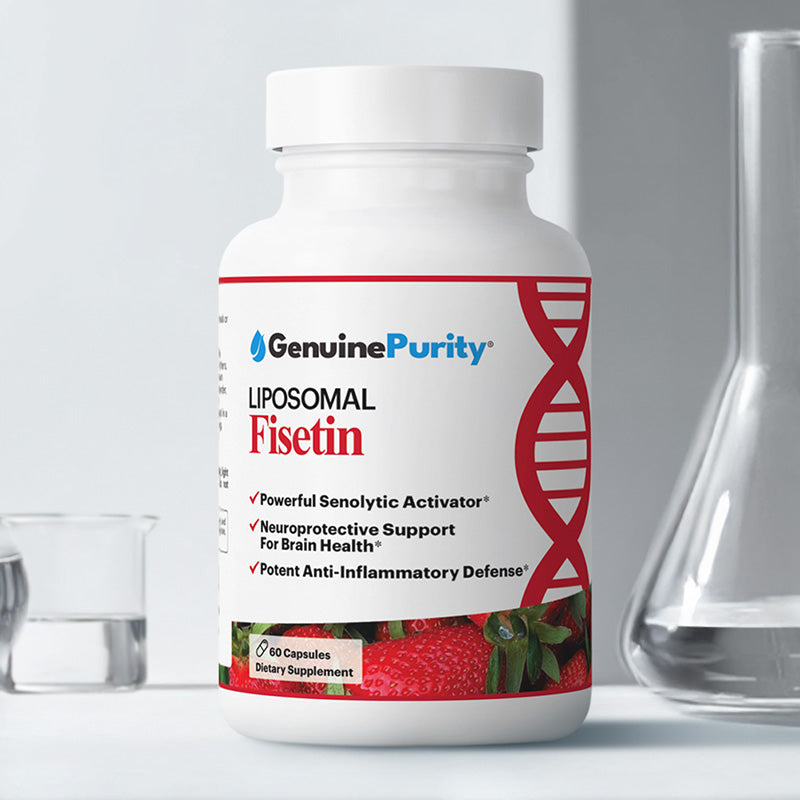
Affiliate disclosure: This article contains affiliate links. If you buy through a link on this page, we may earn a commission paid by the manufacturer, at no extra cost to you. We sell two senolytic-positioned products — GenuinePurity Fisetin (Our Score 6.0/10) and GenuinePurity Quercetin (Our Score 6.0/10) — so this explainer has a commercial interest attached, and it is written to survive that: every claim below is graded as animal evidence, early human evidence, or theory, because senolytics is a field where those three are routinely blurred.
Quick Answer: A Cleanup Idea With Early Evidence
Senolytics are compounds studied for one job: selectively killing senescent cells — aged cells that have stopped dividing but refuse to die, nicknamed "zombie cells." The case against those cells is their behaviour, not their existence: they secrete an inflammatory mixture called SASP that degrades the tissue around them. In mice, clearing senescent cells has improved health measures and extended lifespan. In humans, the field is young: the first senolytic combination was identified in 2015, fisetin emerged as the most potent natural candidate in a 2018 screen, and the human trials that would tell us whether any of this helps healthy people are still recruiting. Everything else in this article is detail under that headline.
What Is a Senescent Cell?
A healthy cell that suffers enough damage — DNA damage, worn-down telomeres, oxidative stress — faces a choice between dying cleanly and arresting itself. Senescence is the arrest: the cell permanently stops dividing, which is genuinely useful early in life (it is one of the body's anti-cancer brakes, and it helps wounds heal). The problem is clearance. Young immune systems remove senescent cells; older ones increasingly do not, so the cells accumulate in skin, joints, blood vessels, fat and elsewhere. A senescent cell is not dead weight, though. It stays metabolically active, and what it does with that activity is the whole story.
SASP: Why a Few Stuck Cells Matter
Senescent cells broadcast. The mixture they secrete — inflammatory cytokines, growth factors and tissue-chewing enzymes — has a name: the senescence-associated secretory phenotype, or SASP. SASP is how a minority of stuck cells exerts outsized influence: it inflames neighbouring tissue, degrades its structure, and can push nearby healthy cells into senescence themselves, spreading the state. In animal research, accumulated senescent cells and their SASP are associated with a long list of age-related dysfunctions, and transplanting senescent cells into young animals measurably ages them — while removing the cells reverses aspects of that decline. That two-way animal evidence is the engine of the entire field, and it is why "zombie cells" stuck as a metaphor: the cells are not dead, not functional, and harmful mainly through what they whisper to their neighbours.
What Senolytics Do Differently
Most supplement categories aim to support, boost or nourish. Senolytics aim to delete. Senescent cells survive by leaning on anti-death pathways — the same pro-survival machinery that makes them hard for the immune system to clear — and senolytic compounds work by briefly disabling those defences so the cell's own death programme can run. The field's founding moment came in 2015, when researchers identified the first senolytic combination: dasatinib, a prescription leukaemia drug, plus quercetin, the plant flavonoid — a pairing chosen by reasoning about those survival pathways, then confirmed against senescent cells. In 2018, a screen of ten flavonoids published in EBioMedicine found fisetin the most potent senolytic of the set in cell and animal work, and reported lifespan extension in mice — the study that put fisetin, a flavonoid from strawberries and other plants, at the centre of the supplement-side conversation. Note the division of labour in that history: the concept and the potency ranking come from laboratories; no part of it is a result in a person who bought a bottle.
Why Pulses, Not Daily?
If senolytics delete a cell population rather than top up a nutrient, the dosing logic flips. A vitamin is taken daily because the body uses and excretes it daily. A senescent cell, once cleared, is gone — and because these cells form slowly, the replacement burden rebuilds over weeks, not hours. The field's term is "hit-and-run" dosing: a short exposure sufficient to trigger the cells' death, followed by a long interval with no drug at all. That is why the human trials in this space are designed around brief, intermittent courses rather than daily regimens, and why the longevity community takes fisetin in monthly pulses rather than as a daily capsule — a custom we examine, with its considerable unknowns, in Fisetin Dosing: Daily 150 mg vs the 20 mg/kg Monthly Pulse. It is also why daily-label senolytic products sit in an awkward position: their format (one capsule, every day, forever) belongs to the vitamin model, while their marketing borrows the hit-and-run model's science. Both cannot be the natural way to take the same compound, and at present neither has a completed human outcome trial behind it.
These statements have not been evaluated by the Food and Drug Administration. This product is not intended to diagnose, treat, cure, or prevent any disease. This article is educational and is not medical advice.
What the Evidence Actually Shows — and Where It Stops
Grade the file honestly and it has three tiers. Tier one, animal evidence: strong and consistent — senescent-cell clearance in mice improves physical function measures and extends lifespan in multiple models, fisetin included. Tier two, human pilot data: small early studies of the dasatinib-plus-quercetin combination in specific patient groups showed senescent-cell markers can be reduced in people; fisetin's own human trials are recruiting-stage. Tier three, human outcomes: empty. No completed trial has shown that clearing senescent cells — by drug or supplement — makes healthy humans live longer, move better, or avoid disease. There is also a measurement problem the marketing never mentions: there is no consumer test for your personal senescent-cell burden, so no buyer of any senolytic product can verify whether it did anything at all. The category sells an invisible outcome, which is precisely why paperwork discipline matters more here than in ordinary supplement categories.
Where Fisetin and Quercetin Fit
On our shelf the senolytic shelf is two flavonoids. Fisetin is the potency candidate — top of the 2018 flavonoid screen — sold by GenuinePurity at 150 mg a capsule, with the notable paperwork gap that the maker publishes no purity percentage for it. Quercetin is the field's original partner compound (the Q in the 2015 combination, though that pairing used a prescription drug as the other half) and the weaker senolytic alone; GenuinePurity sells it at 500 mg a day for $49. Why the community insists on taking them together is its own story: Fisetin + Quercetin: The Senolytic Duo, Compared and Combined. One boundary is worth drawing before you leave this page: senolytics are not the only "cellular cleanup" mechanism on the shelf. Spermidine works the opposite shift — autophagy, the cell's internal recycling — and we cover its very different evidence problem in Spermidine and Autophagy: The Dose Problem. Deleting stuck cells and recycling worn parts are different jobs; the store sells tools for both, and the honest reader keeps the two files separate.
Frequently Asked Questions
What are "zombie cells"?
The nickname for senescent cells: cells that have permanently stopped dividing (so they no longer function) but have not died (so they still occupy tissue and secrete inflammatory signals). The term is a metaphor from the research community's own communication, not a diagnosis.
What does SASP stand for?
Senescence-associated secretory phenotype — the cocktail of inflammatory cytokines, growth factors and enzymes that senescent cells release into surrounding tissue. SASP is the main mechanism by which a relatively small number of senescent cells is thought to drive wider age-related dysfunction, based largely on animal evidence.
Why aren't senolytics taken every day?
Because of what they target. Senescent cells accumulate slowly and, once killed, are gone; there is nothing to "top up" daily. The field's hit-and-run model doses briefly and intermittently — the design used in human trials — though no completed trial has yet proven the model works in people.
Are senolytics proven to work in humans?
Not for outcomes. Animal evidence is strong; human work consists of small pilots showing senescent-cell markers can move, plus recruiting-stage fisetin trials. No completed human trial shows a health or lifespan benefit from any senolytic, drug or supplement.
Is fisetin a drug?
No. Fisetin is a dietary flavonoid sold as a supplement; it has not been approved as a drug for senescence or anything else. The original senolytic partner compound, dasatinib, is a prescription drug — one reason the 2015 research combination is a laboratory milestone, not a self-help protocol.
The Short Version
Senolytics is a real idea with a real mechanism and a genuinely unfinished evidence file: zombie cells and their SASP are well-characterised in animals, clearance helps mice, and the human verdict is still being recruited for. Buy into the category, if you do, at that temperature — as an early, interesting bet with named gaps — and judge every product in it by the paperwork standard we apply on this store: published doses, published purity where the maker dares, and no outcome language the trials have not earned. Our audited starting points are the GenuinePurity Fisetin and GenuinePurity Quercetin product reviews.
Disclaimer: This article is for general information only and is not medical advice. Always consult a qualified healthcare professional before starting any supplement, especially if you have a medical condition or take prescription medication.
Last reviewed: October 2026
