
- Quick Answer: A Tenfold Gap Between the Trial and the Shelf
- What Autophagy Is, and Why Spermidine Owns This Corner
- The Human Anchor: About 1 mg a Day
- The Label Doses: 5, 8, 10 mg
- Why the Gap Exists
- Is More Necessarily Better?
- Safety and the Missing Warnings
- Frequently Asked Questions
- Where This Leaves the Buyer
Affiliate disclosure: This article contains affiliate links. If you buy through a link on this page, we may earn a commission paid by the manufacturer, at no extra cost to you. We sell GenuinePurity Spermidine (Our Score 6.5/10) — an 8 mg-a-day capsule, which sits squarely on the "labels" side of the gap this article describes. That is disclosed here because the article's conclusion cuts against the easy sales pitch: on current evidence, nobody can tell you that 8 mg does more than the roughly 1 mg the human trial used, and this page will not pretend otherwise.
Quick Answer: A Tenfold Gap Between the Trial and the Shelf
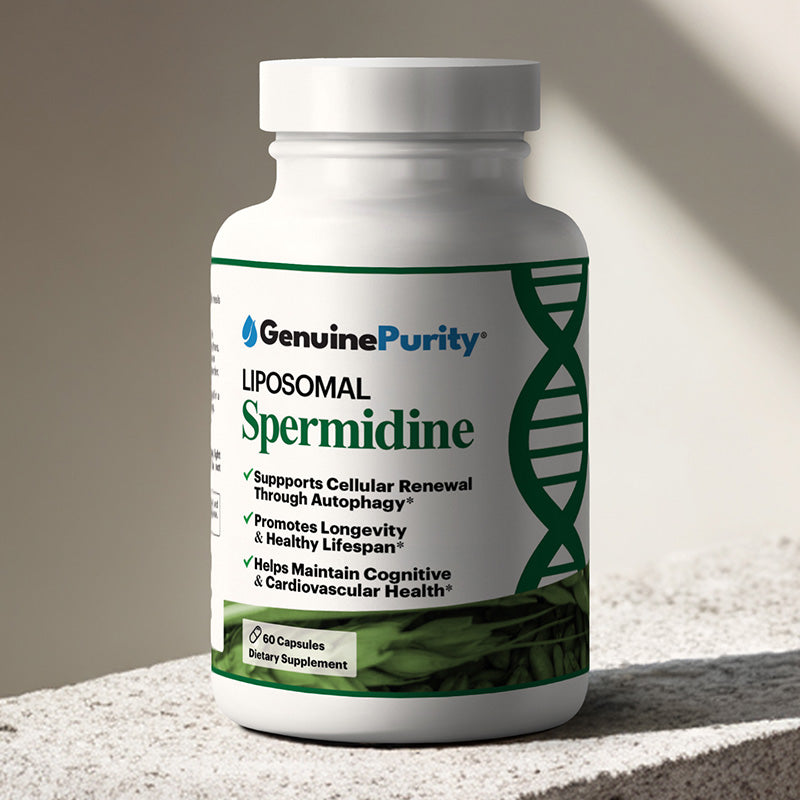
Spermidine is a dietary compound that triggers autophagy — the cell's internal recycling system — in every model organism tested, and it is the rare longevity molecule with a defined human-trial dose: the best-known trial, SmartAge, gave older adults a wheat-germ extract providing about 0.9–1.2 mg of spermidine a day. Supplement labels, meanwhile, compete at 5–10 mg a day — GenuinePurity's capsule delivers 8 mg — with no human trial at those doses and no validated dose for producing any measurable autophagy effect in people. The dose problem is the whole story: the biology is real, the trial anchor is ~1 mg, and everything above it is extrapolation.
What Autophagy Is, and Why Spermidine Owns This Corner
Autophagy is the cell's housekeeping: worn proteins and damaged components are collected, broken down and recycled. The process is vigorous in youth and, on the research consensus, declines with age — one reason it became a longevity target. Spermidine, a polyamine found in every cell and in foods from wheat germ to aged cheese, is among the most reliable autophagy inducers known: in yeast, worms, flies and mice, dietary spermidine switches the recycling machinery on, and in mice it extended lifespan in the research the maker of our shelf product quotes (a 2016 Nature Medicine study among them). It is a genuinely elegant mechanism, and it is a different cleanup job from the senolytic one — deleting whole stuck cells — that fisetin is sold for; we keep the two files separate in Senolytics Explained. What matters here is the distance between "induces autophagy in a mouse" and "does something measurable in a person," because the dose question lives exactly in that distance.
The Human Anchor: About 1 mg a Day
Human spermidine research is thin, but it has one firm number. The SmartAge trial — the best-known controlled human study — supplemented older adults with a wheat-germ extract standardised to provide roughly 0.9–1.2 mg of spermidine daily: a food-level dose, chosen because wheat germ is a natural source and the trial was testing a dietary intervention, not a pharmacological one. That figure is the only point on the entire dose curve that rests on a completed human trial. It does not prove 1 mg is optimal, sufficient, or even effective for any longevity outcome — the trial was not a lifespan study and could not have been. What it establishes is humbler and more useful: when researchers designed a serious human experiment, the dose they considered worth testing was about one milligram. Every claim above that line is, at present, untested in people.
The Label Doses: 5, 8, 10 mg
The market answered the trial with multiplication. Seller FAQ pages field the questions buyers actually ask — "What is the best spermidine dosage per day for longevity?" and "Is 10 mg of spermidine per day safe?" — because the shelf offers a ladder with no obvious rung: 5 mg here, 10 mg there. GenuinePurity's entry is 8 mg a day (two capsules, preferably with food), and to the maker's credit its file is unusually checkable: a stated 99% purity, consistent across its product page, landing page and blog, with third-party Certificates of Analysis published — disclosure several of its own sibling products do not match. The same page, however, carries the line's recurring sloppiness: the guarantee is 97 days on the product page while the maker's landing-page FAQ says 90, and the capsule count per bottle is nowhere published, so the true monthly cost of the two-capsule routine cannot be verified from the page. Price as printed: $59 a bottle, multi-bottle packs at about $53 and about $43 per bottle, or a $39-a-month subscription.
Why the Gap Exists
Nobody should read the gap as a conspiracy; it is an incentive shape. Trials are slow and expensive, and a food-derived compound at food-level doses is a hard thing to fund and an impossible thing to patent — so the human file stays at ~1 mg. Labels, meanwhile, compete in a storefront where milligrams are the visible spec, and "ten times the trial dose" reads as strength rather than as distance from the evidence. The editorial consensus in the dosage literature is blunt about the result: there is currently no clinically validated spermidine dose proven to switch on a predictable amount of autophagy in humans. Higher label doses are not known to be harmful — spermidine is, after all, something every diet contains — but "not known to be harmful" and "known to be more effective" are different sentences, and only the first one is available.
These statements have not been evaluated by the Food and Drug Administration. This product is not intended to diagnose, treat, cure, or prevent any disease. This article is educational and is not medical advice.
Is More Necessarily Better?
For a nutrient-like compound, the honest dose-response answer is: unknown in humans. Biology offers reasons to doubt a straight line — autophagy is a regulated process with feedback controls, not a tank that fills in proportion to intake — and the safety file at label doses, while reassuring in outline (the compound is dietary, ubiquitous, and the maker reports no known adverse-effect pattern), is not the same as long-term human data at 8–10 mg a day, which does not exist. There is also a quieter route to trial-level exposure that this debate usually skips: food itself supplies spermidine daily, and reaching ~1 mg from the plate is realistic — the subject of our companion piece, Spermidine From Food vs Capsules. The capsule question is therefore not "spermidine or none" but "a measured 8 mg, or a dietary ~1 mg" — and only one of those numbers has stood in a trial.
Safety and the Missing Warnings
GenuinePurity publishes no warnings, exclusions or side-effect section for Spermidine; its landing page's only safety-adjacent line is an assurance that the dose "is safe without any negative reported side-effects," which is a maker's claim, not guidance. One gap is specific to this formula: the active is derived from wheat germ, yet no gluten or wheat-allergy note appears on the product pages. If wheat is a medical issue for you, or you take prescription medication, are pregnant or nursing, or manage a health condition, the page gives you nothing to rely on — get individualised advice from a qualified clinician before starting.
Frequently Asked Questions
What dose of spermidine did human trials use?
About 1 mg a day. The best-known trial, SmartAge, used a wheat-germ extract providing roughly 0.9–1.2 mg daily. No completed human trial has tested the 5–10 mg doses on supplement labels.
Is 8–10 mg of spermidine a day safe?
There is no evidence of harm at those intakes in the material we can audit, and spermidine is a normal dietary compound — but there is also no long-term human trial at label doses. "No known harm" is the accurate statement; "proven safe and superior" is not available for any brand, ours included.
Does spermidine really trigger autophagy in humans?
It triggers autophagy reliably in model organisms, and that is where the direct demonstrations end. In humans, the effect at any dose is inferred, not measured — no validated test currently tells a buyer whether their autophagy changed.
Why do labels sell so much more than the trial dose?
Because milligrams are the spec a shopper can compare, and trials of food-level doses are hard to fund. The gap reflects the market's incentives, not a finding that more works better.
Where This Leaves the Buyer
Spermidine is one of the more respectable files on the longevity shelf — a real mechanism, a consistent maker disclosure (99% purity, published CoAs, a printed 8 mg dose) — wrapped around an unresolved tenfold question. Buy the capsule, if you buy it, for what it verifiably is: a measured, tested-for-purity source of a compound whose human trial anchor is ~1 mg a day, in a category that is also covered, alongside the other mechanisms, in our Best Anti-Aging Supplements Compared roundup. The audited product file is our GenuinePurity Spermidine review — including the guarantee conflict and the missing capsule count, stated as plainly there as the strengths. The label checks behind that audit — stated dose, stated purity, a published CoA, a guarantee that agrees with itself — are the same ones set out in our NMN Buying Guide, written for a different molecule and applicable, check for check, to this one.
Disclaimer: This article is for general information only and is not medical advice. Always consult a qualified healthcare professional before starting any supplement, especially if you have a medical condition or take prescription medication.
Last reviewed: October 2026
