
- Quick Verdict: The Newer Molecule Has the Thinner File
- NMNH vs NMN at a Glance
- What "Reduced" Actually Means
- The Human Evidence: Where the Two Files Split
- The Fold Numbers, in Their Original Units
- The GenuinePurity NMNH File: A Dose Problem on Top
- Which One Fits Which Buyer
- Frequently Asked Questions
- Final Verdict
Affiliate disclosure: We sell both products in this comparison — GenuinePurity NMNH and GenuinePurity NMN — through affiliate links, and earn a commission if you buy through them. Every product fact below comes from the maker's own pages, which we audited for our product reviews (NMNH carries our score of 5.5/10; NMN carries 7.5/10). The evidence comparison is drawn from what each maker's file actually cites and from the published state of the research — including the parts that argue against the newer, more expensive product we sell.
Quick Verdict: The Newer Molecule Has the Thinner File
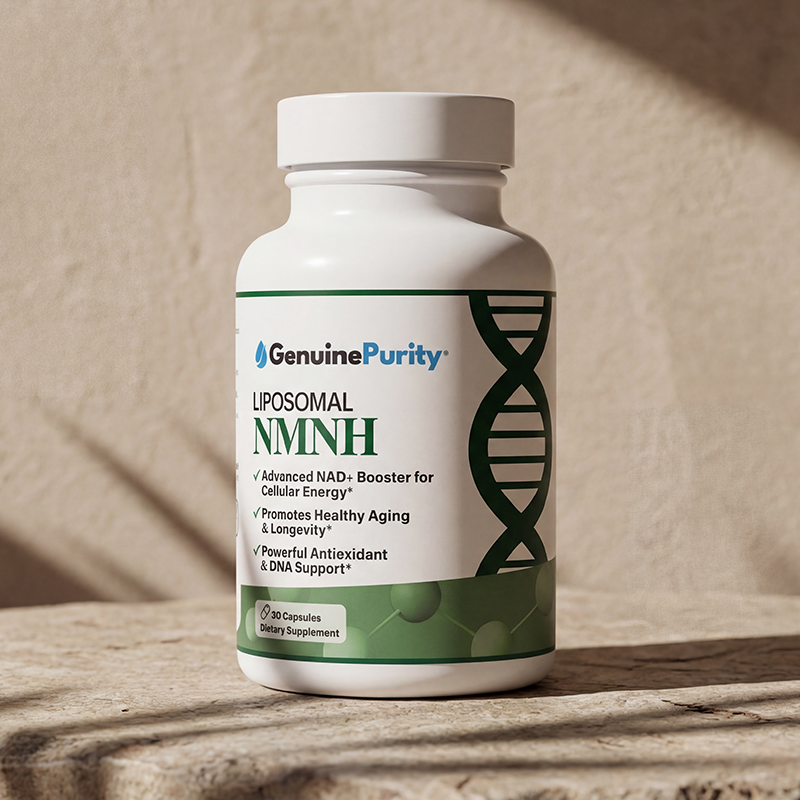
NMNH is NMN's reduced form — the same precursor carrying an added hydrogen — and its marketing runs on a true statement with the units removed: in cell studies, NMNH raises NAD+ by larger multiples than NMN does. What the marketing leaves off is where those multiples were measured (cell cultures and animal work, not people) and what sits on the other side of the ledger. NMN has been tested in multiple human trials, which measured NAD+ rising in people, at known doses, with published safety data. NMNH has, as of this review, preclinical data and one emerging 2026 preprint — and no head-to-head human trial against NMN, or against anything, has been published. If the question is "which precursor is stronger in a person?", the honest answer is that nobody has run the experiment. The comparison below is therefore really two comparisons: the molecules' evidence files, and the two GenuinePurity bottles that carry them — where the NMNH bottle adds a problem of its own, a marketed 500 mg dose its label directions do not deliver.
NMNH vs NMN at a Glance
| NMN | NMNH | |
| What it is | Nicotinamide mononucleotide — a direct NAD+ precursor | The reduced form of NMN (NMN plus an added hydrogen) |
| Human evidence | Multiple published human trials measuring NAD+ and safety at set doses | No human trial described in the maker's material; preclinical data plus one emerging 2026 preprint |
| Head-to-head human trial | None — NMNH and NMN have never been compared in people | |
| Where the big numbers live | Measured NAD+ changes in human blood | Fold-increases in cell cultures and animal models |
| GenuinePurity price | $69 per bottle | $89 per bottle |
| Stated purity (maker) | 96% | 98% |
| Our score (GenuinePurity bottle) | 7.5/10 | 5.5/10 |
What "Reduced" Actually Means
Both molecules feed the same pathway: the body converts them toward NAD+, the coenzyme involved in cellular energy production and repair processes, whose levels decline with age. NMNH differs from NMN by reduction — chemically, it carries an extra hydrogen (extra electrons, in the language of the papers). In laboratory models that reduced state appears to convert to NAD+ quickly and, in some experiments, to keep NAD+ elevated for longer. That is a real and interesting finding, and it is the entire factual basis for the "next-generation precursor" framing. What reduction does not do is exempt the molecule from the ordinary burden of proof. A faster conversion in a dish is a hypothesis about people, not a result in people — and the history of this exact category is littered with precursors (including, at times, NMN itself) whose cell data ran ahead of their human data. NMNH's cell results are the reason researchers are interested in it. They are not yet a reason a buyer can treat it as the stronger product.
The Human Evidence: Where the Two Files Split
NMN's file is human. Multiple trials in people have administered NMN at defined doses, measured NAD+ (or its metabolites) rising, and reported on tolerability. Reasonable people can argue about how much those NAD+ rises matter clinically — the trials are better at showing the molecule moves the biomarker than at showing it moves outcomes — but the file exists, in the species the buyer belongs to, and it can be inspected.
NMNH's file is not yet human. The research GenuinePurity itself quotes is molecule-level and preclinical as presented: a 2021 FASEB Journal paper highlighting NMNH as a new NAD+ precursor, and 2024 papers in Metabolites and Biochemical and Biophysical Research Communications reporting potent NAD+ boosting — in the models those journals' experiments used, which were not people swallowing capsules. Beyond the maker's citations, the human file as of October 2026 consists of a single emerging preprint; there is no published, completed human trial programme, no established human dose-response, and no human safety dataset of the kind NMN has accumulated. None of this makes NMNH bad. It makes it early. The maker's page nonetheless uses the phrases "clinically proven" and "clinically validated" — wording its own citations do not support, because none of the cited work is a clinical (human) trial. That gap between the file and the adjectives is the single most important fact in this comparison.
The Fold Numbers, in Their Original Units
Longevity forums pass around figures for NMNH — NAD+ increases described as "up to 19-fold," and effects at "10-fold lower doses" than NMN. Those numbers are real quotations, and they are routinely quoted one step removed from their context. Both come from cell-study data: cultured cells exposed to the molecule, where NAD+ can indeed multiply dramatically from a low baseline, in a system with no digestion, no circulation, no liver and no excretion. Fold-changes in cell culture do not survive contact with a human body at anything like the same size — for NMN, human trials show NAD+ rising measurably but modestly, nothing like nineteen-fold, because human physiology regulates the pathway. Quoting the cell figure as a product expectation commits a units error: it takes a number measured in one system and spends it in another. Whenever you see a fold-multiplier attached to NMNH, the correct translation is "in cells." In humans, the multiplier is unknown, because the experiment that would produce it has not been run.
The GenuinePurity NMNH File: A Dose Problem on Top
The bottle comparison adds an issue the molecule comparison does not have. GenuinePurity's NMNH page markets — twice, in its advantages list and its FAQ — a "clinically validated 500 mg dose," stating that studies show 500 mg is optimal and "that's exactly what we've given you." Its printed directions say to take one capsule per day, and each capsule contains 250 mg. A buyer following the label takes half the marketed dose; a buyer taking two capsules to reach 500 mg is departing from the printed direction (the FAQ elsewhere hedges to "1–2 capsules"). The 500 mg claim carries no citation at all. Add the rest of the audit: the Certificate of Analysis is available only by email request where sibling pages publish theirs, the capsule count per bottle is not published, a full section of the page is copied verbatim from the maker's Fisetin product, and the price is $89 — the highest single-bottle price in the line, $20 above GenuinePurity's own NMN at $69, which carries a stated 96% purity, published batch reporting and our score of 7.5/10 against NMNH's 5.5/10. The NMNH premium buys novelty. On the paperwork, it does not buy anything else.
These statements have not been evaluated by the Food and Drug Administration. This product is not intended to diagnose, treat, cure, or prevent any disease. This article is educational and is not medical advice.
Which One Fits Which Buyer
Choose NMN if you buy on evidence. It is the precursor with human trials, a known dose-response, the longer safety record, the better-audited GenuinePurity file and the lower price. For most buyers, this comparison ends here — not because NMNH is disproven, but because "untested in humans" is a strange thing to pay a premium for.
Choose NMNH only with your eyes open. The legitimate reasons are narrow: you have already used NMN, you follow this research closely, and you consciously want the newer molecule while its human file is being built — accepting preclinical evidence, an unsettled human dose, a maker page that contradicts itself about that dose, and the highest price in the line. That is an experimenter's purchase, and it should be made as one.
Frequently Asked Questions
Has NMNH been tested in humans?
Not in any completed, published trial we can point to. GenuinePurity's own page describes no human trial of NMNH; its citations are preclinical (cell and animal work). As of October 2026 the human file amounts to one emerging preprint. NMN, by contrast, has multiple published human trials.
Is NMNH stronger than NMN?
In cell cultures, NMNH produces larger NAD+ increases. In humans, the question is untested — there is no head-to-head human trial, and cell-culture fold-changes do not transfer to people at the same size. "Stronger" is currently a claim about dishes, not about buyers.
Where does the "19-fold" figure come from?
From cell-study data quoted in longevity forums (rapamycin.news, r/NMN). It describes NAD+ multiplication in cultured cells, where baselines are low and there is no digestion or excretion. It is not a measured result in any person.
Why does GenuinePurity's NMNH cost more than its NMN?
Positioning, on the evidence of its own page: the NMNH bottle is marketed as the next-generation upgrade at $89 against NMN's $69. Its file does not justify the premium — the purity is stated (98%), but the marketed 500 mg dose is not what the 250 mg-per-capsule directions deliver, and the certificate of analysis is email-only.
Can I take NMN and NMNH together?
No published human trial has tested the combination, and since NMNH has no established human dose on its own, stacking it with NMN adds a second unknown rather than covering a gap. The studied precursor, at its studied doses, is the defensible default.
Final Verdict
NMNH is a genuinely interesting molecule at the start of its evidence story; NMN is a less exciting molecule several chapters in. The GenuinePurity shelf prices them as if the opposite were true — $89 for the preclinical file, $69 for the human-tested one — and then undercuts its own NMNH page with a 500 mg claim its directions halve. Our shelf carries both: GenuinePurity NMN (Our Score 7.5/10) is the evidence-first buy, and GenuinePurity NMNH (Our Score 5.5/10) is the novelty-first one. If NMNH's human trials arrive and deliver, this page will be updated. Until then: stronger in cells, thinner in humans.
Disclaimer: This article is for general information only and is not medical advice. Always consult a qualified healthcare professional before starting any supplement, especially if you have a medical condition or take prescription medication.
Last reviewed: October 2026
