
- Quick Answer
- What "Form" Actually Means
- First, Read the Label: Elemental Zinc
- What the Absorption Studies Actually Show
- The 2014 Isotope Study: Citrate Equals Gluconate, Oxide Trails
- The 1987 Picolinate Study — and Its Limits
- What the 2024 Narrative Review Concluded
- The Five Forms, One by One
- Zinc Gluconate
- Zinc Citrate
- Zinc Picolinate
- Zinc Acetate
- Zinc Oxide
- The Forms Compared
- How Much Zinc Do You Need — and How Much Is Too Much?
- Zinc Lozenges for Colds Are a Different Question
- Interactions and Timing
- So Which Form Should You Choose?
- Frequently Asked Questions
- Is zinc picolinate really the best-absorbed form?
- Why is zinc oxide in so many multivitamins if it absorbs poorly?
- What does "elemental zinc" mean on a label?
- Can I take zinc every day?
- Does zinc interfere with antibiotics?
- Should zinc be taken with or without food?
- Are cold lozenges a good way to get daily zinc?
- What happens if you take too much zinc for too long?
- Read This Next
Quick Answer
The absorption differences between the common zinc forms are modest — much smaller than marketing suggests. In the best modern head-to-head study, citrate and gluconate were absorbed identically, and oxide trailed both.
Zinc oxide is the clear laggard: it is the least soluble form, the worst absorbed, and a poor choice as the sole zinc source in a daily supplement — whatever its other uses.
Citrate, gluconate, picolinate and acetate are broadly comparable in the small human studies that exist. The popular claim that picolinate is dramatically superior rests on one small, old study that later work has not confirmed.
What differs far more than absorption is elemental zinc: how much actual zinc each compound carries. Oxide is about 80% zinc by weight yet worst absorbed; gluconate is about 14% yet well absorbed.
So the practical skill is not picking a winning form. It is reading "elemental zinc" on the label, keeping total intake under the 40 mg/day upper limit, and separating daily supplements from cold lozenges.
What "Form" Actually Means
Zinc is never sold as bare zinc. It arrives attached to a partner molecule — an acid or an amino-acid-like carrier — and that pairing is the "form" printed on the label.
Gluconate pairs zinc with gluconic acid, citrate with citric acid, acetate with acetic acid, and picolinate with picolinic acid. Oxide is the inorganic form: zinc bound directly to oxygen.
The partner's job ends in the gut. It must let go of the zinc in the digestive tract, because only freed zinc ions can be taken up by the intestine's transport systems.
Once absorbed, zinc is zinc. The body cannot tell whether a zinc ion arrived from citrate or gluconate — which is why form differences, where they exist, are differences of degree, not kind.
Solubility is the main reason degree differs at all. Water-soluble salts release their zinc readily; zinc oxide is insoluble in water and must be dissolved by stomach acid first, which some people do poorly.
The NIH Office of Dietary Supplements Zinc Fact Sheet lists the forms commonly found in supplements, including sulfate, acetate and gluconate, and notes that labels declare elemental zinc rather than compound weight.
That last point — elemental zinc — is where most label confusion lives, and it deserves its own section before any absorption numbers make sense.
First, Read the Label: Elemental Zinc
Elemental zinc is the weight of zinc itself inside the compound. Because each partner molecule weighs a different amount, the same capsule weight can deliver very different amounts of actual zinc.
On a US Supplement Facts panel, the milligrams printed for zinc are already elemental. If a label says "zinc (as zinc gluconate) 15 mg", the 15 mg is zinc — the gluconate tablet itself weighs far more.
Confusion starts when marketing or ingredient lists quote compound weight instead. A "50 mg zinc gluconate" claim built on compound weight would deliver only about 7 mg of elemental zinc.
The percentages below come from the elemental-content table in Devarshi et al. (Nutrients, 2024), a narrative review of zinc-form absorption studies. Hydrated versions of a compound carry slightly less zinc than the anhydrous figures.
| Form | Elemental zinc by weight | Compound needed for 15 mg elemental zinc |
|---|---|---|
| Zinc oxide | ~80% | ~19 mg |
| Zinc acetate | ~30% | ~50 mg |
| Zinc citrate | ~31% | ~48 mg |
| Zinc picolinate | ~21% | ~71 mg |
| Zinc gluconate | ~14% | ~107 mg |
Read the table carefully, because it inverts the usual assumption. Oxide looks "strongest" by percentage and is the worst absorbed; gluconate looks weakest and is among the best studied and best absorbed.
Elemental percentage therefore tells you about capsule size and formulation cost — not about quality. A small oxide tablet is easy to manufacture cheaply, which is a clue to why it appears in so many multivitamins.
The only number to compare across products is elemental zinc per serving, set against the daily requirement and the upper limit covered later in this article.
What the Absorption Studies Actually Show
Human absorption data for zinc forms are thinner than the confident marketing implies. Two studies do most of the real work, and a 2024 review summarised the whole field. Each needs its limits stated.
The 2014 Isotope Study: Citrate Equals Gluconate, Oxide Trails
The strongest design belongs to Wegmüller et al. (Journal of Nutrition, 2014): a randomised, double-masked, three-way crossover trial using double-isotope tracers to measure absorption directly in 15 healthy adults.
Each participant received 10 mg of zinc, without food, as citrate, gluconate, or oxide on separate occasions. Isotope methods measure the fraction actually absorbed, rather than inferring it from blood levels days later.
Median fractional absorption was 61.3% for citrate and 60.9% for gluconate — statistically indistinguishable. Absorption from oxide was 49.9%, significantly lower than both (P < 0.01).
The oxide result had a second, more worrying feature: three of the fifteen participants absorbed little or no zinc at all from oxide. An average can hide individual failure; this study showed it.
The NIH ODS fact sheet carries the same summary for clinicians: absorption from citrate or gluconate supplements is similar at approximately 61% in young adults, while absorption from oxide is about 50%.
Two limits apply. The trial was small and single-dose, taken without food; absorption with meals, and over months of daily use, may rank forms slightly differently. It also did not test picolinate or acetate.
The 1987 Picolinate Study — and Its Limits
Picolinate's reputation rests on Barrie et al. (Agents and Actions, 1987), a double-blind, four-period crossover trial in 15 healthy volunteers comparing picolinate, citrate, gluconate, and placebo.
Each form supplied 50 mg of elemental zinc per day for four weeks. Hair, urine and red-blood-cell zinc rose significantly only during the picolinate period; citrate and gluconate produced no significant change in those markers.
That sounds decisive until the design is examined. The study measured status markers after weeks of dosing — not fractional absorption directly — and serum zinc, the most standard marker, did not rise significantly for any form.
The dose also matters: 50 mg/day exceeds the 40 mg/day tolerable upper limit discussed below. A trial run above the safety ceiling is a weak foundation for a daily-use recommendation.
Most importantly, the finding has not been replicated with modern isotope methods in the decades since. No isotope head-to-head including picolinate exists — so "best absorbed" remains an unconfirmed 1987 signal, not an established fact.
Our verdict: picolinate is a reasonable, well-tolerated form, and it may yet prove slightly better absorbed. The honest statement is that the evidence is thin and old, and superiority is unproven.
What the 2024 Narrative Review Concluded
Devarshi et al. (Nutrients, 2024) reviewed the clinical studies comparing two or more zinc forms in humans — single-dose and multi-week trials across acetate, citrate, gluconate, glycinate, oxide, picolinate and sulfate.
Their summary was measured: the evidence suggested zinc glycinate and zinc gluconate are better absorbed than other forms, while several individual findings — including citrate's and picolinate's — rested on single studies each.
Across the review, the consistent loser was oxide: multiple studies found gluconate better absorbed than oxide, and no study made oxide look like a strong oral form.
The review also exposes how few direct comparisons exist at all. For acetate, notably, there is no modern comparative absorption trial — its reputation comes mainly from its lozenge use, a different question entirely.
The Five Forms, One by One
Zinc Gluconate
The workhorse form: water-soluble, cheap, and the most studied of the five. It matched citrate at about 61% fractional absorption in the isotope trial (Wegmüller et al., 2014).
Its low elemental percentage (~14%) simply means a larger tablet for the same zinc dose. Gluconate is also one of the two forms used in the cold-lozenge trials covered later.
Zinc Citrate
Citrate is slightly soluble in water yet absorbed as well as gluconate in the only isotope comparison — 61.3% versus 60.9%. Its higher elemental content (~31%) allows smaller capsules than gluconate.
It is a sensible default for a daily supplement: absorption equal to the best-measured forms, reasonable tablet size, and generally mild taste and stomach profile in the studies reviewed.
Zinc Picolinate
Picolinate pairs zinc with picolinic acid, a compound the body itself makes from the amino acid tryptophan. Its elemental content is about 21%, between citrate and gluconate.
Its absorption claim comes from Barrie 1987 alone, with the limits already described. Choosing it is defensible; paying a large premium for proven superiority is not, because that superiority is not proven.
Zinc Acetate
Acetate is water-soluble with about 30% elemental zinc. The ODS fact sheet lists it among the water-soluble salts commonly used in supplements and lozenges (NIH ODS, Zinc Fact Sheet).
No comparative absorption trial isolates acetate, so ranking it precisely is impossible. Its evidence base is the cold-lozenge literature, where it performs at least as well as gluconate — a local effect in the mouth and throat, not proof about daily absorption.
Zinc Oxide
Oxide is insoluble in water, about 80% elemental zinc, and the cheapest form to manufacture. Those three facts explain its dominance in budget multivitamins and its separate, legitimate career in skin creams and sunscreens.
As an oral supplement it absorbed worst in the isotope trial — about 50% on average, and almost nothing in three of fifteen people (Wegmüller et al., 2014). If a daily product's only zinc is oxide, treat its zinc content as unreliable.
The Forms Compared
| Form | Solubility | Elemental zinc | Absorption evidence | Typical use |
|---|---|---|---|---|
| Gluconate | Water-soluble | ~14% | ~61% absorbed (isotope, n=15) | Daily supplements, lozenges |
| Citrate | Slightly soluble | ~31% | ~61% absorbed (isotope, n=15) | Daily supplements |
| Picolinate | Slightly soluble | ~21% | One small 1987 marker study; unconfirmed | Daily supplements |
| Acetate | Water-soluble | ~30% | No comparative absorption trial | Lozenges, supplements |
| Oxide | Insoluble | ~80% | ~50% absorbed; near-zero in some people | Budget multis, topical products |
The table's honest headline is how close the top four sit — and how the differences that remain are smaller than the difference made by dose, diet, and simply not choosing oxide.
How Much Zinc Do You Need — and How Much Is Too Much?
The Recommended Dietary Allowance for zinc is 11 mg/day for adult men and 8 mg/day for adult women, rising to 11 mg in pregnancy and 12 mg in lactation (NIH ODS, Zinc Fact Sheet).
Most people eating a mixed diet are already near those figures: average US intake from food is about 13 mg/day in men and 9.2 mg/day in women, per the same fact sheet.
The guardrail is the Tolerable Upper Intake Level: 40 mg/day for adults, from food and supplements combined. It is a chronic-intake ceiling, not a target — and not a line that makes 39 mg a goal.
The UL exists because of copper. Doses of 50 mg/day or more over weeks can interfere with copper absorption, reduce immune function, and lower HDL cholesterol, according to the NIH ODS fact sheet.
Copper deficiency is the slow, serious harm of chronic zinc excess: it can produce anaemia, low white-cell counts, and neurological symptoms. It develops over months of over-supplementation, usually unnoticed until it is established.
Short-term excess looks different and milder: nausea, stomach cramps, vomiting, headache, loss of appetite and a persistent metallic taste are the fact sheet's listed effects of high zinc intakes.
The practical counting rule is to add every source. A multivitamin's 15 mg, a standalone supplement's 25 mg, and fortified foods can quietly stack past 40 mg without any single product looking extreme.
Who actually runs low? The fact sheet names people with gastrointestinal disorders or bariatric surgery, vegetarians and vegans (whose phytate-rich diets bind zinc), pregnant and breastfeeding women, and people with alcohol use disorder.
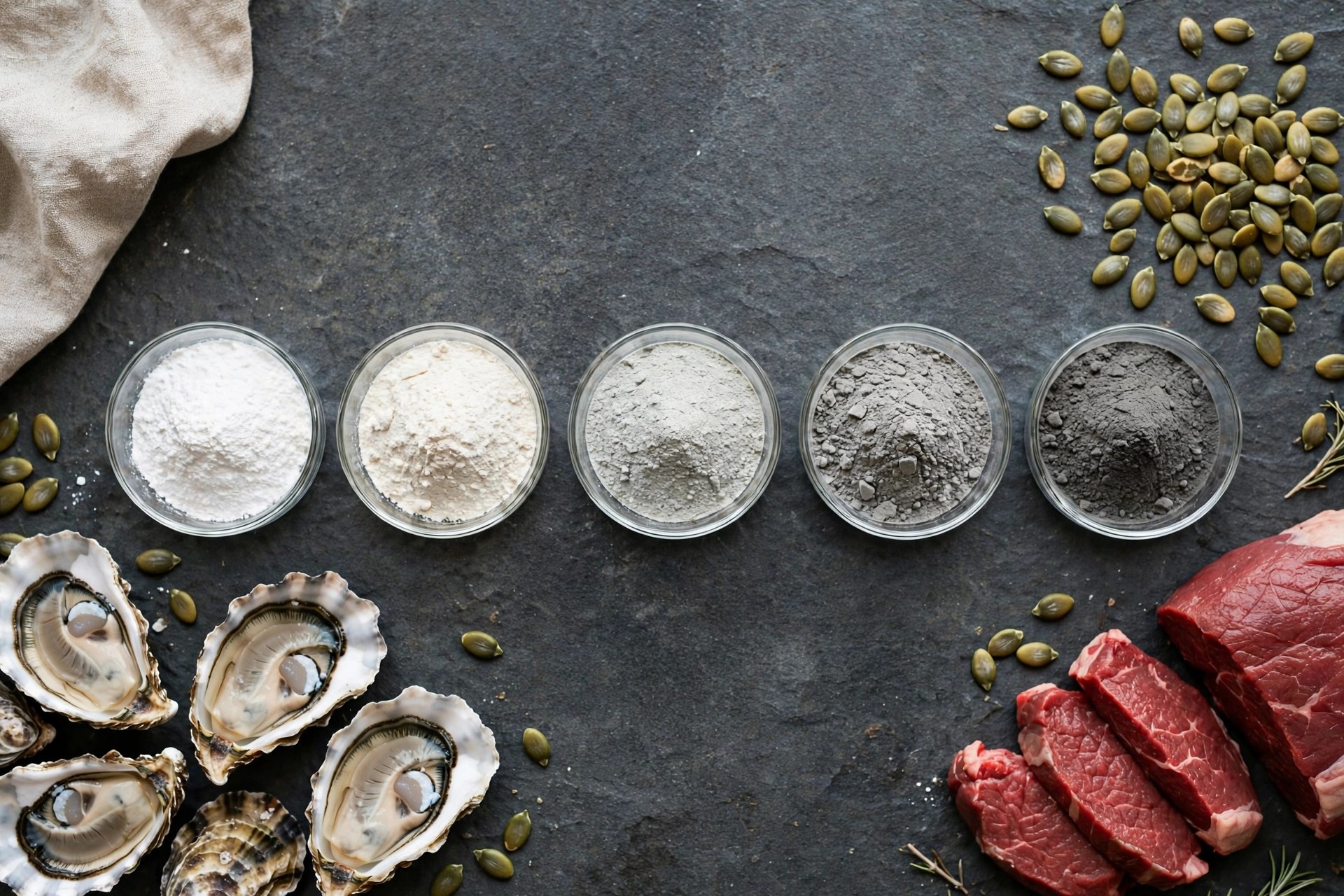
For everyone else, the case for a daily zinc supplement is weaker than the case for checking the diet first — oysters, beef, crab, dairy, beans and pumpkin seeds all contribute meaningfully.
Zinc Lozenges for Colds Are a Different Question
Daily supplementation and cold lozenges answer different questions with different evidence, and merging them is the commonest error in zinc writing. A lozenge works locally, dissolving slowly against the mouth and throat.
Hemilä (JRSM Open, 2017) meta-analysed seven placebo-controlled lozenge trials with 575 participants, restricted to doses above 75 mg/day. Colds were 33% shorter in the zinc groups overall.
Within that analysis, acetate lozenges shortened colds by 40% across three trials and gluconate by 28% across four — a difference between the salts that was not statistically significant (Hemilä, 2017).
The newer and larger synthesis is more cautious. Nault et al. (Cochrane Database of Systematic Reviews, 2024) pooled 34 trials with 8,526 participants and rated the evidence low to very low certainty.
Their conclusion: zinc may reduce the duration of a cold by about two days, appears to make little or no difference in preventing colds, and increases non-serious adverse events such as bad taste and nausea.
Note the dose context. Lozenge protocols delivering 75 mg/day or more run at roughly double the daily upper limit — defensible, if at all, only as a course of a few days at a cold's start, never as a habit.
So acetate's and gluconate's lozenge records say nothing about which form to swallow daily. The delivery route — slow dissolution in the mouth — is the intervention, not superior intestinal absorption.
One safety line belongs here too: intranasal zinc products are a separate category again, and the ODS fact sheet notes that excessive zinc from any source, including nasal and denture-cream products, can cause toxicity. This article covers oral forms only.
Interactions and Timing
Zinc competes in the gut, and several important medicines lose that competition. The NIH ODS fact sheet gives explicit spacing rules, which matter more than any choice between citrate and gluconate.
Quinolone and tetracycline antibiotics: zinc can inhibit absorption of both the antibiotic and the zinc itself. Take the antibiotic at least 2 hours before, or 4 to 6 hours after, a zinc supplement.
Penicillamine: zinc reduces this drug's absorption and action. The fact sheet advises taking zinc and penicillamine at least one hour apart — and anyone on penicillamine should coordinate supplementation with their prescriber.
Iron supplements: taking 25 mg or more of elemental iron at the same time as zinc can reduce zinc absorption and plasma zinc. Separating the two supplements by a few hours avoids the clash.
Thiazide diuretics run the interaction in reverse: they increase urinary zinc excretion and can lower serum zinc over time. Long-term users with low-zinc symptoms have a reason to raise zinc status with their clinician.
Food cuts both ways. Phytates in whole grains, beans and legumes bind zinc and inhibit absorption — one reason plant-based diets deliver less zinc per milligram eaten.
Yet taking zinc on an empty stomach is the commonest cause of nausea from it. The standard compromise is a small meal or snack: slightly lower absorption in exchange for a supplement you will actually keep taking.
None of these interactions depends on the form you chose. A perfectly absorbed picolinate taken with a tetracycline antibiotic still blocks — and is blocked by — the medicine.
So Which Form Should You Choose?
Start by ruling out the one clear loser: for a daily oral supplement, avoid products whose only zinc is oxide. Its absorption is lowest on average and unreliable in a minority of people.
Among the remaining four, choose on elemental dose, tolerability and price. Citrate and gluconate carry the strongest direct absorption evidence; picolinate and acetate are reasonable, with thinner or indirect evidence.
Check the elemental milligrams per serving against your diet. For most adults adding a supplement, a serving in the region of the RDA — roughly 8–15 mg elemental — leaves comfortable room under the 40 mg ceiling.
Treat any daily product above 25 mg elemental zinc as a deliberate, time-limited decision, not a default. Chronic intakes drifting toward the UL are how copper deficiency quietly happens.
If a form upsets your stomach, switching forms is a legitimate fix — tolerability differences between individuals are real even where average absorption is equal. Taking the dose with a small meal helps most people.
And keep the hierarchy in view: form is a third-order detail. Dose relative to the UL, spacing from interacting medicines, and whether you need supplemental zinc at all all matter more.
Frequently Asked Questions
Is zinc picolinate really the best-absorbed form?
It is unproven. One small 1987 crossover study (15 people, 50 mg/day) found picolinate raised hair, urine and red-cell zinc while citrate and gluconate did not (Barrie et al., 1987). No modern isotope study has confirmed it.
Why is zinc oxide in so many multivitamins if it absorbs poorly?
Cost and size. Oxide is about 80% elemental zinc, so a tiny, cheap amount satisfies the label's milligram claim — even though about half is absorbed on average, and some people absorb almost none.
What does "elemental zinc" mean on a label?
It is the weight of zinc itself, excluding the partner molecule. US labels already state elemental zinc in the Supplement Facts panel. Comparing products by elemental milligrams — not compound weight — is the only fair comparison.
Can I take zinc every day?
Daily use at RDA-level doses is the studied pattern for people who need it, provided total intake from food and all supplements stays under 40 mg/day. Chronic intake above that level risks copper deficiency.
Does zinc interfere with antibiotics?
Yes, with quinolone and tetracycline antibiotics: each reduces the other's absorption. The NIH guidance is to take the antibiotic at least 2 hours before or 4 to 6 hours after zinc (NIH ODS, Zinc Fact Sheet).
Should zinc be taken with or without food?
Absorption is somewhat higher away from phytate-rich meals, but nausea is common on an empty stomach. A small meal is the usual compromise. Consistency and staying under the upper limit matter more than the marginal absorption difference.
Are cold lozenges a good way to get daily zinc?
No. Lozenge protocols use 75 mg/day or more — around double the upper limit — for a few days during a cold. That dose pattern is a short treatment course in the trials, not a daily supplementation strategy.
What happens if you take too much zinc for too long?
The established harm is copper deficiency: sustained high zinc blocks copper absorption, which can lead to anaemia, reduced immune function and neurological symptoms. Early excess more often shows as nausea, cramps, headache and metallic taste.
Last reviewed: October 2026. This article is educational and is not medical advice.
