
- Quick Answer
- Tea vs Extract: Why the Difference Matters
- What Is in Green Tea Extract?
- Does It Raise Calorie Burning?
- Does That Turn Into Weight Loss?
- Why do other meta-analyses report about a kilogram?
- How much loss would "clinically important" be?
- What About Belly Fat and Waist Size?
- How much EGCG is actually in the products?
- Is Green Tea Extract Safe for the Liver?
- Why trial safety data look reassuring anyway
- Who Should Avoid Green Tea Extract?
- Green Tea in Fat-Burner Blends: The Stacking Problem
- Does timing or fasting change the picture?
- Why Do the Japanese Trials Look Different?
- What About Matcha and Catechin Drinks?
- The Exolise precedent
- Catechins, iron and folate: the quieter interactions
- The Bottom Line
- Frequently Asked Questions
- How many cups of green tea equal an extract capsule?
- Does decaffeinated green tea extract work for weight loss?
- What EGCG dose did EFSA flag?
- Can green tea extract damage your liver?
- Is green tea extract better than drinking green tea for weight loss?
- Read This Next
Quick Answer
Green tea extract does something real in a laboratory: in tightly controlled studies it raises calorie burning by a few percent for a day. That finding is genuine, and it is also where the good news ends.
When researchers pooled the actual weight-loss trials, the effect shrank to almost nothing. The Cochrane review found the loss small, statistically non-significant outside Japan, and "not likely to be clinically important".
Meanwhile, the concentrated extract — not the drink — carries a liver-safety signal strong enough that Europe's food safety authority set a caution line at 800 mg of EGCG a day.
So the science says two things at once: a measurable metabolic nudge too small to matter on the scale, and a dose-related risk that appears only when the tea is concentrated into pills.
Tea vs Extract: Why the Difference Matters
Almost every confusion about green tea comes from treating the drink and the extract as the same thing. They are not — in dose, in context, or in risk.
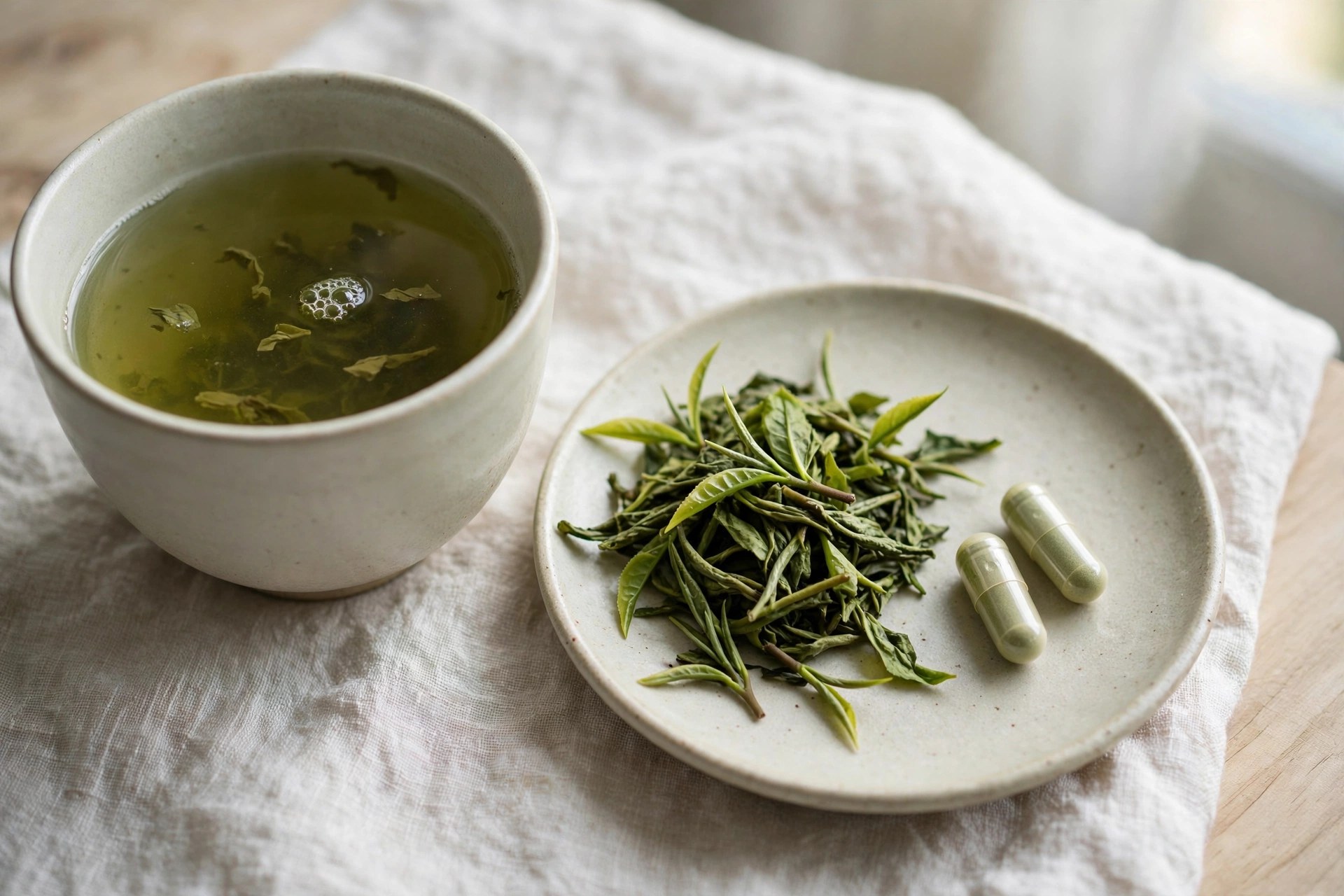
A cup of brewed green tea delivers modest amounts of catechins — roughly 50 to 100 mg of EGCG, the main one — along with about 25 to 35 mg of caffeine, in a litre-scale tradition of safe use.
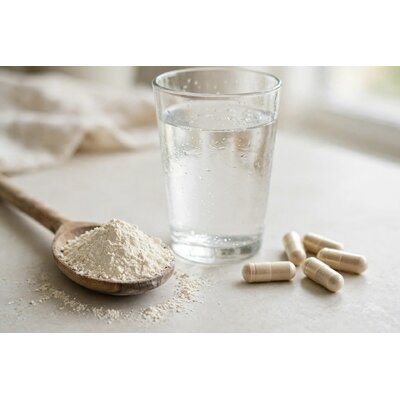
A weight-loss extract capsule concentrates the catechins of many cups into a single pill. Supplement regimens in trials and on shelves commonly reach 500 to 1,000 mg of EGCG a day, sometimes more.
That is an exposure the human liver never met through drinking tea. The benefit claims and the harm reports both attach to the concentrated form — which is why this article is about the extract.
Regulators draw the same line. Assessments that consider brewed green tea safe have repeatedly treated high-dose catechin supplements as a separate question.
What Is in Green Tea Extract?
Green tea comes from Camellia sinensis leaves that are steamed or pan-fired rather than oxidised, preserving a family of polyphenols called catechins.
The most abundant and most studied catechin is epigallocatechin gallate — EGCG. Labels may declare total catechins, total polyphenols, or EGCG specifically; the numbers are not interchangeable.
The second active component is caffeine. A strong extract can carry as much caffeine per dose as a cup of coffee, a fact multi-ingredient "fat burner" labels often bury inside blends.
Both components are biologically active, and the weight-loss hypothesis needs both — which becomes important when the trial data are separated by caffeine content below.
Does It Raise Calorie Burning?
The foundational study is Dulloo and colleagues (1999, American Journal of Clinical Nutrition), a metabolic-ward experiment in young men — the cleanest possible setting for measuring energy expenditure.
Given a green tea extract, participants' 24-hour energy expenditure rose by about 4% compared with placebo, and they burned proportionally more fat. A caffeine-only arm did not reproduce the effect.
Four percent sounds meaningful until it is converted. On a 2,000-calorie day, 4% is roughly 80 calories — and metabolic-ward effects measured over a single day often fade as the body adapts.
The proposed mechanism is synergy: catechins slow the breakdown of noradrenaline, caffeine prolongs its signal, and the sympathetic nervous system keeps fat-burning switched on slightly longer.
Later short-term studies broadly support a small thermogenic effect. What they cannot tell us is whether it persists for months or survives contact with real eating behaviour — the two things weight loss depends on.
Does That Turn Into Weight Loss?
The definitive summary is the Cochrane review by Jurgens and colleagues (2012), which pooled randomised trials of at least 12 weeks in overweight or obese adults — 15 weight-loss trials and 3 weight-maintenance trials, 1,945 participants.
In the six trials conducted outside Japan, the pooled difference was −0.04 kg — effectively zero, and not statistically significant (95% CI −0.5 to 0.4).
The Japanese trials reported larger losses, between −0.2 and −3.5 kg, but they were too different from each other to pool, and their designs and populations limit how far the results travel.
The Cochrane authors' conclusion deserves quoting in spirit: green tea preparations induce a small, statistically non-significant weight loss that is not likely to be clinically important — and they did not help people keep weight off afterwards.
Why do other meta-analyses report about a kilogram?
Two earlier pooled analyses — Hursel and colleagues (2009) and Phung and colleagues (2010) — reported average losses around 1.3 kg favouring green tea catechins with caffeine.
Those pools included shorter and smaller trials, and short trials flatter almost every weight-loss intervention. As duration and rigour increase across analyses, the estimate converges on the Cochrane verdict.
Phung's analysis adds the most useful detail: catechins without caffeine showed no significant benefit. Strip the caffeine out, and the effect largely goes with it.
That finding quietly reframes the product category. Much of what is sold as green tea's fat-burning power is caffeine's familiar thermogenesis wearing a botanical label — plus a catechin contribution that is small and hard to isolate.
How much loss would "clinically important" be?
In obesity medicine, a loss of about 5% of body weight is the usual threshold for measurable health improvements — roughly 4 to 5 kg for a 90 kg adult, sustained.
Against that yardstick, even the most generous pooled estimate for green tea (~1.3 kg, short-term) covers about a quarter of the distance, and the most rigorous estimate covers none of it.
This is the recurring arithmetic of supplement research: a statistically detectable nudge is not the same object as a clinically useful result, and confusing the two is how modest ingredients acquire dramatic reputations.
What About Belly Fat and Waist Size?
Green tea marketing leans heavily on body composition — visceral fat, waist circumference, "stubborn belly fat" — because scale weight alone is such a weak story for this ingredient.
The Cochrane review measured these too. For BMI, the pooled difference outside Japan was −0.2 kg/m² and not statistically significant; waist outcomes were similarly small and inconsistent across trials.
Some Japanese trials and catechin-enriched beverage studies report greater visceral-fat reductions, and catechins plus caffeine plausibly tilt fat oxidation during exercise. These are the most favourable findings in the file — and they remain small, short and hard to replicate outside their settings.
There is also a measurement honesty point. A 1–2 cm waist change over 12 weeks, in a trial where everyone is dieting, is within the range of measurement variation and posture. It is not the visible transformation the advertising photographs promise.
If visceral fat is the genuine goal, the interventions with large, durable visceral effects are sustained weight loss itself — diet, activity, and where indicated medical treatment. Green tea's contribution, at best, rides on top of those at the margins.
How much EGCG is actually in the products?
Trial and toxicology numbers only mean something when converted into shelf reality, so here is the conversion. EFSA's caution threshold is 800 mg of EGCG a day from supplements.
Individual extract capsules commonly provide 200–500 mg of EGCG each. A label directing two capsules twice a day — a common pattern in fat burners — can therefore deliver 800–2,000 mg daily, at or above the flagged range, before anything else is counted.
Labels do not always make that arithmetic easy: some declare "green tea extract 1,000 mg" without stating EGCG content, and proprietary blends hide it entirely.
A consumer cannot manage a dose-related risk they cannot see. That information gap — not any single product — is much of what EFSA's opinion was really about.
For calibration at the other end of the scale: drinking green tea all day, every day, in traditional amounts keeps EGCG exposure in the low hundreds of milligrams, accompanied by fluid, taken with food, and carrying no liver signal in the data.
Is Green Tea Extract Safe for the Liver?
Here the evidence changes register — from "too small to matter" to "small but serious". Concentrated green tea extracts have a case-report literature of liver injury stretching back two decades, including cases requiring hospitalisation.
In 2018, the European Food Safety Authority published a dedicated safety opinion on green tea catechins. Its central finding concerned dose.
EFSA concluded that catechins from brewed green tea are generally safe, but that supplemental EGCG at doses of 800 mg a day or more was associated with statistically significant increases in serum transaminases — the blood markers of liver stress.
The panel could not identify a supplemental dose it could confidently call safe. That is an unusual position for a mainstream food-derived ingredient, and it reflects injury reports that include occasional severe outcomes.
The injury pattern resembles other supplement hepatotoxicity: idiosyncratic, arising weeks to months into use, and typically resolving after the product is stopped — if it is recognised in time.
Why trial safety data look reassuring anyway
Weight-loss trials of a few hundred people, running 12 weeks, are not built to detect an injury that may strike a small minority of users. Absence of cases in trials is weak evidence of absence.
Reported cases also cluster in multi-ingredient fat burners, where green tea extract shares the label with other botanicals. That complicates blame for individual products — but the extract-only case reports exist, and EFSA's dose analysis was based on EGCG itself.
Practical reading of the record: the drink is not the concern; high-dose extracts, fasting use (which raises catechin absorption), and stacking multiple catechin products are.
Who Should Avoid Green Tea Extract?
Anyone with liver disease, or who drinks alcohol heavily, has the least margin for an additional hepatic stressor and should not use concentrated catechin supplements without medical advice.
People sensitive to caffeine should read total daily caffeine across all products — extract capsules plus coffee plus pre-workout can stack into sleep-destroying, anxiety-raising territory quietly.
Green tea catechins can reduce the absorption of some medicines — the beta-blocker nadolol is the documented example — and their vitamin K content is a standard caution for people on warfarin. Spacing and a prescriber conversation are the safe pattern.
Pregnancy and breastfeeding bring two cautions: caffeine limits, and catechin interference with folate metabolism at high doses. High-dose extracts are a poor fit for that window.
And the universal rule applies: jaundice, dark urine, pale stools or unusual fatigue while taking any supplement means stop and seek care, not push through.
Green Tea in Fat-Burner Blends: The Stacking Problem
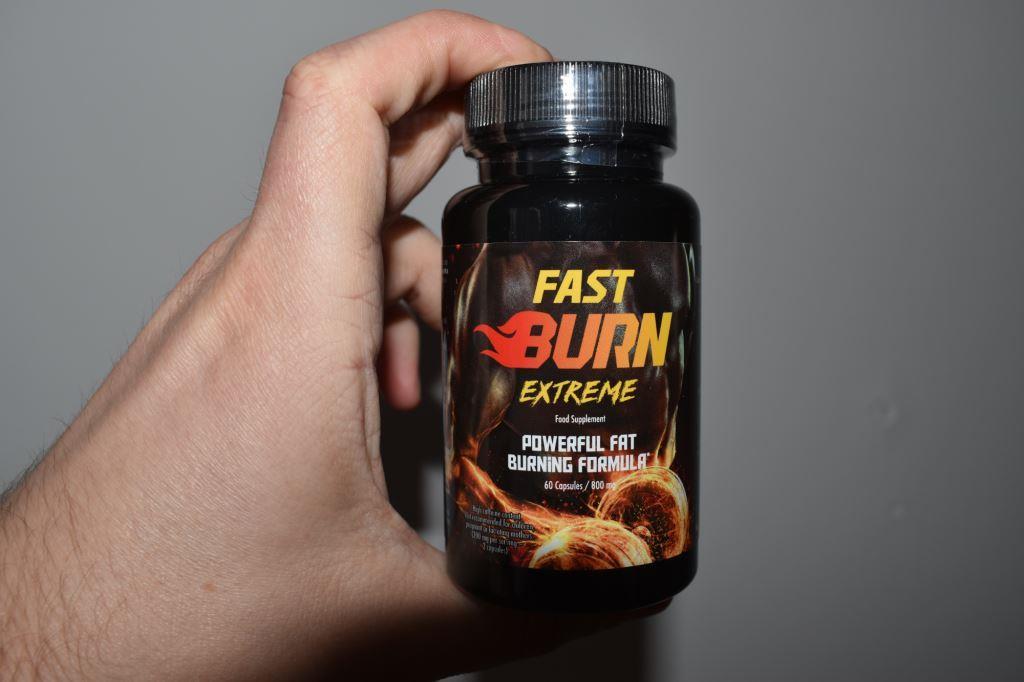
Standalone green tea extract is not how most people meet this ingredient. It is a fixture of multi-ingredient fat burners, stacked with caffeine, garcinia, bitter orange and other botanicals in undisclosed proportions.
Stacking scrambles both questions a consumer might ask. Efficacy cannot be attributed to any one ingredient, and the caffeine total — green tea's plus added caffeine plus other stimulants — can exceed what any single label suggests.
The liver question scrambles too. In the US DILIN liver-injury series for garcinia, a share of cases involved products combining garcinia with green tea — two of this category's most common ingredients in the same capsule.
When several suspects share a label, no one — not the patient, not the doctor, not the regulator — can cleanly assign the injury. Blend opacity protects manufacturers, not users.
This is a structural argument for single-ingredient products with declared doses if someone chooses to experiment at all: they are the only form in which the trial and safety data mean anything.
Does timing or fasting change the picture?
One practical variable does change exposure: taking catechin extracts on an empty stomach substantially raises blood catechin levels compared with taking them with food.
That pharmacokinetic fact cuts both ways in marketing — "take on an empty stomach for maximum effect" also means maximum hepatic exposure, in the dose range EFSA examined.
Several of the documented liver-injury patterns involve high-dose extracts used while dieting hard — which in practice often means fasted dosing, aggressive deficits and multiple stacked products at once.
The tea-drinking cultures that made this ingredient famous consume it in the opposite pattern: dilute, with or after food, in modest catechin amounts. The distance between the two patterns is the distance between the safety records.
Why Do the Japanese Trials Look Different?
The Cochrane split — null outside Japan, positive inside it — is the most interesting puzzle in the green tea file, and it has several non-mystical candidate explanations.
Dose form is the first. Many Japanese trials used catechin-enriched beverages consumed daily in defined amounts, delivering high catechin doses in a food matrix — a different exposure from Western capsule trials.
Background diet and genetics are the second. Populations differ in habitual caffeine intake, in catechin metabolism, and in the dietary context the intervention lands on. Effects measured against one background do not automatically transfer to another.
Trial quality is the third, and Cochrane's reviewers noted the Japanese studies were too heterogeneous to pool — a statistical way of saying they did not agree with each other closely enough to summarise.
When studies cannot be pooled, the honest summary is a range (−0.2 to −3.5 kg), not an average. Marketing invariably quotes the favourable end of that range as if it were the centre.
There is a general lesson here that extends far beyond tea: a literature split by region, with the positive half unpoolable, is a literature asking for one large, rigorous, multinational trial. For green tea and weight, that trial has never been run.
What About Matcha and Catechin Drinks?
Matcha — powdered whole tea leaf whisked into water — delivers more catechins per cup than steeped tea, because the leaf itself is consumed. A strong serving might provide two to three times a normal cup's EGCG.
That still leaves matcha in beverage territory: tens to a couple of hundred milligrams of EGCG, with food-like kinetics, inside the exposure range regulators consider unremarkable.
Catechin-fortified soft drinks, sold in Japan with health claims, are closer cousins to the trials — defined catechin doses in bottles. Their study results mirror the literature: small effects on body fat measures in short trials, contested durability.
Neither format rescues the weight claim, because the weight claim's problem was never only dose. It is that the pooled effect, at every dose tested, lands between negligible and about a kilogram.
If you enjoy matcha or green tea, the evidence fully supports enjoying it — for pleasure, for the ritual, for replacing a sugared drink. Those are real benefits. They are simply not pharmacology, and they do not need to borrow pharmacology's language.
The Exolise precedent
The liver concern is not theoretical or new. In 2003, a concentrated green tea extract sold for weight loss in Europe (brand name Exolise) was suspended in France and Spain after reports of liver injury in users.
That withdrawal predates the modern fat-burner era and involved a defined, single-ingredient extract — which removed the usual "it was the blend" ambiguity two decades before EFSA's dose analysis.
Regulators have therefore met this signal three times in three forms: a product withdrawal (2003), a formal dose-based safety opinion (EFSA 2018), and continuing case reports since. The ingredient's defenders are not short of official warnings to answer.
It is equally worth recording what has never happened: no regulator has raised a liver concern about green tea as a beverage. The line between the drink and the extract is not this article's invention — it is the consistent position of every authority that has examined the question.
Catechins, iron and folate: the quieter interactions
Two nutritional interactions round out the extract's profile, and both matter most to people who would never think of themselves as supplement risk-takers.
Tea catechins bind non-haem iron — the iron in plant foods and supplements — and measurably reduce its absorption when consumed together. For someone managing iron deficiency, high-dose extracts taken with meals or iron tablets are working against the treatment.
At high doses, catechins can also interfere with folate metabolism in experimental systems, which is one reason pregnancy guidance is conservative about concentrated extracts even where ordinary tea is accepted.
Neither effect is a reason for alarm at beverage intakes. Both illustrate the same principle as the liver data: concentration converts a food's trivial chemistry into pharmacology, and pharmacology always has more than one effect.
The Bottom Line
The science on green tea extract is unusually complete, and it says: a real ~4% short-term rise in calorie burning that dissolves, at trial scale, into a weight effect between zero and about a kilogram.
Cochrane's verdict — small, non-significant, not clinically important, no help keeping weight off — remains the fairest one-sentence summary of two decades of research.
The extract's risk profile is the mirror image of its benefit profile: the drink is benign, but concentrated EGCG at 800 mg a day or more carries a regulator-flagged liver signal. Small benefit, concentrated risk, honest arithmetic.
Frequently Asked Questions
How many cups of green tea equal an extract capsule?
Very roughly, a cup of brewed tea provides 50–100 mg of EGCG, while extract regimens commonly deliver 500–1,000 mg a day — the catechin content of perhaps five to fifteen cups, taken at once, often on an empty stomach.
Does decaffeinated green tea extract work for weight loss?
The evidence says the caffeine matters. In Phung and colleagues' 2010 meta-analysis, catechin preparations without caffeine showed no significant weight benefit. A decaffeinated extract removes much of the already-small effect.
What EGCG dose did EFSA flag?
800 mg a day or more from supplements, which was associated with statistically significant increases in liver transaminases. EFSA considered brewed green tea generally safe and could not set a confidently safe supplemental dose.
Can green tea extract damage your liver?
Rarely, yes — case reports and case series link concentrated extracts to liver injury, occasionally severe. The risk is associated with high doses and appears idiosyncratic. Brewed tea does not carry the same record.
Is green tea extract better than drinking green tea for weight loss?
Neither produces clinically important weight loss in trials. The extract concentrates both the (small) active effect and the risk; the drink delivers tiny amounts with a long safety history. The trial advantage of the extract is not meaningful.
Last reviewed: October 2026. This article is educational and is not medical advice.
