
- Quick Answer
- Does Cayenne Pepper (Capsaicin) Help Weight Loss?
- Does Cinnamon Help Blood Sugar or Weight Loss?
- Does Ginger Help Weight Loss, and How Much Ginger Was Studied?
- Kitchen Dose vs Capsule Dose
- The Arithmetic of Putting All Three in One Capsule
- The Three on One Label
- Frequently Asked Questions
- Does cayenne burn belly fat?
- Which cinnamon is better for daily use?
- Does ginger tea count as a trial dose?
- Can I just eat these spices instead of taking a capsule?
- Who Should Buy Piperinox — and Who Should Skip It
- Read This Next
Disclosure: This article contains affiliate links. If you buy through them, we may earn a commission at no extra cost to you. It never changes our conclusions.
Quick Answer
All three spices have real but small human data. Capsaicin's pooled effect is about half a kilogram across 15 trials; cinnamon's pooled weight effect is around a kilogram at gram-level doses, below what most people would call meaningful; ginger's rests on a pilot-scale thermic effect measured in ten men.
Kitchen doses and capsule doses are different exposures — and Piperinox discloses none of the three amounts. Best for: readers who want spice-rack claims sized honestly. Piperinox scores 4.4/10 in our review.
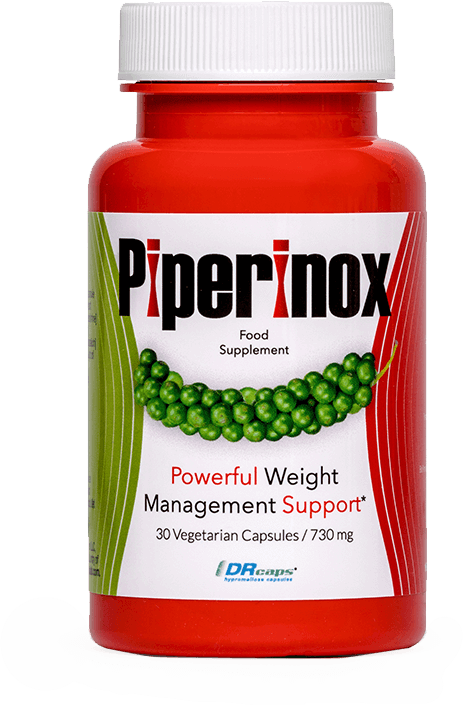
Our Recommendation — Piperinox
Score: 4.4/10 · Best for: adults who want a simple one-capsule-a-day thermogenic and are untroubled by undisclosed doses. Main caution: the panel lists ingredient names only — a delayed-release capsule of an unknown dose is still an unknown dose — and no money-back guarantee is published. Fair trial: the three-bottle pack at $33.33 a bottle — the honest trial length, per our full audit below.
Does Cayenne Pepper (Capsaicin) Help Weight Loss?
Capsaicin, the compound that makes chillies hot, has the deepest file of the trio. The 2023 British Journal of Nutrition meta-analysis pooled 15 randomised trials with 762 overweight or obese adults.
Across those trials, the capsaicin groups lost 0.51 kg more body weight than the control groups, with BMI lower by 0.25 kg/m² and waist circumference lower by 1.12 cm versus controls. The reviewers called the effects "rather modest" — a fair self-assessment that marketing for cayenne products rarely repeats.
The studied doses give the kitchen comparison its anchor. Appetite and expenditure studies typically used around 2.5 mg of capsaicin per meal — roughly what a gram of ground red pepper delivers, or a genuinely spicy dish. The trials, in other words, dosed at culinary levels, which is unusual honesty in this category.
Two qualifiers apply. First, adaptation: regular capsaicin consumers show blunted responses after roughly two weeks of daily exposure, so the trial effect is front-loaded. Second, tolerability: gastrointestinal irritation is the main reported side effect, and it is dose-related — the burn that signals the mechanism is also its ceiling.
Energy-expenditure reviews put capsaicinoids' acute contribution in the few-dozen-kilocalories-a-day region, mostly in people with higher BMI. Half a kilogram across a trial programme plus a small daily expenditure nudge is the complete, honest cayenne dossier: real, small, and available from food.
Does Cinnamon Help Blood Sugar or Weight Loss?
Cinnamon's serious research file is about blood sugar, not weight — modest glucose and HbA1c effects in diabetic populations, contested between meta-analyses. The weight question has its own pooled answer in Mousavi et al. 2020, a dose-response meta-analysis of 12 randomised trials enrolling 786 adults.
Across those trials, cinnamon groups lost 1.02 kg more body weight than control groups, with waist circumference lower by 2.40 cm and fat mass lower by 1.02% versus controls. Those are statistically significant pooled effects — and still small in absolute terms, achieved at supplement doses far above seasoning levels.
The dose-response detail matters more than the headline. Fat-mass effects in Mousavi's analysis appeared at doses of at least 2 g of cinnamon per day sustained for at least 12 weeks, with larger weight effects in participants under 50 and in those starting at a BMI of 30 or above.
Two grams a day is a deliberate supplement regimen, not a sprinkle.
Then there is the species problem, which labels almost never disclose. Common cassia cinnamon carries meaningful coumarin; Ceylon cinnamon carries almost none. The European Food Safety Authority's tolerable daily intake for coumarin is 0.1 mg per kilogram of body weight — a level a daily multi-gram cassia habit can approach, with the liver as the organ of concern.
Piperinox prints "cinnamon bark extract" with neither the species nor the amount. A buyer cannot tell whether they are getting a sub-gram dusting of Ceylon or a gram-level cassia exposure — the two scenarios the evidence and the safety file treat completely differently.
Does Ginger Help Weight Loss, and How Much Ginger Was Studied?
Ginger's weight file is the thinnest of the three. Its anchor is Mansour et al. 2012, a pilot crossover study in ten overweight men given a single 2 g dose of ginger powder in hot water with a meal.
In those ten men, ginger increased the thermic effect of food by 42.7 kcal/day compared with the control condition, and hunger ratings fell. Just as important is what did not move: total resting energy expenditure showed no significant effect, and no metabolic or hormonal parameter changed.
A pilot of ten, by its authors' own framing, is a reason to run a bigger study — not a result to build a product on.
The wider ginger literature is consistent with that scale. Studies generally use 1–2 g/day; meta-analytic weight effects are small; and the practical ceiling is gastrointestinal — heartburn and stomach discomfort climb above roughly 4 g/day in the trial record.
None of this makes ginger useless. As a food it is flavourful, cheap and safe at culinary doses, with genuine if modest metabolic interest. As a capsule ingredient of undisclosed amount, it contributes a name. The distance between those two sentences is the distance this whole set of articles exists to measure.
Kitchen Dose vs Capsule Dose
Step back and the three files share one structure. For each spice, the evidence was generated at a stated, food-comparable dose: capsaicin at about a gram of red pepper per meal, cinnamon at two or more grams a day, ginger at one to two grams.
A spiced meal can match or exceed the studied capsaicin dose; a deliberate cinnamon regimen can match its trial dose. The food route is verifiable by construction — you can weigh a gram of pepper. The capsule route is verifiable only if the maker prints amounts.
This is why "contains cayenne, cinnamon and ginger" is not a summary of this evidence. The trials did not study the presence of these spices. They studied quantities of them. Presence is a label property; quantity is the pharmacological one, and only one of the two appears on a Piperinox bottle.
The Arithmetic of Putting All Three in One Capsule
Piperinox combines all three spices in a single 730 mg capsule, shared with four other ingredients and the capsule's excipients. Set the trial doses beside that constraint and the product's problem stops being rhetorical and becomes arithmetic.
Cinnamon's fat-mass effect in Mousavi's dose-response analysis required at least 2,000 mg of cinnamon a day. That is nearly three entire Piperinox capsules' worth of weight — for the cinnamon alone, before the other six ingredients are counted. The product cannot contain its cinnamon at the studied dose. This is not an inference; it is subtraction.
Ginger's pilot dose was 2,000 mg in a single serving — the same impossibility. Capsaicin is the exception that proves the rule: at roughly 2.5 mg per meal, it is potent enough per milligram that a plausible capsule amount could theoretically reach it. Theoretically — because the amount is undisclosed, the buyer cannot know whether it does.
This is the quiet function of combination formulas. Each ingredient borrows the credibility of trials conducted at doses the combination cannot physically hold. Individually the claims sound modest and evidence-linked. Assembled into one small capsule, they are arithmetically barred from all being true at once.
A disclosed panel would end the argument in one line of print. Its absence is what allows three trial stories to be told about amounts that cannot coexist. When we say Piperinox's dose audit is impossible, this section is the proof of concept: even before causation, the capsule fails capacity.
The Three on One Label
Piperinox lists all three of these spices — cayenne pepper fruit extract, cinnamon bark extract, ginger rhizome extract — with no amount for any of them, as our Piperinox review records. The 730 mg printed on the bottle is the whole capsule's weight, shared with four further ingredients and excipients.
Even the small, honestly-sized effects in this article therefore cannot be assumed for this product. If the cayenne extract were present at trial-equivalent capsaicin levels, the capsule would be noticeably fiery by supplement standards; nothing on the label lets a buyer check. The trio's presence is a roster, not a dose.
Our scoring treats the three spices accordingly: recognisable, plausibly useful ingredients, credited for their category — and discounted to near zero for this product, because a dose audit with no numbers is not an audit. Piperinox's 4.4/10 is what a familiar roster earns when every quantity is withheld.
Our Recommendation — Piperinox
Score: 4.4/10 · Best for: adults who want a simple one-capsule-a-day thermogenic and are untroubled by undisclosed doses. Main caution: the panel lists ingredient names only — a delayed-release capsule of an unknown dose is still an unknown dose — and no money-back guarantee is published. Fair trial: the three-bottle pack at $33.33 a bottle — the honest trial length, per our full audit below.
Frequently Asked Questions
Does cayenne burn belly fat?
No. The pooled effect is about half a kilogram of total body weight across 15 trials in overweight and obese adults — systemic, small, and spread wherever that person's fat distribution puts it. Nothing about capsaicin directs loss to the abdomen; the 1.12 cm waist reduction in the same analysis simply tracks the total loss.
Which cinnamon is better for daily use?
For daily gram-level use, Ceylon — its coumarin content is a small fraction of cassia's, and coumarin is the liver-relevant compound at sustained doses. Cassia at culinary sprinkling levels is a non-issue for most people. The problem case is the undisclosed supplement: species and amount both unknown, taken daily for months.
Does ginger tea count as a trial dose?
It is a food-level exposure, which is fine — but it is not the studied intervention. Mansour's pilot used 2 g of ginger powder, roughly a heaped teaspoon, in a single controlled dose. A weak infusion delivers a fraction of that. Enjoy the tea; do not invoice it as a thermogenic.
Can I just eat these spices instead of taking a capsule?
For capsaicin and ginger, yes — food doses can match the studied exposures, and the dose is whatever you weighed into the pan. For cinnamon, the studied regimen is a supplement-style daily commitment of grams, where species and coumarin start to matter. Either way, the food route's decisive advantage over an undisclosed capsule is that you know what you took.
Who Should Buy Piperinox — and Who Should Skip It
Buy it if you want a once-a-day thermogenic built on familiar ingredients and you are untroubled that the three spices audited here — like everything else on its label — come with no amounts, so none of their trial effects can be claimed for it.
Skip it if the spice evidence is what attracts you: the same effects, at known doses, are available from food and from disclosed-dose products for less money. Skip it also on the standard stimulant cautions — its synephrine and guarana are as undisclosed as its spices.
Last reviewed: October 2026. This article is educational and is not medical advice.
