
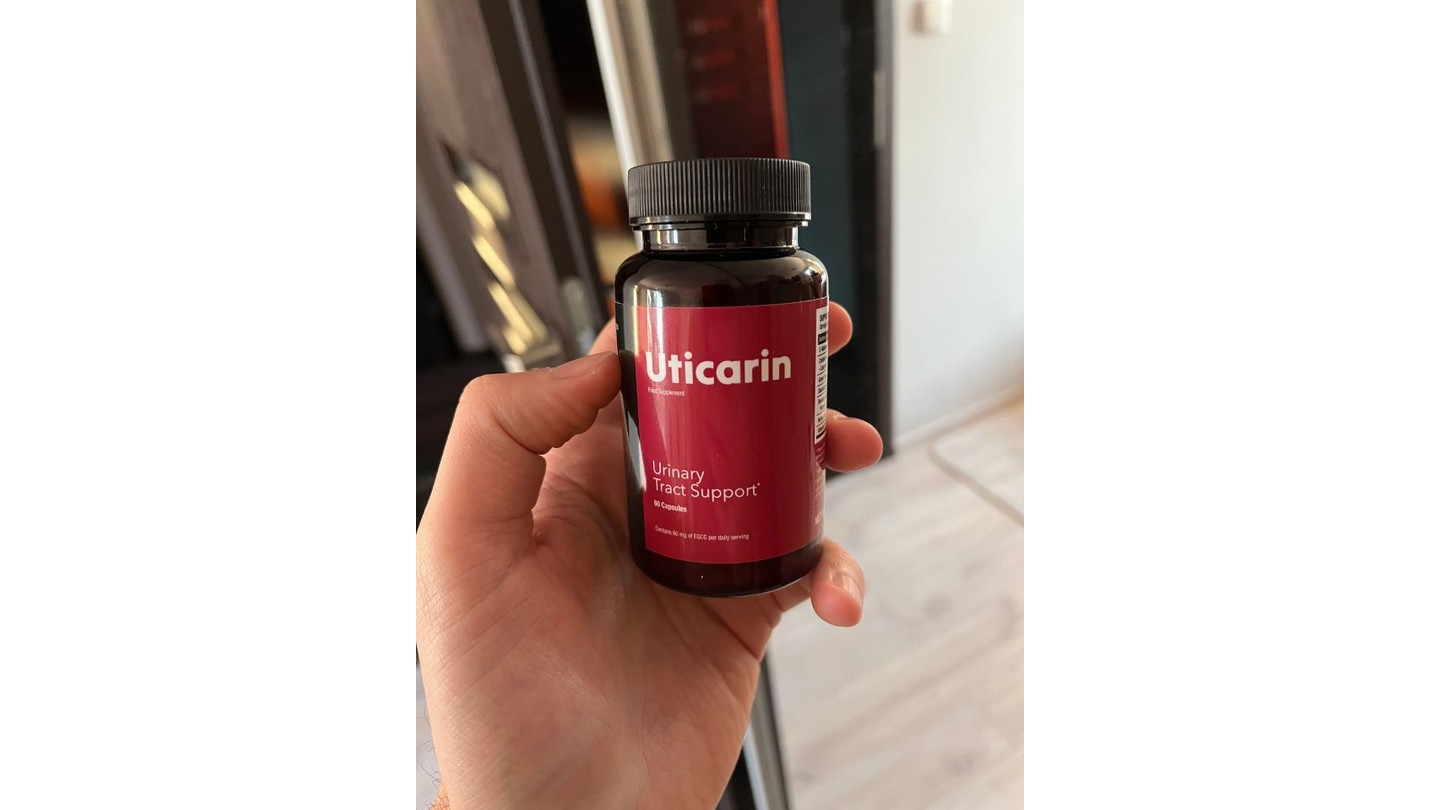
- Quick Answer
- Our Findings
- Why You Should Trust This Review
- Our Verdict
- How We Scored It
- What Is Uticarin?
- The Ingredients
- D-Mannose (400 mg)
- Cranberry Fruit Extract — Exocyan™ Cran 10G (360 mg)
- Green Tea Leaf Extract (200 mg)
- Dandelion Root Extract (100 mg)
- Rosehip Fruit Extract (50 mg)
- Nettle Leaf Extract (50 mg)
- Vitamin D — Vita-algae D® (10 µg)
- The Dose Audit: One Ingredient at Its Studied Level, One at a Fifth of a Failed Dose
- The headline ingredient, read against its own best trial
- Where the positive D-mannose story comes from
- The cranberry sum
- The safety arithmetic
- The Evidence, Read Properly
- Hayward et al. 2024 — the decisive D-mannose trial
- Williams et al. 2023 — the Cochrane cranberry review
- Cooper et al. 2022 — the Cochrane D-mannose review
- Kranjčec et al. 2014 — where the positive D-mannose story comes from
- No clinical trial of the finished Uticarin formula
- How Long Does It Take to Work?
- Is It Safe?
- Side Effects: What Is Actually Known
- When a UTI Needs a Doctor, Not a Supplement
- Is It a Scam?
- Price and Packs
- Purchase Options
- How It Compares
- Who Should Buy It — and Who Should Skip It
- Who should buy it
- Who should skip it
- Frequently Asked Questions
- Does Uticarin actually work?
- Can Uticarin treat a UTI I have right now?
- How much D-mannose is in Uticarin — and how does it compare with the dose in the studies?
- How long does Uticarin take to work?
- Is Uticarin safe — and who should not take it?
- Does Uticarin have a money-back guarantee?
- Uticarin or Confitrol24 — which one do I need?
- Where can I buy Uticarin — and what does a month actually cost?
- Sources & Method
- Read This Next
SuppChecked is an independent supplement review site. When you buy a product through links on our pages, we may earn a commission at no extra cost to you. Every score, price, and product claim on this page is checked against the maker's official records and the published scientific literature, and brands never pay to change our scores.
Shoppers looking at urinary tract supplements usually fall into two camps. One group is women whose urinary tract infections keep returning and who want to avoid another course of antibiotics. The other group has already learned that urinary capsules often pair a familiar ingredient name with a dose too small to matter.
This review puts Uticarin through a direct audit. We read the maker's published panel line by line, checked every amount against the doses and human trials behind them, and priced a realistic trial straight from the maker's own order page.
Quick Answer
Uticarin scores 6.8/10 as a daily prevention option for recurrent urinary tract infections. It is not a treatment for an infection you have now. The panel is published in full, and the cranberry extract delivers 36 mg of proanthocyanidins (PACs) a day — the level covered by the positive Cochrane review evidence.
The headline D-mannose pulls the score down. Its 400 mg daily dose is one fifth of the 2 g amount that its largest, best-designed trial found no better than placebo. No money-back guarantee is published, even though prevention can only be judged over months.
A single bottle costs $47.99 plus $12 shipping. Best for: women with recurrent UTIs who want a transparent, cranberry-led prevention capsule and are ready to test it over three months without a refund guarantee.
Uticarin — Our Score: 6.8/10
Score: 6.8/10 · Sub-scores: Ingredients 8.0 · Evidence 6.5 · Safety 7.5 · Value 6.5 · Best for: Women with recurrent UTIs who want a non-antibiotic prevention option with every amount published, judged over months · Main caution: The D-mannose is 400 mg a day — a fifth of the 2 g dose that showed no benefit over placebo in its largest trial; Uticarin is for prevention, not for treating an infection you have now; no money-back guarantee is published · Fair trial: Three months — the three-bottle pack at $107.98 delivered
Our Findings
What we like
- Full label disclosure: Every ingredient amount and extract standardisation is printed on the box, including the "of which" Vitamin C line inside the rosehip extract and the exact algae-derived Vitamin D dose.
- Studied cranberry PAC dose: At 360 mg standardised to 10% proanthocyanidins, the cranberry fraction supplies 36 mg of PACs a day — right at the level covered by positive Cochrane review evidence.
- Complete safety labelling: The maker prints its own EGCG warning (80 mg per serving; stay below 800 mg a day from all sources) and clearly excludes children and pregnant or breastfeeding women.
- Lowest entry price in its group: A single bottle starts at $47.99 before shipping, making the upfront ticket lower than comparable products in this category.
What gives us pause
- Under-dosed headline ingredient: D-mannose sits at 400 mg a day, which is one fifth of the 2 g dose that failed to beat placebo in its largest, double-blind human trial.
- No money-back guarantee: Urinary prevention takes months to judge, yet the official website publishes no refund policy beyond standard withdrawal on unused goods.
- Unnamed seller: No company name is listed anywhere on the official website, even though the packaging states the capsules are made in the European Union.
- Borrowed headline statistics: The maker's 77% and 39% claims come from footnoted ingredient research, not from any clinical study of the finished Uticarin capsule.
- Four unproven formula lines: Dandelion, rosehip, nettle, and the added vitamins carry no UTI prevention trial record at any dose.
Why You Should Trust This Review
To write this review, we read Uticarin's official sales and order pages in full, audited the physical box panel line by line, and checked the published human trials behind both headline ingredients (Hayward et al. 2024, PMID 38587819; Williams et al. 2023, PMID 37947276). Every product on SuppChecked is graded with the same fixed scoring system, and we print the findings that complicate the sales claims alongside the strengths. Brands never pay to place a product, soften a caution, or move a score.
Our Verdict
Uticarin scores 6.8/10 because it is a split formula. Its second line, cranberry, hits the studied PAC level. Its headline line, D-mannose, delivers one fifth of a dose that already failed to beat placebo in its largest trial. Pairing that dose gap with no money-back guarantee behind a months-long trial is the main drag on the score.
Maker Credibility scores 5.0 in our scoring system, and the reason is a clear split in brand behaviour. The official website names no selling company and builds its headline claims on borrowed ingredient figures. At the same time, the physical label and safety warnings are far more honest and complete than most urinary supplements we audit.
The bottom line is simple. Uticarin makes sense only if you want a transparent capsule anchored by 36 mg of daily cranberry PACs and are comfortable testing it without a refund policy. It is the wrong pick if you are buying for D-mannose or treating an active infection.
Fair-trial maths matters here. Prevention cannot be judged in a single month, so a proper test takes three months. That puts the realistic entry cost at the three-bottle order: $95.98 plus $12 shipping, or $107.98 delivered ($1.20 a day), taken at your own risk.
How We Scored It
Every product we review is scored across the same core areas using published label data, human clinical records, and live order-page pricing. Here is how Uticarin breaks down across its four published sub-scores.
| Criterion | Score |
|---|---|
| Ingredients | 8.0 |
| Evidence | 6.5 |
| Safety | 7.5 |
| Value | 6.5 |
Ingredients (8.0): Every ingredient amount and extract standardisation is published in full, including the Vitamin C yield inside the rosehip line. The cranberry extract lands squarely at the studied PAC dose. The score stops at 8.0 because the headline D-mannose dose sits well below clinical trial levels.
Evidence (6.5): Cranberry is supported at this PAC level by a major Cochrane review showing fewer recurrent UTIs in women. D-mannose pulls the other way: its largest, best-designed trial found no benefit over placebo at five times Uticarin's dose, and no clinical trial tests the finished capsule.
Safety (7.5): Uticarin carries the most complete safety labelling in its product group, printing both its user exclusions and a clear EGCG daily limit warning. The score reflects D-mannose's mild digestive side effects and the reminder that people with diabetes must count it as a sugar.
Value (6.5): At $47.99 for a single bottle, Uticarin offers the lowest entry price in this group, and the multi-bottle tiers lower daily cost cleanly. What holds value back is the complete absence of a money-back guarantee behind a three-month prevention trial.
What Is Uticarin?
Uticarin at a Glance
- Our score: 6.8/10
- Brand: Uticarin
- Company: Not named on the maker's website (product made in the European Union)
- Product type: Urinary tract support capsules — 60 per bottle
- Primary purpose: Marketed to reduce how often urinary tract infections come back
- Formula: 7 lines, every amount published, per 2-capsule daily serving
- Clinical research: No trial of the finished formula; the cranberry fraction sits at the level covered by the positive review evidence, while the D-mannose is a fifth of the dose its largest trial tested
- Research limitation: That largest D-mannose trial (598 women) found no benefit over placebo even at the full 2 g dose
- Recommended use: 2 capsules daily with 300 ml of water, not on an empty stomach
- Money-back guarantee: None published
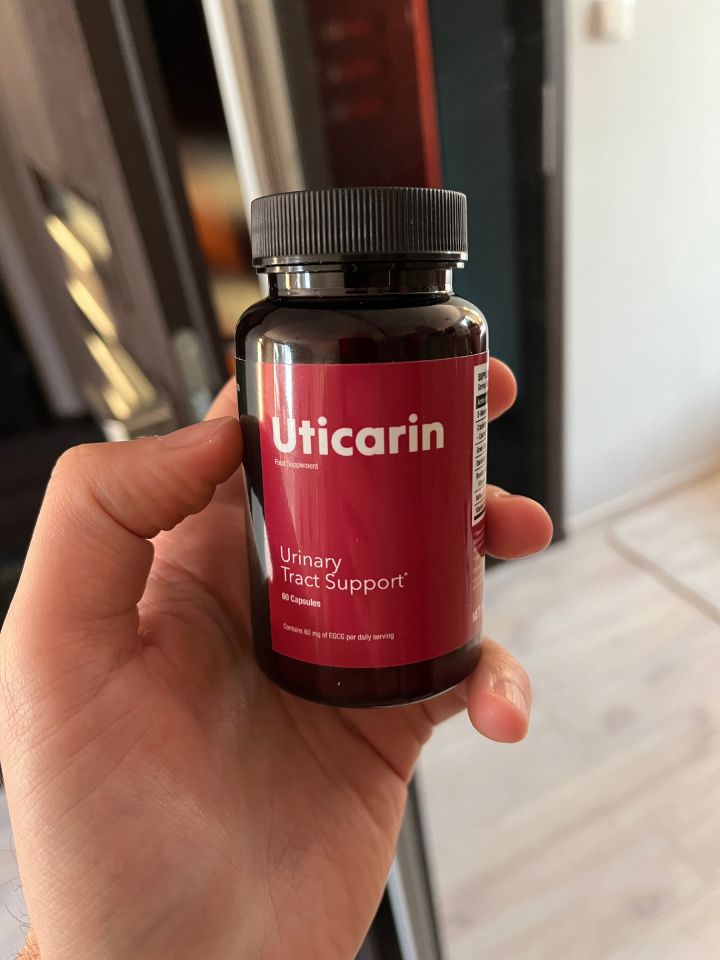
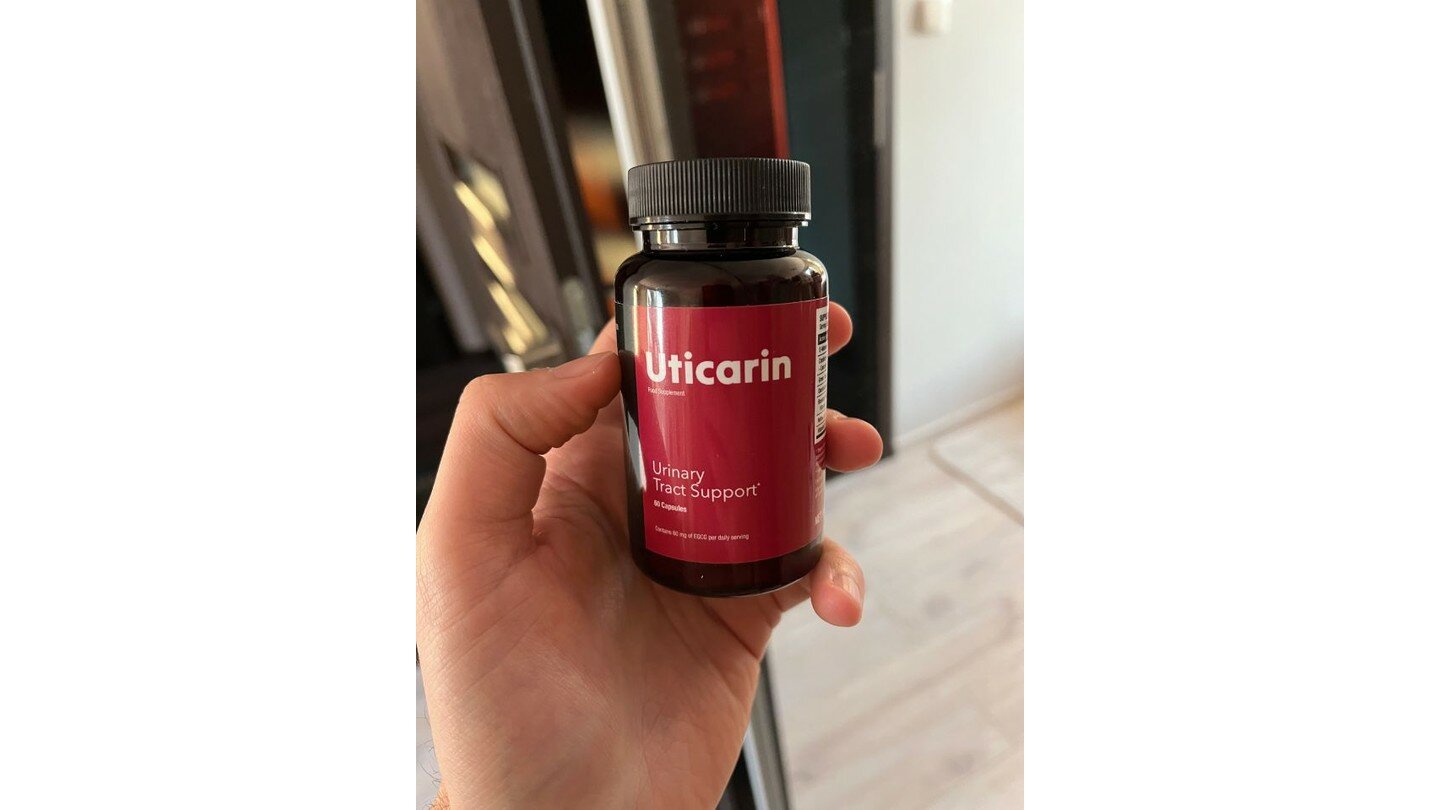
Uticarin is a daily urinary tract prevention supplement designed for women whose urinary tract infections keep coming back. Each bottle contains 60 vegan capsules, providing a 30-day supply at the maker's recommended dose of two capsules a day. The label states the product is made in the European Union and directs users to swallow the capsules with 300 ml of water, never on an empty stomach.
On its official website, the maker positions Uticarin as a way to "overcome recurring bladder problems" and states that it has "helped thousands of satisfied customers." Prominent sales graphics sit under an "Efficacy Confirmed by Research" heading, highlighting a "77% reduced risk of infection" and a "39% decrease in bladder fullness sensation." Both headline numbers carry footnote markers attributing them to ingredient research — neither figure comes from a study on Uticarin itself.
One detail stands out as soon as you look past the sales graphics. No selling company is named anywhere on the official website. That naming gap contrasts sharply with the physical box, which discloses every extract standardisation, vitamin yield, and EGCG warning more cleanly than most brands in this category.
The Ingredients
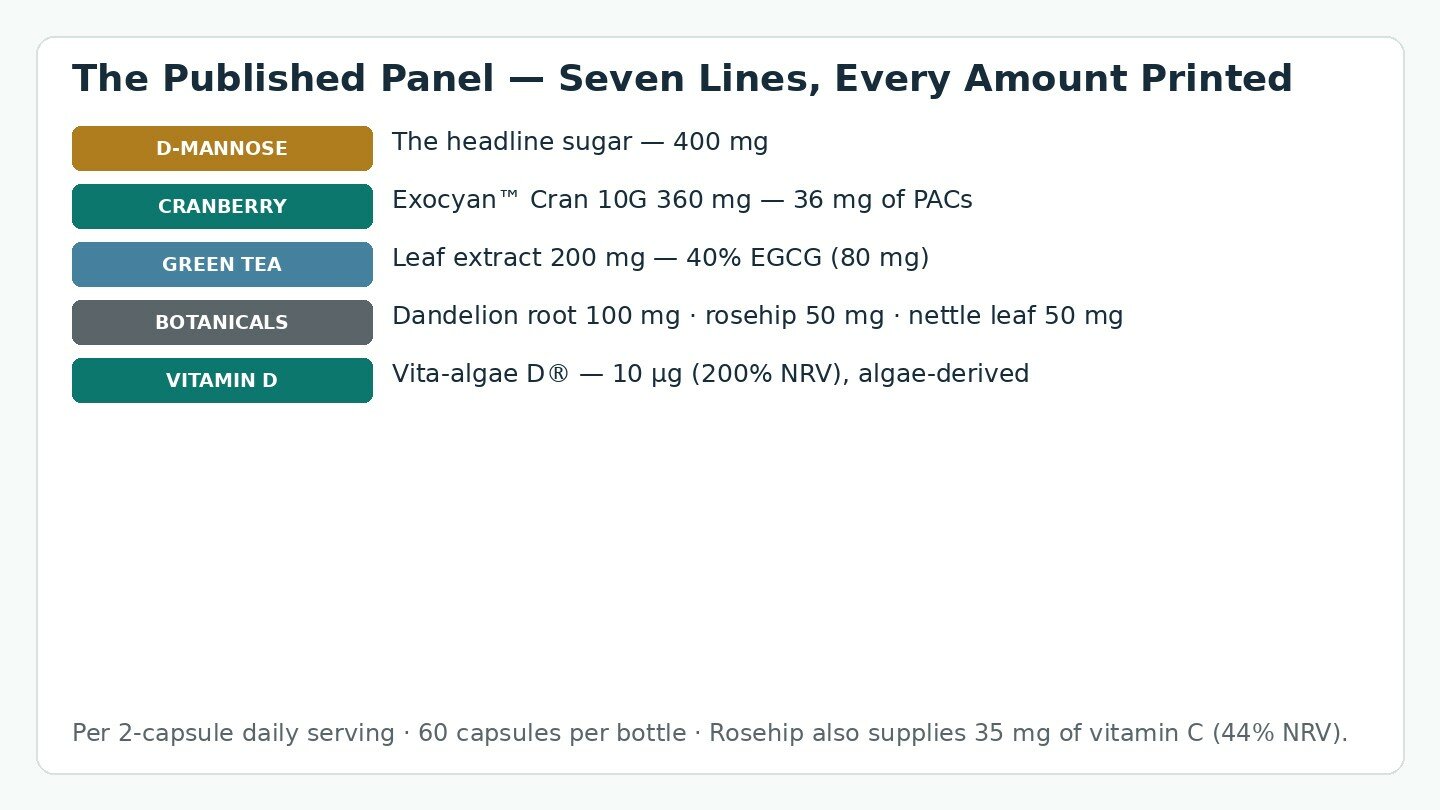
A fully published supplement facts panel with extract standardisations is rare in urinary health supplements. Many brands hide behind proprietary blends so buyers cannot check whether key compounds reach studied amounts. Uticarin does not do that.
Every one of its seven lines is listed with an exact daily weight for the two-capsule serving, alongside standardisations and vitamin breakdowns. That transparency lets you run the two pieces of maths that decide this review — the cranberry PAC total and the D-mannose total — directly from the box.
| Ingredient | Amount per daily serving | Standardisation |
|---|---|---|
| D-Mannose | 400 mg | None (single sugar) |
| Cranberry Fruit Extract (Exocyan™ Cran 10G) | 360 mg | 10% Proanthocyanidin (36 mg PACs) |
| Green Tea Leaf Extract | 200 mg | 40% EGCG (80 mg EGCG) |
| Dandelion Root Extract | 100 mg | Not stated |
| Rosehip Fruit Extract | 50 mg | Of which Vitamin C 35 mg (44% NRV) |
| Nettle Leaf Extract | 50 mg | 4% Polyphenols |
| Vitamin D (Vita-algae D®) | 10 µg (200% NRV) | Algae-derived |
D-Mannose (400 mg)
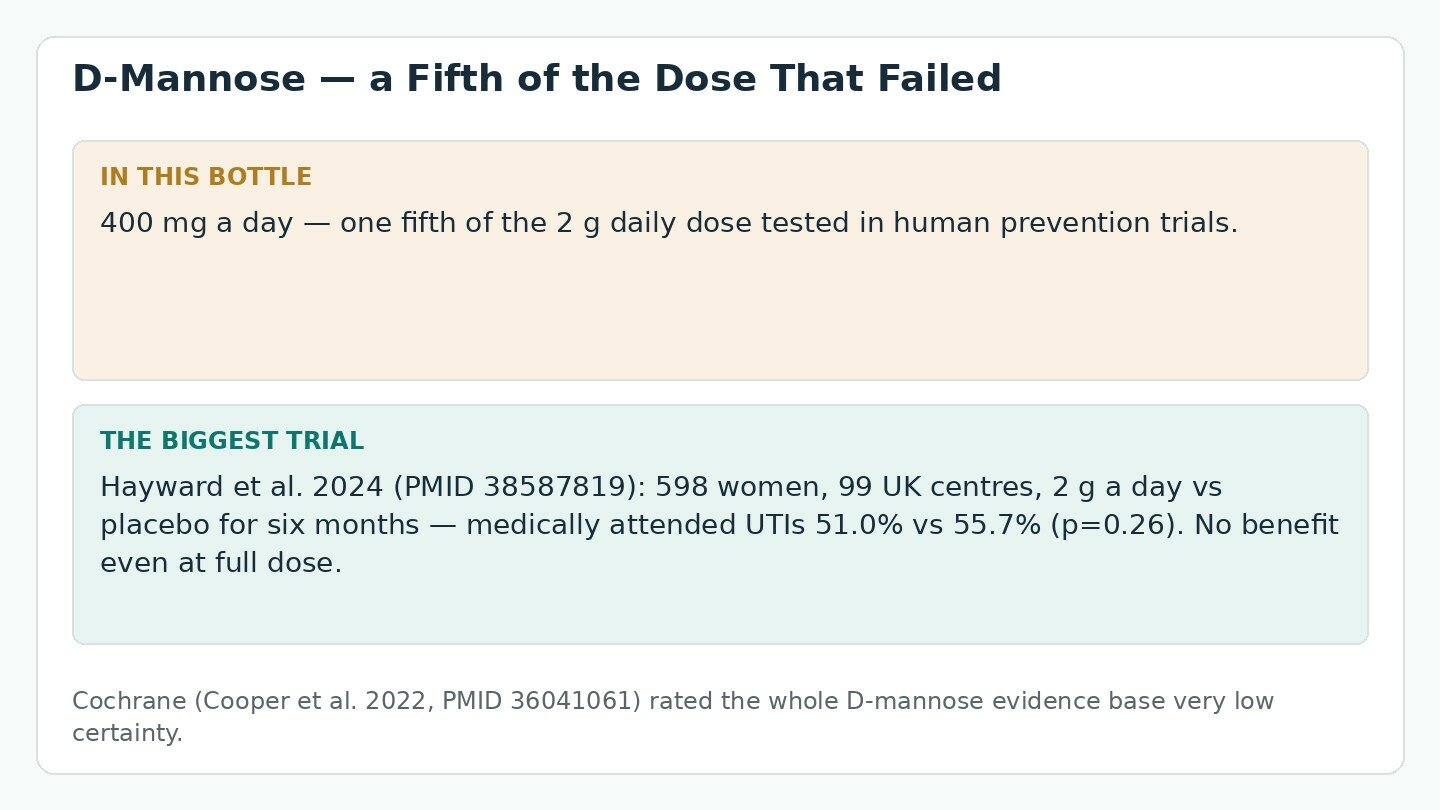
D-mannose is a simple sugar and the top line on Uticarin's supplement facts panel. The maker treats it as a central pillar of the formula's recurrent-UTI prevention pitch, reflecting how widely D-mannose is marketed in women's urinary supplements.
The clinical record creates a two-layer problem at this dose. First, Uticarin delivers 400 mg per daily serving, which is one fifth of the 2 g daily dose tested in human prevention trials. Second, the largest and best-designed trial of D-mannose — a double-blind study of 598 women across 99 UK primary care centres — found that even 2 g a day did not beat placebo over six months (Hayward et al. 2024, PMID 38587819). An earlier Cochrane review had already rated the D-mannose evidence base very low certainty (Cooper et al. 2022, PMID 36041061).
From a safety standpoint, D-mannose trials report mostly mild digestive effects such as bloating and loose stool. Because it is a sugar — even though it is poorly metabolised — people with diabetes should count it and check with a clinician before taking it daily.
Cranberry Fruit Extract — Exocyan™ Cran 10G (360 mg)
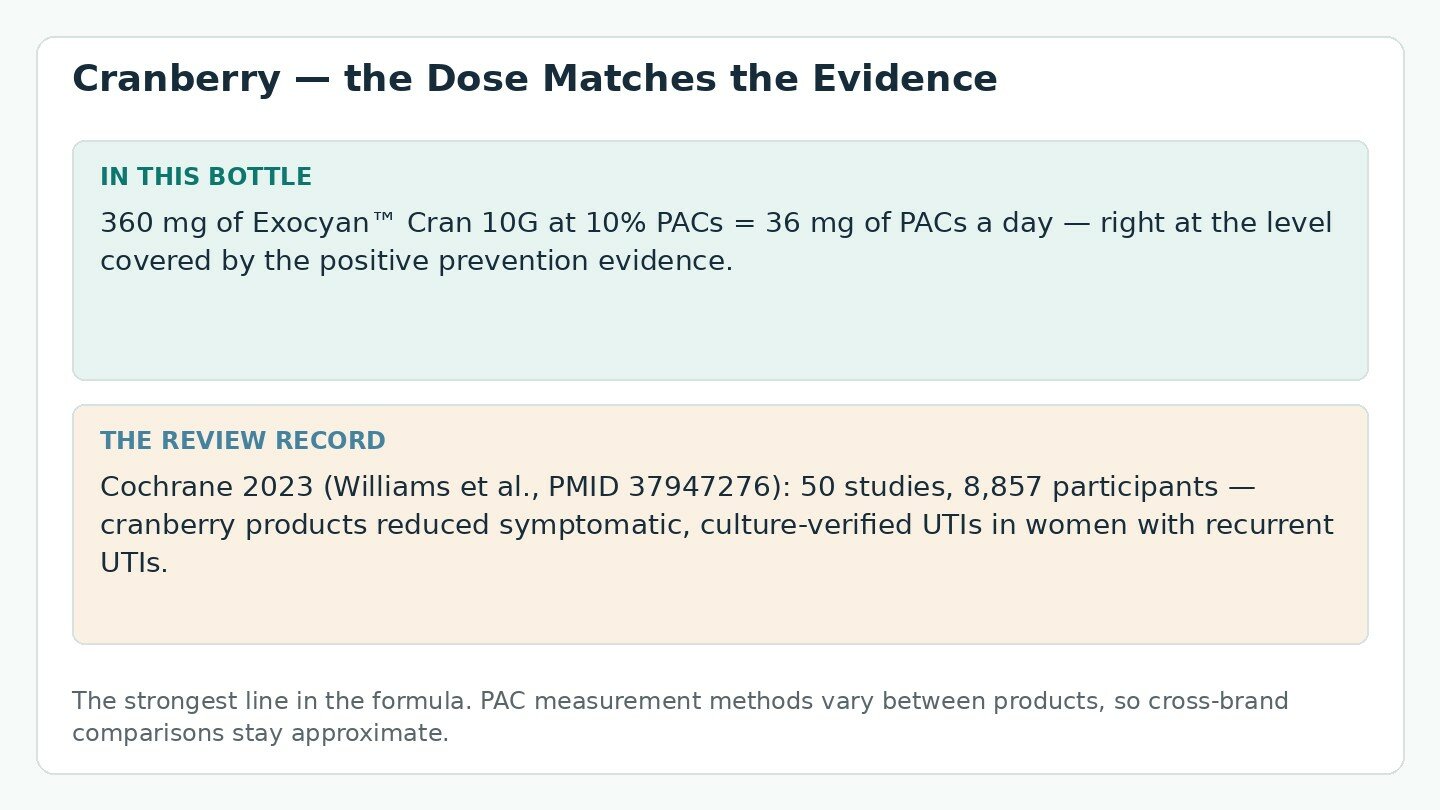
Exocyan™ Cran 10G is a branded cranberry fruit extract standardised to 10% proanthocyanidins (PACs). Placed second on the label, it is marketed alongside D-mannose to help reduce how often urinary tract infections return.
This is the strongest line in the entire formula. Simple arithmetic puts 360 mg of a 10% PAC extract at 36 mg of PACs per day — right at the level covered by positive human prevention evidence, below which trial effects tend to fade. The 2023 Cochrane cranberry review pooled 50 studies covering 8,857 participants and found that cranberry products reduced symptomatic, culture-verified UTIs in women with recurrent UTIs (Williams et al. 2023, PMID 37947276). One honest caveat applies: PAC measurement methods vary between products, so comparing PAC milligrams across brands is always approximate.
Cranberry trials report good overall tolerability. Even at a studied PAC dose, cranberry is for prevention only — never for treating an active infection — and the Cochrane review found little or no benefit in pregnant women, care-home residents, or adults whose bladders do not empty fully.
Green Tea Leaf Extract (200 mg)
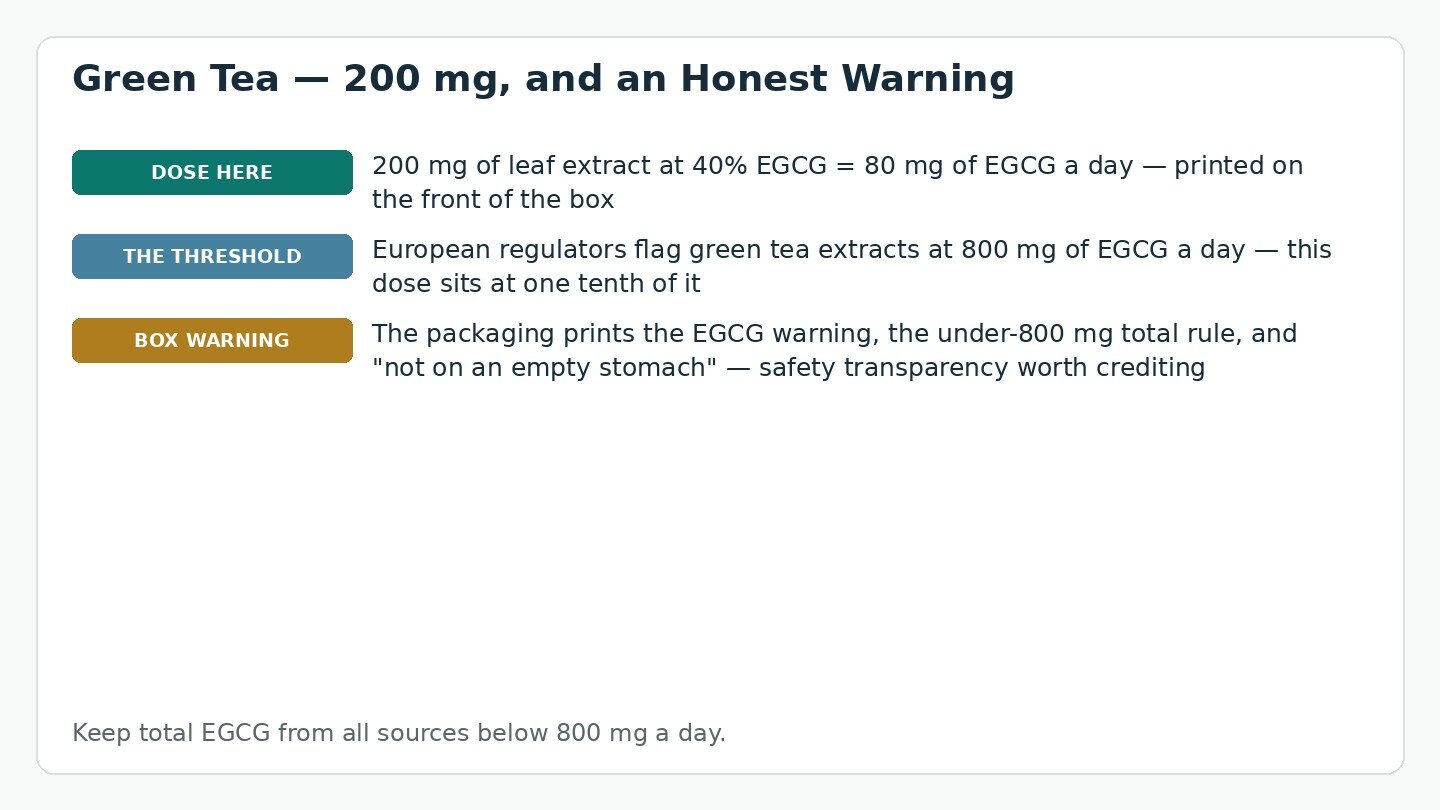
Uticarin includes 200 mg of green tea leaf extract standardised to 40% epigallocatechin gallate (EGCG). By straightforward calculation, two capsules deliver 80 mg of EGCG each day — a number the maker also prints prominently on the front of the box.
In the formula's positioning, green tea leaf extract sits as an antioxidant support ingredient rather than a proven urinary intervention. Our review of the published clinical record found no human UTI outcome trials supporting green tea extract or EGCG for preventing recurrent infections. It does not bridge the gap left by the under-dosed D-mannose.
What stands out here is safety transparency. European food safety regulators flag green tea extracts at 800 mg of EGCG a day, so Uticarin's 80 mg sits at one tenth of that threshold. To the maker's credit, the packaging prints that exact warning, tells buyers to keep total EGCG from all sources below 800 mg daily, and instructs users not to take the capsules on an empty stomach.
Dandelion Root Extract (100 mg)
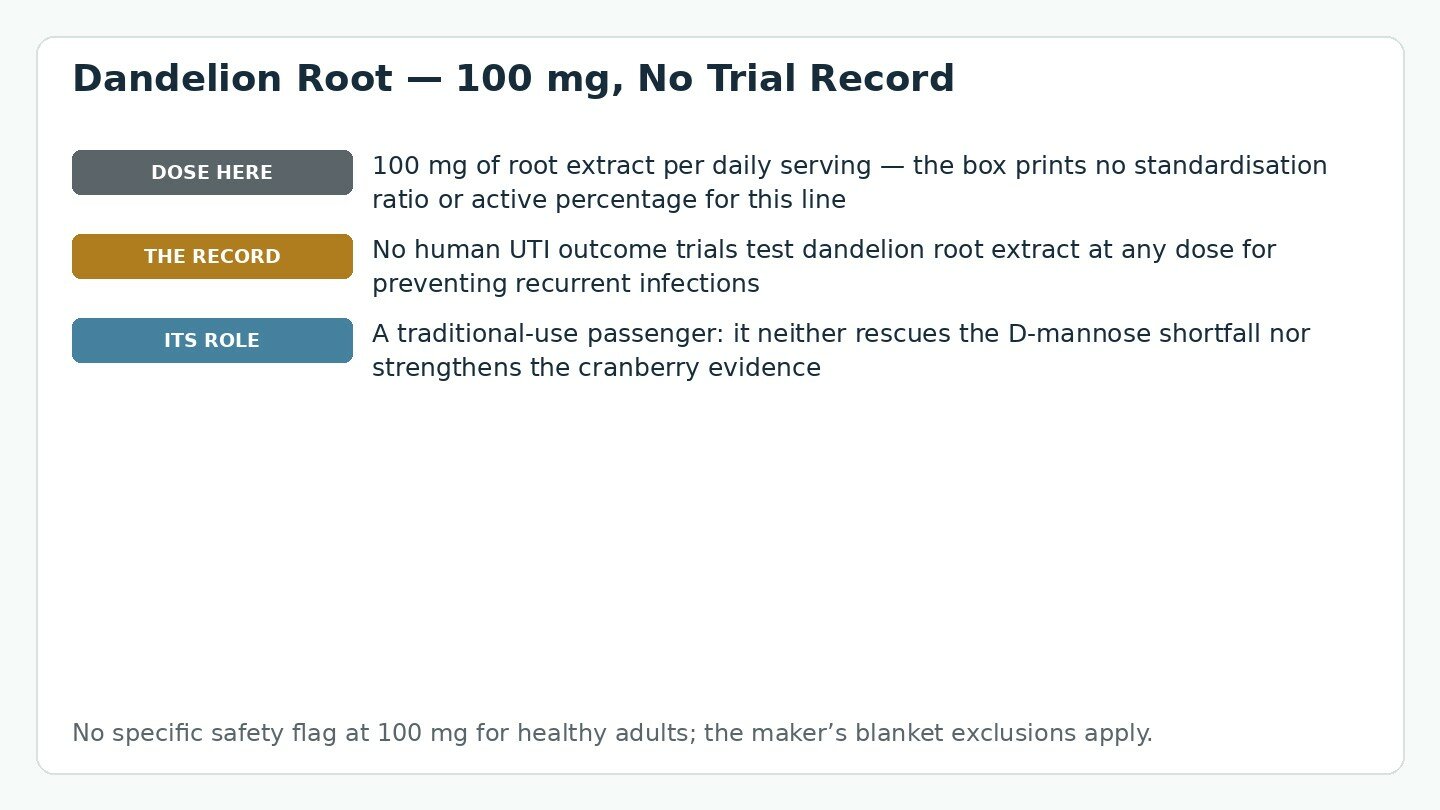
Dandelion root extract appears fourth on the label at 100 mg per daily serving. Unlike the cranberry, green tea, and nettle lines, the box prints no standardisation ratio or active-compound percentage for this extract.
The maker includes dandelion root as part of its multi-botanical urinary support blend. Traditional herbal products often feature dandelion alongside cranberry, which explains why buyers frequently see it in combined urinary capsules.
The published clinical record, however, is empty on this point. We found no human UTI outcome trials testing dandelion root extract at any dose for preventing recurrent infections. At 100 mg a day, it acts strictly as a traditional-use passenger in the capsule: it neither rescues the D-mannose shortfall nor strengthens the cranberry evidence. On safety, 100 mg raises no specific red flag in our audit for healthy adults, though the maker's blanket exclusions for children and pregnant or breastfeeding women apply to the entire formula.
Rosehip Fruit Extract (50 mg)
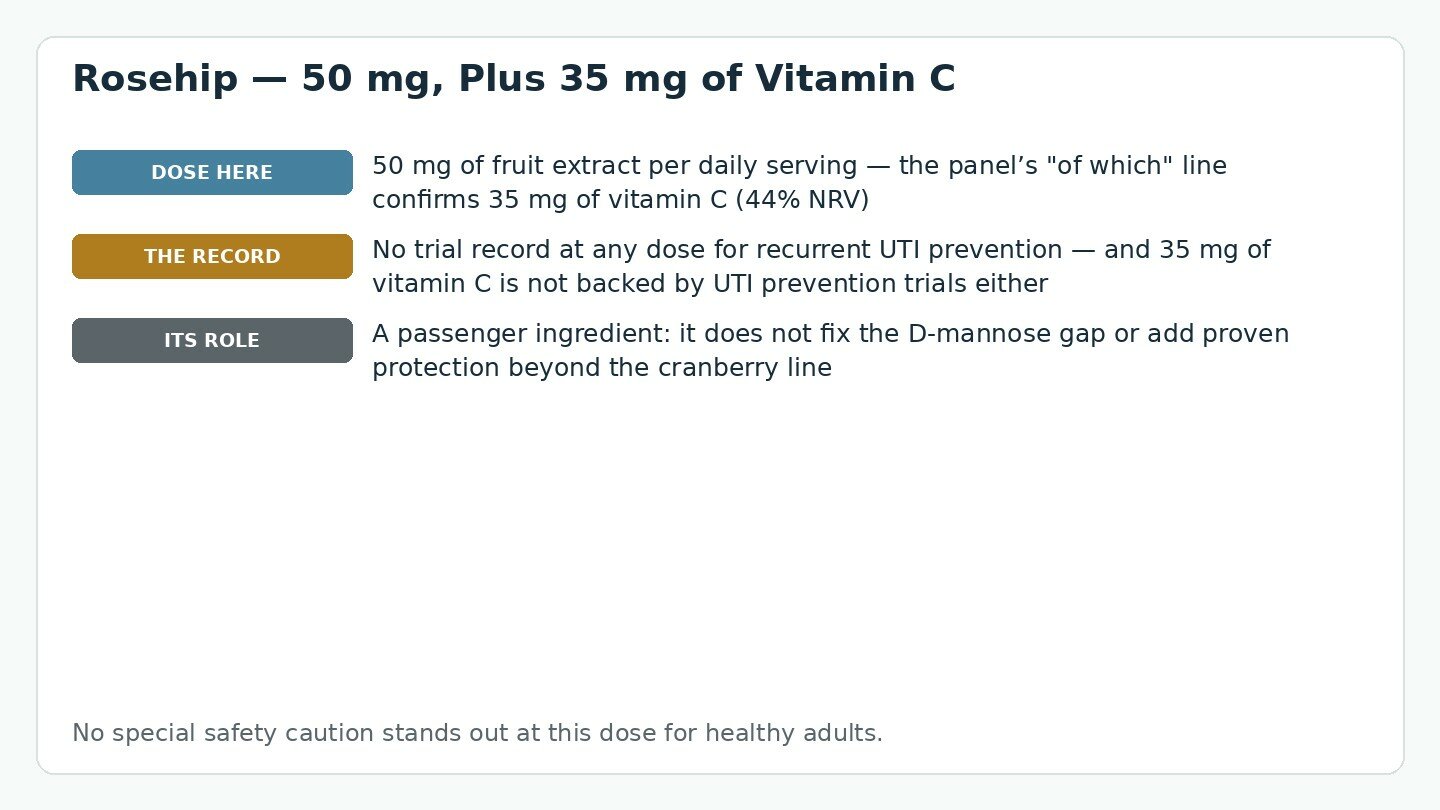
Rosehip fruit extract is dosed at 50 mg per daily serving. To the brand's credit, the panel adds an "of which" sub-line confirming that those 50 mg supply 35 mg of Vitamin C, equal to 44% of the Nutrient Reference Value (NRV).
Its assigned job in Uticarin is supporting botanical and Vitamin C coverage inside the daily urinary blend. Including a modest Vitamin C fraction is common across urinary tract capsules, and printing the exact milligram yield reflects solid label discipline.
In terms of human proof for recurrent UTIs, rosehip fruit extract carries no trial record at any dose in our files, and 35 mg of Vitamin C is not backed by UTI prevention trials either. Like dandelion root, it is a passenger ingredient that neither fixes the D-mannose gap nor adds proven protection beyond the cranberry line. At 50 mg of extract and 35 mg of Vitamin C, no special safety caution stands out for healthy adults outside the maker's stated exclusions.
Nettle Leaf Extract (50 mg)
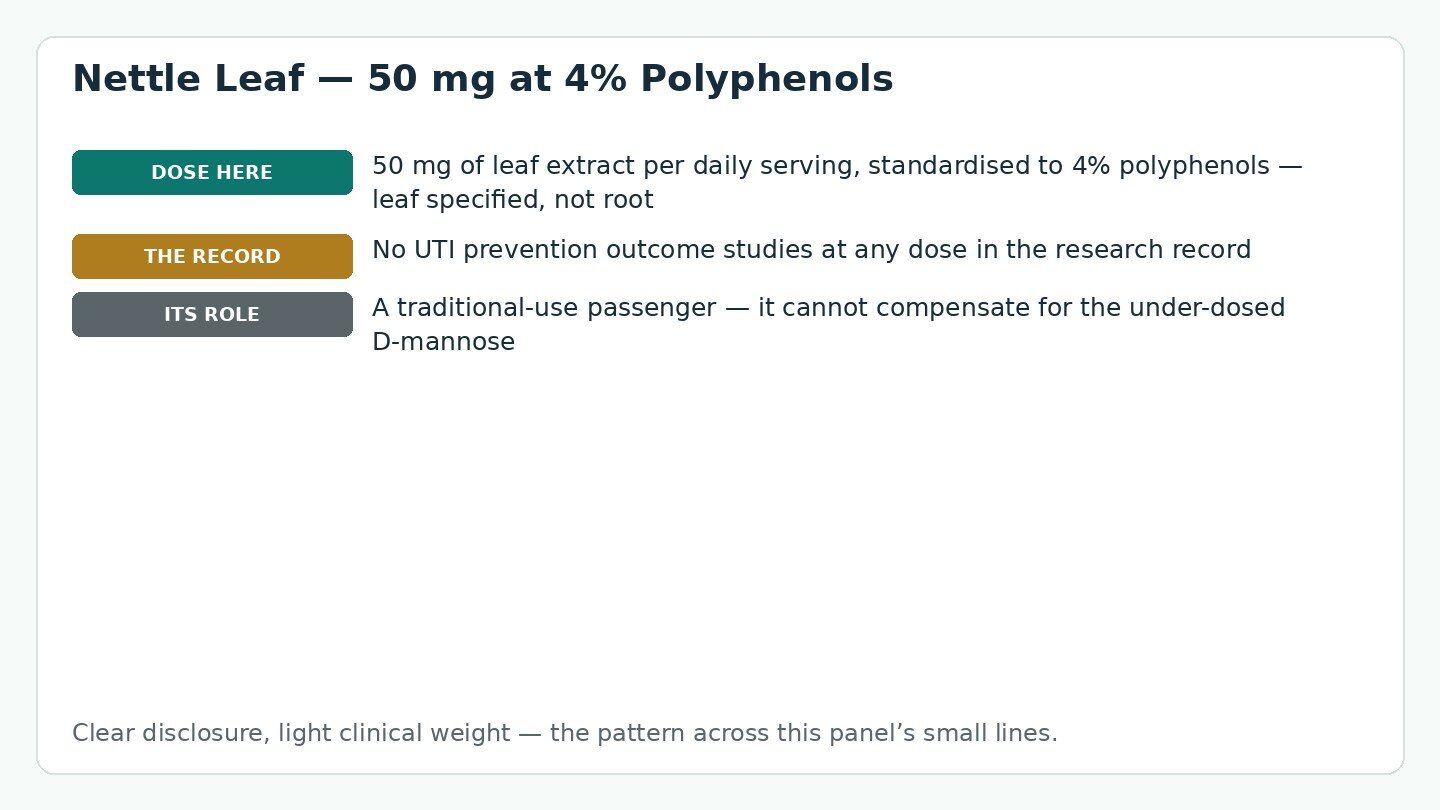
Uticarin provides 50 mg of nettle leaf extract per daily serving, standardised to 4% polyphenols. Specifying the leaf rather than the root — and declaring the exact polyphenol percentage — matches the clear disclosure found across most of the panel.
The maker folds nettle leaf into the botanical back half of the formula as general urinary tract support. Because the label prints the exact weight and standardisation, buyers can see immediately how modest this line is compared with the cranberry and green tea fractions.
When checked against clinical trials, nettle leaf has no UTI prevention outcome studies at any dose in our research record. At 50 mg a day, it remains a traditional-use passenger that does not carry the clinical weight of the cranberry PAC dose and cannot compensate for the under-dosed D-mannose. No ingredient-specific adverse signal is flagged at 50 mg for healthy adults, provided users follow the maker's published exclusions for children and pregnant or breastfeeding women.
Vitamin D — Vita-algae D® (10 µg)
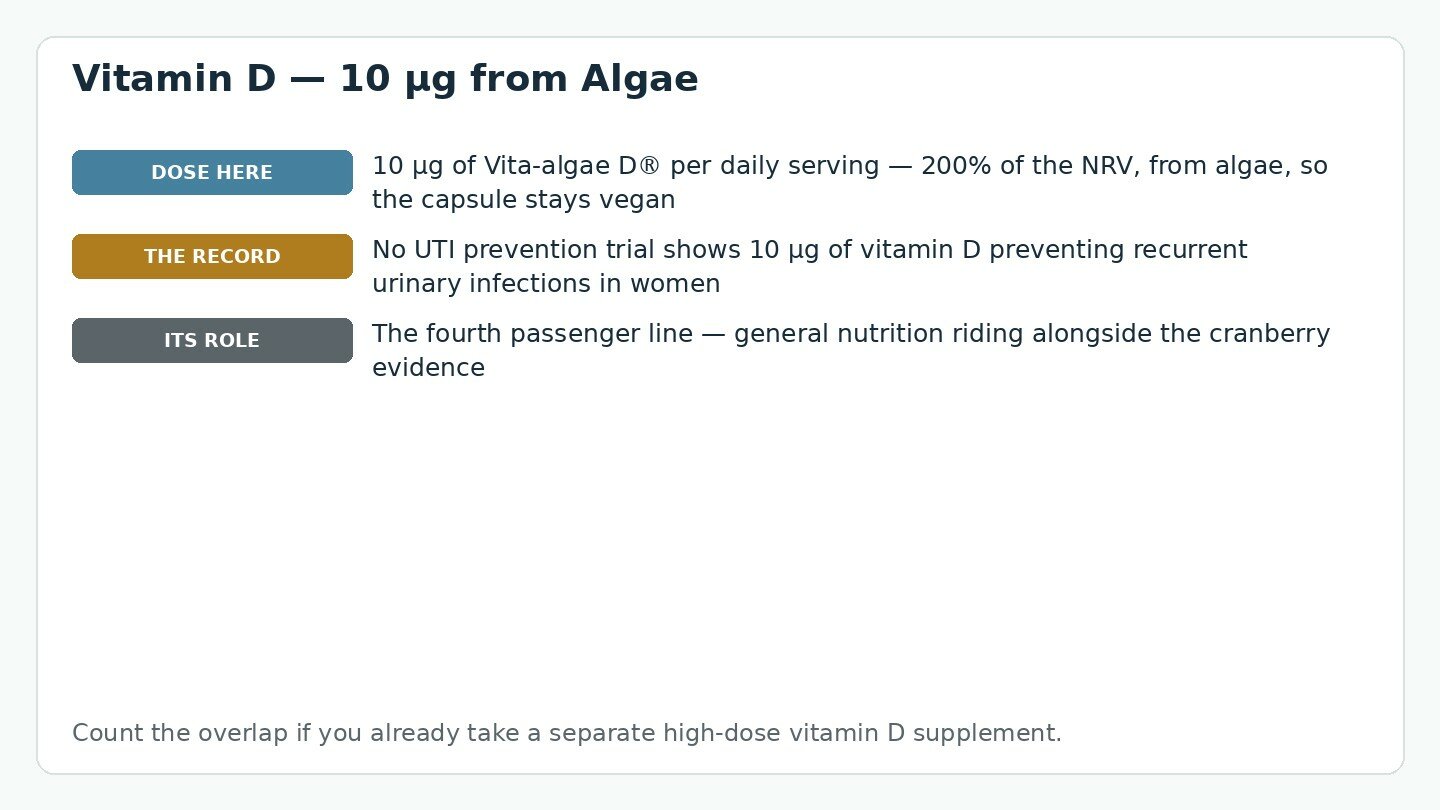
The seventh and final line is Vita-algae D®, a branded, algae-derived form of Vitamin D dosed at 10 µg per daily serving. That equals 200% of the Nutrient Reference Value (NRV) and allows the capsule to remain vegan without relying on animal-sourced Vitamin D.
Its role in Uticarin is general daily nutritional support rather than targeted bacterial prevention in the bladder. As a finishing line on a transparent label, the exact microgram figure and NRV percentage are easy to read and verify.
Our clinical record includes no UTI prevention trial showing that 10 µg of Vitamin D prevents recurrent urinary infections in women. That makes it the fourth passenger ingredient alongside dandelion, rosehip, and nettle. From a safety perspective, 10 µg a day poses no flagged concern for healthy adults, though anyone already taking a separate high-dose Vitamin D supplement should account for the overlap and keep the maker's stated exclusions in mind.
The Dose Audit: One Ingredient at Its Studied Level, One at a Fifth of a Failed Dose
Because Uticarin prints every milligram and standardisation on the box, we do not have to guess what is inside. Four simple checks sum up what the label actually delivers against the clinical literature.
The headline ingredient, read against its own best trial
D-mannose sits at the top of the panel at 400 mg a day. The standard daily dose tested in human prevention research is 2 g — five times higher than what two Uticarin capsules supply.
Even more important is what happened when that full 2 g dose faced a proper test. In Hayward et al. 2024 (PMID 38587819), a double-blind randomised trial of 598 women with recurrent UTIs across 99 UK primary care centres compared 2 g of D-mannose daily against placebo for six months. Medically attended UTIs occurred in 51.0% of the D-mannose group versus 55.7% on placebo (risk difference −5%, 95% CI −13 to 3; p=0.26), with no difference on any secondary measure. Uticarin gives you one fifth of a dose that failed to beat placebo at full strength.
Where the positive D-mannose story comes from
Why do so many urinary brands still treat D-mannose as proven? Most of that confidence traces back to Kranjčec et al. 2014 (PMID 23633128), a six-month study of 308 women comparing 2 g of D-mannose powder a day, nitrofurantoin 50 mg a day, and no prophylaxis at all. Recurrence was 14.6% on D-mannose against 60.8% with no treatment.
That study had two major design limits: the control group received no placebo, and the trial was unblinded, leaving expectation and regression effects uncontrolled. When the Cochrane review by Cooper et al. 2022 (PMID 36041061) pooled seven trials covering 719 participants, it rated the entire D-mannose evidence base very low certainty and found little to no evidence to support or refute it. Uticarin's headline confidence rests on the weakest trial design in the file.
The cranberry sum
The second line tells a much better story. Uticarin contains 360 mg of Exocyan™ Cran 10G standardised to 10% proanthocyanidins, which works out to 36 mg of PACs per daily serving.
That 36 mg figure sits at the level where the Cochrane cranberry review (Williams et al. 2023, PMID 37947276) shows its recurrent-UTI benefit in women: across 8 studies and 1,555 participants, cranberry products lowered symptomatic, culture-verified UTIs (RR 0.74, 95% CI 0.55–0.99). Below roughly 36 mg of PACs, effects in trials fade. This line is dosed where its evidence lives, though buyers should know that PAC measurement methods vary between products, making cross-brand PAC comparisons approximate.
The safety arithmetic
The third line passes a different kind of check: safety maths. Two hundred milligrams of green tea leaf extract at 40% EGCG delivers 80 mg of EGCG per daily serving, which is one tenth of the 800 mg daily level regulators flag for green tea extracts.
Credit goes to the maker for printing that 80 mg figure on the box front, warning users to stay under 800 mg from all sources, and advising against taking the capsules on an empty stomach. The remaining four lines — dandelion root (100 mg), rosehip fruit (50 mg, supplying 35 mg Vitamin C), nettle leaf (50 mg), and algae-derived Vitamin D (10 µg) — have no UTI trial record. They are passengers that neither rescue the D-mannose gap nor add safety risk at these amounts.
The Evidence, Read Properly
Supplement sales pages often mix strong human trials with weak pilot studies as if they carry equal weight. In evidence-based reviewing, study design decides how much trust a result deserves. Large, double-blind, placebo-controlled trials and systematic reviews sit at the top, while unblinded studies without a placebo sit far below them.
Below is the actual human trial record behind Uticarin's two headline ingredients, with every study design and limit attached.
Hayward et al. 2024 — the decisive D-mannose trial
The clearest test of D-mannose to date is a double-blind, randomised, placebo-controlled trial published in JAMA Internal Medicine (Hayward et al. 2024, PMID 38587819). Researchers enrolled 598 women with recurrent urinary tract infections across 99 UK primary care centres. Participants took either 2 g of D-mannose daily or a matching placebo for six months.
The primary outcome was the proportion of women experiencing a medically attended, clinically suspected UTI. That happened in 51.0% of women on D-mannose (150 of 294) compared with 55.7% on placebo (161 of 289). The risk difference was −5% (95% CI −13 to 3; p=0.26), which is not statistically significant, and no secondary outcome differed between groups.
The authors concluded plainly that D-mannose "should not be recommended for prophylaxis in this patient group." Two years earlier, Cochrane reviewers had called for a single adequately powered, placebo-controlled trial to settle the question. Hayward et al. 2024 supplied that exact trial, and the result was negative — at five times the dose inside Uticarin.
Williams et al. 2023 — the Cochrane cranberry review
Cranberry sits on much firmer ground for preventing recurrent infections. The 2023 Cochrane systematic review pooled 50 studies covering 8,857 participants across different patient groups (Williams et al. 2023, PMID 37947276). Overall, cranberry products lowered the risk of symptomatic, culture-verified UTIs (RR 0.70, 95% CI 0.58–0.84).
The most relevant subgroup for Uticarin buyers is women with recurrent UTIs. Across 8 studies involving 1,555 women, cranberry reduced symptomatic, culture-verified infections by roughly a quarter (RR 0.74, 95% CI 0.55–0.99). Benefits also appeared in children (RR 0.46) and in patients following bladder interventions (RR 0.47).
The review was equally clear about where cranberry showed little or no benefit. It did not meaningfully help elderly residents in care homes (RR 0.93), pregnant women (RR 1.06), or adults whose bladders do not empty fully (RR 0.97). Every positive finding applies strictly to prevention, never to treating an active infection.
Cooper et al. 2022 — the Cochrane D-mannose review
Before the 2024 UK trial was published, Cochrane reviewers audited the existing D-mannose literature across seven randomised trials covering 719 participants (Cooper et al. 2022, PMID 36041061). Their conclusion was blunt: there was "little to no evidence to support or refute" D-mannose for either preventing or treating UTIs.
The reviewers rated certainty across the entire evidence base as very low. Most earlier trials were small, lacked proper placebo controls, or varied widely in design. That review set up the exact need for Hayward et al. 2024, which then delivered a clear negative verdict on 2 g daily.
Kranjčec et al. 2014 — where the positive D-mannose story comes from
Most supplement brands that praise D-mannose rely on one older study from Croatia (Kranjčec et al. 2014, PMID 23633128). Researchers assigned 308 women with recurrent UTIs to 2 g of D-mannose powder daily, 50 mg of the antibiotic nitrofurantoin daily, or no prophylaxis at all for six months. Recurrence rates were 14.6% on D-mannose, 20.4% on nitrofurantoin, and 60.8% in the no-treatment group (RR 0.239 versus no prophylaxis).
Read in isolation, those numbers look striking. Read alongside the study's design, the flaw is obvious: the control group received no placebo, and the study was unblinded. Participants knew whether they were taking a daily powder or nothing at all, leaving expectation effects and regression uncontrolled. When tested in a larger, blinded, placebo-controlled trial ten years later, that apparent benefit disappeared.
No clinical trial of the finished Uticarin formula
No clinical trial has ever tested Uticarin's finished seven-ingredient capsule in humans. None of the supporting botanicals — dandelion root, rosehip fruit, or nettle leaf — have UTI prevention trial records at any dose, and neither do green tea extract or vitamins C and D. Any realistic expectation for Uticarin rests entirely on its 36 mg daily cranberry PAC fraction, not on a proven synergy across all seven lines.
How Long Does It Take to Work?
Prevention supplements cannot be judged in a fortnight. Unlike a painkiller or an antibiotic, you are not watching an active symptom clear up overnight. You are tracking whether urinary tract infections come back less often than your usual pattern over several months.
The published cranberry evidence reflects that slow measurement window. Across the trials pooled in the Cochrane review (Williams et al. 2023, PMID 37947276), preventive benefits were tracked over months, with the review's core benefit window running 12 to 24 weeks. Expecting a clear verdict after two or three weeks misunderstands how recurrence prevention works.
For Uticarin, a fair trial is three months of daily use at two capsules per day. That lines up directly with the three-bottle pack at $107.98 delivered ($95.98 plus $12 shipping). Anything shorter gives you too little time to separate genuine protection from normal luck between episodes.
A single 60-capsule bottle lasts 30 days. One month is enough to see whether your stomach handles two capsules a day without digestive upset, and whether you can stick to taking them with 300 ml of water and food. It is not enough time to judge whether the cranberry fraction lowers your infection frequency.
There is a financial catch tied directly to this timeline. Because the official website publishes no money-back guarantee, you carry the entire risk of a three-month trial out of pocket. Your choice of bottle tier is the only practical risk control you have.
One boundary applies across every timeframe. Uticarin cannot treat a urinary tract infection you have right now — not in 24 hours, not in a week, and not in three months. If symptoms of an active infection start while you are taking it, stop treating it as a fix and contact a doctor.
Is It Safe?
Credit where it is due: Uticarin carries the most complete safety labelling we have audited in this product group. Instead of burying warnings in tiny print, the maker states key exclusions and compound limits clearly on the packaging and site.
First, the maker's own exclusions are unambiguous. Uticarin is not intended for children, and it is not intended for pregnant or breastfeeding women. Anyone in those groups should skip the product outright.
Second, the maker prints a clear green tea catechin warning. The front of the box states that a daily two-capsule serving contains 80 mg of EGCG, and the label warns users not to reach 800 mg of EGCG per day from all sources. The directions also specify taking the two capsules with 300 ml of water and never on an empty stomach, which helps reduce stomach discomfort from green tea extract.
Beyond the maker's own text, several practical cautions deserve your attention:
- Diabetes and blood sugar monitoring: D-mannose is a simple sugar. Although the body metabolises it poorly compared with glucose, people with diabetes should still count it and check with their clinician before taking it daily.
- Mild digestive upset: Human trials of D-mannose mostly report mild gastrointestinal side effects such as bloating and loose stool.
- UTIs during pregnancy: Any urinary tract infection in pregnancy is always a medical matter requiring prompt clinical care, regardless of what any supplement label says.
- Vitamin D stacking: Each daily serving supplies 10 µg of algae-derived Vitamin D (200% NRV). If you already take a separate Vitamin D supplement or multivitamin, check your combined daily total.
Finally, keep the evidence boundary in mind. No product-specific safety trial has tested Uticarin's finished seven-ingredient formula in humans, so safety judgements rely on the known profiles and doses of its individual lines.
Side Effects: What Is Actually Known
For Uticarin as a finished product, no adverse-event data has been published because no clinical study has ever evaluated the capsules. Anyone claiming a specific side-effect percentage for Uticarin is guessing. What can be stated reliably comes from the published records of its individual ingredients.
In human D-mannose trials, reported side effects are generally mild and digestive, led by bloating and loose stool. Those trials tested 2 g a day — five times Uticarin's 400 mg dose — so gastrointestinal effects may be less frequent at this lower intake, though sensitive users can still notice them.
Cranberry extracts show good overall tolerability across the trials pooled in the Cochrane review (Williams et al. 2023, PMID 37947276). Green tea leaf extract supplies 80 mg of EGCG daily, sitting at one tenth of the 800 mg daily threshold flagged by European food safety regulators for green tea extracts. Swallowing the capsules with food and 300 ml of water, as directed on the box, further lowers the chance of nausea or stomach upset.
At 100 mg of dandelion root, 50 mg of rosehip fruit (providing 35 mg of Vitamin C), 50 mg of nettle leaf, and 10 µg of Vitamin D, the remaining lines sit at modest amounts with no special adverse signal flagged for healthy adults outside the maker's exclusions. If you notice persistent stomach discomfort, rash, or any unexpected reaction, stop taking the capsules and speak with a healthcare professional.
When a UTI Needs a Doctor, Not a Supplement
Uticarin is not a treatment for an active urinary tract infection, and taking a supplement will not clear bacteria already multiplying in your urinary tract. Seek prompt medical assessment if you develop fever, pain in the back or side, vomiting, blood in the urine, or urinary symptoms that worsen or last beyond 48 hours. Any suspected UTI during pregnancy, and any UTI in a man — since male UTIs are complicated by definition — always needs a doctor, never a supplement. Active infections are treated with prescription antibiotics. When recurrent infections keep returning despite everyday prevention, a doctor can also discuss proven medical options, including a prescription urinary antiseptic such as methenamine hippurate — which met non-inferiority against daily low-dose antibiotics over 12 months in the 240-woman ALTAR trial (1.38 vs 0.89 episodes per person-year; Harding et al. 2022, PMID 35535708) — or, after the menopause, vaginal oestrogen.
Is It a Scam?
No. Uticarin is a real dietary supplement, not a scam or a counterfeit operation. It ships in clearly labelled packaging, states that its vegan capsules are made in the European Union, prints every ingredient weight and extract standardisation on the box, publishes thorough safety warnings, and provides written purchase terms.
Calling it legitimate, however, does not mean the sales page is free of overreach. The fair criticisms are specific, verifiable gaps between the marketing claims and the clinical record:
- An under-dosed headline ingredient: D-mannose sits at 400 mg daily — one fifth of a 2 g dose that failed to beat placebo in its largest, best-designed human trial.
- Borrowed clinical statistics: The sales page runs an "Efficacy Confirmed by Research" section featuring a "77% reduced risk of infection" and a "39% decrease in bladder fullness sensation," alongside claims of helping "thousands of satisfied customers." Footnote markers confirm those numbers come from ingredient research, never from a trial of Uticarin itself.
- An unnamed seller: No company name is printed on the official website, which weakens Maker Credibility even when the physical box is honest.
- No money-back guarantee: Buyers are asked to test a slow-acting prevention capsule with zero satisfaction refund protection.
That adds up to marketing overreach on a real, transparently labelled product — not a fake one. Buyers should also know how ordering and returns work before checking out. Uticarin is sold direct through the official website only, and the only returns route is standard withdrawal on unused goods under the written terms. Those terms also carry standard legal boilerplate stating there is no accuracy guarantee for product descriptions and that refunds may be declined if fraud is suspected.
Price and Packs
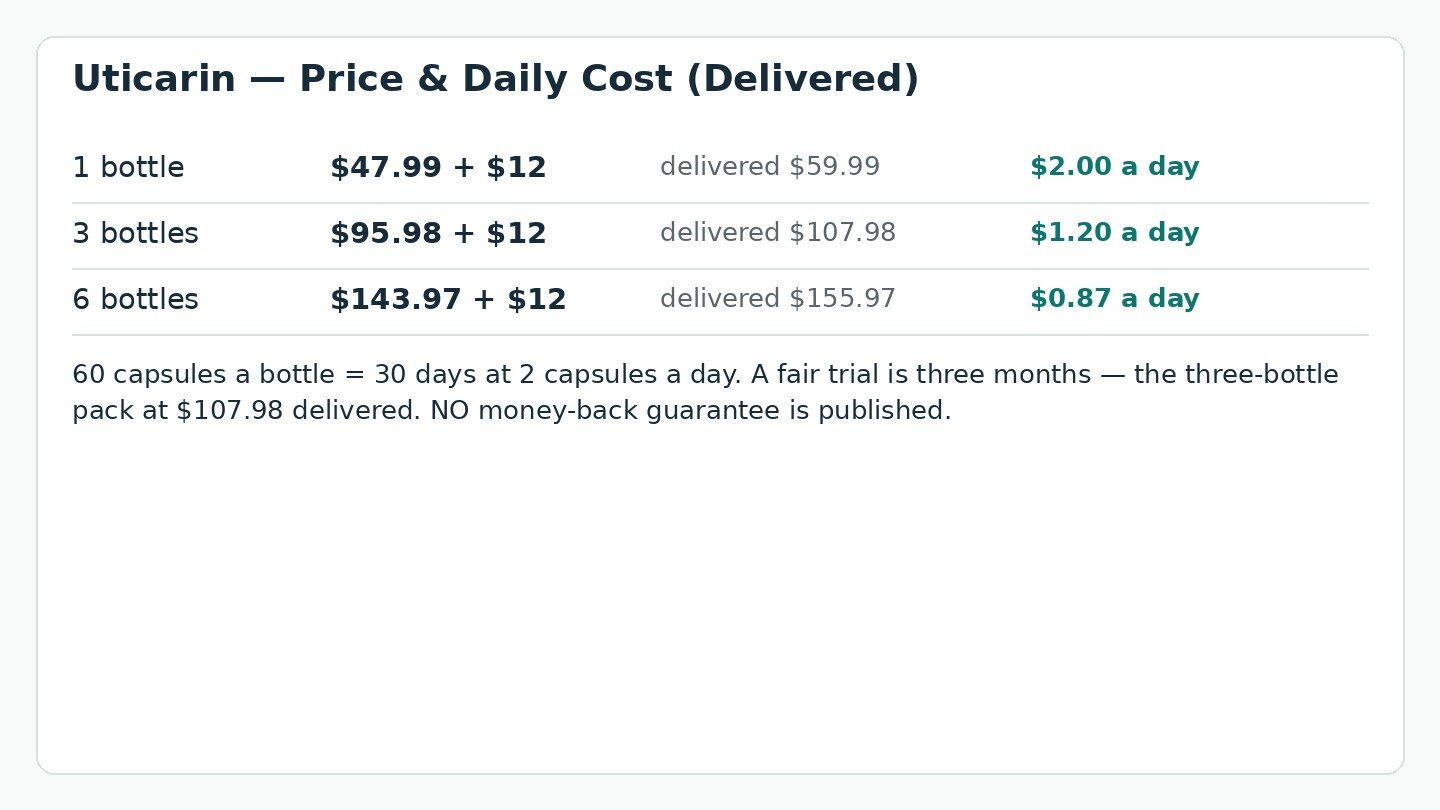
All pricing below comes directly from Uticarin's live order page, read in November 2026. Every bottle contains 60 capsules, supplying one full month (30 days) at the maker's recommended serving of two capsules daily.
| Option | Total | Per bottle | Cost per day |
|---|---|---|---|
| 1 bottle | $47.99 + $12 shipping ($59.99 delivered) | $47.99 | $2.00 |
| 3 bottles ("Buy 2 Items and Get 1 Free") | $95.98 + $12 shipping ($107.98 delivered) | $31.99 | $1.20 |
| 6 bottles ("Buy 3 Items and Get 3 Free!") | $143.97 + $12 shipping ($155.97 delivered) | $23.99 | $0.87 |
The daily figures in the table reflect delivered cost — including the flat $12 shipping charge — across 30, 90, and 180 days. Before shipping, the product-only daily costs work out to $1.60 on one bottle, $1.07 on three bottles, and $0.80 on six bottles.
Two pricing details stand in the brand's favour. First, the order page uses clean tier pricing with no inflated, crossed-out "regular prices" designed to manufacture fake discounts. Second, every tier is a one-time purchase — no recurring subscription or auto-ship programme is attached to checkout.
At $47.99 before shipping, Uticarin carries the lowest single-bottle entry price in its product group. Still, flat $12 shipping adds 25% to a single-bottle order, making the one-month purchase the steepest cost per day by a wide margin.
Purchase Options
Uticarin is sold direct through the maker's official website, which is where the verified November 2026 prices and bundle tiers above apply. Buying direct avoids third-party resellers and ensures you receive the current EU-manufactured box with the published supplement facts panel.
Run three quick checks before picking a tier:
- Match the order size to a fair trial: Judging UTI prevention takes months, not weeks. The three-bottle pack ($107.98 delivered, or $1.20 a day) covers the three-month window needed to see whether recurrence drops.
- Account for the flat shipping fee: Adding $12 to a single bottle pushes your real cost to $59.99 ($2.00 a day) — only sensible if you strictly want a 30-day stomach-tolerance check first.
- Respect the missing guarantee: Because no money-back guarantee is published, never buy the six-bottle option just to chase the $0.87 daily rate unless you are already certain you tolerate the formula and accept the full upfront cost.
How It Compares
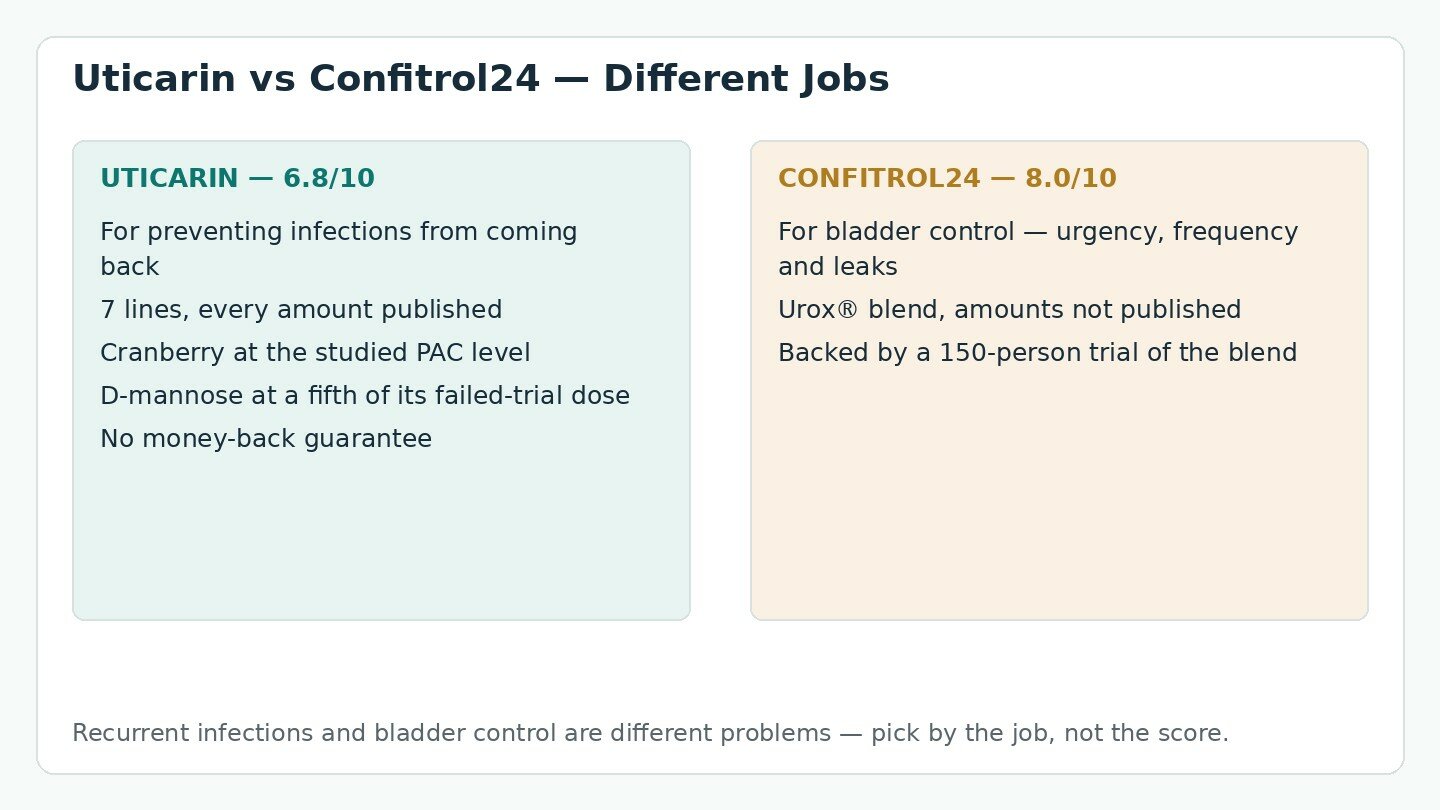
Shoppers researching urinary supplements often compare Uticarin with Confitrol24, another prominent women's urinary formula we have reviewed. Putting them side by side exposes the single most important decision in this category: matching the product to the actual problem.
| Product | Our score | Formula | Job |
|---|---|---|---|
| Uticarin | 6.8/10 | 7 lines, every amount published | Preventing infections from coming back |
| Confitrol24 | 8.0/10 | Urox® blend, amounts not published | Bladder control — urgency, frequency and leaks |
These two supplements answer completely different problems, which is why Confitrol24 is not a simple drop-in substitute despite its higher score. If bacterial urinary tract infections keep returning, your job is infection prevention — that is Uticarin's category, where its cranberry extract hits the studied 36 mg PAC level even though its D-mannose sits far below trial strength. If your daily struggle is sudden urgency, frequent bathroom trips, or leaks without an infection, your job is bladder control — where Confitrol24 (8.0/10) is the stronger product, backed by a 150-person trial of its Urox® blend (Schoendorfer 2018), even though its individual ingredient weights are unpublished.
There is also a third option that belongs in every honest comparison, and it is not a capsule at all: plain water. In a 12-month randomised controlled trial of 140 premenopausal women with recurrent cystitis and low baseline fluid intake, drinking an extra 1.5 litres of water a day cut cystitis episodes nearly in half — 1.7 episodes versus 3.2 over a year, a reduction of 1.5 episodes (p<0.001) — and lowered antibiotic courses from 3.6 to 1.9 (Hooton et al. 2018, PMID 30285042). Before paying $107.98 for a three-month supplement test, increasing daily water intake is the free intervention with a positive human trial already behind it.
Who Should Buy It — and Who Should Skip It
Who should buy it
- Women with recurrent UTIs seeking non-antibiotic prevention: If infections keep returning and you are willing to track results consistently over a full three months, Uticarin's cranberry fraction sits in the right evidence window.
- Label-focused buyers: If you refuse proprietary blends and want every milligram, extract standardisation, vitamin yield, and EGCG limit printed openly on the box, Uticarin delivers rare transparency.
- Cranberry-first shoppers: If your main reason for buying is getting 36 mg of daily PACs from a branded cranberry extract (Exocyan™ Cran 10G) at a reasonable multi-bottle cost, the formula delivers that line honestly.
Who should skip it
- Anyone with a urinary tract infection right now: Active infections require medical assessment and, usually, antibiotics — never a prevention supplement.
- Pregnant or breastfeeding women and children: The maker excludes all three groups directly on the label, and any UTI during pregnancy is always a medical matter.
- Anyone buying mainly for D-mannose: At 400 mg a day, Uticarin supplies one fifth of a 2 g dose that failed to beat placebo in its largest, best-designed trial.
- Anyone who requires a money-back guarantee: No satisfaction refund policy is published here, leaving the cost of a three-month trial entirely on the buyer.
Frequently Asked Questions
Does Uticarin actually work?
No human trial has tested the finished Uticarin capsule, so the combined formula itself is unproven. Auditing the ingredients gives a split answer. The cranberry extract delivers 36 mg of proanthocyanidins (PACs) a day, matching the range where the 2023 Cochrane review found fewer recurrent UTIs in women (Williams et al. 2023, PMID 37947276). The headline D-mannose falls short on both dose and proof: 400 mg is one fifth of a 2 g dose that showed no benefit over placebo in 598 women (Hayward et al. 2024, PMID 38587819).
Can Uticarin treat a UTI I have right now?
No. Uticarin is marketed strictly to help reduce how often urinary tract infections come back, never to treat an active infection. Neither cranberry PACs nor D-mannose will clear bacteria already causing burning, urgency, or pain. If you have symptoms of a UTI now — especially fever, back or side pain, vomiting, blood in the urine, or symptoms lasting beyond 48 hours — see a doctor promptly. Active infections usually require prescription antibiotics, and any UTI in pregnancy or in a man always needs medical care.
How much D-mannose is in Uticarin — and how does it compare with the dose in the studies?
One daily serving of two Uticarin capsules delivers 400 mg of D-mannose. Human UTI prevention studies tested 2 g (2,000 mg) a day — five times higher than Uticarin's label dose. Even at full 2 g strength, D-mannose failed its largest clinical test. In Hayward et al. 2024 (PMID 38587819), a double-blind trial of 598 women found no meaningful difference between 2 g of D-mannose and placebo over six months (51.0% vs 55.7%, p=0.26). If D-mannose is your priority, Uticarin is a poor fit.
How long does Uticarin take to work?
Urinary prevention cannot be judged in two weeks or even a single month. In the Cochrane cranberry review, preventive benefits were measured across months, with the study window running 12 to 24 weeks (Williams et al. 2023, PMID 37947276). A fair trial of Uticarin takes three months, matching the three-bottle option at $107.98 delivered. One 60-capsule bottle lasts 30 days — enough to test stomach tolerance, but too short to evaluate recurrence rates. It will never treat an active infection in any timeframe.
Is Uticarin safe — and who should not take it?
Uticarin prints the most complete safety labelling in its product group. The maker excludes children and pregnant or breastfeeding women, discloses 80 mg of EGCG per daily serving (one tenth of the 800 mg daily threshold flagged by regulators), and instructs users to take two capsules with 300 ml of water — never on an empty stomach. D-mannose trials report mostly mild digestive effects like bloating or loose stool. Because D-mannose is a sugar, people with diabetes should count it and consult a clinician first. No finished-formula safety study exists.
Does Uticarin have a money-back guarantee?
No. As of November 2026, no money-back guarantee is published anywhere on Uticarin's official website. The only returns route in the written terms is standard withdrawal on unused goods, alongside standard legal clauses noting no accuracy guarantee for descriptions and the right to decline refunds where fraud is suspected. Because judging recurrent-UTI prevention takes three months, you absorb the full cost of the trial yourself. Only order the bottle quantity you are comfortable paying for without a refund safety net.
Uticarin or Confitrol24 — which one do I need?
Pick based on your primary symptom, because these two products handle different jobs. Uticarin (6.8/10) is built for recurrent-UTI prevention: it prints every ingredient weight and supplies 36 mg of daily cranberry PACs, though its D-mannose is under-dosed. Confitrol24 (8.0/10) is built for bladder control — urgency, frequency, and leaks without infection — using a Urox® blend backed by a 150-person trial, though its individual amounts are unpublished. Recurrent infections point toward prevention; urgency and leaks point toward bladder control.
Where can I buy Uticarin — and what does a month actually cost?
Uticarin is sold direct through the maker's official website, where verified prices apply. On the order page read in November 2026, a single 60-capsule bottle (one month) costs $47.99 plus $12 flat shipping — $59.99 delivered, or $2.00 a day. Three bottles cost $95.98 plus $12 shipping ($107.98 delivered, $31.99 per bottle before shipping, or $1.20 a day delivered). Six bottles cost $143.97 plus $12 shipping ($155.97 delivered, $23.99 per bottle before shipping, or $0.87 a day delivered). No subscription is offered.
Uticarin — Our Score: 6.8/10
Score: 6.8/10 · Sub-scores: Ingredients 8.0 · Evidence 6.5 · Safety 7.5 · Value 6.5 · Best for: Women with recurrent UTIs who want a non-antibiotic prevention option with every amount published, judged over months · Main caution: The D-mannose is 400 mg a day — a fifth of the 2 g dose that showed no benefit over placebo in its largest trial; Uticarin is for prevention, not for treating an infection you have now; no money-back guarantee is published · Fair trial: Three months — the three-bottle pack at $107.98 delivered
Sources & Method
This review is based on Uticarin's official sales and order pages and its published supplement facts panel (read November 2026), the physical product packaging, and the published human studies cited above: Hayward et al. 2024 (PMID 38587819) and Cooper et al. 2022 (PMID 36041061) on D-mannose, Williams et al. 2023 (PMID 37947276) on cranberry, Kranjčec et al. 2014 (PMID 23633128) for the earlier positive D-mannose trial, Hooton et al. 2018 (PMID 30285042) on daily water intake, and Harding et al. 2022 (PMID 35535708) on prescription methenamine. Uticarin was scored using the standard SuppChecked scoring method across ingredients, evidence, safety, and value.
Last reviewed: November 2026
