
- Quick Answer
- Overactive Bladder Is Not a Prostate Problem
- Why Is Saw Palmetto Even Proposed for the Bladder?
- What Happened When It Was Tested for Prostate Symptoms?
- What About the Study in Women?
- Does It Help Urgency Specifically?
- Does It Help Night-Time Trips?
- Safety and Interactions
- What Has Better Evidence for OAB?
- Why Did the Early Saw Palmetto Trials Look Positive?
- The Branded-Extract Problem
- Night-Time Trips: The Causes a Supplement Cannot Reach
- If someone takes it anyway
- One Thing Saw Palmetto Does Not Do: Mask PSA
- Not all extracts in the trials were the same product
- The Bottom Line
- Frequently Asked Questions
- Does saw palmetto help overactive bladder?
- Will saw palmetto reduce my night-time trips to the bathroom?
- Why is saw palmetto sold for bladder problems if the trials failed?
- Is saw palmetto safe to take?
- What dose was used in the women's bladder study?
- Read This Next
Quick Answer
For urgency specifically: unproven. No trial has shown saw palmetto relieves the sudden, hard-to-defer urge that defines overactive bladder, in either sex.
For night-time trips, the record splits by sex. In men — where the trials are large and rigorous — saw palmetto performed no better than placebo on nocturia or any other urinary symptom, even at triple doses.
In women, one small Japanese trial (76 participants, 12 weeks) found daytime frequency improved on 320 mg a day; the night-time benefit appeared only inside a subgroup, which is hypothesis territory, not proof.
Add that OAB is not a prostate condition in the first place, and the claim's foundations are: borrowed evidence from a condition where the ingredient failed, plus one small positive study awaiting replication.
Overactive Bladder Is Not a Prostate Problem
Saw palmetto's reputation was built entirely on the prostate. Its extract is the world's best-known supplement for benign prostatic hyperplasia (BPH) — the age-related prostate enlargement that narrows the urinary stream in men.
Overactive bladder is a different disorder. The prostate is not involved at all in women, and in men OAB symptoms frequently occur with a normal-sized prostate.
OAB is a storage problem: the bladder muscle (detrusor) signals fullness too early and too urgently. Its defining symptom is urgency, typically with frequency and nocturia, sometimes with urge incontinence.
BPH is an emptying problem: a narrowed outlet causing weak stream, hesitancy and incomplete emptying — though long-standing obstruction can secondarily irritate the bladder into OAB-like symptoms.
The overlap in symptoms (both can mean more night-time trips) is exactly how supplement marketing migrates an ingredient from one condition to the other. Symptoms are not mechanisms, and evidence does not transfer across mechanisms for free.
Why Is Saw Palmetto Even Proposed for the Bladder?
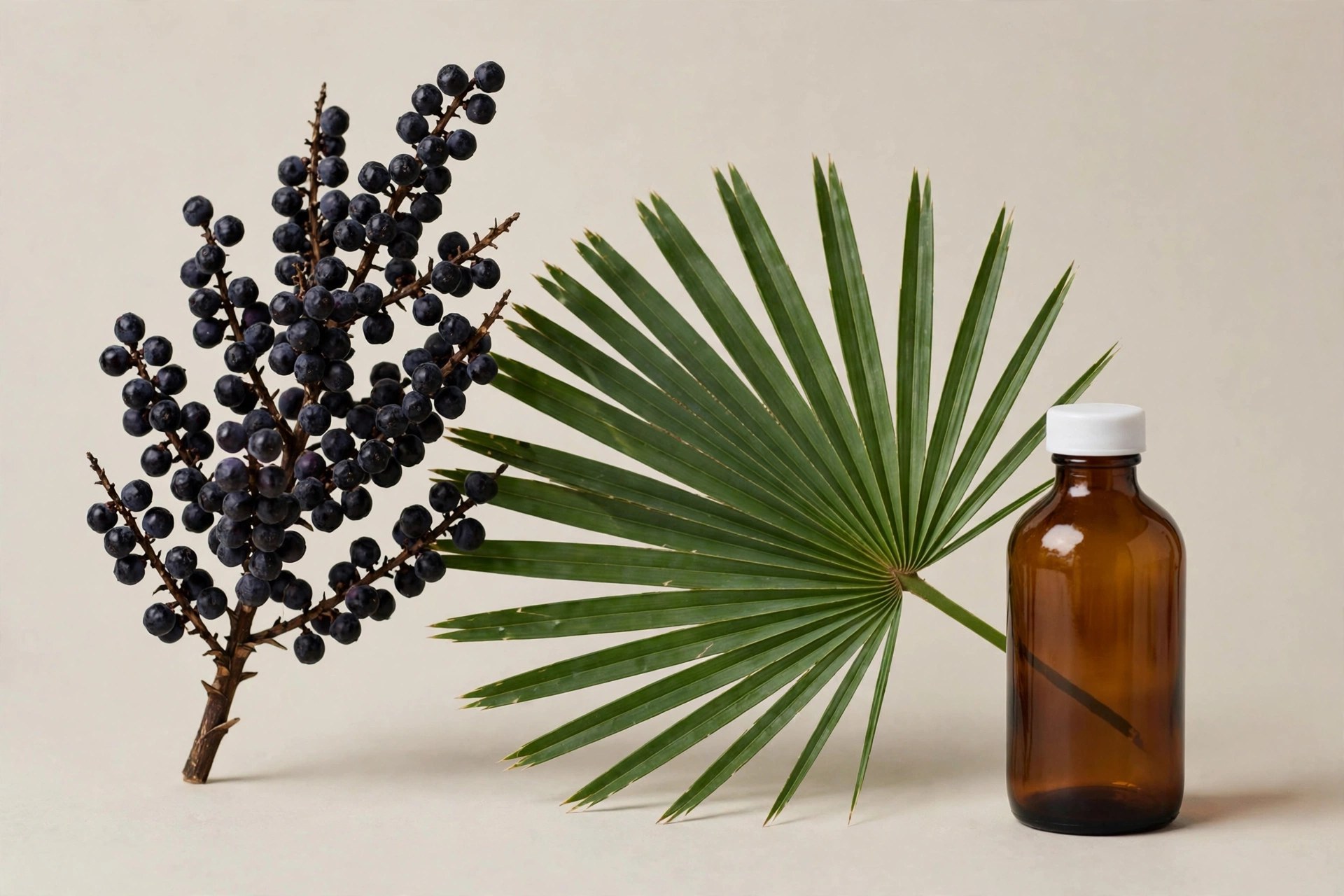
Saw palmetto extract (Serenoa repens) is a fatty-acid-rich berry extract. Its proposed prostate actions — mild interference with the conversion of testosterone to DHT, and anti-inflammatory effects — are outlet-side mechanisms.
The direct bladder rationale comes from animal work. In rat studies, the extract bound muscarinic receptors in the bladder and inhibited vanilloid receptors on bladder sensory nerves.
Those are, on paper, relevant targets: muscarinic receptors drive detrusor contraction (prescription OAB drugs block them), and vanilloid receptors carry the sensory signals that produce urgency.
In hyperactive-bladder rat models, the extract increased bladder capacity and lengthened the interval between contractions. That is a real preclinical signal — the same class of signal that, in supplement research, very often fails to survive human trials.
So the proposal is not absurd. It is a mechanism in search of human evidence. The sections below grade what human evidence exists, condition by condition.
What Happened When It Was Tested for Prostate Symptoms?
The men's data matter here for two reasons: they are the largest and best trials of this extract for any urinary purpose, and their symptom scores include frequency and nocturia — the very endpoints OAB marketing cites.
Bent and colleagues (2006, New England Journal of Medicine) randomised 225 men with BPH to saw palmetto extract 320 mg a day or placebo for a full year. Symptom scores and flow rates improved identically in both groups: no benefit.
The CAMUS trial (Barry and colleagues, 2011, JAMA) answered the "maybe the dose was too low" objection directly. In 369 men, the dose was escalated over 72 weeks from 320 mg to 640 mg, then 960 mg a day.
Even at triple the standard dose, the extract did not beat placebo on the primary symptom score — or on nocturia, flow, prostate size or quality of life. The dose objection has been run, and it failed.
The current Cochrane review of Serenoa repens for BPH, pooling the trial literature, concludes the extract provides little to no benefit for urinary symptoms or quality of life, in the short or long term.
Read those results as an OAB consumer: the symptom of waking at night to urinate was measured, carefully, in hundreds of men, for up to 72 weeks, at up to triple doses — and did not improve beyond placebo. That is the strongest nocturia evidence this ingredient has, and it is negative.
What About the Study in Women?
One trial speaks more directly to bladder symptoms in people without prostates: a multicentre, randomised, double-blind, placebo-controlled study in Japan, published by Yamada and colleagues in Nutrients in 2022.
It enrolled 76 women over 50 with lower urinary tract symptoms — frequent urination, nocturia and/or urgency present for at least two months — and gave them 320 mg of saw palmetto extract or placebo daily for 12 weeks.
The headline result was positive on one measure: the daytime frequency score on the Core Lower Urinary Symptom Score questionnaire was significantly lower in the extract group than on placebo, and the OABSS daytime-frequency item also improved significantly.
That is a real randomised result, and this article reports it as such. It is also — so far — the only one of its kind: a single trial, 76 participants, 12 weeks, one country, one extract.
The history of this ingredient counsels patience with single positive trials. Early small saw palmetto trials in BPH were positive too; the verdict reversed as trials grew larger, longer and better blinded (the extract's distinctive taste and smell make blinding genuinely hard).
Independent replication — different researchers, different populations, ideally a pre-registered design — is what would move this result from "interesting" to "established". It has not happened yet.
Does It Help Urgency Specifically?
Urgency is the defining symptom of OAB and the one sufferers most want relieved. It is also the endpoint with the least support.
In the women's trial, the significant improvements were in daytime frequency. Urgency scores did not produce the headline separation from placebo — a meaningful detail, since frequency and urgency are not interchangeable.
Going often can reflect habit, fluid intake or a small functional capacity; urgency is the bladder's alarm firing early. A remedy can shift the first without touching the second, and only the second defines the condition.
In the men's literature, urgency-type storage symptoms were captured within composite scores across Bent, CAMUS and the Cochrane pool — none of which separated from placebo.
So the accurate statement is narrow: saw palmetto has one small positive trial for daytime frequency in women, and no demonstrated effect on urgency anywhere. Marketing that promises urgency relief is ahead of every dataset that exists.
Does It Help Night-Time Trips?
Nocturia — waking to urinate — is where the sexes' evidence points in opposite directions, and the weighting matters.
In men: measured directly in Bent 2006 and CAMUS 2011, across hundreds of participants and up to 72 weeks, at standard and triple doses. Result: no advantage over placebo. This is as settled as supplement questions get.
In women: the Yamada trial found no overall nocturia separation. A benefit appeared only in a subgroup — women whose baseline questionnaire included a particular bladder-pain/urgency item pattern (CLSS Q5 score of 1 or more).
Subgroup findings are the softest currency in trial reporting. Slice any dataset enough ways and some slice will favour the treatment by chance; that is why subgroups generate hypotheses for new trials rather than conclusions for consumers.
Nocturia also has many causes a berry extract cannot address — sleep apnoea, evening fluid and alcohol, diabetes, heart failure, leg oedema redistributing at night. Persistent night-time trips deserve that differential, not just a supplement.
Weighted honestly: strong negative evidence in men, a tentative subgroup signal in women. "Helps night-time trips" is not a claim this record supports.
Safety and Interactions
Saw palmetto is generally well tolerated. Across the large trials, adverse events tracked close to placebo; the commonest are mild gastrointestinal upset, headache and dizziness.
That tolerability, combined with null efficacy, creates a specific trap: a harmless-feeling product can still do harm by occupying the place of an evaluation. Years of self-treating nocturia can mean years of undiagnosed sleep apnoea or diabetes.
Standard cautions apply: possible additive effects with anticoagulant medicines are the textbook interaction concern, and use in pregnancy is not advised given the extract's hormonal activity in laboratory models.
Quality varies by brand as well — extracts are standardised to fatty-acid content, but the trial extracts (particularly the European hexanic preparation) are specific products, and results — such as they are — do not automatically transfer to every capsule.
What Has Better Evidence for OAB?
First-line OAB care in guidelines is behavioural: bladder training, pelvic floor muscle training, timed voiding, and adjusting caffeine, alcohol and evening fluids. These have randomised-trial support and no systemic side effects.
Where those are insufficient, prescription medicines — antimuscarinics and beta-3 agonists — carry large trial programmes with quantified benefits on urgency and incontinence episodes, and quantified side effects to weigh against them.
That contrast is the fairest summary of saw palmetto's OAB position: the condition has treatments with demonstrated effects on the exact symptom — urgency — that saw palmetto has never been shown to move.
Why Did the Early Saw Palmetto Trials Look Positive?
Understanding this ingredient requires understanding its arc, because the same arc is now the best predictor for how its OAB chapter may end.
Through the 1990s, saw palmetto's BPH literature was encouraging: dozens of small, short trials, many European, reported symptom improvements. The extract was licensed as a medicine in several countries on that basis.
Then the trials grew up. Bent (2006) brought a year of follow-up and rigorous blinding. CAMUS (2011) brought dose escalation. The Cochrane updates brought the whole pool. Each increase in rigour shrank the effect, until it reached zero.
Post-mortems identified the usual suspects: small samples, short durations, and a specific blinding problem — saw palmetto extract has a distinctive taste and odour that can unblind participants, inflating apparent effects in imperfectly masked trials.
Publication bias completed the pattern: positive small trials were published, negative ones filed away, and the visible literature overstated the truth for a decade.
Now place the women's OAB trial on that arc. It is a small, short, single positive trial at the beginning of a new indication — exactly where BPH's literature stood before the rigorous trials arrived. That does not make it wrong. It makes it unproven in a very specific, historically familiar way.
The Branded-Extract Problem
A newer chapter of the marketing deserves its own caution. Trade-press coverage has recently promoted trials of proprietary branded extracts — enhanced-sterol preparations — including a women's bladder study described as "under preparation for publication".
Unpublished data cannot be evaluated. There are no methods to inspect, no numbers to check, no peer review to weigh. A result announced by the ingredient's manufacturer in a trade outlet is advertising with a lab coat on.
Branding adds a second problem: trials of one manufacturer's standardised extract do not validate the generic ingredient. Saw palmetto extracts vary — by extraction solvent, fatty-acid profile and sterol content.
The hexanic extract used in many European trials, the supercritical CO₂ extracts, and the enhanced-sterol branded versions are measurably different products sharing a plant name.
So even a future published positive for a branded extract would license claims for that extract — not for the unbranded capsules that would inevitably borrow its headlines.
Consumers cannot audit any of this from a label. Which is, structurally, the point: in a category where the evidence cannot follow the product home, the marketing always arrives first.
Night-Time Trips: The Causes a Supplement Cannot Reach
Nocturia deserves a fuller differential than supplement pages ever give it, because waking to urinate is a symptom with systemic causes — several of them important.
Sleep apnoea is the great missed one. Airway obstruction strains the heart at night, triggering hormone signals that increase urine production. Treating the apnoea can cut night-time trips in a way no bladder remedy can.
Diabetes — diagnosed or not — raises urine volume around the clock. Heart failure and dependent leg oedema do the nocturnal version: fluid that pooled in the legs all day returns to circulation when lying flat.
Medicines join the list: diuretics taken late, some blood-pressure drugs, and evening alcohol or caffeine all manufacture night-time urine. Sometimes the fix is a timing change, not a new product.
And yes, sometimes it is the prostate, or primary bladder overactivity, or simply age-related changes in bladder capacity and urine concentration rhythms.
A symptom with that differential is not a supplement indication; it is a clinical question. Two or more trips a night, persisting, justify the question being asked properly — especially with snoring, witnessed apnoeas, thirst or swelling in the picture.
If someone takes it anyway
Saw palmetto's tolerability makes it a low-risk experiment for a healthy adult who has had symptoms assessed. The experiment discipline from our other explainers applies unchanged.
Use the studied form and dose (320 mg/day of a defined extract), change nothing else, and track the actual targets — a simple tally of night-time trips and urgency episodes — for the 12 weeks the women's trial ran.
Decide the success threshold in advance. OAB symptoms fluctuate enough that "feels a bit better" will almost always be available as a verdict; the tally is what separates signal from weather.
And keep the exit rule: if the tally has not moved by the review date, the ingredient has given its answer, whatever the next advertisement says.
One Thing Saw Palmetto Does Not Do: Mask PSA
Men evaluating prostate supplements often carry a legitimate worry borrowed from prescription drugs: finasteride and dutasteride halve PSA blood levels, which can mask prostate cancer screening unless the clinician adjusts for it.
Saw palmetto does not share that effect. Across the large trials, including CAMUS at escalating doses, the extract produced no meaningful change in PSA levels.
That is a genuinely reassuring point in its file — one of the few places where the null result is the good news. A man taking saw palmetto is not silently distorting his screening test.
It deserves stating precisely because this article has been critical elsewhere: the criticism is aimed at efficacy claims, and accuracy includes recording where an ingredient is innocent.
The screening caveat that does apply is behavioural, not chemical. A man attributing new urinary symptoms to "just my prostate" and self-treating for years may delay the PSA test and examination that symptoms at his age warrant — whatever he is taking.
Supplements do not mask PSA. Self-diagnosis can mask everything. The distinction is worth the appointment.
Not all extracts in the trials were the same product
One nuance cuts in both directions and deserves a fair sentence. "Saw palmetto extract" names a family of preparations — hexanic, ethanolic and supercritical-CO₂ extracts with different fatty-acid and sterol profiles.
The null mega-trials used specific, well-characterised extracts, which is why their verdicts are strong for those products. Defenders argue other extracts might differ; the burden of that argument is a trial, and for OAB no extract of any type has one beyond the single women's study.
For consumers the implication is blunt: a claim cannot borrow Bent's and CAMUS's rigour for credibility while disowning their results on extract technicalities. The trials are the ingredient's best evidence, whichever way they point.
The Bottom Line
Saw palmetto for overactive bladder rests on a category error and a single small trial. The category error: importing a prostate ingredient into a bladder condition. The trial: 76 women, 12 weeks, daytime frequency improved, urgency unproven, nocturia positive only in a subgroup.
Against that stands the men's record — Bent, CAMUS at triple dose, and a Cochrane review — where the same extract, measured on overlapping symptoms, matched placebo for years of cumulative follow-up.
If future independent trials confirm the women's result, this verdict should change; evidence-first means following the data in both directions. On today's record, urgency relief from saw palmetto is a claim without a dataset.
Frequently Asked Questions
Does saw palmetto help overactive bladder?
It has not been shown to. The only directly relevant trial — 76 women, 320 mg/day, 12 weeks — found improved daytime frequency but no demonstrated effect on urgency, the defining OAB symptom. No trial in men with OAB exists, and men's prostate trials were null.
Will saw palmetto reduce my night-time trips to the bathroom?
In men, the large trials (Bent 2006; CAMUS 2011, up to 960 mg/day for 72 weeks) found no benefit over placebo for nocturia. In women, a benefit appeared only in a subgroup of one small trial. Persistent nocturia has many causes — get it evaluated.
Why is saw palmetto sold for bladder problems if the trials failed?
Because its fame comes from prostate marketing, and urinary symptoms overlap between conditions. Supplement claims do not require proof of efficacy before sale in many markets, so a reputation built in one condition migrates freely into adjacent ones.
Is saw palmetto safe to take?
Generally well tolerated — trials show adverse events close to placebo, mostly mild digestive upset or headache. Cautions: possible interaction with anticoagulants, not advised in pregnancy, and self-treating bladder symptoms for years can delay diagnosis of their real cause.
What dose was used in the women's bladder study?
320 mg of saw palmetto extract once daily for 12 weeks — the same standard dose used in the (null) men's prostate trials. Higher doses have been tested in men up to 960 mg/day without benefit, so "more" is not an evidence-based answer.
Last reviewed: October 2026. This article is educational and is not medical advice.
