
- Quick Answer
- What Is Overactive Bladder?
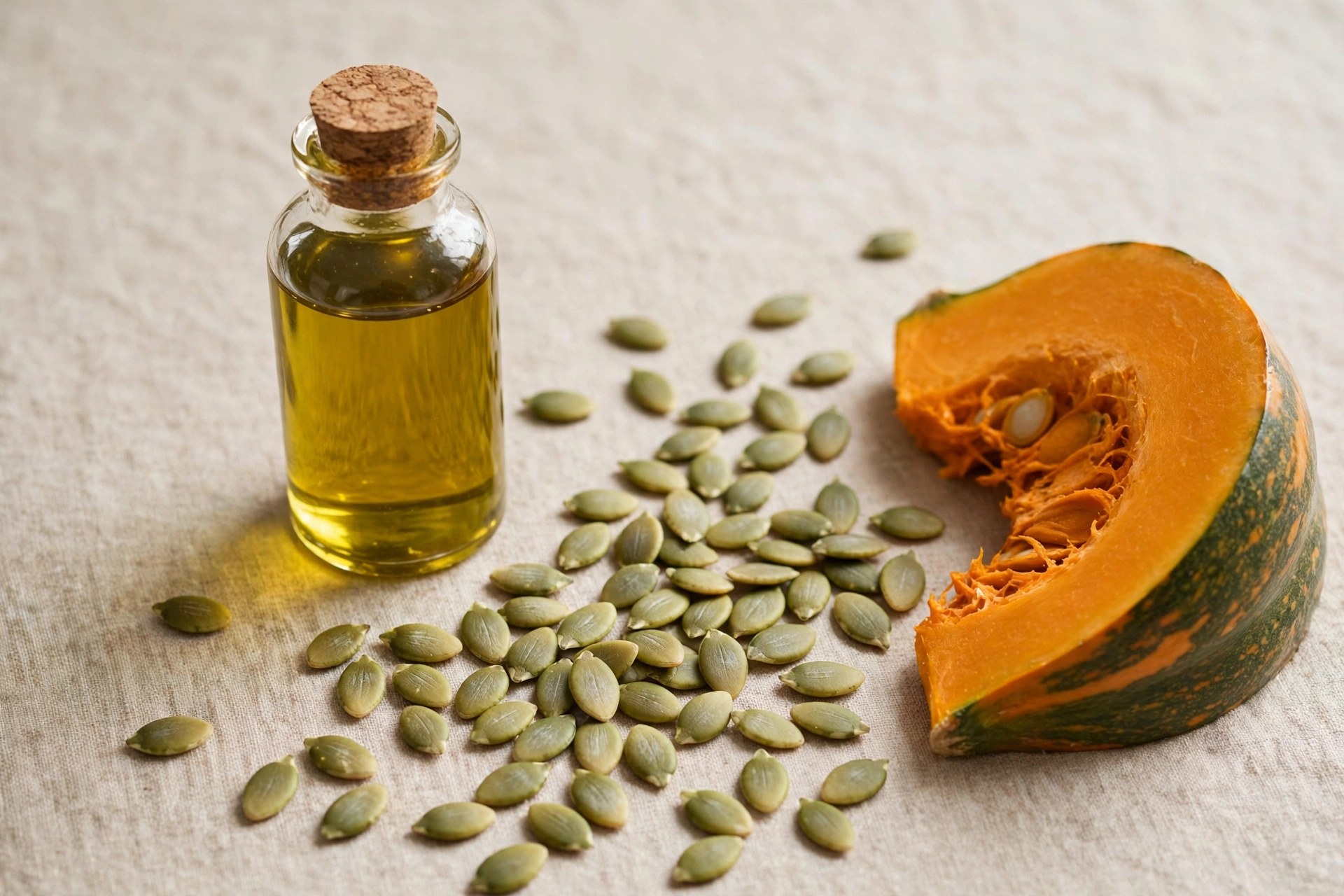
- What Is Pumpkin Seed Oil, and Why Is It Proposed for the Bladder?
- What Did the Main OAB Trial Actually Do?
- What About the Placebo-Controlled Blend Trial?
- What Does the Prostate Evidence Add — and Not Add?
- How Strong Is the Evidence, Honestly Graded?
- Safety and Practical Notes
- What Has Better Evidence for OAB?
- Seed, Oil or Extract: The Forms Are Not Interchangeable
- Why Baseline Comparisons Flatter Bladder Remedies
- The Soy Question: The Blend's Other Half
- What a fair trial would look like
- What About Just Eating Pumpkin Seeds?
- The Bottom Line
- Frequently Asked Questions
- Has pumpkin seed oil been proven to work for overactive bladder?
- How much pumpkin seed oil was used in the studies?
- Is pumpkin seed oil safe?
- What is the difference between the prostate and bladder evidence?
- What should I try first for overactive bladder?
- Read This Next
Quick Answer
The evidence for pumpkin seed oil in overactive bladder consists of small, short studies — the most-cited one had 45 people, no placebo group and no blinding — in which symptom scores improved over 12 weeks.
That is a genuinely positive-looking result inside a design that cannot separate the oil's effect from placebo response, expectation and the natural day-to-day fluctuation of bladder symptoms.
The one placebo-controlled trial in the area tested a proprietary blend of pumpkin seed and soy germ extract, so its result cannot be credited to pumpkin seed alone.
Honest grading: a plausible, apparently safe traditional remedy at the "promising but unproven" stage — several evidence tiers below the prostate data, and nowhere near proof. This article shows the workings.
What Is Overactive Bladder?
Overactive bladder (OAB) is a symptom syndrome defined by urgency — a sudden, hard-to-defer need to urinate — usually with frequency during the day and nocturia (waking at night to urinate), with or without urge incontinence.
It is a bladder storage problem, not an obstruction problem. That distinction matters for this article, because most pumpkin seed research money and history sits on the prostate side of urology.
OAB is common and becomes more so with age, in both sexes. Its symptoms fluctuate naturally — good weeks and bad weeks — which is one reason uncontrolled studies of bladder remedies so easily look positive.
The standard symptom scale in research is the Overactive Bladder Symptom Score (OABSS), which grades daytime frequency, nocturia, urgency and urge incontinence. It is the yardstick the main pumpkin trial used.
What Is Pumpkin Seed Oil, and Why Is It Proposed for the Bladder?
Pumpkin seeds (Cucurbita pepo and Cucurbita maxima) have a long folk history for urinary complaints in European herbal medicine, and the oil pressed from them concentrates their fatty acids and phytosterols.
The sterol fraction — including unusual delta-7 sterols — is the part researchers point to, along with the seeds' traditional use around prostate and bladder symptoms in men.
Proposed bladder mechanisms are preclinical: laboratory and animal work suggesting effects on bladder muscle tone and on the tissues supporting the bladder outlet. Nothing in that literature amounts to a demonstrated mechanism in humans with OAB.
It is worth pausing on how the ingredient reached bladder marketing: largely by adjacency. Pumpkin seed had prostate data (reviewed below), a benign safety profile, and a traditional-use story — a combination that travels easily into adjacent claims.
Adjacency is not evidence. The OAB claim has to stand on OAB trials, so let us look at exactly what those trials were.
What Did the Main OAB Trial Actually Do?
The study behind most of the marketing is Nishimura and colleagues (2014, Journal of Traditional and Complementary Medicine), conducted in Japan.
It enrolled 45 adults with overactive bladder and gave them 10 g of pumpkin seed oil (from Cucurbita maxima) daily for 12 weeks. OABSS was measured at baseline, 6 weeks and 12 weeks.
The results, as reported, were favourable across the board: the total OABSS and every subscore — daytime frequency, nocturia, urgency and urge incontinence — improved significantly at 6 and 12 weeks compared with baseline.
Now the design, which decides how much of that to believe. The trial was open-label: everyone knew they were taking the oil. It was single-arm: there was no placebo group, no comparison treatment, nothing to subtract.
Every improvement is measured against the person's own starting point. In a condition defined by subjective urgency, with symptoms that fluctuate week to week, that design is close to guaranteed to show improvement.
Placebo responses in properly blinded OAB drug trials are famously large — often 30–40% improvements in episode counts. Nishimura's design cannot tell us whether the oil beat that invisible benchmark, matched it, or fell short of it.
The study is best read as a feasibility signal: people took a large daily dose of the oil for 12 weeks, tolerated it, and reported better scores. That justifies a proper trial. It is not one.
What About the Placebo-Controlled Blend Trial?
One randomised, placebo-controlled trial does exist in this space — of a proprietary extract blend sold as Cucuflavone, combining pumpkin seed extract with soy germ extract.
It enrolled 120 patients with overactive bladder for 12 weeks and reported significant advantages over placebo in daytime frequency, urgency episodes, incontinence episodes and nocturia.
A positive placebo-controlled result is exactly what the oil-only literature lacks — but this trial cannot supply it, because the intervention was a blend. Soy germ extract brings its own isoflavones and its own hypothesised effects on the bladder.
Attributing the blend's result to pumpkin seed alone is the same logical move as crediting one instrument for an orchestra's sound. The trial shows a two-ingredient product beat placebo; the contribution of each ingredient is unknowable from it.
So the OAB evidence ledger reads: one small open-label oil study (positive, uncontrolled), one positive blend RCT (unattributable), and no placebo-controlled trial of pumpkin seed oil itself. That is the whole file.
What Does the Prostate Evidence Add — and Not Add?
Pumpkin seed's most rigorous trial is in a different condition: the GRANU study, a 12-month randomised trial in 1,431 men with lower urinary tract symptoms from an enlarged prostate.
Men taking whole pumpkin seed (10 g/day) met the responder definition at 58.5% versus 47.3% on placebo — a modest gap the authors described cautiously. Notably, the standardised pumpkin seed extract arm (1 g/day) did not separate from placebo at all.
An Iranian trial (Zerafatjou and colleagues, 2021) compared pumpkin seed oil (360 mg twice daily) against the drug tamsulosin in men with prostate symptoms: both groups improved over three months, tamsulosin more so, with fewer side effects reported on the oil.
And an early Korean study (Hong and colleagues, 2009) gave 320 mg of oil daily for 12 months and reported symptom improvement against baseline — again, no placebo to compare against.
Useful context — but prostate obstruction and overactive bladder are different mechanisms producing some similar symptoms. A remedy easing a narrowed outflow says nothing reliable about calming an overactive detrusor muscle.
If anything, the prostate data carry a warning for the OAB claim: when pumpkin seed finally met a large, rigorous, placebo-controlled design, the extract form failed to beat placebo. Rigor has not been this ingredient's friend.
How Strong Is the Evidence, Honestly Graded?
On the standard evidence ladder — case reports and tradition at the bottom, large blinded RCTs at the top — pumpkin seed oil for OAB sits near the bottom rungs with human data.
What exists: traditional use, mechanistic speculation, one 45-person open-label study, and one positive trial of a two-ingredient blend. What does not exist: any blinded, placebo-controlled trial of the oil itself, at any size, in any population.
Effect sizes quoted in marketing ("reduced night-time trips by X%") are drawn from the uncontrolled study, measured against baseline, in a fluctuating condition with a huge known placebo response. Those percentages describe what happened, not what the oil caused.
None of this proves the oil does nothing — absence of good evidence is not evidence of absence. It means anyone claiming it works is claiming more than the record holds, and the record is old enough that the missing trial is a choice, not an oversight.
Safety and Practical Notes
Safety is the ingredient's strongest suit. Pumpkin seed oil is a food oil; in trials it was well tolerated, with no pattern of serious adverse effects at the doses used.
The studied OAB dose deserves attention, though: 10 g of oil a day is roughly two teaspoons — about 90 extra calories daily — not the few drops or single small capsule many commercial products imply.
Products on the market vary enormously in dose and species (C. maxima in the OAB study; C. pepo in most prostate work), another gap between the evidence and the shelf.
Allergy to pumpkin or other cucurbits is the main individual caution. And bladder symptoms can flag other conditions — infection, diabetes, prostate problems, occasionally worse — so new or worsening symptoms warrant a medical workup before a supplement trial.
What Has Better Evidence for OAB?
Guideline first-line treatment for OAB is behavioural, not supplemental: bladder training (gradually extending the interval between voids), pelvic floor muscle training, and managing fluid timing and bladder irritants such as caffeine and alcohol.
These approaches have randomised-trial support and are the recommended starting point in the American Urological Association's OAB guideline, before medication is considered.
When behavioural measures are not enough, prescription options with substantial trial programmes exist — antimuscarinics and beta-3 agonists — with known effect sizes and known side-effect trade-offs, which is more than can be said for any supplement in this space.
None of that forbids trying a benign food oil with open eyes. It does set the order: proven measures first, unproven ones as adjuncts, and persistent symptoms reviewed rather than endlessly self-treated.
Seed, Oil or Extract: The Forms Are Not Interchangeable
Pumpkin reaches consumers as whole seeds, cold-pressed oil, and standardised extracts — and the evidence treats those forms as different interventions, because they are.
The GRANU trial is the standing demonstration: in the same population, over the same 12 months, whole seed modestly beat placebo while the standardised extract did not separate from it at all.
Whatever the seed provides — the full matrix of oil, sterols, protein and fibre — the 1 g extract capsule apparently did not reproduce. Concentration changed the intervention, not just the convenience.
Now map that lesson onto OAB products. The single OAB study used 10 g of whole oil daily. The capsules on most shelves deliver a few hundred milligrams of oil or extract — a tenth or less of the studied exposure.
Even if the open-label result were taken at face value, it would describe an outcome at a dose and in a form that most products do not match. The form gap is this category's quiet disqualifier.
It also cuts the other way for fairness: a future trial of low-dose capsules that failed would not refute the 10 g oil question. Each form owes its own evidence — and so far, only the oil has any, of the weakest design.
Why Baseline Comparisons Flatter Bladder Remedies
It is worth understanding the machinery that makes uncontrolled bladder studies look positive, because the same machinery inflates much of the supplement literature.
First, the placebo response in OAB is among the largest in medicine. In blinded drug trials, placebo groups routinely record 30–40% reductions in incontinence episodes and meaningful score improvements.
Second, regression to the mean: people enrol in studies — and start remedies — when symptoms are at their worst. Fluctuating conditions then improve on average whatever is taken.
Third, study participation itself changes behaviour. Keeping a bladder diary, attending appointments and being asked about fluids quietly trains exactly the habits that first-line therapy teaches.
An open-label, single-arm design captures all three effects and labels the sum as the treatment's result. Nishimura's improvements are real numbers; what they are numbers of is precisely what the design cannot say.
This is not a technicality reserved for statisticians. It is the difference between "scores improved while taking it" — true — and "it improves scores" — unproven. Marketing lives in the gap between those two sentences.
The Soy Question: The Blend's Other Half
Because the one placebo-controlled trial used a blend, its second ingredient deserves a paragraph of its own — both to be fair to the result and to show why blends frustrate science.
Soy germ extract is rich in isoflavones — plant compounds with weak oestrogen-like activity. The bladder rationale is not fanciful: bladder and pelvic tissues are hormone-responsive, and postmenopausal changes are part of the OAB story in women.
So the Cucuflavone result has two live candidate explanations — pumpkin, soy, or the combination — and the trial's design cannot arbitrate between them. Any of the three could be true; the marketing invariably selects pumpkin, the ingredient with the brand recognition.
This is the structural flaw of blend research: a positive result that cannot be decomposed teaches the field almost nothing, while giving every ingredient in the blend a lifetime of borrowed credibility.
Proprietary blends are, from a manufacturer's perspective, a feature — the formula is protectable and the halo is shared. From an evidence perspective, they are where knowledge goes to stop accumulating.
What a fair trial would look like
The study that would settle pumpkin seed oil's OAB question is neither exotic nor expensive by pharmaceutical standards. Its absence is a choice the market keeps making.
It would randomise a few hundred adults with diagnosed OAB to the studied oil dose (10 g/day) or an identical-looking, identical-tasting placebo oil, for at least 12 weeks.
Its outcomes would be objective where possible: voiding diaries counting frequency, nocturia episodes and incontinence, alongside OABSS — with the analysis pre-registered so endpoints cannot be chosen after the fact.
Until a trial of roughly that shape reports, every claim about pumpkin seed oil and overactive bladder should be read with the same suffix: "in a study that could not separate the oil from the placebo effect".
What About Just Eating Pumpkin Seeds?
Given the GRANU result — whole seed modestly beating placebo where extract failed — the food question is fair: is snacking on pumpkin seeds a bladder strategy?
For OAB specifically, no trial has tested eating the seeds. GRANU's population had prostate symptoms, its dose was a defined 10 g a day for a year, and its endpoint was prostate symptom response.
As food, pumpkin seeds need no trial to justify themselves: they provide magnesium, zinc, unsaturated fats and protein in a satiating package, and they displace worse snacks.
That is the correct category for them — a nutritious food with a traditional urinary reputation and one encouraging prostate trial behind the whole-seed form.
The supplement industry's move is to convert that modest, food-level story into concentrated pills with disease-level claims. Each step of concentration has, in this ingredient's own data, weakened rather than strengthened the effect.
If the story of pumpkin seed teaches anything general, it is that "eat the food" and "take the extract" are different interventions with different evidence — and the food's evidence is currently the better of the two.
The Bottom Line
Pumpkin seed oil for overactive bladder is a traditional remedy with a thin modern file: one small open-label study showing improved scores it cannot attribute, one positive trial of a blend it cannot claim, and rigorous prostate data that counsel humility.
Its safety profile is genuinely good, and if the missing placebo-controlled trial is ever run, the question will finally have an answer worth the name.
Until then, the accurate label is "unproven" — and any product page stating its OAB benefits as established fact is describing the marketing record, not the evidence record.
Frequently Asked Questions
Has pumpkin seed oil been proven to work for overactive bladder?
No. The most-cited study (Nishimura 2014) was open-label with no placebo group — 45 adults, 10 g/day, 12 weeks, scores improved versus baseline. The only placebo-controlled trial tested a pumpkin-and-soy blend, which cannot be credited to pumpkin seed alone.
How much pumpkin seed oil was used in the studies?
The OAB study used 10 g a day of Cucurbita maxima oil — about two teaspoons — for 12 weeks. Prostate studies used far less in capsule studies (320–720 mg/day) or 10 g/day of whole seed in the large GRANU trial.
Is pumpkin seed oil safe?
It is a food oil with a good trial safety record and no pattern of serious side effects. The main cautions are cucurbit allergy and the ~90 kcal in a 10 g daily dose. New or worsening bladder symptoms should be medically assessed first.
What is the difference between the prostate and bladder evidence?
The large, rigorous trials are in prostate (BPH) symptoms — and there, whole seed modestly beat placebo while a standardised extract did not. OAB is a different mechanism, and its evidence is far weaker: no placebo-controlled trial of the oil itself exists.
What should I try first for overactive bladder?
Guideline first-line care is behavioural: bladder training, pelvic floor exercises, and adjusting fluid timing and irritants like caffeine. These have trial support. If symptoms persist, prescription options with large evidence bases exist — discuss them with a clinician.
Last reviewed: October 2026. This article is educational and is not medical advice.
