
- Quick Answer
- What is valerian root?
- What did the reviews actually find?
- The optimistic file
- The strict file
- Why do the regulators disagree about it?
- What dose did the trials use?
- Why does valerian take weeks to work?
- Is valerian root safe?
- Tea, tincture or extract: does the form matter?
- What about valerian for anxiety?
- How to run a fair trial of valerian on yourself
- What did the sleep-lab studies actually see?
- Valerian and driving, work and next-day function
- One population with a cleaner positive trial: postmenopausal women
- The standardisation problem, up close
- Frequently Asked Questions
- How long before bed should I take valerian?
- What is the right valerian dose for sleep?
- Is valerian better than melatonin?
- Can I take valerian every night?
- Does valerian cause a hangover effect?
- Who should avoid valerian?
- Can valerian help with anxiety as well as sleep?
- Why does valerian smell so bad?
- Can I take valerian and melatonin together?
- Is valerian addictive?
- Read This Next
Quick Answer
Valerian root probably improves how people rate their sleep — and the sleep laboratory mostly cannot see why. That split verdict has survived two decades of reviews and is the honest summary of its evidence.
The most-cited meta-analysis found people taking valerian were about 1.8 times as likely to report improved sleep quality as people on placebo — while flagging that the underlying studies were weak and probably publication-biased.
On objective measures the effect nearly vanishes: one meta-analysis put the difference in time taken to fall asleep at 0.7 minutes against placebo, inside the margin of error.
Trials used 300 to 600 mg of root extract, taken 30 to 60 minutes before bed, for two to four weeks. Its safety record is genuinely good — which is why it survives as a reasonable experiment for mild sleep trouble, and also why you should expect a nudge, not a transformation.
What is valerian root?
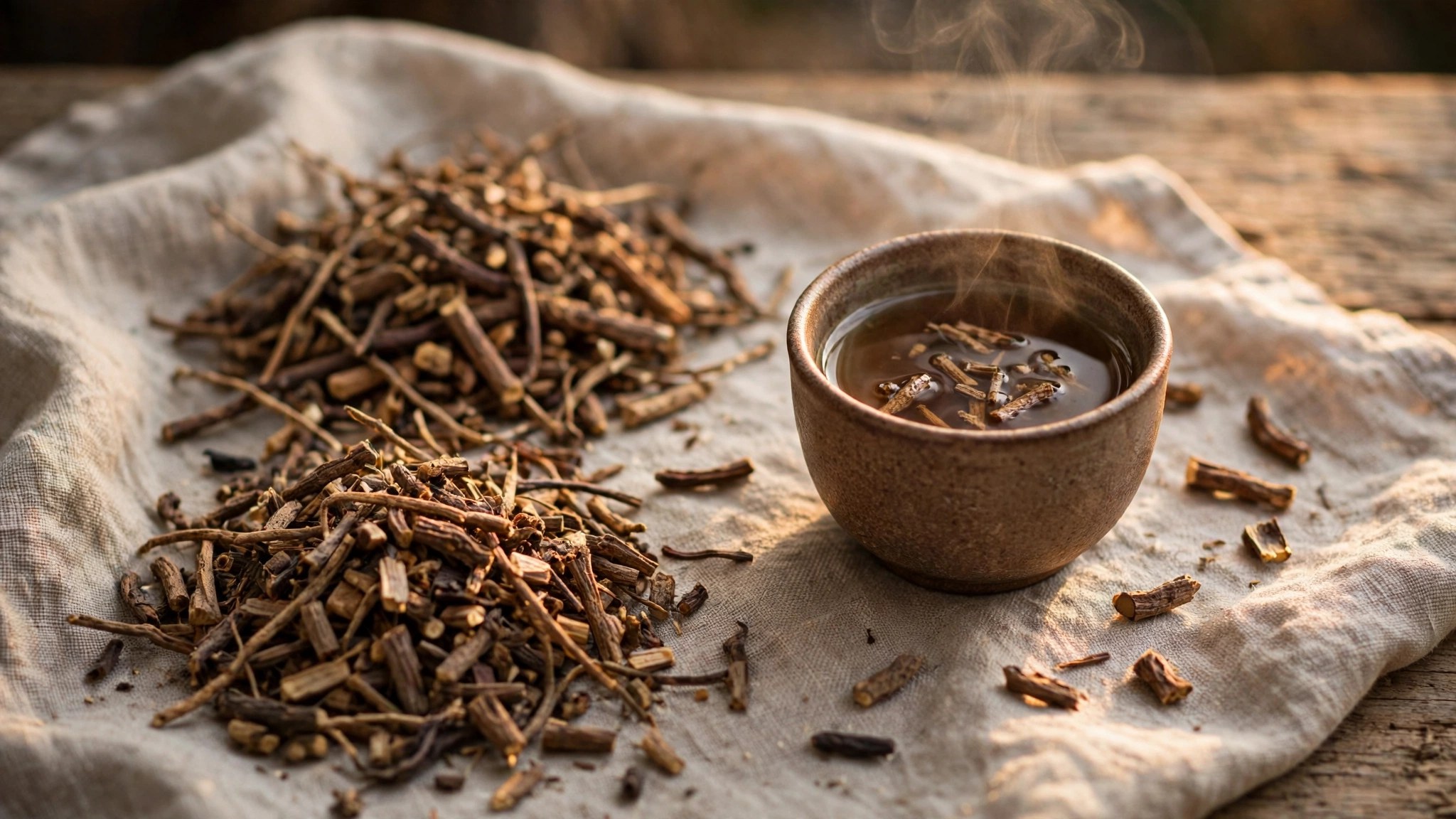
Valerian is a flowering plant (Valeriana officinalis) whose root and rhizome have been used as a calming preparation since at least the era of Greek and Roman medicine.
Modern products are usually extracts of that root, standardised — in the better ones — to their valerenic acid content. Valerenic acid is the constituent most often credited with the calming effect.
The proposed mechanism involves GABA, the brain's main inhibitory messenger. Valerenic acid appears to slow GABA breakdown and interact with certain GABA-A receptors.
Note the wording: interacts with certain receptors. It does not bind the same site as benzodiazepine sleeping drugs, and it does not produce their effect profile. Pages implying valerian is "nature's Valium" are marketing, not pharmacology.
The root is also famously unpleasant-smelling — often compared to old socks — because of isovaleric acid. Capsules exist largely to route around that fact.
What did the reviews actually find?
The optimistic file
The optimistic case rests on Bent and colleagues' 2006 systematic review and meta-analysis in the American Journal of Medicine: 16 randomised trials, 1,093 participants.
Its headline result: people taking valerian were about 1.8 times as likely to report improved sleep quality as those on placebo, without a hangover-style side-effect burden.
The same paper carried the caveat its quoters usually drop: most of the included studies had methodological problems, and the pattern of results suggested publication bias — positive trials get published, null ones quietly disappear.
A larger 2020 review by Shinjyo and colleagues, spanning 60 studies, softened rather than overturned that picture: a small, fairly consistent benefit on subjective sleep quality and anxiety, with better results from higher-quality extracts.
The strict file
Now the other drawer. When Fernández-San-Martín and colleagues pooled the trials that measured sleep latency in 2010, the difference between valerian and placebo was 0.7 minutes.
Taibi and colleagues' 2007 review of 37 studies concluded valerian is safe but that the most rigorous recent trials showed no significant effect on sleep.
A 2024 umbrella review — a synthesis of eight systematic reviews — landed in the same place: good safety, subjective improvement, no confirmation on objective measures.
Hold both files at once and the pattern is consistent: people on valerian reliably feel they slept better; polysomnography reliably struggles to show where the improvement lives.
That gap does not make the benefit fake — sleep quality is partly a perception, and perceiving better sleep has value. It does cap what anyone honest can promise you.
Why do the regulators disagree about it?
In 2017, the American Academy of Sleep Medicine's pharmacologic guideline (Sateia and colleagues) suggested that clinicians not use valerian for chronic insomnia in adults — a weak recommendation, but a negative one.
The European Medicines Agency, by contrast, recognises standardised valerian root preparations for mild nervous tension and mild sleep problems, while stressing that the effect builds gradually.
These are not the contradiction they appear. The AASM was answering: "should doctors prescribe this as a treatment for diagnosed chronic insomnia?" The EMA was answering: "is traditional use for mild, self-limiting sleep trouble acceptable?"
Different questions, different evidence bars, two defensible answers. Our reading: valerian's file fits the second question far better than the first.
What dose did the trials use?
Most controlled trials used 300 to 600 mg of a root extract, taken 30 to 60 minutes before bed.
Some trials went to 900 mg. The higher end did not add benefit, and in at least one study it added next-morning grogginess that 600 mg did not produce.
Standardisation is the quiet variable. European pharmacopoeial extracts are commonly specified around 0.8 percent valerenic acid; many products elsewhere state no standardisation at all, and independent testing of herbal products routinely finds wide variation between brands.
Two more practical details from the trial record. Combinations — valerian with hops, or with lemon balm — produced more consistent results in several head-to-head comparisons than valerian alone.
And if nothing has changed after about four weeks of consistent use at a standard dose, the trial record gives no reason to escalate. The dose-response curve in this literature is flat, not promising.
Why does valerian take weeks to work?
Single doses have an inconsistent record: in healthy sleepers, one night of valerian usually does not shorten the time to fall asleep in any measurable way.
The positive subjective results cluster in trials that dosed nightly for two to four weeks. Something about repeated use — or about the ritual and expectation built over a fortnight — is doing part of the work.
The EMA's monograph position matches: valerian is described as having a gradual onset and as unsuitable for acute, one-off use.
Set expectations accordingly. Valerian is a two-to-four-week experiment with a diary, not a tonight solution. Judge it on your sleep ratings across the last week of the trial, not on night one.
Is valerian root safe?
The safety record is the strongest part of valerian's file — the 2024 umbrella review confirmed it across the whole literature.
Reported side effects are usually mild: headache, stomach upset, a groggy morning at higher doses, and vivid dreams in some users.
A minority of people get the opposite of calm — restlessness or stimulation instead of sedation. If a calming herb winds you up, that is a stop signal, not a dosing puzzle.
The serious warnings are about combinations. Valerian adds to the effect of alcohol, sedative medicines and anaesthesia; it should not be mixed with them casually, and surgical teams generally want to know about it in advance.
Case reports describe withdrawal-like symptoms after abrupt stopping in people who used high doses for a long time. Tapering after months of nightly use is the cautious route.
Liver injury appears in the case literature mostly attached to multi-herb products containing other suspect ingredients; valerian alone has not been established as the culprit. Pregnancy and breastfeeding lack safety data — the standard advice is to avoid it.
Tea, tincture or extract: does the form matter?
The trials behind the reviews above used standardised root extracts in capsules. The shelf offers at least three other forms, and the distance between them and the evidence is rarely printed.
Valerian tea is the traditional preparation — hot water over dried root. It delivers an unstandardised, generally lower dose, and demands tolerance for the smell, which hot water does nothing to hide.
Tinctures concentrate the root in alcohol, with dropper dosing that varies by maker. Alcohol-based preparations also sit awkwardly beside the rule about not combining valerian with sedating substances.
Combination products — valerian plus hops, lemon balm, passionflower or melatonin — are the commonest retail form of all. Recall that the combinations sometimes outperformed valerian alone in trials; also recall that a blend makes the active variable unknowable.
If you want your experiment to resemble the literature, the choice is boring: a single-ingredient extract, standardised to valerenic acid, at 300 to 600 mg. Everything else is a different experiment with a thinner file.
What about valerian for anxiety?
Valerian's traditional use covers nervous tension as well as sleep, and the EMA recognition spans both. The anxiety evidence is smaller than the sleep evidence — a handful of small trials and the secondary anxiety findings inside the 2020 review.
Shinjyo and colleagues' 2020 synthesis noted a mild anxiolytic signal alongside the sleep-quality one, from studies of generally modest quality.
The practical relevance is narrow but real: the reader whose insomnia is driven by a wired, tense evening is the reader whose problem most resembles what valerian was ever for.
It is not a treatment for an anxiety disorder, and the gap between "takes the edge off a tense evening" and "treats generalised anxiety" is exactly the gap this site exists to keep visible.
How to run a fair trial of valerian on yourself
Because the expected effect is small and subjective, an unstructured try will tell you nothing — placebo response and a fortnight of earlier nights will happily impersonate a result.
Run it the way the trials did. Fix the dose at 300 to 600 mg of a standardised extract, 30 to 60 minutes before a fixed bedtime, every night for at least two weeks and ideally four.
Rate each morning, in a note you will actually keep: time to fall asleep as best you can judge it, number of wakings, and a 1-to-10 sleep-quality score. The third number is the one the literature says might move.
Change nothing else during the trial — no new caffeine rules, no new screens policy — or you will credit the herb for the hygiene.
Decide by the last week's average, not by the best night. And pre-commit to the exit: if four weeks at a proper dose moved nothing, the trial record says escalation will not rescue it. Stop, and take the problem to a clinician with your diary in hand — that diary is genuinely useful to them.
What did the sleep-lab studies actually see?
The subjective/objective split deserves one level more of detail, because "labs can't see it" is easy to overstate into "nothing happens".
Polysomnography studies of valerian are few and small. One frequently cited experiment gave 600 mg to poor sleepers for a single night and recorded more slow-wave sleep and less light stage-1 sleep — a shift towards deeper architecture.
Other lab studies found no significant change in sleep onset or structure. The fair summary is that the objective file is not empty; it is inconsistent, underpowered and unable to agree with itself.
That distinction matters for how you weight valerian against its rivals. Subjective-only evidence is weak evidence — but a small objective literature pointing in different directions is a different thing from a large one pointing nowhere.
It also explains why the reviews keep landing on "more research needed" after twenty years: the decisive trial — hundreds of participants, standardised extract, objective plus subjective endpoints, a month of dosing — has simply never been funded into existence.
Until it is, the rational position is the one this article opened with: a safe, cheap, modest experiment for mild trouble, judged on your own ratings, with a pre-set stopping point.
Valerian and driving, work and next-day function
Next-morning performance was one of the original selling points: early studies comparing valerian with conventional sedatives found no morning-after impairment of reaction time or concentration at standard doses.
That finding has held up reasonably — the Bent meta-analysis noted the absence of the hangover profile that defines benzodiazepine mornings.
Two qualifications keep it honest. The 900 mg trial data did show morning grogginess, so the clean record belongs to the 300–600 mg range. And individual paradoxical stimulation exists: a minority feel wired rather than rested, which is its own kind of impairment.
The practical rule mirrors alcohol guidance in miniature: learn your own response on a night when the next morning does not matter before trusting it on one that does.
One population with a cleaner positive trial: postmenopausal women
Buried in the valerian literature is a subgroup result worth surfacing, because it shows the shape positive valerian data takes when it appears.
A randomised trial in postmenopausal women with insomnia used 530 mg of valerian extract daily for four weeks and found a significant improvement in sleep-quality scores against placebo.
Postmenopausal sleep disruption is its own clinical territory — vasomotor symptoms fragment the night — so the result does not automatically generalise to a stressed 30-year-old man.
But note its features: a defined population, a defined extract, a month of nightly dosing, and a subjective endpoint. That is the template of nearly every positive valerian finding, and of none of the miraculous ones.
The standardisation problem, up close
Two bottles both labelled "valerian root extract 600 mg" can be meaningfully different products, and this is not a hypothetical.
Valerenic acid content varies with the plant material, the extraction solvent and the manufacturer's discipline. Pharmacopoeial standards exist — the roughly 0.8 percent valerenic-acid specification used for European extracts — but nothing forces a US supplement onto that standard.
Independent analyses of herbal products routinely find wide inter-brand variation in marker compounds, and valerian has appeared in that literature. The trial record, built on characterised extracts, transfers imperfectly to uncharacterised ones.
Practical consequences: buy standardised, stay with one product for your whole self-trial, and do not interpret a null result on an unlabelled extract as a verdict on the plant.
This is, admittedly, an unsatisfying consumer position — "the evidence is modest and the products are inconsistent" — but it is the accurate one, and it prices valerian correctly: as a cheap experiment, not a therapy.
Frequently Asked Questions
How long before bed should I take valerian?
Trials used 30 to 60 minutes before bed. But the timing matters less than the calendar: expect to judge it after two to four weeks of nightly use, not after the first night.
What is the right valerian dose for sleep?
The studied range is 300 to 600 mg of root extract. Doses around 900 mg did not improve outcomes and added morning grogginess in at least one trial. A product standardised for valerenic acid content gives you the only meaningful potency reference.
Is valerian better than melatonin?
They do different jobs — melatonin is a timing signal for falling asleep, valerian a slow-building calming herb for sleep quality. We compare them problem by problem in our valerian vs melatonin article.
Can I take valerian every night?
Trials ran nightly for up to about six weeks with a good safety record. Long-term nightly safety data beyond that are limited, and case reports of withdrawal-like symptoms after abrupt stopping argue for tapering rather than quitting suddenly after long use.
Does valerian cause a hangover effect?
Usually not at 300 to 600 mg — the absence of morning impairment was one of Bent 2006's noted findings. At 900 mg, next-morning grogginess has been reported.
Who should avoid valerian?
Pregnant and breastfeeding women (no safety data), anyone combining it with alcohol or sedative medication, people scheduled for surgery unless their team knows, and anyone it stimulates rather than calms.
Can valerian help with anxiety as well as sleep?
Possibly, mildly. The 2020 review literature includes a small anxiolytic signal alongside the sleep findings, and European regulators recognise traditional use for mild nervous tension. It is not a treatment for a diagnosed anxiety disorder.
Why does valerian smell so bad?
Isovaleric acid, a compound in the root also found in sweaty socks and certain cheeses. The smell is normal, increases as the root ages, and is the main reason capsules outsell the raw herb. It is not a sign of spoilage by itself.
Can I take valerian and melatonin together?
There is no proper trial of the combination, so no measured benefit or interaction exists to cite. The cautious reading is additive drowsiness, plus a methodological one: combining a same-night signal with a weeks-long herb makes it impossible to tell what helped. Our valerian vs melatonin comparison works through the matching logic.
Is valerian addictive?
It is not classified as dependence-forming, and it does not produce benzodiazepine-style dependence — the pharmacology differs at the receptor level. The honest caveat is the case-report literature on withdrawal-like symptoms after abrupt cessation of long-term high-dose use, which argues for tapering after months of nightly use rather than assuming a clean stop at any dose.
Last reviewed: October 2026. This article is educational and is not medical advice.
