
- Quick Answer
- Why is turmeric plausible for acne at all?
- What is the bioavailability problem?
- What have human studies actually tested?
- The photodynamic study — real result, wrong inference
- Gels and oral adjuncts — small and early
- What is not in the file
- What about the numbers you will see elsewhere?
- Topical or oral: what can each realistically do?
- Is turmeric safe on skin and by mouth?
- Where does turmeric sit next to proven treatments?
- How much curcumin is actually in turmeric?
- How to run a fair home trial, if you run one
- Which kind of acne could turmeric plausibly suit?
- Can turmeric be combined with real acne treatments?
- What do dermatologists actually say about it?
- Frequently Asked Questions
- Does turmeric cure acne?
- How long would turmeric take to show any effect?
- Is a turmeric face mask worth trying?
- Turmeric or curcumin — is there a difference?
- Can I take turmeric supplements for acne instead?
- Does turmeric help acne marks and dark spots?
- Can turmeric make acne worse?
- Does turmeric work for back and body acne?
- Is golden milk or turmeric tea good for skin?
- Read This Next
Quick Answer
Turmeric's active compound, curcumin, does things in a laboratory that are genuinely relevant to acne: it damps the inflammatory signalling that makes spots red and swollen, and it inhibits the acne bacterium in vitro.
The problem is delivery. Swallowed curcumin barely reaches the blood, let alone the skin, and curcumin smeared on skin penetrates poorly and breaks down in light. The gap between the mechanism and the face mask is where most claims quietly die.
Human evidence consists of small, early, formulation-specific studies — a light-activated curcumin treatment, a gel trial, an oral adjunct pilot. None of it tests kitchen turmeric, and none of it puts turmeric anywhere near the evidence tier of standard acne treatments.
Verdict: a plausible adjunct experiment for mild inflammatory acne, with a staining problem and a patch-test requirement — not a treatment, and not a reason to delay one.
Why is turmeric plausible for acne at all?
Acne has four drivers: excess sebum, blocked pores, the bacterium Cutibacterium acnes, and inflammation. The red, painful spot is mostly the fourth — an inflammatory response.
Curcumin's best-documented action is anti-inflammatory. It inhibits NF-κB, a master switch for inflammatory cytokines including IL-1β and TNF-α — the same signalling family acne lesions run on.
In laboratory work, curcumin also shows antibacterial activity against C. acnes and antioxidant effects. That is a coherent mechanism story, and it explains turmeric's long traditional use on skin in Ayurvedic practice.
But grade the evidence types honestly. Cytokine pathways and petri dishes are hypothesis-grade evidence: they tell you a compound deserves trials, not that a treatment works.
Our acne coverage applies one rule to every ingredient — zinc, lactoferrin, now turmeric: a percentage is only meaningful attached to its endpoint, its population and its formulation. Turmeric's claims face that rule next.
What is the bioavailability problem?
Curcumin is notoriously badly absorbed. Swallowed plain, very little reaches the bloodstream intact: it dissolves poorly in water, is metabolised rapidly in the gut and liver, and is eliminated fast.
Blood levels after ordinary turmeric powder — in food, golden milk or a basic capsule — are low enough that researchers question whether meaningful amounts reach peripheral tissues like skin at all.
The famous workaround is piperine, the black-pepper alkaloid. A small 1998 study by Shoba and colleagues found piperine increased curcumin's measured bioavailability dramatically in humans — the source of the "2,000 percent" figure repeated everywhere.
Read that figure the way we teach in our other audits: a large percentage of a very small base, in a small study, for a specific extract pairing. It says absorption can be raised; it does not say acne improves.
Topical use has its own version of the problem. Curcumin is fat-soluble yet penetrates the skin barrier poorly, and it degrades on exposure to light — a paste on your face is delivering less, for less long, than the ingredient list suggests.
What have human studies actually tested?
The photodynamic study — real result, wrong inference
The most striking numbers in this literature come from a split-face study of curcumin-based photodynamic therapy: one side of each participant's face received curcumin plus a specific therapeutic light, the other light alone.
The curcumin side cleared 54.7 percent of total lesions against 28.1 percent on the light-only side. For inflamed lesions specifically — the endpoint that matters for red, sore acne — the figures were 59.3 percent versus 36.5 percent.
Those are real, endpoint-named results, and they support the anti-inflammatory mechanism. What they do not support is any conclusion about masks or supplements: this was a clinic treatment using light to activate the compound.
Gels and oral adjuncts — small and early
A small randomised trial of a gel containing 1 percent curcumin reported significant reductions in inflammatory lesion counts over eight weeks against a placebo gel.
A separate pilot combined oral curcumin with standard acne treatment and found larger lesion reductions than standard treatment alone.
Both findings are the right shape and the wrong size: small samples, short runs, specific formulations, no large replication. In evidence terms they are invitations to do a proper trial, and that trial has not been done.
A 2016 systematic review by Vaughn and colleagues gathered the clinical literature on turmeric and curcumin across skin conditions and found statistically significant improvements in a subset of studies — spanning psoriasis, eczema, photoaging and itching as well as acne. Skin generally, in other words, is more studied than acne specifically.
What is not in the file
No trial tests turmeric paste, turmeric tea or a generic turmeric capsule as a standalone acne treatment. No acne guideline — including the American Academy of Dermatology's — lists turmeric among recommended therapies.
That absence is the finding. An ingredient can be mechanistically plausible, traditionally beloved and commercially everywhere, and still have an empty chair where its clinical evidence should be.
What about the numbers you will see elsewhere?
Search this topic and you will meet confident tables: a percentage reduction in lesions, an improvement rate, attributed to a famous institution or journal. Some of those tables do not survive thirty seconds of checking.
The tell-tale pattern, which our competitor research has documented across acne ingredients: a precise percentage with no endpoint named (reduction in what — total lesions? inflammatory lesions? severity scores?), no population, and a citation that dissolves when you look for the paper.
The same pattern has attached a fermented-milk trial's results to a different ingredient entirely in lactoferrin marketing, and inflated a real 28.5 percent total-lesion reduction into a "94 percent" headline elsewhere in this category.
Apply the house rule to turmeric claims: no endpoint, no population, no formulation — no belief. The photodynamic numbers above pass that test; most turmeric tables online do not.
Topical or oral: what can each realistically do?
Topical is the more defensible route for a home experiment, because it at least puts the compound at the site — calming surface inflammation in mild, red, superficial breakouts is the realistic ceiling.
Expect a mask to behave like a mild soothing cosmetic, not like a retinoid. It does nothing for blocked pores, nothing proven for bacteria in living skin, and nothing for hormonal drivers.
Oral turmeric faces the absorption wall described above. Without an enhanced formulation, systemic anti-inflammatory effects at skin level are speculative.
With an enhanced (piperine or otherwise bioavailability-boosted) formulation, you have absorption data and an acne-evidence gap — a combination worth recognising, because it describes half the supplement shelf.
Either way, moderate-to-severe acne — deep, cystic, scarring — is outside this conversation. Scarring is permanent in a way breakouts are not, and delaying effective treatment for scarring acne is the costliest error in this whole category.
Is turmeric safe on skin and by mouth?
The signature side effect is cosmetic but real: turmeric stains. Skin can stay yellow-tinged for hours after a mask, and fabrics fare worse. It is temporary and it is not a rumour.
Contact dermatitis is documented — redness, itching and irritation, particularly with concentrated or repeated application, and in people reactive to related plants. A patch test behind the ear or on the inner arm, 24 hours before a full application, is the standard precaution.
Oral turmeric in food amounts is a spice with a long safety history. Supplement doses are a different exposure: gastrointestinal upset is the common complaint.
The cautions that matter: turmeric and curcumin can interact with blood-thinning medication, may stimulate gallbladder contraction (a problem with gallstones), and in concentrated supplement form are generally advised against in pregnancy.
High-dose curcumin also contains oxalates — a consideration for people with a history of kidney stones. None of this makes turmeric dangerous; all of it makes "it's just a spice" an incomplete safety argument at supplement doses.
Where does turmeric sit next to proven treatments?
The guideline-supported acne toolkit — topical retinoids, benzoyl peroxide, topical and oral antibiotics used carefully, hormonal therapy where appropriate, isotretinoin for severe disease — earned its place in trials with thousands of participants and named endpoints.
Turmeric's honest position is several tiers below: plausible mechanism, delivery problems, a handful of small positive signals in formulations you cannot buy as tested.
That does not make it worthless. It makes it an optional experiment alongside a real regimen for mild inflammatory acne — chosen with patch test done, staining expected, and a deadline: if eight to twelve weeks bring nothing, the experiment has reported.
What it should never be is the reason a treatable, scarring condition goes untreated while the marks it leaves become the next problem to solve.
How much curcumin is actually in turmeric?
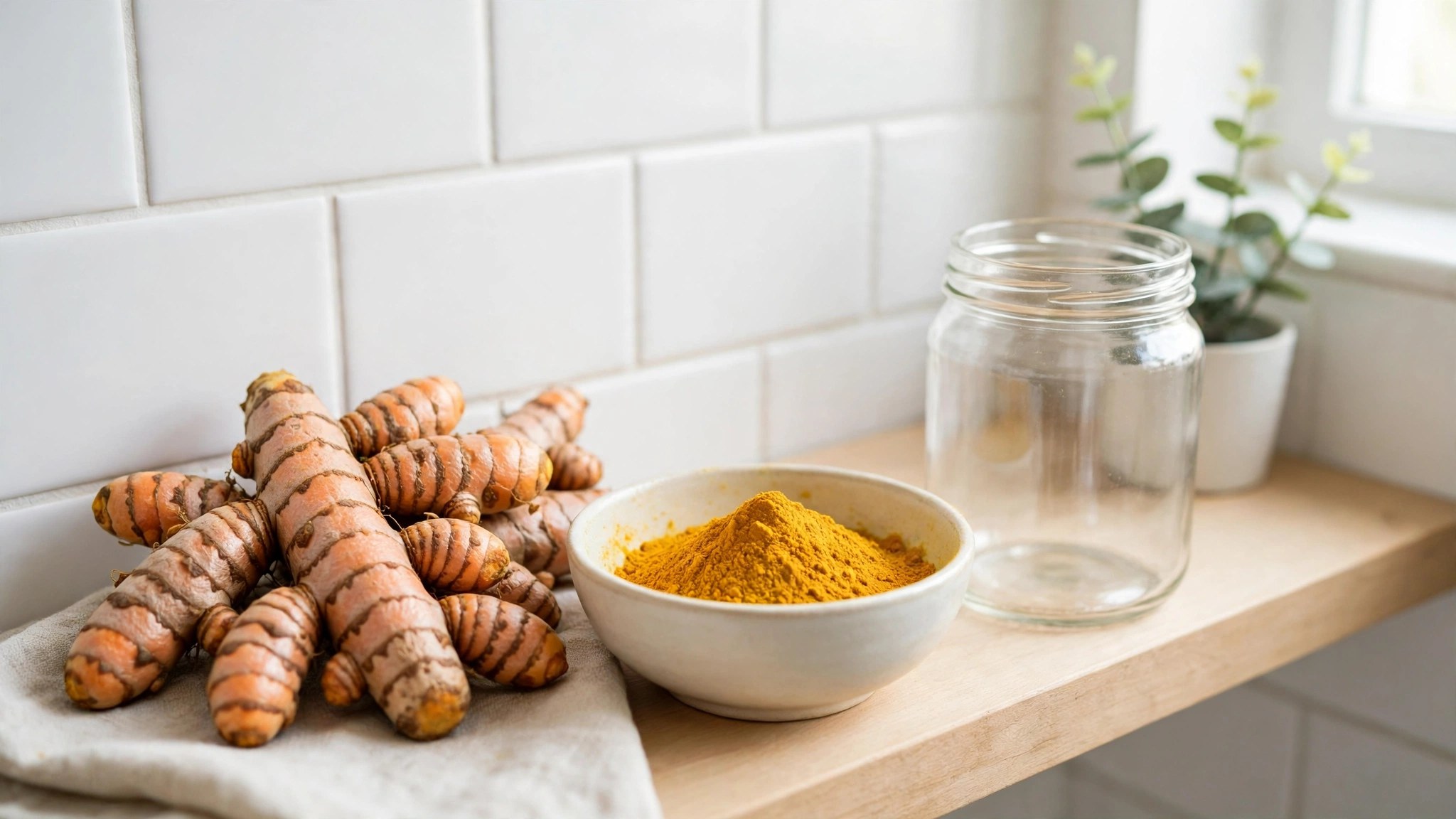
The translation problem starts with arithmetic. Turmeric root powder is only a few percent curcumin by weight — commonly around 2 to 5 percent, varying with source and processing.
A teaspoon of turmeric in a golden-milk recipe therefore carries perhaps 100 to 200 mg of curcuminoids before absorption losses, in a form the gut is exceptionally good at destroying.
The studies cited in this article used standardised extracts, formulated gels or light-activated preparations delivering curcumin at concentrations and exposures a kitchen cannot reproduce.
None of this makes culinary turmeric pointless — as food, it is a perfectly good spice with a plausible background role in an anti-inflammatory dietary pattern. It makes it untested: the trial results belong to the extracts, and borrowing them for the spice jar is a category error.
Supplement labels exploit the same gap in reverse, quoting turmeric powder weight (500 mg!) where the active curcuminoid content may be a twentieth of that. The number to look for is standardised curcuminoid content — and then to remember that even that number has no acne trial behind it.
How to run a fair home trial, if you run one
If you test turmeric on mild inflammatory acne anyway, run the experiment so its result means something.
Patch-test first: a small area behind the ear or on the inner arm, 24 hours, watching for redness or itching. Contact dermatitis discovered on one square centimetre is information; discovered across a forehead, it is a second skin problem.
Change nothing else. Keep your cleanser, moisturiser and any real treatment constant for the trial's length, or attribution becomes impossible — the commonest way home experiments manufacture false positives.
Photograph weekly in the same light, and count inflammatory lesions if you can bear the bookkeeping. Skin memory is notoriously generous, and the small trials that found anything used lesion counts, not impressions.
Set the deadline before you start: eight to twelve weeks matches the trial horizons. No change by then is a result — the correct response is to retire the experiment, not to add a second unproven ingredient on top of it.
And hold the red line from earlier in this article: deep, painful, scarring acne skips the home-trial queue entirely. That is dermatology territory, where the treatments with real evidence live.
Which kind of acne could turmeric plausibly suit?
Acne is not one condition, and matching the ingredient to the subtype sharpens the verdict.
Inflammatory acne — red papules and pustules, sore to touch — is the only subtype whose mechanism turmeric even addresses. If an adjunct can calm surface inflammation, this is where it would show.
Comedonal acne — blackheads and whiteheads from blocked pores — has no inflammatory headline for curcumin to act on, and no plausible route by which a mask unblocks a pore. That is retinoid and salicylic-acid territory.
Hormonal acne in adult women, patterned along the jaw and cycling with the month, is driven from inside. A topical anti-inflammatory does not reach the driver, and oral turmeric's absorption problem applies at full strength.
Severe nodular and cystic acne sits beyond adjunct logic altogether, for the scarring reason already given.
So the defensible turmeric candidate is narrow: mild inflammatory breakouts, in skin that tolerates it, alongside a real routine. Narrow is not nothing — but it is the opposite of the universal remedy the marketing describes.
Can turmeric be combined with real acne treatments?
Gently, and with the irritation budget in mind. Acne skin on a retinoid or benzoyl peroxide is already spending its tolerance; adding a daily botanical paste can overspend it.
The dermatology-consistent approach is alternation, not layering: turmeric experiments on off-nights, at mask frequency (once or twice weekly), with the proven treatment's schedule untouched.
Combining botanicals with exfoliating acids (AHAs and BHAs) raises compounded irritation risk — reviews of curcumin in skin flag the combination — so spacing applications by many hours, or choosing one, is the prudent structure.
And any new burning, peeling or spreading redness during a combination experiment ends the experiment. Irritated skin grows acne more readily than calm skin; an adjunct that inflames has failed its only job.
What do dermatologists actually say about it?
Asked directly, dermatology's position is short: turmeric is not a recommended acne treatment, full stop — it appears in no guideline therapy list, and no dermatology body endorses it as an alternative to standard care.
Integrative dermatologists — the specialists most sympathetic to botanicals — generally place it where this article does: possibly soothing for mild inflammation, unproven as treatment, and a staining and irritation consideration on skin already using actives.
The more useful professional point is about sequence. Every month spent trialling kitchen remedies on inflammatory acne that is leaving marks is a month in which the marks accumulate; dermatology's urgency about early effective treatment is about scars, not spots.
If a turmeric experiment and a dermatologist visit are competing for the same month, the visit is the one with compounding returns.
Frequently Asked Questions
Does turmeric cure acne?
No. There is no clinical evidence that turmeric — as a mask, food or generic supplement — clears acne as a standalone treatment, and it appears in no acne treatment guideline. Small trials of specific formulations show early anti-inflammatory signals, mostly as adjuncts.
How long would turmeric take to show any effect?
The small formulation trials ran about eight weeks. Any honest home trial should be judged on a similar horizon — eight to twelve weeks — with photographs, since memory grades skin generously in both directions.
Is a turmeric face mask worth trying?
For mild, red, superficial breakouts, it is a low-risk soothing experiment if you patch-test first and accept temporary yellow staining. It will not unblock pores or substitute for a retinoid, and concentrated or daily use raises the irritation risk.
Turmeric or curcumin — is there a difference?
Yes. Turmeric is the whole spice; curcumin is its main active polyphenol, a few percent of the root by weight. Studies use curcumin extracts and formulations, which is one more reason results do not transfer directly to kitchen turmeric.
Can I take turmeric supplements for acne instead?
You can, but the evidence does not follow you there: oral curcumin is poorly absorbed, and no trial shows a generic capsule clearing acne. Enhanced formulations raise blood levels without closing the acne-evidence gap, and supplement doses bring drug-interaction and gallbladder cautions that food use does not.
Does turmeric help acne marks and dark spots?
The evidence is thinner than for inflammation — mostly laboratory work on pigment pathways, no large clinical trials measuring fading on real faces. Distinguishing marks from melasma matters more than any single ingredient here; our guide to dark spots versus acne marks covers the identification step.
Can turmeric make acne worse?
It can make skin worse, which amounts to the same week ruined. Contact dermatitis from topical turmeric is documented, heavy or occlusive pastes can irritate and congest, and scrubbing inflamed skin with any gritty mixture aggravates the inflammation acne already runs on. Patch-testing and gentle handling are the mitigations.
Does turmeric work for back and body acne?
There is no body-acne-specific evidence for turmeric, and the practical barriers grow: large areas, staining of clothing and bedding, and skin that is often better served by benzoyl peroxide washes designed for the purpose. The face verdict — plausible anti-inflammatory, unproven treatment — applies with extra friction.
Is golden milk or turmeric tea good for skin?
As a drink, it is a pleasant anti-inflammatory dietary pattern choice with the full bioavailability problem attached: a few percent curcumin in the powder, poorly absorbed, with no skin trial behind it. Enjoy it as food. Do not invoice it as acne treatment — that claim belongs to formulations and light devices in clinics, and even there it is early.
Last reviewed: October 2026. This article is educational and is not medical advice.
