
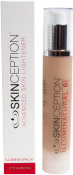
Affiliate disclosure: This article contains affiliate links. If you buy through a link on this page, we may earn a commission paid by the manufacturer, at no extra cost to you. That never changes what we publish — and here it means putting the caution before the commerce: some marks on skin should never be treated with a cosmetic at all until a doctor has looked at them. This page helps you sort ordinary dark spots, leftover acne marks and melasma from each other — and ends with the short list of warning signs that override everything else on it.
"Dark spots" is a shopping term, not a diagnosis. Under it sit several different kinds of mark, made by different processes, behaving differently, and responding to different things. The maker of Illuminatural6i lists its targets together — freckles, sun and age spots, birth marks, acne scars, melasma, chloasma, post-inflammatory hyperpigmentation and more, all "caused by excess deposits of melanin." That list is a useful starting roster. But a brightening product treats these marks as one category, while your skin does not. Knowing which kind you have is what tells you whether a serum is a reasonable tool, a partial one, or the wrong errand entirely.
Quick Answer: How Do the Three Differ?
Sun and age spots are individual, well-defined flat spots that accumulate on sun-exposed skin over years — the backs of hands, face, shoulders. Acne marks (post-inflammatory hyperpigmentation) are flat discolourations left exactly where breakouts or irritation happened, appearing after the spot itself heals and fading as the skin renews. Melasma is a broader, patchier, often symmetrical pattern — across the cheeks, forehead, upper lip — driven by sun combined with hormonal influence, and it behaves less like a blemish and more like a recurring condition. The sections below take each in turn.
Sun and Age Spots: The Cumulative Kind
These are the marks most people mean by "dark spots." Each one is a small, local overproduction of pigment in skin that has seen a lot of ultraviolet light over a long time. They tend to be round or oval, fairly uniform in colour, with clear edges, and they arrive gradually — typically from middle age onward, earlier in people with heavy sun exposure. Because the pigment sits in skin that formed it slowly, it also leaves slowly: these are the marks for which the standard brightening timeline — first change around one 28-day skin cycle, best judgement at roughly 90 days — was essentially written.
The practical point: sun spots are the most straightforward cosmetic case of the three. The pigment is the problem, the surrounding skin is otherwise uninvolved, and a twice-daily brightening routine plus strict sun protection addresses cause and appearance at once. What they are not is fast. A spot that took a decade of summers to form does not leave in a fortnight, whatever a label implies.
Acne Marks: The Leftovers
Post-inflammatory hyperpigmentation is the skin's habit of leaving a pigmented signature wherever it has been inflamed — a healed pimple, a picked spot, a rash, a scratch. The mark is flat (if it is raised, indented or textured, that is a scar, a different structure and a different conversation), it matches the map of where the breakouts were, and it is often more noticeable and slower to clear on deeper skin tones. Crucially, new marks keep arriving as long as new inflammation does: treating the leftovers while breakouts continue is mopping with the tap running.
The maker's own positioning draws one line worth respecting: Illuminatural6i is presented for acne scars and marks, and the maker states plainly that it is not specifically recommended for treating acne itself. That distinction is the honest one. A brightener can work on the pigmented aftermath; it is not an acne treatment, and active, inflamed skin is also skin more likely to react to a new product — the maker's patch-test advice (a small amount on the upper arm or jaw line first) applies with double force here.
Melasma: The Pattern, Not the Spot
Melasma looks different because it is different. Instead of individual spots, it forms larger, blotchy patches with softer edges, characteristically symmetrical — both cheeks, both sides of the forehead, the upper lip. Sunlight drives it, but so do hormonal shifts: it is strongly associated with pregnancy (the maker's list includes its older name, chloasma) and with hormonal contraception, and it disproportionately affects women. Where a sun spot is an event, melasma is a tendency: it lightens and darkens with exposure and hormones, and it commonly returns after it fades.
That behaviour changes what a reasonable expectation is. A cosmetic brightener may improve melasma's appearance, and the maker includes melasma in this product's target list. But melasma is also the entry on this page where self-treatment has the clearest limits: it is frequently managed with a clinician's help precisely because it is recurrent, because some lightening approaches can irritate it into darkening further, and because patches that look like melasma occasionally are not. If your marks form the symmetrical patch pattern, are tied to pregnancy or hormonal changes, or keep returning after they fade, that pattern itself is the reason to involve a dermatologist — before, or at least alongside, any cosmetic routine.
The Warning Signs: When It Is Neither a Serum Nor a Guide You Need
Everything above assumes ordinary, stable pigmentation. The following do not belong in that assumption, and no article's affiliate link outranks them:
- A new mark appearing in adulthood, especially after 40, that you cannot account for.
- A changing mark — growing, darkening unevenly, developing an irregular or ragged border, or varying in colour within itself.
- A mark that itches, crusts, bleeds, or does not heal.
- Any single spot that simply looks different from your others.
Lightening a mark like that is the one genuinely bad move available: it can alter what a doctor needs to see, and it spends the weeks during which the mark should have been examined. The maker's pages publish no guidance on this — no warning about new or changing marks appears in its safety material. We regard that as a gap in the maker's paperwork, and we fill it here: new, changing or irregular marks get assessed medically first. Cosmetics come after, if at all.
These statements have not been evaluated by the Food and Drug Administration. This product is not intended to diagnose, treat, cure, or prevent any disease. This article is educational and is not medical advice.
So Which Kind Do You Have — and What Follows?
Individual, stable spots on sun-exposed skin: the standard brightening case, judged over 90 days of twice-daily use and real sun protection. Flat marks mapping exactly onto healed breakouts: the same routine applies to the marks, but the breakouts themselves are a separate problem the maker does not claim to treat. Symmetrical patches with a hormonal storyline: a cosmetic can play a supporting role, with a dermatologist directing. And anything new, changing or irregular: a doctor, full stop.
Where Illuminatural6i (our score: 6.1/10) fits in that map is as the tool for the ordinary cases — freckles, sun and age spots, acne marks — with two honest caveats that apply whichever kind you have: its current formula publishes no ingredient concentrations, and every study on its maker's site belongs to an older formula the current product does not match. Those are reasons to buy it with open eyes and a calendar, not reasons it cannot do the ordinary job.
Disclaimer: This article is for general information only and is not medical advice. It cannot diagnose your skin. Always consult a qualified healthcare professional about any mark that is new, changing or concerning. Individual results vary, and no result is guaranteed.
Last reviewed: October 2026
