
- Quick Answer
- Dry vs Mixed: the Comparison the Trend Never Shows
- Why It Cannot Work Faster: the Dissolving Problem
- How Common Is It? The TikTok Numbers
- The Airway Problem: Choking, Aspiration, Pneumonia
- The Cardiac Case File — With Its Caution Levels Stated
- The Oesophagus Case: Ulcers From a Stuck Bolus
- The Dosing-Error Machine: How One Scoop Becomes Three
- The Mouth Itself: Enamel, Burns and Taste Buds
- For Parents: What the AAP Wants You to Know
- Red Flags: Stop and Get Help
- The Only Correct Way to Take It
- Frequently Asked Questions
- Does dry scooping make pre-workout hit faster?
- Why do people dry scoop, then?
- Can dry scooping actually cause a heart attack?
- Is snorting pre-workout a thing? Is it worse?
- Can't I just chase it with a full bottle of water?
- Can I take pre-workout dry if I drink water right after?
- Someone I know dry-scoops and is fine. Doesn't that settle it?
- What should I do if I inhaled powder?
- My teen dry-scoops. What's the one thing to say?
- Read This Next
Disclosure: This article contains affiliate links. If you buy through them, we may earn a commission at no extra cost to you. It never changes our conclusions.
Quick Answer
Dry scooping — tipping a scoop of pre-workout powder straight into your mouth and chasing it with a sip of water — does not make the product work faster, stronger or better in any demonstrated way. Powder must dissolve in fluid before its ingredients can be absorbed; a dry mouthful simply relocates the dissolving to your stomach while adding risks the mixed drink doesn't have: choking and inhaling powder into the airway, chemical irritation of the mouth and oesophagus, dosing errors from an undissolved bolus, and — in the published and reported case file — cardiac events in young users. The American Academy of Pediatrics' guidance to parents lands on the same verdict: nothing suggests it works better, and it is dangerous. This is a safety article, not a technique guide: the only "how" in it is how to take pre-workout the way its maker directs — mixed in water. Best for: nobody — dry scooping is a risk with no matching reward, and the mixed drink is the entire technique.
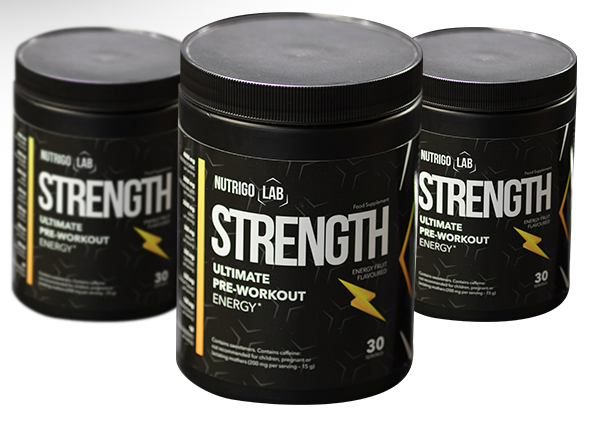
Our Recommendation — Nutrigo Lab Strength
Score: 6.1/10 · Best for: lifters who want a transparent, fully labelled pre-workout taken exactly as its maker directs — mixed in water, where the studied 30–60 minute caffeine window applies Main caution: dry scooping itself adds choking and airway, mouth-irritation and dosing-error risks with no faster effect — and the tub's beta-alanine sits low (1,000 mg), with no money-back guarantee published Fair trial: one tub at $68.99 (about 30 servings) covers a month of training days taken the directed way — with no guarantee published, that spend is committed up front.
Dry vs Mixed: the Comparison the Trend Never Shows
| Dry scooped | Mixed in water (as directed) | |
|---|---|---|
| Speed of effect | No meaningful difference — ingredients absorb after dissolving in GI fluid either way | The studied, labelled pattern; caffeine peaks ~30–60 min |
| Dose accuracy | Poor — heaped scoops, powder lost to coughing/spillage, concentrated bolus swallowed unevenly | The measured serving the label's numbers describe |
| Airway risk | Real — fine powder plus a gasp or laugh can be inhaled | None beyond ordinary drinking |
| Mouth/oesophagus contact | Concentrated acidic powder held against tissue | Diluted to a drink |
| What the maker directs | Never | Always — e.g. Nutrigo Lab Strength: 2 scoops (15 g) in 200 ml of water |
Why It Cannot Work Faster: the Dissolving Problem
The trend's founding claim — that dry powder "hits faster" because it supposedly absorbs through the mouth — does not survive contact with pharmacology. Caffeine and the other pre-workout ingredients are absorbed overwhelmingly from the gastrointestinal tract, after dissolving in fluid. A mouthful of dry powder is not dissolving in your mouth; saliva cannot wet 15 g of powder into solution in the seconds before you swallow. What actually happens is slower and messier: you swallow a concentrated paste, it finishes dissolving in the stomach, and absorption proceeds from there — the same destination, reached less reliably. The AAP's summary for parents states the conclusion flatly: there is nothing to suggest dry scooping makes a supplement work better. Claims of absorption "starting in 5–15 minutes through the mucous membranes" circulate on content sites without citation, and they confuse contact with absorption: tingling on the tongue is beta-alanine irritating local nerves, not caffeine entering your bloodstream ahead of schedule. The one real difference dry scooping makes is concentration and control — a full serving compressed into a bolus, delivered unevenly, sometimes on top of a second attempt after the first was coughed away. That is a dosing-error machine, and dosing error — not faster absorption — is the defensible mechanism behind the worst cases below.
How Common Is It? The TikTok Numbers
This is not a fringe behaviour. An analysis presented at the American Academy of Pediatrics' 2021 conference (Lin et al., published in Pediatrics) examined 100 TikTok videos under #preworkout and found 31% depicted dry scooping, with the dry-scoop content accumulating roughly 8.2 million likes. The audience for those videos skews young, the format rewards the stunt over the outcome, and the comment sections rarely include the follow-up video from the emergency department. The trend's demographics are exactly why this article carries a parent section: the typical dry-scooper is not a competitive lifter optimising absorption kinetics; they are a teenager imitating a feed.
The Airway Problem: Choking, Aspiration, Pneumonia
Fine, dry, flavoured powder is engineered to dissolve in a glass — in a mouth it behaves like the cinnamon of the cinnamon challenge, the parallel the AAP itself draws. The failure sequence is mundane: powder coats the mouth and throat, triggers coughing or a gasp, and powder-laden air is drawn into the airway. Outcomes range from a ruined set and a coughing fit to aspiration — material in the lungs — which can produce chemical irritation, asthma-like episodes and aspiration pneumonia, and which has sent dry-scoopers to emergency departments. Swallowing difficulties compound it: a dry bolus sticks, burns on the way down, and the natural response — a big, fast gulp of water — arrives while the airway is already irritated. None of this requires an allergy, a condition or bad luck; it is what fine powders do in airways, which is why every maker's directions begin with water in a shaker, not powder in a mouth.
The Cardiac Case File — With Its Caution Levels Stated
Two cases anchor the cardiac discussion, and intellectual honesty requires presenting them at different weights. Pallangyo et al. 2024 (SAGE Open Medical Case Reports) is a published case report: a healthy 25-year-old man who had used pre-workout normally — mixed — for 8 months, then switched to dry scooping and, three days later, suffered an STEMI heart attack with a thrombotic blockage of the left anterior descending artery. A single case cannot prove the dry scooping caused the event, and the report doesn't claim otherwise; what it documents is a serious cardiac event in a young, healthy user temporally tied to the switch. Briatney Portillo (2021) is a self-reported case, not a published report: a 20-year-old woman who reported a mild heart attack (NSTEMI) after dry-scooping a high-caffeine pre-workout as a first-time user with low caffeine tolerance, with no underlying condition reported in coverage of her account. Her story is widely shared and plausible — a full stimulant serving hitting a naive system — but it rests on her own reporting, and we weight it accordingly. Together the cases support a narrow, defensible claim: dry scooping has coincided with cardiac events in young, apparently healthy people, the plausible mechanisms are stimulant dose delivered badly plus exertion, and neither case needed to happen for a benefit that does not exist.
The Oesophagus Case: Ulcers From a Stuck Bolus
Caratenuto et al. (2023, Journal of General Internal Medicine) reported oesophageal ulcerations linked to pre-workout powder — concentrated, acidic powder (pre-workout mixes are acidic solutions, in the pH ~2.6–3.8 range) lodging against the oesophageal lining instead of passing through diluted. The mouth and throat versions of the same injury are milder — burning, irritation, mouth sores — but they share the mechanism: tissue designed for drinks meeting a concentrate. Mixed as directed, the same serving passes through as a dilute flavoured drink, which is why this injury category belongs to the dry method specifically.
The Dosing-Error Machine: How One Scoop Becomes Three
The cardiac and airway cases share a quieter accomplice worth naming, because it is the dry method's most ordinary failure. A mixed drink enforces its dose: the scoop is levelled, dissolved, and consumed over minutes, and nobody makes a second one by accident. The dry ritual removes every one of those governors. Scoops are heaped rather than levelled (a heaped scoop of a dense powder can carry well beyond the labelled serving). A coughing fit mid-attempt scatters an unknown fraction — and the common sequel is a second scoop to "make sure," converting an unknown partial dose into a near-double. Powder clings and is re-swallowed unevenly, so the dose arrives as a concentrated bolus rather than a drink's gradual entry. Layer the setting on top — a first-time user (the Portillo profile), a high-caffeine formula, a hard session immediately after — and the case file stops looking like freak accidents and starts looking like a system working exactly as badly as designed. This is the mechanism to cite when the trend is defended as harmless: not faster absorption, which is a myth, but worse dosing, which is arithmetic.
The Mouth Itself: Enamel, Burns and Taste Buds
The mildest injuries in the file are dental and oral, and they are the easiest to overlook. Pre-workout powders are acidic — citric and malic acid are standard ingredients — and a drink dilutes that acidity to a brief pass over the teeth. Held dry against enamel and mucosa, the same acids sit at full concentration, the pattern behind the enamel-damage and mouth-irritation reports that trail the trend, and a small-scale version of the oesophageal injury above. Beta-alanine contributes its own oral tingling and burning, harmless but frequently misread by first-timers as an allergic reaction. None of this is the argument's centre — choking and cardiac events are — but it completes the pattern: at every point where the dry method touches the body, it does so at a concentration the product was never designed to be used at.
For Parents: What the AAP Wants You to Know
If your teenager dry-scoops, the paediatric guidance is unambiguous and worth having verbatim in spirit: the practice is dangerous and offers no benefit. The AAP's parent guidance flags the choking and breathing risks, notes that a single pre-workout serving concentrates 150–350 mg of caffeine — soda-can multiples, in a product class adolescents shouldn't be using in stimulant form at all — and points families back to the unglamorous basics that actually govern teen athletic performance: carbohydrate before training, water during it, and 8–10 hours of sleep. Practical steps: ask what they're taking and where they saw it (the answer is usually a feed, not a coach); check the product's label together — the caffeine number reframes the conversation better than a lecture; and treat any episode of chest pain, palpitations or breathing difficulty after a supplement as a same-day medical conversation, not a scare to sleep off. If a teen is set on a pre-training routine, the negotiated landing spot is food, hydration and sleep, in that order.
Red Flags: Stop and Get Help
After any pre-workout use — dry or mixed — the following are stop-and-seek-care symptoms, not train-through ones: chest pain, pressure or tightness; a racing, pounding or irregular heartbeat that doesn't settle at rest; breathlessness beyond the effort; fainting or near-fainting; coughing that won't clear after inhalation, or later fever and breathlessness after a powder-inhalation episode (the pneumonia window); difficulty swallowing with chest pain after a stuck bolus. Our side-effects triage article sets out the full normal-vs-dangerous table for ordinary use.
The Only Correct Way to Take It
Use the worked example's own directions, because they are the category's standard: Nutrigo Lab Strength — 2 scoops (15 g) dissolved in 200 ml of water, about 15 minutes before training (our timing article suggests 30 minutes as the evidence-aligned compromise), delivering a measured 200 mg of caffeine. First time? Half that, mixed the same way. That is the complete technique section of this article, and its brevity is the point: the mixed method needs no skill, no stunt and no video.
Our Recommendation — Nutrigo Lab Strength
Score: 6.1/10 · Best for: lifters who want a transparent, fully labelled pre-workout taken exactly as its maker directs — mixed in water, where the studied 30–60 minute caffeine window applies Main caution: dry scooping itself adds choking and airway, mouth-irritation and dosing-error risks with no faster effect — and the tub's beta-alanine sits low (1,000 mg), with no money-back guarantee published Fair trial: one tub at $68.99 (about 30 servings) covers a month of training days taken the directed way — with no guarantee published, that spend is committed up front.
Frequently Asked Questions
Does dry scooping make pre-workout hit faster?
No. The ingredients must dissolve before they can be absorbed, and that happens in the stomach either way. The AAP states there is nothing to suggest it works better; the tingling on your tongue is local nerve irritation, not absorption.
Why do people dry scoop, then?
Social media. About 31% of #preworkout TikTok videos in the AAP-presented analysis showed dry scooping, and the format rewards the stunt. Convenience theatre, not pharmacology.
Can dry scooping actually cause a heart attack?
A published case report documents an STEMI in a healthy 25-year-old three days after switching to dry scooping, and a widely reported self-described case involves a 20-year-old first-time user. Single cases cannot prove causation — but with zero upside on the other side of the ledger, the risk doesn't need proving beyond reasonable doubt to be a bad trade.
Is snorting pre-workout a thing? Is it worse?
It appears in trend content, yes, and it is worse by inspection: powder directly into the nasal airway, with irritation and injury risk and no absorption advantage whatsoever. There is no version of bypassing the glass that improves the product.
Can't I just chase it with a full bottle of water?
Chasing is the ritual's own admission that the powder needs mixing — it just moves the mixing into your stomach, after the powder has coated your mouth and throat at full strength and after the airway has had its chance to object. A shaker does the same job upstream, where it is safe.
Can I take pre-workout dry if I drink water right after?
That is still dry scooping — the chase changes nothing about the powder's contact with your mouth, throat and airway, which is where the method's risks live. Mix it in the glass; the ten seconds saved are the most expensive in the category.
Someone I know dry-scoops and is fine. Doesn't that settle it?
It settles that one person, so far, the way a driver who never wears a seatbelt is "fine." The case reports exist because the practice's failures are episodic, not universal — choking requires one bad gasp, and dosing error one heaped second scoop. A benefit of zero does not need a high failure rate to be a bad bargain; it needs any failure rate at all.
What should I do if I inhaled powder?
Stop, stay calm, and let the coughing clear it; sip water once you can swallow comfortably. If coughing persists, breathing feels difficult, or fever and breathlessness develop in the following days, get medical care and mention the inhalation episode — aspiration pneumonia can declare itself late.
My teen dry-scoops. What's the one thing to say?
That it doesn't work — the powder still has to dissolve in their stomach — so the choking risk, the ulcer case and the cardiac case reports are being traded for literally nothing. Then offer the AAP's basics: food, water and sleep outperform the scoop anyway.
Last reviewed: October 2026. This article is educational and is not medical advice.
