
- Quick Answer
- What Is Tribulus Terrestris Used For?
- Does Tribulus Raise Testosterone? The Trial Record
- Why Did the Testosterone Story Take Hold?
- What About Erections and Libido?
- Does It Help Athletic Performance?
- What Other Uses Are Claimed?
- The Standardisation Problem: Why Labels Mislead
- Safety: Side Effects, Liver and Kidney Case Reports, Interactions
- Who Should Skip Tribulus?
- The Bottom Line
- Frequently Asked Questions
- How long does tribulus take to work for erections?
- What dose of tribulus did the studies use?
- Can tribulus help fertility or sperm quality?
- Is tribulus banned in sport or a doping risk?
- Who should definitely not take tribulus?
- Can women take tribulus?
- Read This Next
Quick Answer
Tribulus terrestris is sold mainly as a testosterone booster, and on that claim the human evidence is clear: randomised trials in men find no increase in testosterone. That result has now repeated across several decades and study designs.
A separate, smaller signal exists for erectile function. Some trials, and one 2025 meta-analysis, found modestly better erection scores on tribulus than on placebo, with testosterone unchanged. The effect, if real, is not hormonal.
Two practical problems follow. Products vary enormously in what they actually contain, because the herb's active saponins are rarely standardised outside one Bulgarian trial extract.
And while trials report few side effects, published case reports describe severe liver and kidney injury in a small number of users. Both points are covered in full below, because the safety block matters with this herb.
What Is Tribulus Terrestris Used For?
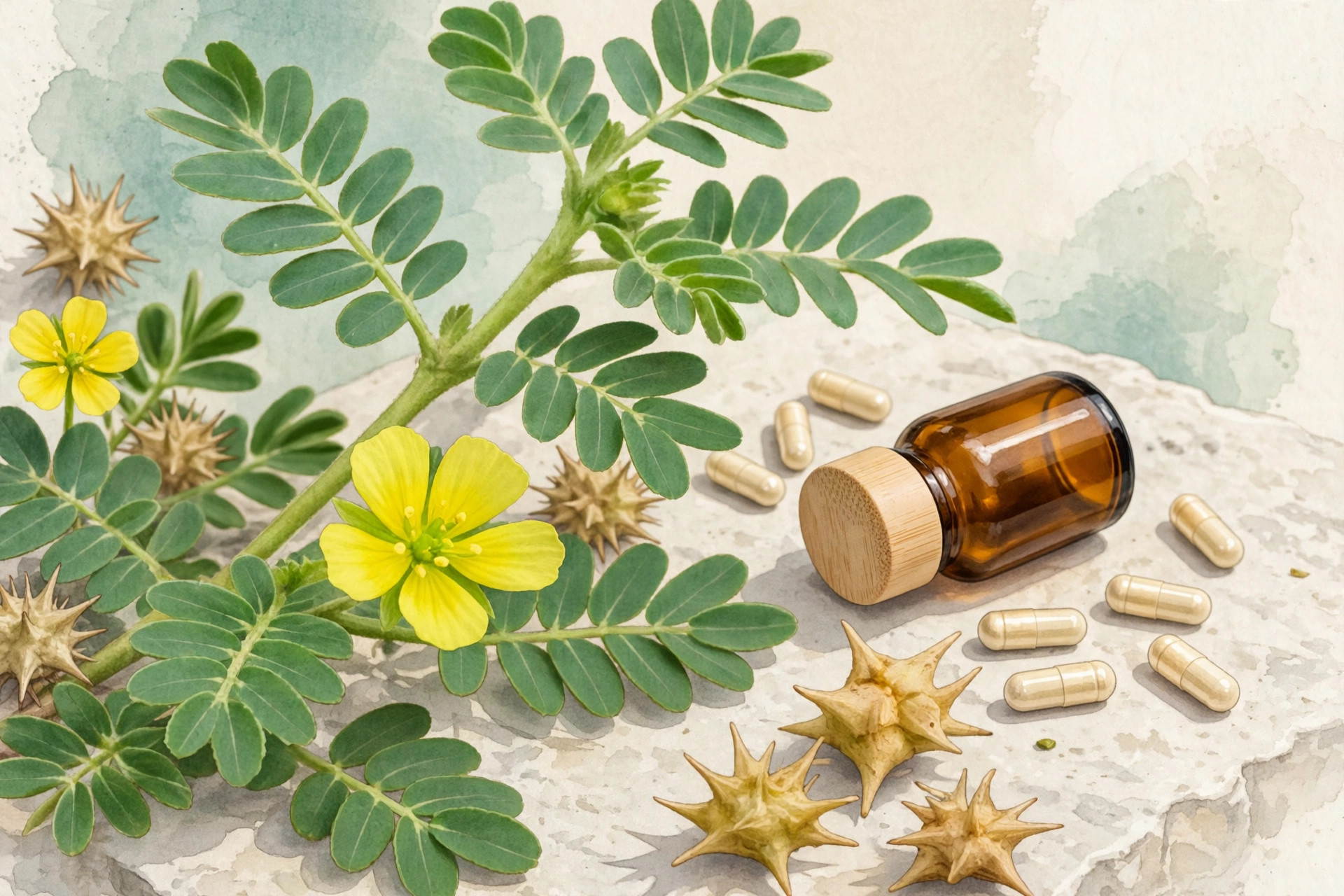
Tribulus terrestris is a spiny, ground-hugging plant found across warm regions worldwide. Its fruit has a long history in Ayurvedic and traditional Chinese medicine, where it was used for urinary complaints, vitality and sexual problems.
The modern supplement trade rests on a narrower story. In the 1970s and 1980s, a standardised Bulgarian extract, sold as Tribestan, was promoted around Eastern-bloc weightlifting, and the herb acquired a reputation as a natural anabolic.
Animal experiments fed that reputation. In rodents, rabbits and rams, tribulus preparations raised luteinising hormone (LH) or testosterone in several studies, which marketers converted directly into a human testosterone claim.
That conversion is exactly where the chain breaks. Animal hormone data are a reason to run human trials, not a result, and the human trials have now been run repeatedly.
Today tribulus is marketed for testosterone, libido, erectile function, athletic performance, fertility and general "male vitality". The sections below grade the first four against the human record; fertility claims in men rest on thin, mixed data and no firm conclusion.
Does Tribulus Raise Testosterone? The Trial Record
The cleanest early test came from Neychev and Mitev in 2005. Twenty-one healthy young men took tribulus extract at 10 or 20 mg per kilogram of body weight daily, or served as controls, for four weeks.
The result was unambiguous: no significant difference in testosterone, androstenedione or LH between groups. The authors concluded the extract's saponins have neither direct nor indirect androgen-raising properties in young men.
Rogerson and colleagues then tested the athletic claim in 22 elite rugby league players during five weeks of preseason training. The dose was 450 mg of extract daily, against placebo, in a double-blind design.
Strength and fat-free mass improved in both groups from training, with no difference between tribulus and placebo. The urinary testosterone-to-epitestosterone ratio, the doping-control marker, was also unchanged.
Later trials and reviews have not reversed this picture. A 2025 systematic review of the testosterone literature found most included trials reported no androgen change, and the erectile-function meta-analysis discussed below likewise found no testosterone difference versus placebo.
Verdict on the headline claim: in men, tribulus does not raise testosterone. Anyone whose blood test is genuinely low needs a medical workup, not an herb with a null hormonal record.
Why Did the Testosterone Story Take Hold?
Three ingredients built the myth, and it is worth separating them because the same pattern sells many supplements.
First, the animal data were real. Tribulus extracts did shift reproductive hormones or sexual behaviour in several animal models, and protodioscin, its best-known saponin, was proposed to convert to DHEA or to stimulate LH.
Second, the Bulgarian athletic era supplied testimonials at exactly the moment Western bodybuilding was looking for steroid alternatives. Testimonials are not measurements, but they travel further.
Third, the mechanism sounded plausible enough to print on labels. In humans, though, the proposed pathway has simply never shown up in blood work: LH does not rise, and testosterone does not follow.
The lesson generalises. An herb can be genuinely active in a rat, genuinely traditional in two medical systems, and still do nothing to the human hormone it is sold for.
What About Erections and Libido?
Here the record is more interesting, and it needs stating precisely. The best-known positive trial is Kamenov and colleagues' 2017 study of Tribestan, the standardised Bulgarian extract made by Sopharma.
The trial randomised 180 men with mild or moderate erectile dysfunction, some also reporting low desire, to Tribestan or placebo for twelve weeks. The dose was substantial: two 250 mg tablets three times daily, 1,500 mg a day.
Each tablet was standardised to at least 112.5 mg of furostanol saponins, so men received at least 675 mg of saponins daily. This matters when comparing the trial with unstandardised shop products, as the standardisation section explains.
Erectile-function scores improved significantly more on Tribestan than on placebo. In the intention-to-treat analysis, the between-group difference was 2.70 points on the IIEF erectile-function domain, a modest but real margin on that scale.
Crucially, testosterone did not rise. The Kamenov result is a symptom-score result, not a hormone result, and any retelling that turns it into testosterone evidence is misreporting the trial.
Two cautions belong beside it. The trial was not unanimous company: a smaller Brazilian RCT (Santos and colleagues, 2014) found no IIEF advantage over placebo. And Kamenov's trial carries manufacturer entanglement, with the lead author reporting honoraria from Sopharma and a co-author serving as its medical advisor.
A 2025 systematic review and meta-analysis pooled eight randomised trials in erectile dysfunction. Against placebo, tribulus improved IIEF-5 scores by a mean of 3.23 points (95% confidence interval 1.89 to 4.58).
The same analysis found testosterone levels not significantly different between groups, and no difference in adverse-event rates within the trials. Small, short, heterogeneous trials underpin that pooled figure, so treat it as a genuine but preliminary signal.
To calibrate the size: the IIEF-5 runs from 5 to 25, with scores of 22 to 25 considered normal function and 17 to 21 classed as mild erectile dysfunction. A mean advantage of about three points can move an average patient across a category boundary, which is noticeable but far from transformative.
It is also an average across small trials using different extracts and doses, several from single research groups. Independent replication with a defined product is the missing step, as it so often is with herbal medicines.
How an herb could help erections without touching testosterone is unresolved. Proposed routes include nitric-oxide pathways in penile tissue, shown in animal work, but no human mechanism has been demonstrated.
The animal work is worth a sentence of its own: in rabbit and rat penile tissue, tribulus extracts relaxed the corpus cavernosum through nitric-oxide and endothelium-dependent pathways. That is a plausible pharmacology for an erection effect, and it does not require any change in blood testosterone.
Plausible is not proven, though. Tissue baths and rodent studies sit several rungs below randomised human trials on the evidence ladder, and they cannot tell us the size of any effect in men.
Does It Help Athletic Performance?
The performance claim inherits the testosterone claim's problem: the proposed engine, higher androgens, does not switch on in humans.
Rogerson's rugby study is the direct test, and it found no advantage in strength, body composition or power measures over placebo during heavy training. Other small trials in athletes and exercising men point the same way.
A 2022 systematic review of tribulus in physically active men, covering sport and health biomarkers, found the evidence inconsistent and insufficient to support performance claims, with most hormonal outcomes unchanged.
One practical note for tested athletes: Rogerson's unchanged testosterone-to-epitestosterone ratio suggests tribulus itself should not trip that particular doping marker. Contamination of multi-ingredient products with undeclared substances remains a separate, well-documented risk in this market.
What Other Uses Are Claimed?
Beyond sex and sport, tribulus is sold for kidney stones, as a diuretic, for cholesterol and blood sugar, and to women for libido and menopausal symptoms. The evidence thins out quickly in each direction.
The diuretic and stone uses are traditional, and the herb does show diuretic activity in animal studies. There is a certain irony in the Talasaz case report in the safety section: the patient was drinking tribulus specifically to protect his kidneys from stones.
For cholesterol and blood sugar, the human literature consists of small, short, low-quality trials, mostly in specific patient groups, with inconsistent results. Nothing there supports using tribulus instead of, or alongside without advice, actual metabolic treatment.
Trials in women exist for sexual desire, including in postmenopausal women, with some positive small studies. They do not change the male picture, and they are too small to ground the confident claims made for female products either.
The pattern across all secondary uses is the same as the primary ones: traditional use and animal data are plentiful, adequate human trials are scarce, and the marketing runs several lengths ahead of both.
The Standardisation Problem: Why Labels Mislead
"Tribulus extract" on a label can mean almost anything. The compounds of interest are steroidal saponins, chiefly protodioscin, and their concentration in the plant varies sharply with where and how it was grown.
Dinchev and colleagues (2008, Phytochemistry) mapped steroidal saponin content across tribulus sourced from different geographical regions and found markedly different profiles, with Bulgarian material at the high end for protodioscin.
Tribestan, the product used in the positive erectile-function trial, is standardised: every 250 mg tablet guarantees at least 112.5 mg of furostanol saponins. Most generic capsules state no saponin content at all, or print a percentage with no independent verification behind it.
So even a reader who accepts the Kamenov result cannot assume a random tribulus product reproduces it. The trial tested one defined extract at 1,500 mg a day, not the category.
Buying rules that follow from this: prefer products stating a standardised saponin content per serving, be sceptical of proprietary blends that hide amounts, and treat "clinically studied ingredient" claims as meaningless unless the studied extract is the one in the bottle.
Safety: Side Effects, Liver and Kidney Case Reports, Interactions
Within the randomised trials, tribulus looks well tolerated. The 2025 meta-analysis found no significant difference in adverse events versus placebo, and the complaints reported across studies are usually mild: stomach cramps, nausea, reflux, diarrhoea and restlessness or sleep disturbance.
Trials, however, are short, small and screened. The case-report literature tells a rarer, more serious story, and it deserves prominence rather than a footnote.
In 2010, Talasaz and colleagues reported a young, healthy man who drank a tribulus preparation for two days, intending to prevent kidney stones. He presented with a seizure, very high liver enzymes and acute kidney injury; he recovered after the herb was stopped.
In 2015, Ryan and colleagues described acute kidney injury with marked hyperbilirubinaemia in a young man after tribulus ingestion, with kidney biopsy findings of acute tubular necrosis. He too recovered with supportive care.
The most severe recent case (Mohy-Ud-Din and Jonassaint, 2024) involved a 46-year-old man who took tribulus daily for two months. His bilirubin peaked at 48 mg/dL, his creatinine at 7.1, and liver biopsy showed drug-induced liver injury; he needed three sessions of plasma exchange before recovering.
Veterinary medicine supplies the background hum: tribulus is a recognised livestock poison, causing liver damage and a photosensitisation syndrome in grazing sheep and goats. That does not convict the human supplement, but it establishes that the plant contains genuinely hepatotoxic chemistry at sufficient exposure.
Rarer reports round out the picture, including a published case of priapism, a prolonged and painful erection requiring emergency treatment, attributed to tribulus (International Journal of Impotence Research, 2016). Single case reports cannot establish rates; they mark the edges of what has been seen.
Balance matters here. The NIH's LiverTox database, which reviews supplement-related liver injury, treats the human evidence cautiously: tribulus extracts at typical doses have not been convincingly linked to liver injury, and some reported cases may have involved other causes, including anabolic steroid use.
The fair reading is that serious injury appears rare but real enough to take seriously. Multi-ingredient "testosterone boosters" muddy attribution further, since the tribulus on the label may not be the only, or the actual, culprit.
Interactions are thinly documented but plausible. Tribulus has diuretic activity in animal work, and reviews note possible additive effects with blood-pressure and blood-sugar medication. Anyone taking antihypertensives, diabetes drugs or lithium should clear it with their doctor first.
Stop rules: stop the product and seek medical care promptly for yellowing of the skin or eyes, dark urine, pale stools, severe nausea, or a sharp drop in urine output. Those are the presenting signs in the published injury cases.
Pregnant and breastfeeding women should avoid tribulus entirely; animal data raise developmental concerns and there are no human safety data. It is also a poor idea alongside fertility treatment or hormone therapy without medical input.
Who Should Skip Tribulus?
Men hoping to raise a low testosterone reading should skip it and get the low reading investigated instead; the herb has a null record on exactly that outcome.
Anyone with liver or kidney disease, and anyone on blood-pressure, diabetes or lithium medication, should avoid it or use it only with medical supervision, given the case reports and interaction potential above.
A man with erectile dysfunction who wants to try the standardised extract studied in trials is in a different position: the evidence there is modest but real. Persistent ED still warrants a cardiovascular and hormonal check first, because ED is often an early vascular warning sign.
The Bottom Line
As a testosterone booster, tribulus fails its own trials: Neychev 2005, Rogerson 2007 and the reviews since find no rise in testosterone or LH in men.
As an erectile-function aid, it has a modest, preliminary signal: one standardised extract beat placebo by 2.70 IIEF points in its largest trial, and a 2025 meta-analysis pooled a 3.23-point IIEF-5 advantage, with hormones unchanged.
The product in the bottle is the weak link. Saponin content varies by source and is usually unstandardised, so trial results do not transfer automatically to generic capsules.
And respect the safety record: trials are reassuring, but published cases of severe liver and kidney injury mean jaundice or falling urine output on this herb is a stop-and-seek-care event, not a side effect to push through.
Frequently Asked Questions
How long does tribulus take to work for erections?
The trials that found an effect ran for twelve weeks, and the positive Kamenov study measured its outcome at the end of that period. There is no good evidence for a same-day or first-week effect. Anyone trialling it should judge it over two to three months, not days.
What dose of tribulus did the studies use?
Testosterone trials used 450 mg of extract daily in athletes and weight-based doses around 10 to 20 mg per kilogram in young men. The positive erectile-function trial used 1,500 mg daily of a standardised extract. Label doses on generic products are often far lower and unstandardised.
Can tribulus help fertility or sperm quality?
The human data are small and mixed, and no firm conclusion is possible. Some small studies report changes in individual semen parameters, others do not, and none establishes improved pregnancy rates. Couples with fertility problems should get a proper semen analysis and workup rather than rely on this herb.
Is tribulus banned in sport or a doping risk?
Tribulus itself is not a prohibited substance, and the athlete trial found the urinary testosterone-to-epitestosterone ratio unchanged. The real risk is the product category: multi-ingredient boosters are repeatedly found contaminated with undeclared drugs or prohormones. Tested athletes should use only independently certified single-ingredient products, if any.
Who should definitely not take tribulus?
Pregnant or breastfeeding women, people with liver or kidney disease, and anyone taking lithium, blood-pressure or diabetes medication without medical advice. Men with genuinely low testosterone should also skip it, not because it is uniquely dangerous for them, but because it delays a diagnosis that matters.
Can women take tribulus?
Some small trials in women, including postmenopausal women, report improved sexual desire scores, but the studies are few and small, and certainty is low. There are no adequate safety data in pregnancy, and animal data raise developmental concerns, so tribulus should be avoided entirely by pregnant or breastfeeding women.
Last reviewed: November 2026. This article is educational and is not medical advice.
