
- Quick Answer
- What Fenugreek Is Supposed to Do
- The Trials, One by One
- Testofen® studies: Rao 2016 and Rao 2020
- The Trigozim trial: the baseline-vs-placebo trap
- The rest of the file
- The Pooled Verdict
- Percentages vs Numbers: What "+13%" Hides
- Would a Rise This Size Change Anything?
- Dose Audit: What the Trials Used vs What Labels Deliver
- Libido Is Not Testosterone
- Safety and Interactions
- FAQ
- Does fenugreek raise free testosterone?
- How much fenugreek was used in the studies?
- How long do the trials run?
- Fenugreek for libido — does that part work?
- Is fenugreek safe with diabetes medication?
- Testofen vs regular fenugreek powder — same thing?
- Can fenugreek treat low testosterone or replace TRT?
- Read This Next
Quick Answer
Fenugreek has been tested properly — in randomized, placebo-controlled trials — and the honest summary is: a small, inconsistent effect on total testosterone, and essentially nothing reliable on free testosterone.
The largest rise in any single trial was about 44 ng/dL. When the trials are pooled, free testosterone's effect estimate crosses zero. Fenugreek is not a treatment for low testosterone, and no trial has tested it as one.
What follows is the audit: each trial, what it actually measured, and why the percentages on seller pages mislead.
What Fenugreek Is Supposed to Do
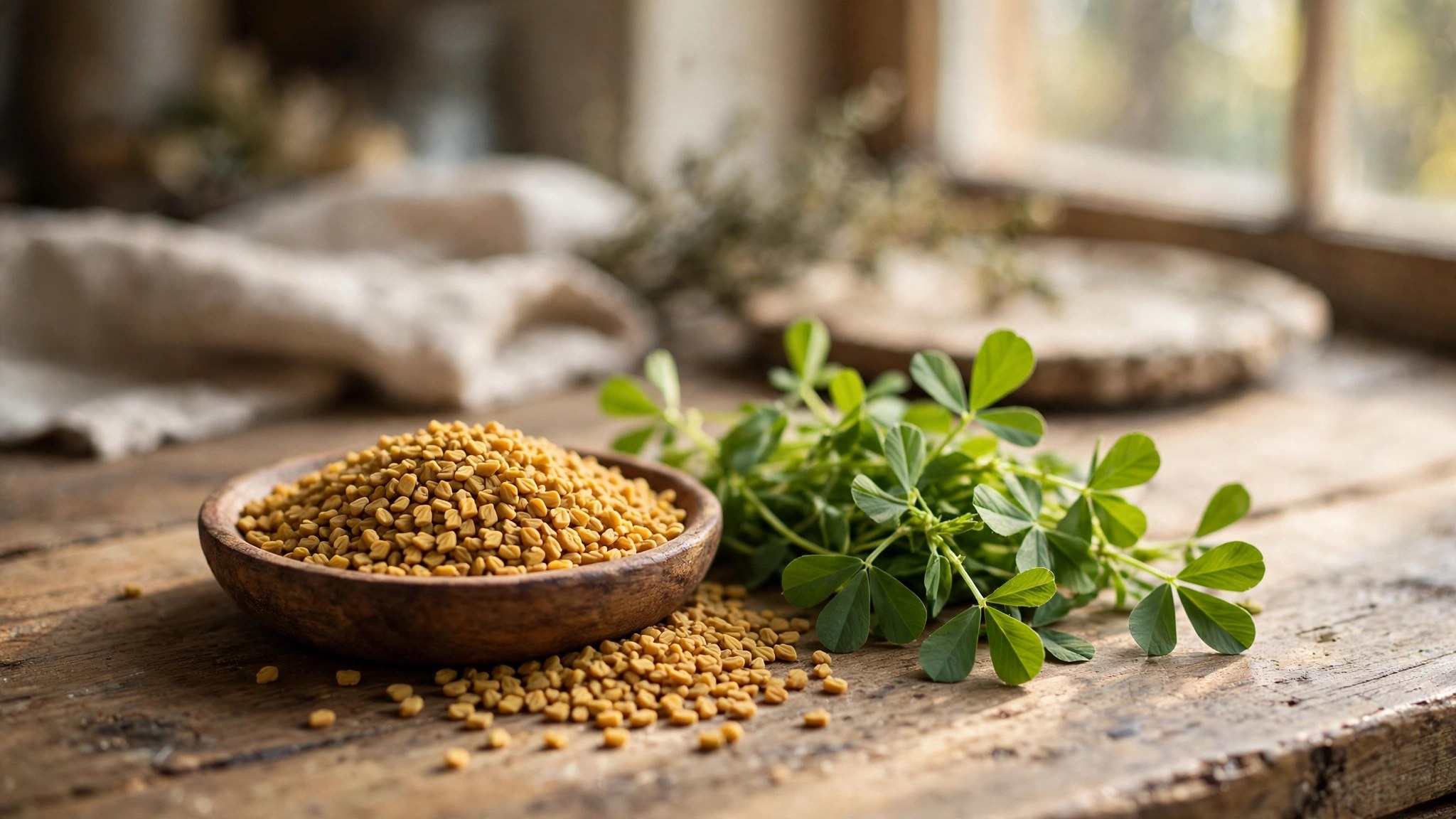
Fenugreek (Trigonella foenum-graecum) is a legume whose seeds are rich in steroidal saponins, including protodioscin — the same saponin family behind tribulus marketing, which we audited separately in our tribulus evidence check.
The standard claim is that these saponins block two enzymes: aromatase, which converts testosterone to estrogen, and 5-alpha-reductase, which converts it to DHT. Less conversion, the logic goes, means more testosterone left circulating.
That mechanism is speculation, and the primary literature says so itself. The authors of the largest fenugreek trial note that aromatase and 5-alpha-reductase inhibition "has not been tested directly with use of fenugreek."
A second proposed mechanism — protodioscin displacing testosterone from its binding proteins to free it up — is described by the same authors as something that "has not been shown experimentally." Treat both as hypotheses, not findings.
One more piece of borrowed credibility deserves naming. Fenugreek saponins include diosgenin, a compound laboratories use as a starting material for manufacturing steroid drugs.
That industrial chemistry happens in reactors, not in people. The human body has no pathway that converts swallowed diosgenin into testosterone, and no trial has ever shown it doing so.
The Trials, One by One
Nine placebo-controlled trials have measured testosterone in men taking a standardized fenugreek seed extract. They disagree with each other about which fraction of testosterone moves, and in several of them the placebo group improved too.
Almost every trial was funded by, or run by people affiliated with, the company selling the extract tested. That does not invalidate the results, but it sets the standard of scrutiny.
Testofen® studies: Rao 2016 and Rao 2020
Testofen is a standardized fenugreek seed extract made by Gencor, and it carries the strongest results in the file. Rao and colleagues (2016) randomized 120 healthy men aged 43 to 70 to 600 mg of Testofen or placebo for 12 weeks.
In the Testofen group, total testosterone rose by about 44 ng/dL on average — from 354 to 398 ng/dL — and the increase was statistically significant compared with placebo. Calculated free testosterone also increased compared with placebo.
The same trial reported reduced aging-male symptom scores and improved sexual function, including more morning erections, in the Testofen group compared with placebo. It was funded by Gencor Pacific, Testofen's maker.
The follow-up was less generous. Rao, Mallard and Grant (2020) randomized 138 men aged 25 to 47 to 600 mg, 300 mg, or placebo, alongside an eight-week calisthenics programme.
At 600 mg, total testosterone rose by 1.3 nmol/L — from 17.2 to 18.5 nmol/L, roughly 37 ng/dL — while the 300 mg dose and placebo did not move it. Free testosterone did not change in any group, including the 600 mg group.
Notably, the 600 mg group also gained strength and lean mass and lost body fat compared with placebo. Those physical changes arrived in a trial where free testosterone stayed flat — a pattern that recurs throughout this literature.
The Trigozim trial: the baseline-vs-placebo trap
The most rigorous recent trial is also the most misread. Lee-Ødegård and colleagues (PLOS ONE, 2024) gave 95 men aged 40 to 80 either placebo or 600, 1,200, or 1,800 mg of a fenugreek extract called Trigozim, for 12 weeks.
The headline that circulates — "testosterone up 13%" — is real but incomplete. Plasma total testosterone rose 13.0% from baseline across the fenugreek groups, and the free testosterone index rose 16.3% from baseline.
The comparison that matters is against placebo, and there the result dissolves. The placebo group's total testosterone rose 9.0% over the same 12 weeks, and its free testosterone index rose 11.3%.
The between-group differences were not statistically significant (p = 0.122 for total testosterone; p = 0.059 for the free testosterone index). The authors' own conclusion states there was no significant difference in plasma testosterone compared with placebo.
Saliva told a different story: salivary testosterone rose 37.2% compared with placebo across the fenugreek groups (p = 0.042), driven by the 1,800 mg dose, which rose 19.6% on its own.
Saliva measures only the free fraction and is a noisier, less standard clinical measure than blood. The trial's two measurement methods disagreed, and only the less standard one favoured fenugreek.
Two design details deserve credit and caution in equal measure. All four groups, placebo included, received the same vitamins and minerals, so the comparison genuinely isolates the extract.
But the study was financed by the product's seller, and the laboratory analyses were performed by a company in which two authors hold stock. And despite the saliva result, the men reported no subjective changes — desire, vitality, and erections were statistically indistinguishable from placebo.
The result is also fragile under its own sensitivity check. When the authors restricted the analysis to men who took at least 90% of their tablets, the free testosterone index lost statistical significance even against baseline.
The rest of the file
Wankhede and colleagues (2016) tested a different extract, Fenu-FG, at 600 mg per day in 60 young men during eight weeks of resistance training. It is the source of the most dramatic free-testosterone claim in the category.
Free testosterone in the fenugreek group rose 98.7% from baseline, from 17.8 to 35.3 ng/dL. What the claim leaves out: the placebo group rose 48.8% over the same eight weeks, from 21.3 to 31.7 ng/dL.
The two groups started at different levels and finished nearly level — 35.3 versus 31.7 ng/dL. Total testosterone did not significantly change. It was a small pilot study, and two of its three authors were affiliated with the extract's manufacturer.
Earlier still, Poole and colleagues (2010) gave 49 resistance-trained men 500 mg per day of a fenugreek extract for eight weeks and reported strength and body-composition findings without any testosterone benefit.
Read together, the pattern across the file is consistent: total testosterone occasionally rises modestly against placebo, free testosterone almost never separates convincingly, and physical outcomes improve in trials where hormones barely move.
The Pooled Verdict
The cleanest summary available is a 2026 systematic review and meta-analysis in Frontiers in Nutrition, which pooled the randomized, placebo-controlled fenugreek trials in adult men.
For total testosterone, six trials pooled to a standardized mean difference (SMD) of 0.25 (95% CI 0.02 to 0.48; p = 0.037). That is a small effect, and a fragile one — the confidence interval nearly touches zero.
For free testosterone, five trials pooled to an SMD of 0.08 (95% CI −0.48 to 0.63; p = 0.725), with high heterogeneity between studies (I² = 66.7%). In plain terms: no detectable effect on the fraction of testosterone that is biologically available.
What does an SMD of 0.25 mean in real units? Translated using the spread of testosterone values in these trials, it works out to a few dozen ng/dL at most — the same order as the single best trial result, and far below what would move a man across a diagnostic threshold.
The reviewers' quality assessment is the sobering part. Of 13 included studies, none was judged at low risk of bias, and the certainty of evidence for both testosterone outcomes was rated very low.
Their conclusion is worth quoting in substance: current evidence does not support clinical or commercial testosterone-boosting claims for fenugreek. Our audit of the individual trials lands in the same place.
Percentages vs Numbers: What "+13%" Hides
Percentages are how small hormone changes are made to sound large. A percentage is meaningless until you know the starting level, the population, and what the placebo group did over the same weeks.
Take the Trigozim headline at two starting points. A 13% rise for a man starting at 350 ng/dL adds about 45 ng/dL, taking him to roughly 395 ng/dL — still in the same low-normal band.
For a man starting at 650 ng/dL, the same 13% adds about 85 ng/dL. The percentage is identical; the clinical meaning is not, and neither man has crossed any threshold that changes his diagnosis or treatment.
Now subtract the placebo. In that trial, men taking dummy tablets rose 9% from baseline. The honest fenugreek headline is not "+13%" — it is a four-point gap over placebo that did not reach statistical significance.
This is why our verdict leans on absolute numbers with their comparators attached. About 44 ng/dL, in men aged 43 to 70, against placebo, in the best trial: that is the claim the evidence can actually carry.
Would a Rise This Size Change Anything?
Suppose the best-case result is real and repeatable: roughly 44 ng/dL. What would that actually do for the man who gets it?
Low testosterone is not diagnosed on one number. Standard practice requires symptoms plus repeatedly low morning blood measurements, because levels swing substantially by time of day, sleep, illness, and ordinary day-to-day variation.
A shift of a few dozen ng/dL sits inside that normal noise for most men. It does not move a clearly low reading into the normal range, and no fenugreek trial enrolled men with diagnosed testosterone deficiency to test whether it could.
Symptom relief is the outcome that would matter, and the trials barely speak to it. Rao 2016 did report improved symptom scores alongside its testosterone rise, in healthy men with age-related complaints.
But the Trigozim trial found no subjective benefit at all, and no trial has shown that the men whose testosterone rose were the same men who felt better. The hormone number and the lived outcome remain unlinked.
Dose Audit: What the Trials Used vs What Labels Deliver
Every result above came from a standardized seed extract at a defined dose — not from generic fenugreek. The doses that produced measurable comparisons were 600 mg per day and above.
| Preparation | Trial dose | Duration | What separated from placebo |
|---|---|---|---|
| Testofen® (Gencor) | 600 mg/day | 12 weeks (Rao 2016); 8 weeks (Rao 2020) | Total T in both; free T in 2016 only; 300 mg failed in 2020 |
| Trigozim | 600–1,800 mg/day | 12 weeks | Saliva T only; plasma total and free T did not |
| Fenu-FG | 600 mg/day | 8 weeks | Free T rose, but placebo rose ~49% too; total T unchanged |
Three audit points follow. First, the one dose-response test in the file is discouraging: 300 mg of Testofen did not raise total testosterone where 600 mg did, so half-doses cannot borrow the headline.
Second, an extract is not a powder. Testofen, Trigozim, and Fenu-FG are concentrated, standardized preparations; a capsule of plain ground seed is a different product, and no testosterone trial has tested it.
Third, fenugreek frequently appears inside multi-ingredient blends at undisclosed amounts. If a label will not tell you how much standardized extract you are getting, there is no trial result you can honestly attach to it.
Standardization is the detail to look for. The trial extracts were manufactured to a defined saponin specification, so every capsule delivered roughly the same chemistry. A label that lists only a milligram weight, with no extract standardization, is not describing the trial product.
Libido Is Not Testosterone
Some of fenugreek's best results are about desire rather than hormones, and the two are routinely blurred in marketing. The clearest case is Steels, Rao and Vitetta (2011).
Sixty healthy men aged 25 to 52 took 600 mg of Testofen with a mineral formulation, or placebo, for six weeks. Scores for sexual arousal and orgasm improved significantly in the Testofen group.
Serum testosterone, meanwhile, did not rise — the paper reports that testosterone and prolactin levels remained within the reference range. Desire moved; the hormone did not.
The Trigozim trial cuts the other way: salivary testosterone rose against placebo while the men's reported desire, vitality, and erections did not change at all. Hormone moved; desire did not.
This dissociation is not unique to fenugreek — maca shows the same pattern, as our maca evidence review sets out. A libido benefit may be real and still tell you nothing about testosterone.
Safety and Interactions
Fenugreek is a food with a long culinary history, and the trials above reported few side effects at extract doses. The NCCIH's fenugreek fact sheet lists the established cautions, which are worth taking seriously.
The common side effects are digestive: diarrhea, nausea, and other gastrointestinal symptoms. Large doses may cause a harmful drop in blood sugar.
That glucose effect is the main interaction concern. Fenugreek may lower blood sugar, so anyone taking diabetes medication — insulin or oral glucose-lowering drugs — should treat unsupervised use as a hypoglycemia risk and discuss it with their clinician first.
Fenugreek is a legume, in the same plant family as peanut and chickpea, and allergic reactions, including serious ones, are documented. Anyone with a legume allergy should regard it as a genuine risk, not a footnote.
Finally, fenugreek is not safe in pregnancy at amounts above those found in food; use in pregnancy has been linked to increased risk of birth defects. That caution is about supplemental doses, not about eating fenugreek as a spice.
FAQ
Does fenugreek raise free testosterone?
Not reliably. Pooled across five placebo-controlled trials, the free-testosterone effect was an SMD of 0.08 with a confidence interval crossing zero (p = 0.725). Individual trials disagree, and the loudest claim comes from a pilot where placebo rose about 49% too.
How much fenugreek was used in the studies?
The trials used 600 to 1,800 mg per day of standardized seed extracts — Testofen, Trigozim, or Fenu-FG. The single dose-response comparison found 300 mg of Testofen ineffective where 600 mg raised total testosterone. Plain seed powder has not been tested for testosterone.
How long do the trials run?
Six to twelve weeks. The libido trial ran six weeks; the exercise trials ran eight; the two largest testosterone trials ran twelve. No trial tells you anything about effects, or safety, beyond three months of use.
Fenugreek for libido — does that part work?
It has the more consistent signal, oddly. In 60 men aged 25 to 52, Testofen improved arousal and orgasm scores over six weeks while testosterone stayed in range. Read our libido section above: a desire effect is plausible, but it is not evidence of a hormone effect.
Is fenugreek safe with diabetes medication?
Use caution. Fenugreek can lower blood sugar, and large doses may cause a harmful drop; combined with insulin or glucose-lowering medication, that risk compounds. This is a discuss-with-your-clinician situation, not a self-experiment — see the NCCIH summary linked in our safety section.
Testofen vs regular fenugreek powder — same thing?
No. Testofen is a standardized, concentrated seed extract, and it is the preparation the positive trials used. Ground seed powder differs in composition and dose, and has no testosterone trial behind it. Results from one preparation do not transfer to the other.
Can fenugreek treat low testosterone or replace TRT?
No trial supports that use. The studies enrolled healthy men, mostly with normal levels, and produced average changes of a few dozen ng/dL at best. Diagnosed testosterone deficiency is a medical condition with its own workup and treatments; a supplement effect of this size is not a substitute for either.
Our wider audit of this category, Do Testosterone Boosters Actually Work?, applies the same standard to the other headline ingredients.


Last reviewed: October 2026. This article is educational and is not medical advice.
