
- Quick Answer
- The Common Causes of "Weak" Joints
- What Actually Strengthens Them
- 1. Progressive strengthening (the core intervention)
- 2. Low-impact cardio
- 3. Weight management
- 4. Load management while you rebuild
- Red Flags: Get Assessed Instead
- The Honest Place of Supplements Here
- A Simple 8-Week Starter Structure
- Frequently Asked Questions
- Is walking good or bad for weak knees?
- Can supplements strengthen joints?
- Why do my knees feel weaker as I age?
- When is weakness a sign of something serious?
- Read This Next
Disclosure: This article contains affiliate links. If you buy through them, we may earn a commission at no extra cost to you. It never changes our scores or conclusions.
Quick Answer
"Weak knees" are usually not weak joints — they are weak muscles around the joint, excess load, or an old injury making the joint feel unstable. Joints themselves are strengthened indirectly: progressive strengthening of the quadriceps, hips and glutes, low-impact cardio, and weight management are what guidelines recommend first.
No supplement can strengthen a muscle or stabilise a knee — at best, supplements support comfort while you do the training that actually works.
The Common Causes of "Weak" Joints
- Deconditioning: the most common cause. Thigh and hip muscles that are rarely loaded leave the knee poorly supported. Stairs and squatting start to feel unreliable.
- Excess body weight: every extra kilogram multiplies the load across the knee with each step — the joint is not weak, it is overloaded.
- Old injury and instability: ligament damage (an ACL tear is the classic) lets the joint shift abnormally, wearing cartilage unevenly and producing giving-way episodes.
- Osteoarthritis: cartilage loss changes how the joint tracks and loads. Pain then suppresses muscle use, which worsens the weakness — a cycle exercise is specifically meant to break.
- Alignment and overuse: knock-knees or bow-legs concentrate load on one compartment. Repetitive kneeling, squatting or climbing at work accelerates the process.
- Systemic disease: gout, rheumatoid arthritis, uncontrolled diabetes or thyroid disease can all present as "weak", painful joints — a reason new or worsening symptoms deserve assessment first.
What Actually Strengthens Them
1. Progressive strengthening (the core intervention)
Quadriceps, hamstrings, hips and glutes are the knee's real support system. Physiotherapy-style staples — sit-to-stands, step-ups, straight-leg raises, hamstring curls, side-lying hip work, calf raises — done two to three times a week and progressed gradually, rebuild that support over 8–12 weeks. This is the first-line recommendation in osteoarthritis guidelines, ahead of any drug or supplement.
2. Low-impact cardio
Walking, cycling and swimming maintain mobility and circulation without hammering the joint. 20–30 minutes most days is a realistic target. Warm up with gentle range-of-motion movement first.
3. Weight management
If you carry extra weight, even modest loss takes measurable pressure off weight-bearing joints and slows further damage. It is unglamorous arithmetic and the highest-leverage change available.
4. Load management while you rebuild
Cushioned footwear, avoiding sudden twisting/jumping loads, breaks from prolonged kneeling, and heat for stiffness or cold after activity for swelling — small levers that keep you training consistently.
Red Flags: Get Assessed Instead
- The knee gives way, locks, or cannot fully straighten
- Recurrent swelling, or swelling within hours of an injury
- Pain after a specific trauma, or pain that is worsening month on month
- A hot, red joint, or joint pain with fever
- Weakness in several joints at once, or with other systemic symptoms
These suggest instability, internal injury, inflammatory or systemic disease — diagnoses a supplement shelf cannot make.
The Honest Place of Supplements Here
Supplements do not strengthen anything. Muscle strengthens from progressive load. Cartilage and tendons adapt slowly to training. What a supplement can plausibly do is make the training period more comfortable for some people, and supply specific nutrients around connective tissue.
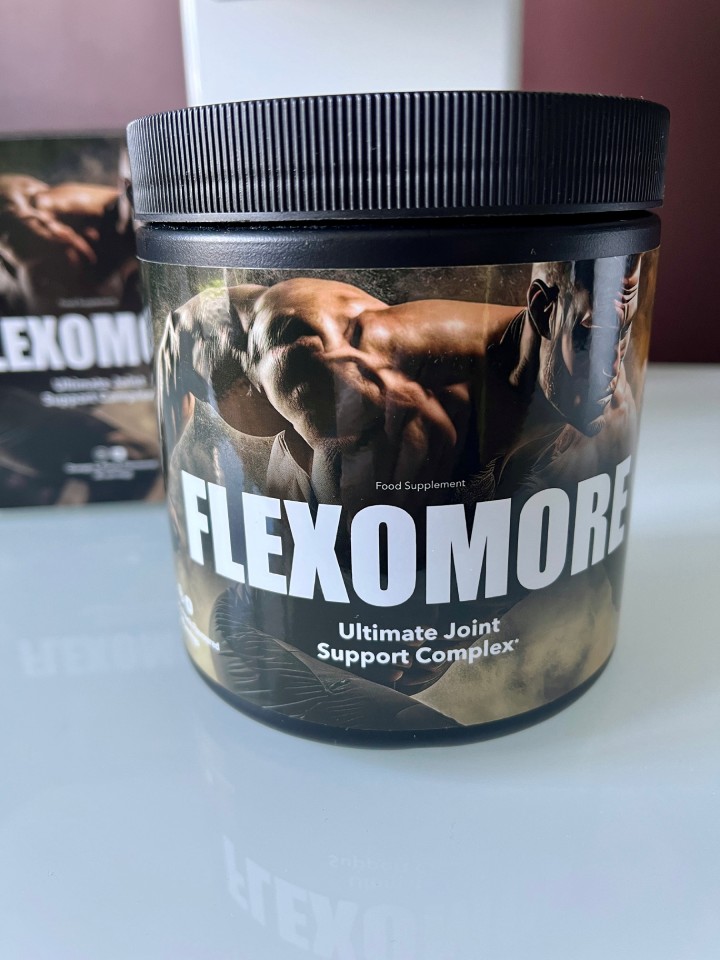
The cleanest illustration is Flexomore: its tendon ingredient, Tendoforte® collagen peptides, was studied combined with calf-strengthening exercises in runners with Achilles tendon pain — the supplement rode along with the training, exactly the right relationship. Flexomore also provides a full dose of glucosamine and minerals in a daily drink (we score it 6.8/10) — support, not a substitute.
Anyone selling you a powder as a replacement for strengthening work is selling the relationship backwards.
A Simple 8-Week Starter Structure
- Weeks 1–2: daily walking (build to 20–30 minutes) Strength circuit twice a week at easy effort — sit-to-stands, step-ups, calf raises, side-lying leg lifts, hamstring curls (2 sets of 10–15).
- Weeks 3–6: same circuit three times a week. Add load or reps weekly. Add cycling or swimming once a week.
- Weeks 7–8: reassess: stairs confidence, walking distance, pain scores. Progress the exercises, or book a physiotherapist if progress stalls or red flags appear.
- Track pain 0–10 weekly — if you are also trialling a supplement, this is the only way to judge it fairly.
Frequently Asked Questions
Is walking good or bad for weak knees?
Good — for a knee that is not acutely injured or diseased in a way a clinician has flagged, regular walking strengthens support muscles and maintains the joint. Build distance gradually and use cushioned shoes.
Can supplements strengthen joints?
No. They may support comfort or provide connective-tissue nutrients, but strength comes from progressive exercise. Treat any "strengthen your joints" supplement claim as marketing.
Why do my knees feel weaker as I age?
Muscle mass and strength decline with age (sarcopenia) while joint changes accumulate — the combination feels like "weak joints". Strength training directly targets the muscle half of that equation at any age.
When is weakness a sign of something serious?
When it comes with giving way, locking, recurrent swelling, a hot red joint, or follows an injury — see the red flags above and get assessed.
Last reviewed: October 2026. This article is educational and is not medical advice. Exercises should be adapted to your condition. A physiotherapist can tailor the programme.
