
- Quick Answer
- First, the Honest Baseline
- The Ingredients With the Most Support
- 1. Glucosamine sulfate — the classic, with conditions
- 2. UC-II undenatured type II collagen — the small-dose contender
- 3. Curcumin (turmeric extract) — the anti-inflammatory option
- 4. Collagen peptides — for active joints and tendons
- 5. Boswellia, ginger and MSM — reasonable supporting players
- What to Skip
- A Worked Example: Reading a Real Label
- How to Run a Fair Test on Yourself
- Frequently Asked Questions
- What is the single best joint supplement for osteoarthritis?
- Can supplements replace knee replacement or medication?
- How long should I try a joint supplement?
- Are combination formulas better than single ingredients?
- Read This Next
Disclosure: This article contains affiliate links. If you buy through them, we may earn a commission at no extra cost to you. It never changes our scores or conclusions.
Quick Answer
No joint supplement has strong evidence for osteoarthritis — guidelines are split, and the biggest trials show small effects at best. The most defensible options are crystalline glucosamine sulfate (1,500 mg/day), UC-II undenatured collagen (40 mg/day) and absorption-enhanced curcumin (~1,000 mg/day of curcuminoids), each judged after a fair 3-month trial.
Exercise, weight management and topical anti-inflammatories remain the proven core of osteoarthritis care. Below: what each ingredient can realistically do, the doses that matter, and the label traps to avoid.
First, the Honest Baseline
Osteoarthritis is the gradual breakdown of cartilage and change in the whole joint — not simple "wear" that a capsule can reverse. No supplement regrows cartilage in any proven, clinically meaningful way. The strongest recommendations in the NICE guideline for osteoarthritis are exercise, weight loss if you carry extra weight, and education about the condition.
Topical NSAIDs are the first-line drug option. Supplements sit on top of that foundation, aiming at modest symptom relief — typically a small reduction in pain and stiffness for some people, after weeks of daily use.
That context matters because "best" lists usually rank products by commission, not evidence. We rank by ingredient, dose and trial quality.
The Ingredients With the Most Support
1. Glucosamine sulfate — the classic, with conditions
The most-studied joint supplement in the world. The honest summary: evidence is genuinely mixed. The large NIH-funded GAIT trial (1,583 people) found glucosamine no better than placebo overall, and a BMJ network meta-analysis found effects below the threshold patients can actually feel.
But positive trials cluster around one specific form — crystalline glucosamine sulfate at 1,500 mg/day — and some European guidance still supports that form. NICE advises against glucosamine. The AAOS says it "may be helpful" for mild-to-moderate knee osteoarthritis.
If you try it: sulfate form, full 1,500 mg dose, three months, then keep it or drop it based on your own result.
2. UC-II undenatured type II collagen — the small-dose contender
A different mechanism: 40 mg of structurally intact type II collagen works through "oral tolerance", calming the immune response against your own cartilage. In a 180-day randomised trial it outperformed glucosamine plus chondroitin on pain, stiffness and function scores. It is a separate purchase from collagen peptide powders — the two are not interchangeable.
3. Curcumin (turmeric extract) — the anti-inflammatory option
Multiple trials at around 1,000 mg/day of curcuminoids show reduced knee osteoarthritis pain over 4–8 weeks, with one trial finding a turmeric extract comparable to ibuprofen with fewer stomach effects. The catch is absorption: plain turmeric powder barely registers. Look for piperine-paired or otherwise enhanced extracts, and check the curcuminoid milligrams, not the turmeric milligrams.
4. Collagen peptides — for active joints and tendons
Hydrolysed collagen at around 10 g/day has a modest joint-pain signal over ~3 months, and specific bioactive peptide ingredients are formulated for tendons and ligaments rather than cartilage — relevant if your "joint" problem is really an overuse tendon problem from training.
5. Boswellia, ginger and MSM — reasonable supporting players
Boswellia extracts have some of the faster trial signals (1–2 weeks in some studies) Ginger shows small consistent benefits but often causes stomach upset. MSM's evidence is thinner. These make sense inside a formula, less sense as your only bet.
What to Skip
- Proprietary blends with hidden amounts — if the label will not say how much of each ingredient you get, assume the dose is decorative.
- Homeopathic "joint formulas" and ingredients with no human joint trials at all.
- Mega-dose vitamin stacks sold as joint cures — vitamins C, D and K matter for bone and collagen formation when you are deficient. They are not osteoarthritis treatments.
- Anything promising cartilage regrowth or a surgery alternative.
A Worked Example: Reading a Real Label
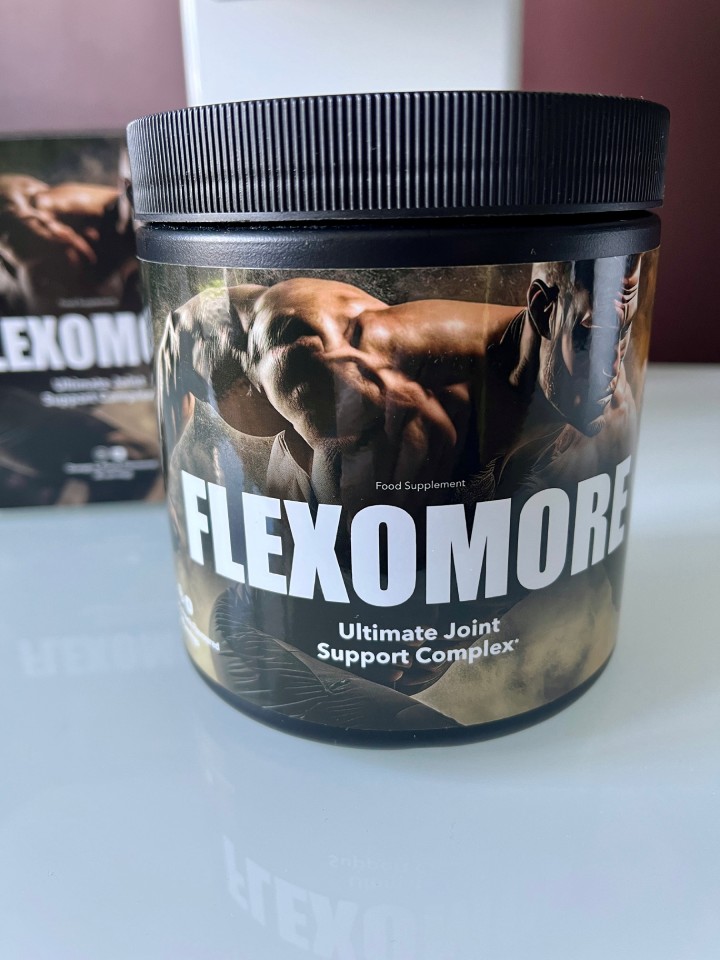
Flexomore, the joint formula in our catalogue, shows what a transparent label looks like — and its limits.
Per scoop it publishes everything: glucosamine sulfate 2,000 mg (1.5 g of D-glucosamine — the full studied dose), Tendoforte® bioactive collagen peptides 2.5 g (a tendon-focused ingredient), MSM 1,000 mg, turmeric extract 200 mg, ginger 200 mg, boswellia 100 mg, Aquamin™ minerals and magnesium.
That is a sensible, fully disclosed supporting formula, which is why we score it 6.8/10.
Its honest gaps matter just as much: it contains no chondroitin and no UC-II, its turmeric (20 mg of curcuminoids) is a supporting dose rather than the ~1,000 mg used in turmeric trials, and the maker publishes no money-back guarantee. If your single priority is a turmeric trial or UC-II, buy those separately.
If you want one daily drink covering glucosamine at full dose plus tendon and mineral support, it is a coherent choice — full breakdown in our review.
How to Run a Fair Test on Yourself
- Start ONE product. Change nothing else for the first month.
- Score your pain and stiffness 0–10 weekly, same time of day.
- Keep up the exercise and weight work — supplements are the garnish, not the meal.
- Decide at 12 weeks: clear improvement, keep it. Nothing, stop and spend the money elsewhere.
Frequently Asked Questions
What is the single best joint supplement for osteoarthritis?
There is no proven winner. Crystalline glucosamine sulfate has the deepest (if contested) evidence. UC-II has a strong head-to-head trial. Enhanced curcumin has the best anti-inflammatory trial record. Your response to any of them is individual — run the 3-month test.
Can supplements replace knee replacement or medication?
No. They target modest symptom relief. Severe, worsening or mechanically unstable joints need medical care, not a stronger supplement.
How long should I try a joint supplement?
About three months of consistent daily use at the studied dose — the same stop-rule NHS patient guidance gives for glucosamine.
Are combination formulas better than single ingredients?
Only when each ingredient is present at a meaningful dose. A long label of trace amounts is marketing, not synergy.
Last reviewed: October 2026. This article is educational and is not medical advice. Osteoarthritis that is severe, worsening or follows an injury should be assessed by a clinician.
