
- Quick Answer
- First, Untangle the Three Products Called "Collagen"
- Marine vs Bovine: the Evidence Verdict
- What the Joint Evidence Shows
- How This Maps to a Real Product
- Frequently Asked Questions
- Which collagen type is best for joints?
- Is marine collagen worth the extra money?
- How long does collagen take to work for joints?
- Can I take collagen with glucosamine?
- Read This Next
Disclosure: This article contains affiliate links. If you buy through them, we may earn a commission at no extra cost to you. It never changes our scores or conclusions.
Quick Answer
For joints, the marine-versus-bovine question is the wrong question — no study shows one outperforming the other, and the one direct crossover comparison found equivalent absorption. Both are type I collagen.
What actually decides results is form and dose: hydrolysed collagen peptides at around 10 g/day for joint pain over ~3 months, or undenatured type II collagen (UC-II) at 40 mg/day working by a completely different mechanism — and specific bioactive peptides (like Tendoforte®) aimed at tendons rather than cartilage.
First, Untangle the Three Products Called "Collagen"
| Form | What it is | Dose | Best-supported use |
|---|---|---|---|
| Hydrolysed collagen peptides | Collagen cut into small fragments; dissolves in drinks | 10 g/day typical for joints (2.5–5 g in skin studies) | Joint pain in active adults and OA; skin elasticity |
| Undenatured type II (UC-II) | Structurally intact type II collagen from chicken sternum cartilage | 40 mg/day | Knee osteoarthritis — works via oral tolerance (immune calming), beat glucosamine+chondroitin in a 180-day trial |
| Specific bioactive peptides | Engineered peptide profiles for a target tissue (e.g. Tendoforte® for tendons/ligaments) | Ingredient-specific (Tendoforte® 2.5 g/day) | Tendon and ligament support for active people |
Buying "collagen" without knowing which of these you are getting is like buying "medicine" without the drug name. A 40 mg UC-II capsule and a 10 g peptide powder are not weaker and stronger versions of one thing — they are different interventions.
Marine vs Bovine: the Evidence Verdict
Marine collagen comes from fish skin and scales. Bovine from cattle hides and bones. Both are overwhelmingly type I collagen (bovine adds type III).
Marketing claims of superior marine absorption rest on smaller average peptide size — but in the only crossover study giving the same people both sources, uptake of the marker amino acid was equivalent, and no trial has connected any blood-level difference to a better joint, skin or bone outcome.
Honest reasons to choose marine: you avoid beef, you follow a pescatarian diet, you prefer the taste/price in your market. Honest reasons to choose bovine: deeper research base for bone endpoints, usually cheaper per gram. For joints specifically, neither is "the joint one" — cartilage's own collagen is type II, which is why UC-II exists as a separate category.
What the Joint Evidence Shows
- Peptides: trials of ~10 g/day hydrolysed collagen in adults with knee osteoarthritis and in athletes with activity-related joint pain show modest pain improvements emerging around 8–12 weeks. Effects are real but small. Funding is often from ingredient manufacturers.
- UC-II: in the 180-day trial, WOMAC scores improved about twice as much as with glucosamine+chondroitin. It is the collagen category's strongest single trial — for cartilage-focused immune calming, at a tiny dose.
- Tendon peptides: Tendoforte® was studied in 18 recreational runners with Achilles tendon pain who combined it with calf-strengthening exercises. 12 of 18 returned to running within three months. Small and uncontrolled by drug-trial standards — but it studied the right tissue: tendon problems in active people, which are not osteoarthritis.
Vitamin C deserves a footnote: it is required for collagen synthesis in the body, and sensible formulas include it (the body cannot store much, so a modest 80 mg alongside peptides is a rational inclusion, not a megadose).
How This Maps to a Real Product
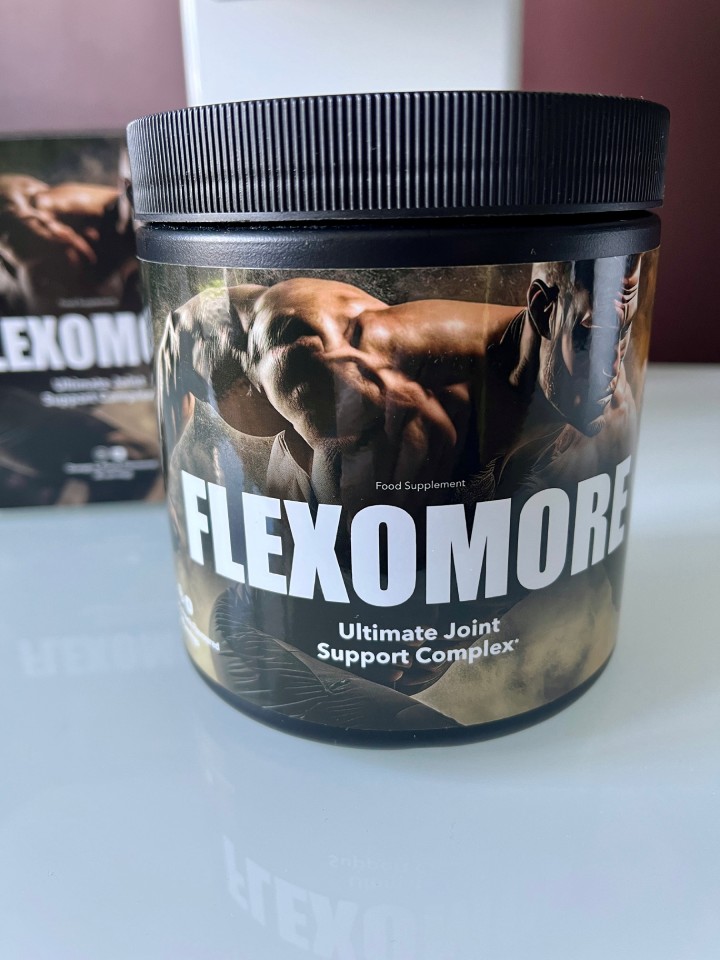
Flexomore contains 2.5 g of Tendoforte® per scoop plus 80 mg of vitamin C — the tendon-peptide category, at its studied dose, inside a glucosamine-led formula. Read it correctly: Flexomore is a reasonable pick if your joint complaints involve training load and tendons.
It is not a 10 g general collagen product and contains no UC-II, so if either of those is your strategy, buy them dedicated. We score Flexomore 6.8/10 with that positioning made explicit.
Frequently Asked Questions
Which collagen type is best for joints?
For cartilage symptoms, undenatured type II (UC-II) has the most targeted trial. For general joint pain, hydrolysed type I/III peptides at ~10 g/day. For tendons, specific bioactive peptides. "Type" marketing on peptide powders matters less than dose.
Is marine collagen worth the extra money?
Not for outcomes — no evidence shows better results than bovine. Pay the premium only for dietary preference.
How long does collagen take to work for joints?
Plan on 12 weeks. Tendon and joint studies cluster around 90 days. UC-II's key trial ran 180 days.
Can I take collagen with glucosamine?
Yes — they are combined in many formulas and trials. Stagger starts if you want to know which one is helping you.
Last reviewed: October 2026. This article is educational and is not medical advice.
