
- Quick Answer
- The Theory, Stated Fairly
- The Evidence Check
- Decoding the Units on This Label
- The Proteolytic Pair: Bromelain and Papain
- ???? "100% Safe" — the Claim Check
- The Verdict
- Frequently Asked Questions
- Has any digestive enzyme blend been tested for bad breath?
- What do the units on an enzyme label mean?
- Can papain dissolve the coating on my tongue?
- Are digestive enzymes completely safe?
- If my breath is digestive, should I start with enzymes?
- Read This Next
Disclosure: This article contains affiliate links. If you buy through them, we may earn a commission at no extra cost to you. It never changes our conclusions.
Quick Answer
The theory is coherent. If food is incompletely digested, the reasoning goes, fermentation and gas follow, and some of that reaches the breath. Digestive enzymes, on that theory, should help by finishing the digestive job.
The trial file, however, is empty. No enzyme blend — DigeZyme® included — has ever been tested in a trial with breath as an outcome. What exists for the breath claim is anecdote and buying-guide assertion.
And the base rate closes the argument for most readers. Sources put the oral share at roughly 80–90% of halitosis cases, compared with a small minority from elsewhere. Even a perfect digestive effect addresses the minority cause. Dentolan scores 5.4/10 in our review.
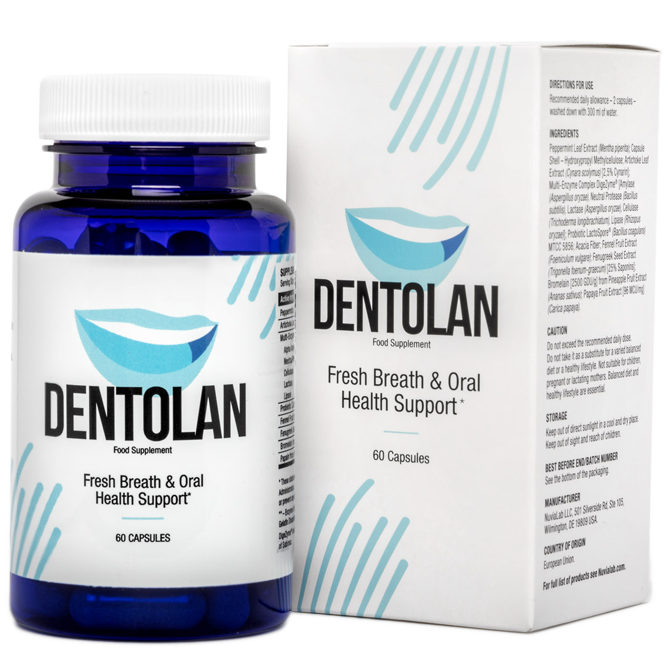
Our Recommendation — Dentolan
Score: 5.4/10 · Best for: adults whose breath worsens with meals and heavy digestion, who want every ingredient amount and the probiotic's strain printed on the label. Main caution: most bad breath is oral in origin, not digestive — and no money-back guarantee is published. Fair trial: one bottle — one month — judged honestly, with dental causes ruled out before a second.
The Theory, Stated Fairly
Start with the strongest honest version of the idea, because it deserves one. Digestion is enzymatic work: proteins, starches, fats and lactose are each broken down by specific enzymes, mostly produced by the body itself.
Where that work runs short, the shortfall is real and felt. Undigested material passing further along the gut gives intestinal bacteria more to ferment. The results — gas, bloating, discomfort after meals — are familiar and genuinely enzyme-related.
The breath step of the theory borrows from a real route. Reflux can carry stomach contents and their odours upward, and breath that travels with heartburn and regurgitation is a recognised pattern. Enzymes, the argument runs, reduce the material available to reflux.
That is the whole theory, and nothing in it is foolish. It chains three plausible steps: incomplete digestion, more fermentable residue, more odour reaching the breath by a digestive route. Plausible chains, however, are what trials exist to test.
One short passage is all the general background this page needs. For how supplemental enzymes work, when enzyme insufficiency is real, and what the general evidence supports, read our companion explainer: do you need digestive enzymes? This article stays on breath.
Notice also what the theory quietly assumes. It assumes the reader's breath problem is the digestive kind. For the large majority of readers, that assumption fails before the enzymes are even discussed — their cause sits on the tongue or below the gumline.
There is a subtler weakness in the middle step, too. Fermentation in the large intestine mostly produces gases that leave by the ordinary route. For odours to reach the breath, they generally need reflux, or absorption into the blood and release through the lungs.
Both of those bridges exist, but both are narrow. Blood-borne odour is the pattern of specific metabolic conditions, not of an ordinary heavy lunch. Reflux-borne odour belongs to reflux, a diagnosable condition with its own management — not to enzymes as a first move.
So stated fairly, the theory survives — as a minority-cause theory with narrow bridges. It explains a pattern some readers genuinely have. It does not describe the typical reader, and its own logic says so.
The Evidence Check
Search the enzyme literature and a pattern appears quickly. The studies measure digestion outcomes: meal tolerance, bloating scores, nutrient absorption, symptoms in people with specific insufficiencies. Breath is not among the measured endpoints.
That is not a pedantic distinction. A blend can perform exactly as its digestion studies suggest and still do nothing measurable for breath, because breath was never the thing tested. Extrapolation is not evidence, however reasonable it feels.
What fills the gap in marketing is thinner material. Occasional case-level anecdotes describe breath improving alongside digestive treatment, and buying guides repeat the enzyme-breath idea as settled advice. Anecdote can raise a hypothesis. It cannot carry a claim.
We found no randomised trial, no cohort study and no controlled comparison of any digestive enzyme blend — DigeZyme® or any rival — against a breath outcome. The file is not mixed or contested. It is absent.
Compare that with how a supported claim looks. Lactase for lactose intolerance has a defined population, a mechanism and outcome trials. Enzyme replacement in pancreatic insufficiency is prescribed medicine with measured endpoints. The breath application has none of that scaffolding.
Now restate the base rate, because it decides how much this absence matters. Most bad breath — roughly 80–90% of cases across the review literature, compared with the small extra-oral minority — is made in the mouth, by bacteria breaking down protein on the tongue and in gum pockets.
A digestive enzyme acts in the stomach and intestine. It does not clean a tongue, close a gum pocket or restore saliva. For the typical case, the proposed mechanism and the actual cause occupy different organs.
For the minority digestive pattern, the honest sequence runs through diagnosis first. Reflux and other gut causes have their own tests and treatments. Reaching for an enzyme blend before that work is done treats the theory, not the person.
So the evidence check ends in a short sentence worth remembering: plausible mechanism, appropriate digestion evidence, zero breath trials. Any product copy that says more than that is writing fiction in a lab coat.
It is worth asking why the trial has never been run. Breath is easy to measure — sulfur monitors and trained-judge scoring are standard tools. A blend maker confident in the claim could test it in weeks, at modest cost, against placebo.
The absence is therefore informative. Categories with a working claim tend to produce at least one sponsor-funded trial, however small. A claim carried for years by assertion alone, in a category that markets aggressively, has told you something about itself.
Until such a trial exists, the burden sits where it started: on the claim. Shoppers are not obliged to disprove an enzyme-breath effect. Sellers are obliged to show one, and none has.
Decoding the Units on This Label
Dentolan's panel does something most enzyme labels avoid: it prints activity figures. Per two capsules, its DigeZyme® multi-enzyme complex totals 150 mg, broken down as amylase 3,600 U, protease 900 U, lactase 600 U, lipase 150 U and cellulase 30 U.
Those units deserve a plain explanation. Enzymes are catalysts, so what matters is not their weight but their activity — how much substrate they can process under a defined test. Activity units exist because a milligram of one enzyme preparation is not a milligram of another.
Amylase works on starches, protease on proteins, lactase on milk sugar, lipase on fats and cellulase on plant fibre humans cannot otherwise break down. The printed split at least shows which jobs this blend is weighted towards: starch and protein first.
Two further proteolytic enzymes sit outside the blend, printed with their own activity measures. Bromelain is listed at 50 mg with 125 GDU, and papain at 50 mg with 4,800 MCU — activity scales specific to each enzyme's standard assay.
Why can labels not simply print milligrams and be done? Because weight alone cannot compare enzyme products. A concentrated preparation and a diluted one can share a milligram figure while differing severalfold in what they actually do in a test tube.
Activity units fix that problem only partly — and here is the honest limit. Different manufacturers use different assays, substrates and conditions, so a unit on one label is not guaranteed equal to a unit on another. Cross-product comparison remains near-impossible even with units printed.
Within one label, though, the numbers are genuinely informative. They show the blend's internal proportions, they let a pharmacist sanity-check the formula, and they expose token inclusions that a bare ingredient name would hide. Printing them is a transparency choice.
So credit the label for what it proves: this maker specifies its enzymes more completely than most of its category. Then hold the line on what it cannot prove. Precise units describe digestive capacity. They are not breath data, and no unit converts into one.
The Proteolytic Pair: Bromelain and Papain
Bromelain is a protein-splitting enzyme mixture drawn from pineapple, chiefly the stem. Papain is its papaya counterpart, taken from the fruit's latex. Both have long histories in food processing — they tenderise meat by cutting protein chains.
In supplements, both are marketed for protein digestion support, and both appear across digestive and combination formulas at modest doses. Dentolan carries each at 50 mg per daily serving, with the activity figures noted above.
Neither has breath-outcome evidence. No trial has given bromelain or papain to people with halitosis and measured their breath. Their presence in a breath product rests on the same digestion theory as the blend — plausible, untested for this endpoint.
One advertorial line deserves naming directly. Marketing in this genre claims papain "dissolves biofilm", implying it strips the bacterial coating from the tongue. That is an in-vitro mechanism story — enzyme acting on protein in a dish — not a clinical finding in a mouth.
The route problem returns as well. A swallowed capsule's papain reaches the stomach, not the tongue's back third where the coating sits. An enzyme cannot dissolve a biofilm it never contacts, at any dose the capsule could carry.
None of this makes the pair pointless ingredients. As digestive enzymes they are defined, specified and traditionally used. The grading is narrower: for breath specifically, they are passengers on a theory, presented in some marketing as if they were the engine.
???? "100% Safe" — the Claim Check
The maker's material for DigeZyme® describes the blend with an absolute: "100% safe". Two words like that should trigger any reviewer's claim check, because safety is the one subject on which absolutes are never available.
Here is the corrected version. Enzyme ingredients of this class are generally benign for most adults, and their commonest effects are mild and gastrointestinal — some gas, looseness or discomfort, typically early on. "Generally benign" is a supportable sentence. "100% safe" is not.
No ingredient file supports a hundred percent. Individual reactions exist for almost any substance, doses differ, medications interact, and populations differ — pregnancy, childhood and serious illness all change a safety calculation that a marketing line pretends is universal.
The pair beside the blend underline the point. Bromelain and papain each carry their own caution notes in reference sources, including allergy considerations — papain belongs to a fruit family some people react to. Cautions can be minor and still falsify an absolute.
Our objection is therefore to the wording, and the wording matters beyond pedantry. A maker willing to print "100%" on safety is telling you how its other claims were written. Read its efficacy language with the discount that this line has earned.
The accurate summary a careful label could print is short: well tolerated by most adults at label doses, mild digestive effects possible, check with a clinician if you are pregnant, medicated or unwell. That sentence sells less. It also happens to be true.
The Verdict
Assemble the pieces. The digestive theory behind enzymes for breath is coherent. The digestion evidence behind these enzymes is real, within its own endpoints. The breath evidence is, for every blend on the market, an empty file.
Dentolan's version of the idea is at least the best-documented one we audited in this wave: full activity units, named enzymes, no hidden proprietary blend. As set out in our full Dentolan review, that transparency is exactly what its 5.4/10 score rewards.
What the score cannot reward is an application with no trial behind it, aimed at the minority cause of the problem. A well-specified panel behind an unproven application is still an unproven application.
Practical order of operations, then, for a reader with persistent bad breath: tongue cleaning, interdental cleaning, a dental check for gum disease and decay, dry mouth addressed. Only a problem surviving that order earns the digestive conversation.
And in that conversation, enzymes sit behind diagnosis. If a digestive pattern is confirmed, its proven routes — reflux management, treating identified causes — come first. An enzyme capsule is, at best, an untested extra.
Buy the theory if you find it interesting. Just price it as what the evidence says it is: a plausible idea, honestly labelled here, that nobody has yet bothered to test on breath.
One last distinction for the shelf: none of this argues against enzymes for their own sake. A reader with genuine meal-related digestive discomfort is judging a different claim, with a different evidence file — the subject of the companion explainer linked earlier.
Our Recommendation — Dentolan
Score: 5.4/10 · Best for: adults whose breath worsens with meals and heavy digestion, who want every ingredient amount and the probiotic's strain printed on the label. Main caution: most bad breath is oral in origin, not digestive — and no money-back guarantee is published. Fair trial: one bottle — one month — judged honestly, with dental causes ruled out before a second.
Frequently Asked Questions
Has any digestive enzyme blend been tested for bad breath?
No. We found no trial of DigeZyme® or any other enzyme blend with a breath outcome. Enzyme research measures digestion endpoints — bloating, meal tolerance, absorption. The breath claim rests on anecdote and buying-guide assertion, not controlled evidence.
What do the units on an enzyme label mean?
They measure activity — how much work the enzyme does in a standard test — rather than weight. Dentolan prints amylase 3,600 U, protease 900 U, lactase 600 U, lipase 150 U and cellulase 30 U per serving. Assays differ between makers, so cross-label comparisons stay unreliable.
Can papain dissolve the coating on my tongue?
That claim comes from marketing, based on protein-splitting behaviour in vitro. A swallowed capsule delivers papain to the stomach, not the tongue, and no clinical study shows a breath benefit. Tongue coating is removed mechanically — by cleaning the tongue.
Are digestive enzymes completely safe?
No ingredient is "100% safe", despite the maker's wording for DigeZyme®. These enzymes are generally well tolerated, with mild digestive effects the commonest issue, and bromelain and papain carry their own cautions. Anyone pregnant, medicated or unwell should ask a clinician first.
If my breath is digestive, should I start with enzymes?
Start with diagnosis. A genuine digestive pattern — breath travelling with heartburn or regurgitation, for example — deserves assessment for reflux and other causes with proven treatments. Enzymes for breath remain an untested extra, behind those routes.
Last reviewed: October 2026. This article is educational and is not medical advice.
