
- Quick Answer
- What the Trials Actually Tested
- The Two Reviews Disagree — Read Both
- The 2025 Review
- The 2022 Meta-Analysis
- How Long They Take — and Whether Effects Last
- Adjunct, Not Replacement
- The Strain in This Wave's Product
- Frequently Asked Questions
- Which probiotic strains have actually been tested for bad breath?
- Do probiotics really work for bad breath, yes or no?
- How long do oral probiotics take to work?
- Can a probiotic replace brushing and tongue cleaning?
- Is a swallowed probiotic capsule the same as a breath lozenge?
- Are oral probiotics safe?
- Does Dentolan's probiotic have evidence for bad breath?
- Read This Next
Disclosure: This article contains affiliate links. If you buy through them, we may earn a commission at no extra cost to you. It never changes our conclusions.
Quick Answer
Probiotics for bad breath are strain-specific and site-specific. The randomised trials tested mouth lozenges that dissolve on the tongue — Streptococcus salivarius K12 and M18, and Weissella cibaria — not probiotic capsules swallowed into the stomach.
Two systematic reviews of those trials disagree. The 2025 review reads mostly positive; the 2022 meta-analysis pooled the results and found no significant effect. Both can be honest, and this article reports both in full.
Even the positive review calls probiotics an adjunct to oral hygiene, not a replacement for it. Best for: readers comparing lozenge evidence with capsule marketing. Dentolan scores 5.4/10 in our review — its strain is a gut strain, as the final section explains.
Our Recommendation — Dentolan
Score: 5.4/10 · Best for: adults whose breath worsens with meals and heavy digestion, who want every ingredient amount and the probiotic's strain printed on the label. Main caution: most bad breath is oral in origin, not digestive — and no money-back guarantee is published. Fair trial: one bottle — one month — judged honestly, with dental causes ruled out before a second.
What the Trials Actually Tested
Start with the delivery form, because it decides everything that follows. In the breath trials, participants sucked lozenges that dissolved slowly in the mouth. The bacteria were released onto the tongue and throat, the exact surfaces where odour-producing bacteria live.
The strains were chosen for that address. Streptococcus salivarius K12 and M18 are natural residents of a healthy mouth and tongue. Weissella cibaria, the other trialled organism, was likewise delivered orally, to compete where the volatile sulfur compounds are produced.
The proposed mechanism is competition, not disinfection. K12 produces antimicrobial compounds active against several odour-associated species and colonises the tongue's surface itself. The idea is to change who lives on the tongue, so less sulfur gas is produced in the first place.
Strain codes are not decoration. K12 and M18 are specific, characterised isolates of Streptococcus salivarius; a label reading only "S. salivarius" names the species, not the studied strain. Probiotic effects are strain-specific in this literature, and evidence does not transfer across a species.
No trial in either review handed participants a capsule to swallow with water. A swallowed capsule transits the mouth in seconds and releases its contents in the gut. Whatever it does there, it does not seed the tongue — a different experiment entirely.
Trial durations ran from two to twelve weeks across the studies in the two reviews. That is weeks of daily lozenge use, with the organism repeatedly delivered to the mouth — not a few days, and not a passive presence in the digestive tract.
Outcomes were measured two ways. Volatile sulfur compound levels were read by instrument, usually a halimeter-type device. Organoleptic scores were graded by trained assessors smelling the breath directly. A convincing result ideally moves both: the gas count and the human judgement.
Participants were generally adults with genuine oral halitosis, and in the 2025 review they were systemically and periodontally healthy adults compared against placebo. That population matters: the trials were not testing probiotics as a treatment for gum disease or neglected mouths.
Placebo design in these trials is worth respecting. Participants in the control arms used identical lozenges without the live strain, so the comparison isolates the organism itself — not the saliva stimulation, flavour, or ritual of taking something daily for one's breath.
Hold that picture — lozenge, mouth strain, weeks, measured gases — because every product claim in this category should be checked against it. A product that differs on delivery, strain, or timeline is not supported by these trials, however similar its label sounds.
The Two Reviews Disagree — Read Both
Two systematic reviews cover substantially the same small trial literature and reach different headline conclusions. Selective quotation could make probiotics look proven or pointless, depending on which review a writer chose. We present both, with their numbers, and let the disagreement stand.
The 2025 Review
Passadakis et al. 2025, in the Journal of the International Society of Preventive and Community Dentistry, gathered six randomised controlled trials with 360 participants in total. The full text is available as PMC12425399.
Five of the six trials showed a significant reduction in volatile sulfur compounds after the probiotic intervention, compared with their control conditions. That is the strongest sentence the pro-probiotic case has, and we print it without trimming it down.
Three studies reported improvements in organoleptic scores — the trained-sniff measure — particularly with Streptococcus salivarius K12 and with Weissella cibaria. Instrument readings and human judgement moving together is more persuasive than either measure moving alone.
Four studies confirmed changes in the oral microbiome, and the review reports that probiotic effects persisted after treatment ended in four studies. Persistence matters, because a benefit that vanishes the day the lozenges stop is a rental, not a change.
The same review carries its own caveats, and they are part of its finding. The authors note heterogeneity between studies and limited long-term follow-up, call for larger standardised trials, and conclude that probiotics present a safe adjunct therapy — adjunct, in their words.
Scale deserves emphasis too. Six trials and 360 participants is a small evidence base — fewer people than a single mid-sized drug trial. Positive findings across five small trials are encouraging and fragile at once: small studies produce larger, less stable effect estimates.
No serious adverse effects were reported across the included trials. That safety record belongs to the trialled lozenge strains at the trialled doses, in the trialled populations. It is reassuring for those products; it does not automatically transfer to unrelated strains.
The 2022 Meta-Analysis
López-Valverde et al. 2022, in Frontiers in Nutrition, took the stricter statistical route: a systematic review with a pooled meta-analysis of the randomised trials meeting its criteria, also readable as PMC8813778.
Four randomised trials qualified, covering 283 participants treated with probiotics, with follow-up of at least two weeks and up to twelve weeks. Three of the studies used Streptococcus salivarius strains K12 and M18; one used Weissella cibaria.
The pooled result was not statistically significant: p = 0.53 for the probiotic-versus-control comparison. In plain terms, when the eligible trials were combined, the average effect could not be distinguished from no effect at the conventional threshold.
The authors themselves were not dismissive. They wrote that some probiotics may have a beneficial effect on halitosis despite the null pooled result, while concluding that more clinical trials are needed to establish real evidence. That nuance belongs in any honest summary.
Why can both reviews be honest? They asked slightly different questions of a tiny literature. The 2025 review counted significant results trial by trial across six studies; the 2022 analysis pooled four studies into one average, where small, inconsistent effects can wash out.
Outcome choice adds another layer. Some trials reported only volatile sulfur levels, others only organoleptic scores, others both. A review pooling gas readings answers a narrower question than a review counting significant improvements — and breath, ultimately, is judged by noses, not instruments alone.
Trial counts this small make every inclusion decision loud. Add or remove one small study and a pooled estimate can swing. Heterogeneity — different strains, doses, durations, and measures — further limits what any single summary number can claim for the whole category.
Our reading is the narrow one the evidence supports. Specific mouth lozenge strains show promise, with several positive small trials. The pooled statistical case is unproven. Anyone quoting only the 2025 review, or only the p-value, is editing the record.
How Long They Take — and Whether Effects Last
The trial timelines run in weeks. Follow-up in the 2022 analysis ran from at least two weeks to twelve weeks; the 2025 review's trials likewise dosed daily over weeks before outcomes were read. Nothing in either review describes a few-days transformation.
That timeline is the sourced counterweight to a maker claim worth naming. Dentolan's maker claims "ultra-fresh breath in just a few days." That is the maker's claim, attributed as such — no trial of Dentolan, at any timeline, exists to support it.
Colonisation explains the timeline. A lozenge strain must establish itself among resident tongue bacteria, outcompete odour producers, and shift gas production. Even under ideal delivery, that is a process of repeated dosing over weeks, not a single exposure.
Colonisation is also usually temporary. Oral probiotic strains typically fade after dosing stops, which is why the 2025 review's post-treatment persistence findings — in four studies — are interesting rather than assumed. Benefits generally depend on continuing use.
Continued use has a cost implication buyers should price in advance. If benefits depend on ongoing dosing, a lozenge is a subscription, not a course. Compare monthly costs on that basis, and be sceptical of any product implying a short course permanently resets the mouth.
For a buyer, the practical translation is simple. Judge any oral probiotic over a full trial-length window, measured honestly, while continuing normal hygiene. A product promising results in days is promising a timeline faster than every trial in its own evidence base.
And judge a swallowed capsule by a stricter standard still. The weeks-long timelines above belong to organisms living on the tongue. A gut-transiting strain has no trial timeline for breath at all — not a longer one, a missing one.
Adjunct, Not Replacement
Both reviews land, in different language, on the same practical conclusion. Probiotics are an addition to oral hygiene, not a substitute for it. The 2025 review's own conclusion calls them a safe adjunct therapy for halitosis management.
The logic is mechanical. Lozenges may shift which bacteria dominate the tongue coating; they do not remove the coating, clean between teeth, or treat gum pockets. The debris those bacteria feed on remains exactly where brushing, scraping, and flossing would have removed it.
The best results in this literature sit alongside hygiene programmes and, where relevant, professional cleaning. A mouth whose coating and plaque are controlled gives a colonising strain a realistic contest. A neglected mouth gives it an unwinnable one.
Sequencing is the practical lesson. Clean first — professionally where deposits exist, mechanically at home — then consider a lozenge to help hold the ground. Starting a probiotic in an uncleaned mouth reverses the order every protocol in this literature actually used.
The enrolled populations set another boundary. Trials recruited adults whose mouths were broadly healthy apart from the odour itself. Someone whose breath comes from active periodontitis is outside that population: their first treatment is periodontal care, and evidence gathered elsewhere does not reach them.
This also answers the most common buyer question directly: no, a probiotic does not replace brushing. Every serious source in this field positions hygiene first. Any product framing that inverts that order is marketing, contradicted by its own cited reviews.
Remember the base rate behind all of this. Across the halitosis literature, 80–90% of cases are oral in origin — tongue coating, gum disease, and dry mouth lead. Probiotic lozenges at least aim at that majority. Hygiene treats it directly.
The Strain in This Wave's Product
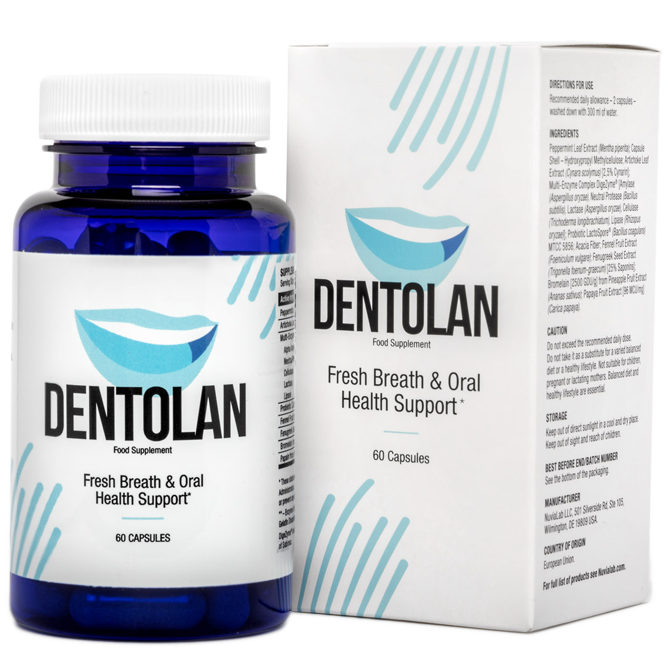
Dentolan's probiotic is named on its panel to strain level, which we credit: LactoSpore®, Bacillus coagulans MTCC 5856, at 2 billion CFU per two-capsule daily serving. Strain-level naming is the transparency the trial literature itself demands, and many labels omit it.
The identity, though, is the problem. Bacillus coagulans is a gut strain: a spore-forming organism that survives transit to the intestine, where its evidence file sits — digestive outcomes such as irritable bowel symptoms and diarrhoea-type endpoints in the monograph literature.
One genuine convenience deserves noting. As a spore former, Bacillus coagulans is shelf-stable and needs no refrigeration — a real formulation advantage for a gut product. Stability in the bottle, however, says nothing about efficacy on the tongue, which is the question this article asks.
It is not among the trialled breath strains. Neither review includes a Bacillus coagulans trial, because none exists: no study has tested B. coagulans — as a lozenge or a capsule — for bad breath outcomes in people.
Delivery widens the gap further. As our full Dentolan review records, Dentolan is a swallowed capsule, two a day with water. Its probiotic passes the tongue in seconds and works, if anywhere, in the gut — the minority route for halitosis.
The wider panel shows the same design. Per two capsules: peppermint 300 mg, artichoke extract 200 mg, the DigeZyme® enzyme complex 150 mg with printed activity units, fennel 100 mg, fenugreek 100 mg, bromelain 50 mg, and papain 50 mg, in an HPMC shell.
It is, as a digestive formula, one of the most completely disclosed panels we have audited: full amounts, enzyme units, a named strain. The price is $59.99 for one 60-capsule bottle, falling to $30.00 per bottle on the six-pack, plus $12 shipping on every order.
Two purchase facts complete the picture. No money-back guarantee is published — the terms allow only a 10-day withdrawal for unused goods. And no trial of Dentolan, DigeZyme®, or LactoSpore® for bad breath exists. The breath claim rests on the digestive theory alone.
What would change this verdict is specific: a randomised trial of B. coagulans, delivered to the mouth or swallowed, measuring volatile sulfur compounds or organoleptic scores against placebo. Until such a trial exists, the strain's breath benefit is a hypothesis, and hypotheses are not evidence.
So the verdict separates disclosure from evidence. Dentolan earns its 5.4/10 partly for printing what competitors hide. But the probiotic literature in this article — lozenges, mouth strains, contested pooled results — lends its formula no support at all.
Our Recommendation — Dentolan
Score: 5.4/10 · Best for: adults whose breath worsens with meals and heavy digestion, who want every ingredient amount and the probiotic's strain printed on the label. Main caution: most bad breath is oral in origin, not digestive — and no money-back guarantee is published. Fair trial: one bottle — one month — judged honestly, with dental causes ruled out before a second.
Frequently Asked Questions
Which probiotic strains have actually been tested for bad breath?
Streptococcus salivarius K12 and M18, and Weissella cibaria, delivered as mouth lozenges. Three of the four trials in the 2022 meta-analysis used the S. salivarius strains and one used W. cibaria. Bacillus coagulans has never been trialled for breath.
Do probiotics really work for bad breath, yes or no?
The honest answer is unsettled. Passadakis et al. 2025 found five of six trials significant on volatile sulfur compounds. López-Valverde et al. 2022 pooled four trials and found no significant effect, p = 0.53. Promise for specific lozenge strains; proof, not yet.
How long do oral probiotics take to work?
Weeks, on the trial record. Studies in the two reviews dosed daily with follow-up from two to twelve weeks. Colonisation is usually temporary and benefits generally depend on continued use. Claims of results in a few days outrun every trial timeline available.
Can a probiotic replace brushing and tongue cleaning?
No. The 2025 review itself concludes that probiotics are an adjunct therapy, and the best results sit alongside hygiene programmes. Lozenges do not remove tongue coating, interdental plaque, or gum-pocket deposits. Hygiene remains the treatment; a probiotic is, at best, support.
Is a swallowed probiotic capsule the same as a breath lozenge?
No — delivery is the difference. A lozenge dissolves on the tongue and seeds the mouth, where 80–90% of halitosis originates. A swallowed capsule transits the mouth in seconds and releases in the gut. The breath trials tested only the lozenge route.
Are oral probiotics safe?
In the trialled populations, yes, on current evidence: no serious adverse effects were reported across the 2025 review's six trials, in systemically healthy adults. That record covers the lozenge strains studied. People with severely weakened immune systems should discuss any live-culture product with a clinician.
Does Dentolan's probiotic have evidence for bad breath?
No breath trial exists for its strain, Bacillus coagulans MTCC 5856, in any delivery form. Its evidence file is digestive. Dentolan is also swallowed rather than dissolved in the mouth, so it differs from the trialled products on both strain and route.
Last reviewed: October 2026. This article is educational and is not medical advice.
