
- Quick Answer
- What the System Is
- The four extracts and their traditional-use framing
- Each extract, weighed separately
- Who makes the technology
- Did Nano T-Growth Really Increase Hair Density by 8.7%?
- Is Folicerin Clinically Proven?
- What Does Encapsulated Caffeine Do That Regular Caffeine Doesn't?
- What encapsulation can and cannot change
- Why Folicerin Reviews List Ingredients That Aren't on Its Label
- How invented lists are made — and the two-minute check
- Our Verdict
- Frequently Asked Questions
- What is Nano T-Growth made of?
- Is the 8.7% hair density figure from a real study?
- Has Folicerin itself been clinically tested?
- Does Folicerin contain saw palmetto or rosemary oil?
- Who makes Folicerin?
- Read This Next
Disclosure: This article contains affiliate links. If you buy through them, we may earn a commission at no extra cost to you. It never changes our conclusions.
Quick Answer
Nano T-Growth Hair is the branded ingredient system at the centre of Folicerin shampoo: a blend of four botanical extracts — black pepper, licorice, burdock and ginseng — built on encapsulation technology the maker credits to a company called Nanovetores.
No independent coverage of the system exists, and no published trial of it can be found. The only number attached to it — an "8.7% increase in average density of new hair strands" — is cited by the maker, traces to no published paper we could locate, and comes from a regimen applied once a day for 56 days, while the product itself directs use five times a week.
That absence, not hostility, is why Folicerin scores 4.6/10 in our review. A branded system is a promise of standardisation; here the branding is the only part of the promise that can be verified.
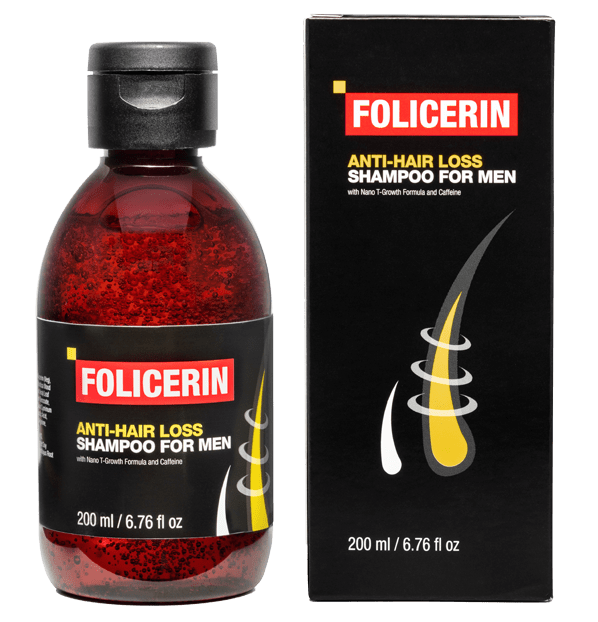
Our Recommendation — Folicerin
Score: 4.6/10 · Best for: men with early thinning who want a botanical, caffeine-based shampoo as a cosmetic add-on alongside whatever else they are doing. Main caution: no money-back guarantee is published, and the label lists ingredient names with no amounts. Fair trial: the three-bottle Standard pack — about three months at directed use, $111.98 with shipping.
What the System Is
The four extracts and their traditional-use framing
The blend combines four plant extracts with long traditional-use histories in hair and skin care. Black pepper extract carries the system's boldest framing — it is the ingredient behind the DHT claim we test in Can a Shampoo Block DHT? Licorice brings a soothing, anti-inflammatory reputation. Burdock is a traditional scalp botanical. Ginseng is the category's familiar "vitality" ingredient.
Traditional use is a reason an ingredient gets formulated, not a result it has produced. None of the four has a human hair-growth trial as a shampoo ingredient, individually or in this combination. The system's novelty is the blend and its delivery technology — which means the evidence for the system has to come from testing the system, and that testing is exactly what cannot be found.
Each extract, weighed separately
Start with black pepper, because it carries the boldest claim. Its traditional-use framing in this system is stimulation: a warming spice recast as a scalp ingredient. Behind that framing there is no human hair-growth trial of black pepper as a shampoo ingredient — not for this blend, and not on its own.
Licorice arrives with a calmer reputation: soothing and anti-inflammatory, in the maker's framing. A soothing reputation is a claim about comfort, not about growth, and it should be weighed as one. No human shampoo trial shows licorice regrowing hair, and the absence matters precisely because comfort claims are easy to mistake for efficacy claims.
Burdock is the traditional scalp botanical of the four: the ingredient whose presence needs the least explaining to anyone who reads herbal hair care. Traditional presence, however, is the whole of its file here. No human trial of burdock in a shampoo — for growth, density or shedding — stands behind its place in this system.
Ginseng is the category's familiar vitality ingredient, and familiarity does quiet commercial work: buyers feel they already know it. Feeling familiar is not evidence. As a shampoo ingredient in this blend, ginseng has the same file as the other three — traditional use, a plausible story, and no human hair-growth trial a reader can examine.
Put the four files together and the pattern is the finding. Each extract was chosen for a reason a formulator can explain; none brings human shampoo evidence of its own. A blend of four untested ingredients is not four times as tested. It is untested in a more complicated shape, which is why the system itself needed testing.
Who makes the technology
The encapsulation technology behind Nano T-Growth is credited by the maker to Nanovetores. Note what that credit is and is not: it names the technology supplier for the ingredient system. It does not name the seller of Folicerin — who is never named anywhere in the product's terms, which refer only to the product's own website name under Hong Kong law.
A buyer trying to answer "who stands behind this product?" therefore gets a technology credit, a trademark, and a website — but no company. That gap is part of the audit, and it recurs across this product's paperwork: the closer a document gets to accountability, the less it says.
Did Nano T-Growth Really Increase Hair Density by 8.7%?
The figure appears in the maker's material as the system's evidence centrepiece: an 8.7% increase in the average density of new hair strands. We attempted to trace it to a published, peer-reviewed paper — the normal next step for any percentage printed on a product page. No such paper could be traced from the material available.
So the figure's status is precise: it is maker-cited. It may describe a real internal or supplier study; it may describe a study of the ingredient system under conditions unlike the product's use. Without a paper — authors, journal, sample size, design, comparator — there is no way to know, and a percentage that cannot be examined cannot be credited.
And the tension must be printed in the same passage, because the maker never prints it together: the regimen behind the figure applied the system once a day for 56 days. Folicerin's own directions say to use the shampoo five times a week. The product is therefore directed to be used less often than the schedule that produced its headline number.
Neither half of that sentence is a detail. A buyer replicating the cited regimen would use roughly forty percent more product than the directions describe — and would run through a "one-month" bottle correspondingly faster. A claim and its conditions belong together; separating them is how an 8.7% figure gathered under daily use ends up selling a five-times-a-week shampoo.
Is Folicerin Clinically Proven?
Search the product's name and you will meet clinical language: review pages describe the formula as clinically backed, research-proven, or developed from clinical findings. Those pages are part of an affiliate review ecosystem — they carry star ratings without review counts, and "Side Effects — N/A" as a section entry. Their clinical vocabulary is furniture, not sourcing.
Against that language, the record is short: no published trial of Folicerin exists. Not a small one, not an open-label one — none that we could find in the material available, and none the maker cites with enough detail to locate. The finished product, as sold, has never been tested in any study we can identify.
The accurate sentence is therefore unglamorous: Folicerin is an untested finished product containing an ingredient system with one maker-cited figure behind it. Every stronger sentence in circulation traces to pages that profit from the product's sale. That is why this site quotes the maker's claims as claims — attributed, dated, and weighed — rather than absorbing them into our own voice.
What Does Encapsulated Caffeine Do That Regular Caffeine Doesn't?
Folicerin's second branded system, NV Caffeine ECO, encapsulates caffeine in biopolymer particles larger than 200 nanometres. The maker's framing is that encapsulation helps the caffeine stay on the scalp — a sensible goal for a product that is rinsed off within two minutes.
What would prove the advantage is retention data: measurements showing how much caffeine remains on the scalp after rinsing, compared with an unencapsulated formula. No such data is published for this system. And because the INCI list publishes no amounts, there is no stated caffeine quantity for the encapsulation to deliver in the first place.
Our caffeine shampoo review grades the underlying ingredient: real laboratory effects, real penetration, no human regrowth trial. Encapsulation may yet prove to be a better vehicle for that ingredient. On the published record, it is currently a claim about a claim — an unmeasured delivery system for an unproven-at-shampoo-dose ingredient.
What encapsulation can and cannot change
Encapsulation, described plainly, wraps an ingredient inside a carrier particle. What that wrapping can plausibly do is protection: shield a fragile ingredient from air, light and the rest of the formula until it is used. Protection is a real formulation goal, and a maker choosing it is not doing anything strange.
What wrapping cannot do by itself is prove delivery. A particle that protects caffeine in the bottle still has to survive dilution, two minutes on a wet scalp, and a rinse — and then leave its contents where they matter. Each of those steps is a separate question, and none is answered by the word encapsulated.
The rinse is the honest difficulty for every delivery claim in this format. Most of what is applied is designed to leave: that is what shampoo is. A delivery system for a rinse-off product therefore carries a heavier burden of proof than the same system in a leave-on product, where hours of contact do part of the work.
So the qualitative verdict has two halves that must stay together. Encapsulation can change how an ingredient is stored, handled and released; those are genuine formulation variables. It cannot, without retention measurements, change what a buyer is entitled to conclude — and for this system, as the section above notes, no retention measurements are published.
A useful way to hold the distinction: protection is a claim about the bottle, delivery is a claim about the scalp. The first can be true on formulation logic alone. The second needs numbers gathered on skin, after rinsing, against an unencapsulated comparison. Only the first kind of claim is currently available for NV Caffeine ECO.
None of this makes encapsulation pointless. It makes it unproven, which is a different and narrower charge. A buyer who likes the rest of the formula can treat the particles as a reasonable bet. A buyer asked to pay a premium for delivery itself is being asked to pay for the missing measurement.
Why Folicerin Reviews List Ingredients That Aren't on Its Label
Read three Folicerin review pages and you will meet ingredients the bottle does not contain: saw palmetto, rosemary oil, nettle, horsetail. None of them appears in the verified INCI list. The reviews appear to have assembled a plausible hair-shampoo formula from category conventions — and from other products — rather than from this product's label.
This matters beyond pedantry. A review ecosystem that invents ingredients will invent everything else on the same page: the efficacy language, the safety summary, the star rating. When a page's ingredient list is wrong, its conclusions were never derived from the product at all. They were derived from the category's template.
The corrective is unglamorous and available to anyone: read the actual INCI list. Our Folicerin product page carries the verified list exactly as the maker publishes it — the two branded systems, the named supporting ingredients, and the wheat and soy proteins the review pages also omit. If a review's ingredients disagree with the label, believe the label and discount the review entirely.
It is also why rosemary oil and onion juice appear in this article's reading rail: they are real, separately researched topics — covered in our guides to rosemary oil for hair loss and onion juice for hair growth — that review pages keep pasting into this shampoo's formula. They belong in Folicerin discussions only as examples of what is not in it.
How invented lists are made — and the two-minute check
Invented ingredient lists are rarely written from nothing. The economical way to produce one is copying: take the formula of a better-known hair product, or the ingredient story from another review of the same product, and paste it under this product's name. The next page copies the copy, and repetition starts to look like confirmation.
Notice what that workflow never includes: the label. Checking a list against a bottle takes minutes and produces no new content, so a page paid per click has no incentive to do it. An ingredient that sounds right for the category — saw palmetto, rosemary, nettle — survives every copy precisely because nobody's job was verification.
The reader's defence is deliberately small, because it has to survive real life. Give any review two minutes and one question: do the ingredients it names appear on the maker's own INCI list for this product? Open both lists side by side and compare names, not impressions.
Work the check in a fixed order. First, find one distinctive ingredient the review praises and search for that exact name in the label list. Then reverse it: pick one distinctive name from the label and search for it in the review. A review that fails in both directions was not written from the product.
Apply that check here and the result is immediate. Saw palmetto and rosemary oil appear in reviews of this shampoo and nowhere in its verified list, while the wheat and soy proteins on the real label go unmentioned. Two minutes is enough to learn which document — review or label — deserves to be believed.
Keep the habit for the next product, whatever it is. Labels can be incomplete in what they quantify, as this article has shown, but they are accountable documents: a maker answers for them. A copied review answers to no one, which is exactly why its ingredient list should never outrank the bottle in your hand.
Our Verdict
Nano T-Growth is a branded blend of four traditional botanicals whose entire evidence file is one maker-cited percentage, gathered under a daily regimen the product's own directions do not follow, in a study no reader can locate. The system may be a perfectly good shampoo ingredient. Nothing published allows a stronger sentence than that.
That is the standard this site applies uniformly: claims are weighed by what can be checked. Folicerin's label can be checked — and its INCI honesty about what is in the bottle is genuinely better than the review pages written about it. Its evidence cannot be checked at all. The 4.6/10 score is those two facts added together.
Our Recommendation — Folicerin
Score: 4.6/10 · Best for: men with early thinning who want a botanical, caffeine-based shampoo as a cosmetic add-on alongside whatever else they are doing. Main caution: no money-back guarantee is published, and the label lists ingredient names with no amounts. Fair trial: the three-bottle Standard pack — about three months at directed use, $111.98 with shipping.
Frequently Asked Questions
What is Nano T-Growth made of?
Four botanical extracts: black pepper, licorice, burdock and ginseng, delivered in an encapsulated system whose technology the maker credits to Nanovetores. The INCI list publishes no amount for the system or for any individual ingredient, so the proportions inside the blend are known only to the maker.
Is the 8.7% hair density figure from a real study?
It is maker-cited, and no published paper behind it could be traced from the available material — no authors, journal, sample size or design can be examined. The cited regimen also applied the system once a day for 56 days, while Folicerin's directions say five times a week. Treat the figure as an unverified claim, not a finding.
Has Folicerin itself been clinically tested?
No published trial of the finished product exists that we could find, and the maker cites none with locatable detail. Review pages calling it clinically proven are affiliate content; their ingredient lists for this shampoo include ingredients the verified label does not contain, which indicates how closely they examined the product.
Does Folicerin contain saw palmetto or rosemary oil?
No. Review pages list both, but neither appears in the verified INCI list. The label names the Nano T-Growth and NV Caffeine ECO systems plus caffeine, arginine, niacinamide, calcium pantothenate, zinc gluconate, biotin, hydrolyzed wheat protein, hydrolyzed soy protein and ginseng berry extract. Believe the label over any review — including, on checkable facts, ours.
Who makes Folicerin?
The product is made in the EU, but the seller is never named: the terms refer only to the product's website name, under Hong Kong law. The Nano T-Growth technology is credited to Nanovetores, which is a technology credit for the ingredient system — not the identity of the company selling you the shampoo.


Last reviewed: October 2026. This article is educational and is not medical advice.
