
- The Trial, Exactly as Run
- Who the Result Does and Does Not Cover
- What "As Good as Minoxidil" Leaves Out
- Why the 3-Month Result Matters
- What Rosemary Oil Is Not Proven to Do
- How People Use It, Safely
- Where It Sits in a Real Plan
- Frequently Asked Questions
- How long until rosemary oil shows anything?
- Can you use rosemary oil with minoxidil?
- Is rosemary oil safe for women?
- Does rosemary oil block DHT?
- Why does this one small trial get shared so much?
- Does it work for a receding hairline specifically?
- Is rosemary oil as good as 5% minoxidil?
- Read This Next
The Trial, Exactly as Run
The study is Panahi and colleagues, published in SKINmed in 2015: a randomised comparative trial in patients with androgenetic alopecia, run over six months.
One hundred patients were randomly assigned to two groups of fifty. One group applied rosemary oil; the other applied minoxidil 2%. The regimen, as reported for the trial, was twice-daily application.
Hair was not judged by eye or by patient impression. A standardised professional microphotographic assessment was taken at the initial visit and again after three and six months, and hair counts were compared.
That measurement choice is a real strength. Hair counts from standardised photographs are harder to fool than self-ratings, which is one reason this small trial gets cited so often.
The three-month result was flat. As the abstract reports, no significant change was observed in mean hair count at the three-month endpoint in either the rosemary group or the minoxidil group.
The six-month result was different. Both groups experienced a significant increase in hair count compared with baseline and with the three-month point, at the P < .05 level.
Crucially, no significant difference was found between the study groups on hair count at month three or at month six. Rosemary oil did not beat minoxidil, and minoxidil did not beat rosemary oil.
Side effects were tracked too. The frequencies of dry hair, greasy hair and dandruff did not change significantly from baseline in either group at either checkpoint.
Scalp itching rose in both groups compared with baseline. But itching was significantly more frequent in the minoxidil group than in the rosemary group at both the three-month and six-month assessments.
The authors concluded that their findings provided evidence for the efficacy of rosemary oil in the treatment of androgenetic alopecia. That conclusion, and its limits, are what the rest of this article separates.
One design detail deserves a line of its own: the trial is indexed as single-blind. That means one side of the measurement process was blinded, not every part of it, as in a double-blind drug trial.
The full result, in one view:
| Checkpoint | Rosemary oil group | Minoxidil 2% group |
|---|---|---|
| 3 months | No significant change in mean hair count | No significant change in mean hair count |
| 6 months | Significant increase vs baseline | Significant increase vs baseline |
| Between groups | No significant difference at month 3 or month 6 | |
| Scalp itching | Increased vs baseline; less frequent than minoxidil | Increased vs baseline; more frequent than rosemary |
Who the Result Does and Does Not Cover
A trial result belongs to the people who were in the trial. Panahi enrolled patients with androgenetic alopecia — pattern hair loss — which is the condition most adults searching this ingredient actually have.
That match is worth stating plainly, because much of the natural-hair literature fails it: ingredients are routinely tested in animals, in unrelated conditions, or not tested at all, then sold for pattern loss.
The boundaries are equally plain. The trial was run at a single centre, over six months, in a defined patient group. Results in teenagers, in very advanced loss, or over years of use are all unmeasured.
Six months is also short in the life of this condition. Pattern hair loss is managed over years, and a treatment's value depends on whether gains hold — something a six-month trial cannot show.
Nor does the trial compare starting points. It tells us nothing about whether beginning rosemary oil early in the loss process works better than beginning late. No subgroup claim of that kind was reported.
And because there was no untreated or placebo arm, the trial cannot say how much better either group did than doing nothing at all over the same six months.
Read with those boundaries, the study is best understood as a promising first comparison that earned a larger, longer, placebo-controlled follow-up — a follow-up that, a decade later, still has not appeared.
What "As Good as Minoxidil" Leaves Out
The headline version of this trial — "rosemary oil works as well as minoxidil" — is technically traceable to the data. It is also missing the four words that change its meaning: the dose of minoxidil.
The comparator was minoxidil 2%. That is not the strength most men use for pattern hair loss; the standard men's products are 5%. Rosemary oil has never been tested against 5% minoxidil.
It has never been tested against finasteride either, or against oral minoxidil. Every "natural alternative to the proven drugs" claim built on this trial is built on a comparison with the weakest common version of one drug.
The second omission is the missing placebo group. With only two active arms, the trial cannot separate either treatment's effect from everything else that six months of twice-daily scalp application involves.
That list is not trivial: the vehicle the ingredients were carried in, the daily application ritual itself, seasonal shedding cycles, and ordinary fluctuation in hair counts over half a year.
Both groups improving by a similar amount is consistent with both treatments working. It is also consistent with shared non-specific effects lifting both groups together. This design cannot tell those two stories apart.
The third omission is statistical. "No significant difference" in a trial of 100 people is not the same as proof that two treatments are equal.
Panahi was a comparative trial, not a formal equivalence or non-inferiority trial with pre-set margins. A study of this size can miss a real difference simply because it lacks the numbers to detect one.
The fourth omission is replication. This is one trial, from one centre and one research group, published in 2015. In the decade since, no second group has repeated it at larger scale.
Finally, the endpoint itself was a hair count in photographed areas. The trial did not report whether patients or independent observers rated overall coverage or appearance as visibly improved.
To be fair to the researchers, 2% minoxidil was a legitimate comparator: it is an approved, widely used strength, and a reasonable first drug to test a natural oil against. The distortion happens downstream, in marketing.
Somewhere between the paper and the product page, the "2%" falls off the claim. What survives is "clinically shown to work as well as minoxidil" — a statement the trial, as designed, never tested at standard strength.
The itching finding gets the same treatment. "Less itching than minoxidil" is true relative to the 2% arm in this trial. It is not a guarantee of a side-effect-free experience; itching rose in the rosemary group too.
None of this makes the result worthless.
A randomised trial with objective counts, a real drug comparator and a six-month duration is more than most natural hair ingredients ever produce. It makes the result preliminary.Why the 3-Month Result Matters
The most under-reported number in this trial is the zero at three months. Nothing measurable happened in either group — including the group using minoxidil, a drug with decades of evidence behind it.
That is how hair biology works. A follicle influenced today produces visible change on a timescale of months, because hair grows slowly and shedding and regrowth cycles overlap.
For anyone trying rosemary oil, the implication is blunt: judging it at four, six or even twelve weeks is judging it before the only trial behind it saw any effect from anything.
The symmetrical implication matters just as much. Social-media posts promising visible rosemary-oil results in a few weeks are promising something the ingredient's own best evidence does not show.
The three-month flat line also reframes the six-month gain. Whatever happened in this trial happened slowly, under a twice-daily regimen sustained for half a year. Occasional use is a different, untested intervention.
Adherence is part of the treatment being tested, in other words. A trial result belongs to the regimen that produced it — twice a day, every day, for six months — not to the bottle alone.
This is also why before-and-after photographs taken a month apart prove so little, for any product. The trial's own drug arm could not produce a measurable count change in twice that time.
What Rosemary Oil Is Not Proven to Do
Marketing for rosemary oil usually adds a mechanism: it is said to block DHT, the hormone that drives pattern hair loss, by inhibiting the enzyme 5-alpha-reductase. That claim needs a label.
The DHT claim rests on laboratory work with rosemary compounds — in-vitro speculation, not a measurement made in human scalps. No human study has shown that applying rosemary oil lowers scalp DHT or blocks the enzyme in people.
We therefore do not print "carnosic acid inhibits 5-alpha-reductase" as a fact about what happens on your head. A compound doing something in a dish is a reason to run a human trial, not a result.
The trial paper itself offers a softer rationale: rosemary is a medicinal plant described as enhancing microcapillary perfusion. Improved blood flow is a proposed explanation for the result, not a demonstrated one.
Other hair-loss types are outside the evidence entirely. Panahi enrolled people with androgenetic alopecia. The trial says nothing about alopecia areata, stress-related shedding, or scarring hair-loss conditions.
There is also no dose information to borrow. One preparation, at one strength, on one schedule was tested. Stronger, weaker or differently formulated rosemary products cannot claim the result as theirs.
A related caution applies to a second study often mentioned online: an unnamed "2022 study" said to show similar results in six weeks. We could not verify that study, so it plays no part in this article.
Six weeks should trigger scepticism on its own. It is shorter than the three months in which Panahi's trial — rosemary and minoxidil alike — recorded no significant change whatsoever.
What remains after these subtractions is still a real finding: one preparation of rosemary oil, used twice daily for six months, matched 2% minoxidil on hair counts in one trial. That is the whole claim the evidence supports.
How People Use It, Safely
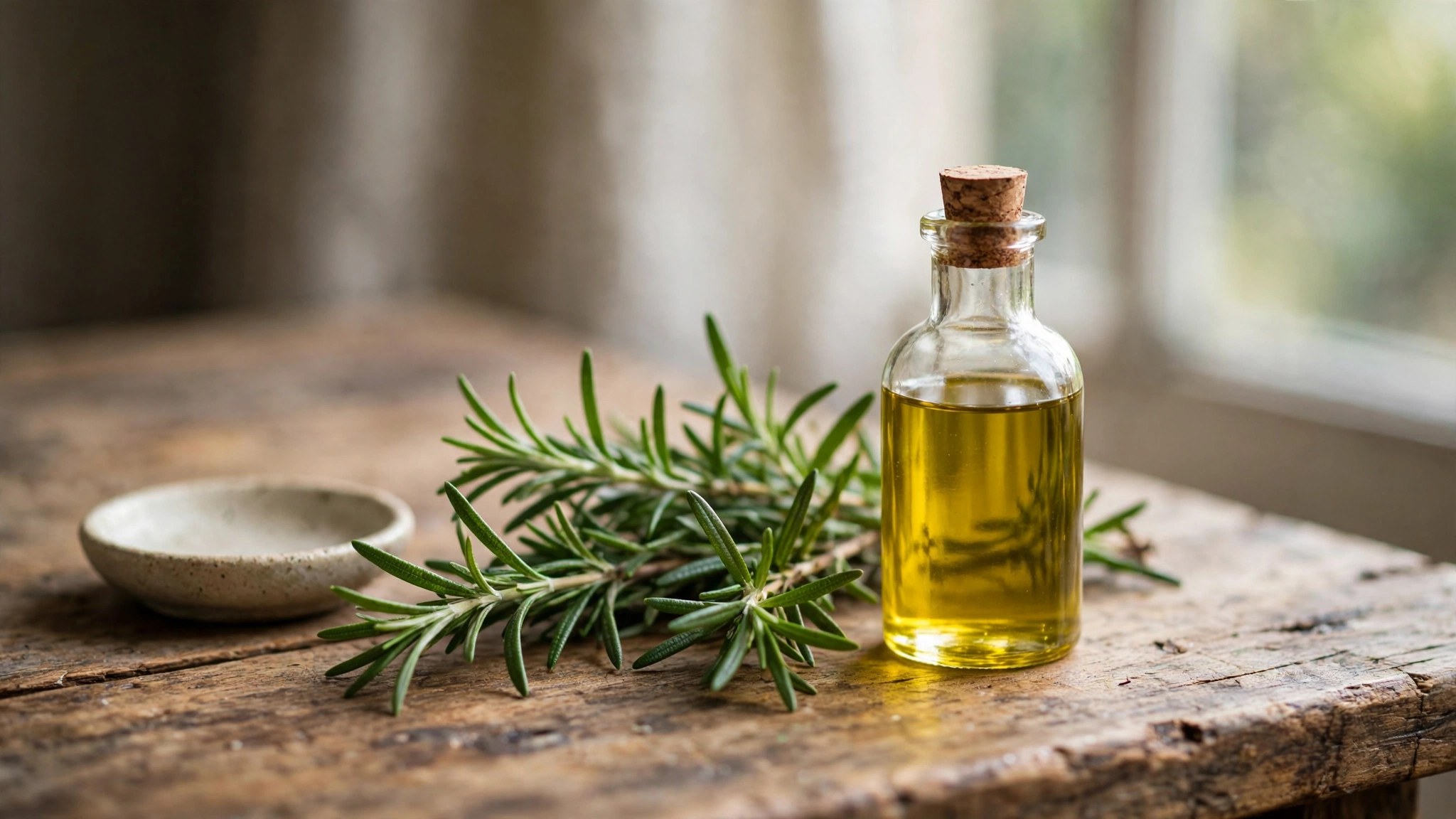
Rosemary oil is an essential oil, and essential oils are concentrated plant extracts. The standing safety rule is simple: dilute rosemary oil in a carrier oil before it goes on the scalp. Never apply it neat.
A carrier is a plain, skin-tolerated oil used to spread a few drops of essential oil over a wider area at a lower concentration. The point is contact without the irritation that undiluted oils can cause.
Patch-test first. Apply a small amount of your diluted mixture to a discreet area of skin, such as the inner forearm, and watch it for at least a day before wider use.
Burning, spreading redness or a rash after a patch test is a stop signal, not something to push through. The same rule applies at any point during use: worsening irritation means stop.
The trial offers one tolerability data point here. Scalp itching increased from baseline in both of its groups — rosemary oil included — even though itching was less frequent than with minoxidil.
So mild itching on rosemary oil is not unheard of. Itching that escalates, soreness, flaking that worsens, or any blistering is outside what the trial described and is a reason to discontinue and seek advice.
Keep the oil away from your eyes, and do not apply it to broken or inflamed skin. Those are basic essential-oil precautions, and they apply however natural the product sounds.
Use that mirrors the trial is twice-daily application, sustained for six months before judgement. Anything less frequent, or judged sooner, is an experiment the evidence does not describe — set expectations accordingly.
Safety beyond the trial population is unstudied. Panahi enrolled adults with pattern hair loss; the trial provides no safety data for pregnancy, breastfeeding or use on children, so those situations are a clinician conversation.
One practical note: oils change how the scalp and hair feel and can build up. The trial found no significant change in greasy hair frequency, but cosmetic acceptability is a legitimate reason people quit — plan for it.
Where It Sits in a Real Plan
Pattern hair loss has treatments with far deeper records than one 2015 trial. Minoxidil and finasteride remain the options with decades of data, regulatory scrutiny and long-term follow-up behind them.
Rosemary oil's honest position is narrower: a preference-based alternative for someone who will not use drug treatment, chosen with the knowledge that its best comparison is against 2% minoxidil only.
It can also be framed as an adjunct — something used alongside an established routine. But note that the trial tested rosemary oil instead of minoxidil, not in combination with it. Combination use is untested.
Cost and effort belong in the decision too. The trial regimen is twice-daily, indefinite, and slow to judge. A cheap bottle is not a cheap regimen if it takes six months to learn anything.
Diagnosis comes before any of this. Hair loss that is rapid, patchy, painful, inflamed or accompanied by scaling is not automatically pattern hair loss, and it needs a clinician, not an oil.
If you do try it, borrow the trial's measurement discipline as well as its regimen. Photograph the same areas, in the same light, at the start and at three and six months. Memory flatters every treatment.
Our verdict: the Panahi trial makes rosemary oil the rare natural hair ingredient with a genuine comparative result.
It does not make it a proven equal of standard-strength minoxidil, and it proves nothing about DHT.If you use it, use it the way the trial did — diluted, twice daily, judged at six months — and keep the claim attached to it exactly as large as the evidence, and no larger.
Frequently Asked Questions
How long until rosemary oil shows anything?
In the only comparative trial, nothing measurable happened by three months in either group. Hair counts rose significantly by six months. Judge any rosemary-oil routine at six months, not before.
Can you use rosemary oil with minoxidil?
The combination has never been tested. Panahi compared rosemary oil against minoxidil as alternatives. Using both together is common in online routines, but no trial describes its effect or tolerability.
Is rosemary oil safe for women?
The 2015 trial studied pattern hair loss and does not provide a separate safety record for women, pregnancy or breastfeeding. Dilution and patch testing apply to everyone; pregnancy use is a clinician question.
Does rosemary oil block DHT?
There is no human evidence that it does. The DHT and 5-alpha-reductase claims come from laboratory work on rosemary compounds. No study has measured a DHT effect from rosemary oil applied to a human scalp.
Why does this one small trial get shared so much?
Because it is genuinely unusual: a randomised trial, an objective hair-count endpoint, and a real drug as the comparator. Most natural hair ingredients have none of the three. Scarcity of good evidence makes one decent trial travel far.
Does it work for a receding hairline specifically?
The trial measured hair counts in standardised photographed areas and reported the overall result. It published no hairline-versus-crown breakdown, so any claim that rosemary oil works better in one zone is not from this study.
Is rosemary oil as good as 5% minoxidil?
Unknown. It was compared only with 2% minoxidil, the weaker strength. No trial has tested rosemary oil against the 5% products most men use, or against finasteride.

Last reviewed: October 2026. This article is educational and is not medical advice.
