
- Quick Answer
- The Claim, Word for Word
- What Would Have to Be True
- The enzyme would have to be inhibited at the follicle
- By an ingredient delivered in a 2-minute rinse
- At an amount the maker doesn't publish
- The arithmetic fails twice, independently
- What the Laboratory Record Actually Contains
- The Category's Track Record
- What "Blocks DHT" Can Honestly Mean on a Shampoo Label
- A decoder for label language
- Three questions for any DHT shampoo
- Our Verdict
- Frequently Asked Questions
- Has any shampoo been shown to lower scalp DHT?
- Does black pepper extract inhibit 5-alpha-reductase?
- If saw palmetto is a natural DHT blocker, why did its trials fail?
- What DHT treatment actually has evidence?
- Should the DHT claim stop me buying Folicerin?
- Read This Next
Disclosure: This article contains affiliate links. If you buy through them, we may earn a commission at no extra cost to you. It never changes our conclusions.
Quick Answer
No shampoo has ever been shown to reduce scalp DHT in humans. Not one — of any brand, with any ingredient. The measurement has simply never been made and published for a rinse-off product.
The black pepper version of the claim, attached to Folicerin's Nano T-Growth system, traces to marketing and review copy, not to trials. And the deeper problem is categorical: even the systemic "natural DHT blockers" — swallowed daily, at full doses — start from a weak trial base, as saw palmetto's record shows. A two-minute rinse begins several floors below that.
So this article's answer is not "probably not". It is that the claim, for black pepper in a shampoo, has no human evidence of any kind behind it — and the honest label sentence would say so.
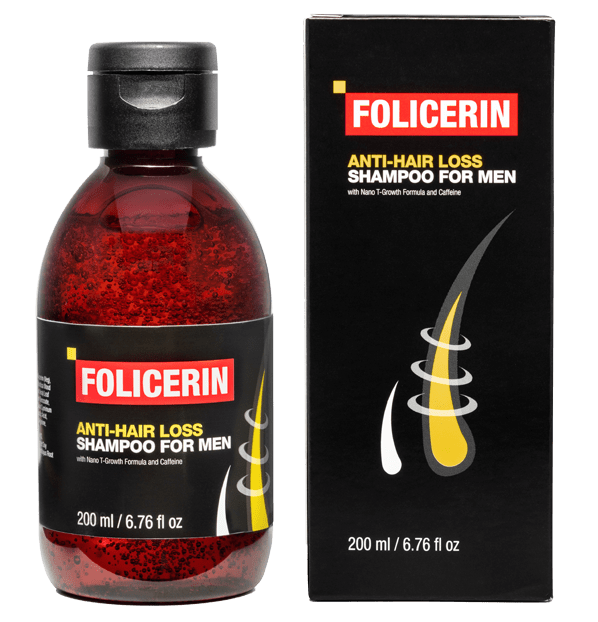
Our Recommendation — Folicerin
Score: 4.6/10 · Best for: men with early thinning who want a botanical, caffeine-based shampoo as a cosmetic add-on alongside whatever else they are doing. Main caution: no money-back guarantee is published, and the label lists ingredient names with no amounts. Fair trial: the three-bottle Standard pack — about three months at directed use, $111.98 with shipping.
The Claim, Word for Word
The sentence in circulation describes black pepper extract as "known for inhibiting the activity of 5-alpha-reductase" — the enzyme that converts testosterone to DHT. It appears on review and content pages about Folicerin (blastfitness and saulmd are among its carriers), phrased as settled knowledge: known for.
Trace it and the trail ends at copy, not data. No trial is cited. No study of black pepper and 5-alpha-reductase in human scalp is named, because none is available to name. The sentence's authority is its repetition: each page that prints it becomes the next page's reason to print it.
In Folicerin, black pepper is one of four extracts inside the Nano T-Growth system — the system examined in What Is Nano T-Growth? Its amount is unpublished, like every amount on that label.
So the claim asks you to believe that an unstated quantity of one extract, inside a blend, inside a two-minute rinse, inhibits an enzyme at the base of the follicle. Each of those qualifiers is a place the evidence would have to exist. It exists at none of them.
What Would Have to Be True
The enzyme would have to be inhibited at the follicle
5-alpha-reductase does its work inside cells, including the follicle's dermal papilla, several millimetres below the scalp surface. A DHT claim requires the ingredient to reach that site and inhibit the enzyme there, measurably. Finasteride's claim rests on exactly that kind of measurement, made in treated men during its trial programme.
By an ingredient delivered in a 2-minute rinse
The delivery window is the directed use: apply, massage, leave two minutes, rinse. Penetration research on caffeine shows follicular delivery begins within minutes — which keeps the claim physically conceivable — but delivery of something is not inhibition of the enzyme, and no study bridges that gap for any shampoo ingredient.
At an amount the maker doesn't publish
Enzyme inhibition is dose-dependent in every system where it has been measured. Folicerin publishes no amount for black pepper extract — not in the system, not in the bottle. A dose-dependent claim with no dose is unfalsifiable by design: whatever the result, the label never committed to the quantity that would let anyone check.
The arithmetic fails twice, independently
It helps to separate the two failures, because fixing one would not fix the other. The first failure is amount: inhibition depends on concentration, and the concentration here is unpublished. The second failure is contact: whatever the amount, it is diluted, spread across the scalp, and rinsed away after two minutes of directed use.
Work the first failure as reasoning, without inventing numbers. A formulator can put a trace of an extract in a blend or a substantial share, and both formulas print the identical line on the label: the extract's name, with no amount. The claim sounds the same in both bottles, which is why the claim carries no information.
Now work the second failure the same way. Even a generously dosed rinse must cross from the scalp surface to the enzyme's home inside the follicle, within two minutes, against a flow of water designed to remove it. Delivery beginning within minutes — the caffeine finding — shows the journey can start. It does not show it arriving in strength.
Independent failures multiply rather than add. A strong amount with weak delivery fails at delivery; perfect delivery of a trace amount fails at amount. The shampoo claim needs both steps to succeed at once, in the same two minutes, with neither step measured. That is the qualitative arithmetic the marketing sentence asks buyers to skip.
Compare the shape with the drug the claim imitates. Finasteride's dose is named, its contact is daily and sustained, and its enzyme effect was measured in the men taking it. Every quantity the shampoo leaves blank, the drug publishes. The comparison is not unfair to the shampoo; it is simply what a dose-dependent claim requires.
Notice, finally, that the two failures protect the claim from testing. Because the amount is unstated, a null result can always be blamed on a future, stronger formula. Because delivery is unmeasured, a null result can always be blamed on contact time. A claim arranged so it cannot lose has also arranged that it cannot win.
What the Laboratory Record Actually Contains
Laboratory discussions of botanical 5-alpha-reductase inhibition do exist as a genre. Plant compounds are tested against the enzyme in vitro, or in cultured follicles, and inhibition percentages in a dish get quoted as if they were scalp measurements. Fischer's caffeine work — discussed honestly in our caffeine shampoo review — is the genre's respectable end: real follicles, a real mechanism, and results its authors confined to the model they used.
For black pepper specifically, there is not even that. We know of no published study — in vitro, animal or human — that measures black pepper extract's effect on scalp DHT, and none that the claim's carriers cite. The laboratory record for this ingredient and this claim is not thin. It is absent.
That absence is the finding, and it is worth stating without decoration: a claim repeated across dozens of pages, attached to a selling product, for which the underlying measurement has never been performed by anyone, anywhere, as far as the published record shows.
The Category's Track Record
Suppose, generously, that black pepper did inhibit 5-alpha-reductase in a dish. The category's history says what happens next. Saw palmetto — the flagship "natural DHT blocker", with genuine laboratory inhibition data behind it — was tested systemically at full supplement doses, and its best trials failed.
In Bent et al. 2006 (New England Journal of Medicine), 225 men took 320 mg/day of standardised saw palmetto extract or placebo for a year: no difference in symptoms, and no movement in PSA, the androgen-sensitive marker a real DHT effect should shift.
The CAMUS trial (Barry et al. 2011, JAMA) escalated to 960 mg/day over 72 weeks in 369 men and again found the extract indistinguishable from placebo. Our saw palmetto review grades that record in full.
That is the ceiling the shampoo claim must clear: an ingredient with lab data, taken orally, at up to triple dose, for over a year, could not demonstrate the effect. The "natural DHT blocker" framing is graded as a category in our natural DHT blockers audit — and the framing fails there too, before any shampoo enters the discussion.
What "Blocks DHT" Can Honestly Mean on a Shampoo Label
Strip the claim to what could honestly be printed and very little survives. A label could say an ingredient has been discussed in laboratory contexts in relation to 5-alpha-reductase. It could say the formula is designed with DHT in mind. Both are statements about intention and literature, not about your scalp.
What it cannot honestly say — as a finding — is that the product blocks DHT, reduces scalp DHT, or inhibits the enzyme in the person washing with it. No measurement supports those sentences for Folicerin, whose black pepper sits at an unpublished amount inside a four-extract system. The gap between the honest sentence and the circulating one is the entire marketing content of the claim.
A decoder for label language
Labels and listings rarely print the blunt sentence 'blocks DHT' without a softener in front of it. The softeners are the product. Each one lowers what the maker has actually committed to, until the commitment reaches zero while the impression stays. Reading them literally — as logic, not as advertising — is the whole skill.
'Helps inhibit 5-alpha-reductase' commits the maker to almost nothing. Helps names no degree, no site and no measurement: an effect too small to detect would still, in this phrasing, be helping. Inhibit, without a percentage or a human study behind it, is a direction of travel claimed in a system the sentence never identifies.
'Supports a DHT-blocking routine' commits the maker to even less. The shampoo no longer claims to block anything itself; it claims to accompany other things that supposedly do. A pleasant wash supports a routine in the same empty sense — it fits into one. The sentence is true of every shampoo ever sold, which is why it proves nothing about this one.
'With DHT-blocking ingredients' is the weakest form of all. With states only that named ingredients are present — which, at unpublished amounts, the label already said. Blocking has quietly moved from a result the product produces to an adjective borrowed from the ingredients' marketing. Presence is checkable on an INCI list; the borrowed adjective is not checkable anywhere.
The decoder rule is therefore simple. Ask of any version: what measurement, in what people, at what amount, would make this sentence false if the product did nothing? If no answer exists — and for all three phrasings above, none does — the sentence was built to survive the product doing nothing. Treat it accordingly.
There is a simple test for any future version of this claim, from any brand: ask for the human measurement. A scalp-DHT study — subjects, shampoo, measured DHT before and after — either exists or it doesn't. For every shampoo on the market today, it doesn't. The first brand to run that study will not need reviewers to repeat its sentences for it.
Three questions for any DHT shampoo
Before the verdict, a checklist short enough to use in a shop or on a product page. It asks for nothing exotic — only the three things every substantiated version of this claim, in any category, has been able to produce when challenged. A claim that cannot answer them has told you what it is.
Question one: where is the human measurement? Not a dish, not a traditional use, not a reviewer's sentence — a study in people, using a shampoo, with scalp DHT measured before and after. As this article has shown, no shampoo of any brand can currently produce that document. The question ends most claims on its own.
Question two: what is the amount? Inhibition is concentration-dependent, so a claim without a dose is a claim without its central fact. If the label publishes no amount for the named ingredient — in the blend or in the bottle — the maker has declined to state the one number the claim turns on.
Question three: what exactly does the sentence commit to? Run it through the decoder above — helps, supports, with — and strip the softeners away. What remains is either a measurable promise about your scalp or a sentence designed to survive doing nothing. Buy only on the first kind, and expect, for now, to find only the second.
Our Verdict
Can a shampoo block DHT? On the published record: no shampoo has been shown to, the black pepper claim behind this article has no study of any kind beneath it, and the strongest systemic candidate in the category failed its best trials at full oral doses for over a year.
Judge Folicerin on what remains once the claim is removed — a botanical caffeine shampoo with a plausible ingredient story — and it is an ordinary cosmetic with an ordinary evidence file. The DHT sentence is doing commercial work that no data does. When a claim's entire support is its own repetition, the correct response is not scepticism about the degree. It is to decline the claim.
Our Recommendation — Folicerin
Score: 4.6/10 · Best for: men with early thinning who want a botanical, caffeine-based shampoo as a cosmetic add-on alongside whatever else they are doing. Main caution: no money-back guarantee is published, and the label lists ingredient names with no amounts. Fair trial: the three-bottle Standard pack — about three months at directed use, $111.98 with shipping.
Frequently Asked Questions
Has any shampoo been shown to lower scalp DHT?
No. No published study has measured scalp DHT in people using any shampoo — medicated, caffeine-based or botanical. DHT reduction has been measured for prescription drugs taken orally or applied as leave-on treatments. For rinse-off products, the measurement the claim depends on has never been performed.
Does black pepper extract inhibit 5-alpha-reductase?
There is no published human evidence that it does, at any dose, by any route — and no scalp study at all. The sentence circulates in marketing and review copy without a citation. Laboratory inhibition claims for botanicals generally come from test-tube systems; for black pepper and DHT, even that tier of evidence is not publicly attached to the claim.
If saw palmetto is a natural DHT blocker, why did its trials fail?
Because laboratory enzyme inhibition does not guarantee a clinical effect. In Bent 2006, 320 mg/day for a year in 225 men did not beat placebo or move PSA; CAMUS 2011 escalated to 960 mg/day for 72 weeks with the same result. The ingredient's defenders dispute the extracts and endpoints — but the flagship systemic candidate's best tests are null, which is the base rate any shampoo claim starts from.
What DHT treatment actually has evidence?
Finasteride, a prescription drug whose DHT reduction was measured directly in treated men and whose hair outcomes were tested in placebo-controlled trials — with real side effects that require a clinician's involvement. That is what a substantiated DHT claim looks like: a named drug, a measured mechanism, a trial record, and a side-effect profile printed on the label.
Should the DHT claim stop me buying Folicerin?
It should stop you buying it for the DHT claim. As a botanical shampoo judged on ordinary cosmetic grounds, it is a defensible purchase for some men. As a DHT intervention, it is a claim with no measurement beneath it, at an unpublished dose, in a two-minute rinse. Buy the shampoo if you want the shampoo — not the sentence.
Last reviewed: October 2026. This article is educational and is not medical advice.
