
- Quick Answer
- Irritation vs Allergy: Two Different Problems
- Irritant reactions
- Allergic contact dermatitis
- The Allergens That Actually Cause Shampoo Reactions
- Hunting an allergen on the INCI list
- Patch-testing a new shampoo at home
- The Shedding Nobody Warns About
- Class Lessons From Medicated Shampoos
- The ladder, step by step
- One Product's Paperwork, Read Against Itself
- Damaged or Broken Scalp
- When to Stop — and When to See a Doctor
- Our Verdict
- Frequently Asked Questions
- Can a hair loss shampoo make hair loss worse?
- How do I tell irritation from allergy?
- Is Folicerin really 100% safe, as its FAQ says?
- What ingredients in shampoo cause the most allergic reactions?
- Can I use a hair loss shampoo on a broken or eczema-affected scalp?
- Read This Next
Disclosure: This article contains affiliate links. If you buy through them, we may earn a commission at no extra cost to you. It never changes our conclusions.
Quick Answer
Shampoos are an uncommon cause of serious reactions: they are diluted, briefly in contact, and rinsed away, and dermatology references treat them accordingly. The realistic risks are more ordinary — irritation, allergic contact dermatitis, and, least intuitively, a bout of shedding that can follow a scalp reaction by two to four months.
But "uncommon and usually mild" is not "100% safe", and no product in this category earns that sentence — including Folicerin, whose own FAQ prints exactly that claim while its caution modal warns about hypersensitivity. Both documents come from the same maker. Only one of them is credible.
This article is organised risks-first: what can actually happen, how to tell the reaction types apart, which ingredients cause them, and the point at which the answer stops being a different shampoo and becomes a doctor.
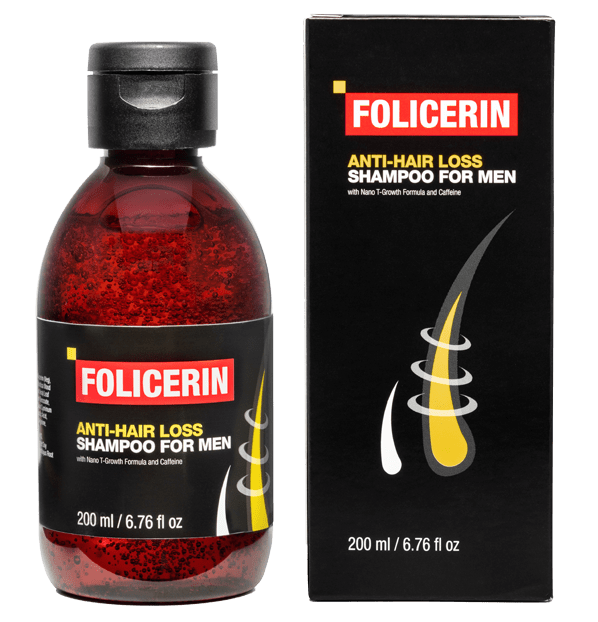
Our Recommendation — Folicerin
Score: 4.6/10 · Best for: men with early thinning who want a botanical, caffeine-based shampoo as a cosmetic add-on alongside whatever else they are doing. Main caution: no money-back guarantee is published, and the label lists ingredient names with no amounts. Fair trial: the three-bottle Standard pack — about three months at directed use, $111.98 with shipping.
Irritation vs Allergy: Two Different Problems
Irritant reactions
An irritant reaction is chemistry, not immunity: the product's detergents or solvents disturb the skin surface, and burning or stinging starts during or immediately after the wash. Sodium lauryl sulfate is the classic example — a genuine irritant at sufficient exposure, and, importantly, not an allergen. Irritant reactions track with exposure: more frequent use, longer contact, already-damaged skin.
Because they are dose-driven, irritant reactions are the manageable kind. Reduce frequency, shorten contact time, rinse thoroughly, and they usually settle. They are also the commonest reason a new shampoo "doesn't suit" someone — an ordinary event that marketing language about gentle formulas tends to hide.
Allergic contact dermatitis
Allergy is a different mechanism: the immune system has been sensitised to a specific ingredient, and reactions are delayed — typically appearing 24 to 72 hours after the wash, not during it. The pattern is diagnostic: itching and redness at the scalp margin, hairline, ears, neck and upper back, where shampoo runs and lingers. Dermatology teaching on scalp contact dermatitis describes exactly this drip-zone distribution.
Unlike irritation, allergy does not improve with reduced exposure — once sensitised, small amounts can trigger it, and the answer is identifying and avoiding the ingredient. Persistent, recurring "shampoo reactions" with the delayed timing and drip-zone pattern are a patch-test conversation with a dermatologist, not a brand-switching exercise.
The Allergens That Actually Cause Shampoo Reactions
When shampoo allergy is patch-tested, the same names recur. Cocamidopropyl betaine (CAPB), a surfactant derived from coconut chemistry and present in a large share of "gentle" formulas, is a leading cause — documented in the contact-dermatitis literature since Fowler's 1997 analysis and named an Allergen of the Year by the American Contact Dermatitis Society. Physician-reviewed summaries of shampoo allergy (Curex, Dr. Chet Tharpe) put CAPB at the top of the hierarchy for exactly this reason.
Methylisothiazolinone (MI), a preservative, is the second name — potent enough as a sensitiser that regulators restricted it in leave-on cosmetics. Formaldehyde-releasing preservatives and fragrance components complete the usual list. Botanical extracts belong on it too: plant ingredients are chemicals with allergenic potential, and "natural" is not a safety category.
This is why switching to a "sulfate-free" shampoo so often fails to fix a reaction. If the culprit is CAPB or MI, the sulfate-free replacement may contain both. The ingredient list — not the front-of-bottle claim — is where reactions are diagnosed, which is one more reason labels that can actually be read matter.
Hunting an allergen on the INCI list
Hunting starts with exact names, not front-of-bottle language. Open the full ingredient list and search it — on paper or with a phone's find function — for cocamidopropyl betaine first, then for methylisothiazolinone. Those are the two names this article has already identified as the recurring shampoo culprits, and both hide inside formulas marketed as gentle.
Work the list in that order for a reason. The famous irritant discussed earlier is not the allergen most patch tests find, so a list cleared only of sulfates has not been cleared at all. Read past the marketing words — sulfate-free, natural, botanical — and read only the names themselves, in full, one by one.
Keep the result, because it becomes your filter for every later purchase. If cocamidopropyl betaine is the name your reactions track with, that single line of knowledge does more work than any brand loyalty. A product either contains your allergen or it does not, and the list — not the shelf talk — answers that question.
Random rotation fails for the mirror-image reason. Swapping brands without reading lists usually swaps everything except the culprit: the same surfactant and the same preservative recur across brands, price points and gentle ranges. Each new bottle then re-runs the same exposure under a new label, and the buyer concludes that every shampoo causes the problem.
Patch-testing a new shampoo at home
The cautious practice the maker's own hypersensitivity warning implies is a home patch test before the first full use. In general terms: apply a small amount of the product to a discreet area of skin, in the same diluted way it would meet the scalp in a wash, and watch that area before committing the whole head.
Repeat the small application rather than trusting a single dab, and give the area time. That timing follows from the mechanism described earlier in this article: allergic reactions are delayed, typically appearing 24 to 72 hours after exposure. A test judged after ten minutes can only rule out immediate irritation, not the allergy that matters more.
Read the result plainly. Burning during the test points toward irritation; itching and redness arriving a day or two later, in the tested area, points toward allergy — the same timing-and-pattern distinction this article uses for full washes. Either result is useful information bought cheaply, on a small patch of skin instead of the whole scalp.
A clear patch test is permission to proceed carefully, not a guarantee — the article's whole argument is that no such guarantee exists for any product. Start the full routine at the directed frequency, keep the first weeks otherwise unchanged, and let any new itching or redness be read against the clean baseline the test established.
The Shedding Nobody Warns About
A significant scalp contact-dermatitis episode can trigger hair loss two to four months after the episode itself. The mechanism is the familiar one: inflammation pushes follicles out of the growth phase together, and the shed arrives a cycle later — long enough afterwards that almost nobody connects it to the shampoo reaction that caused it.
Worse, the episode can aggravate existing pattern loss in the affected area. A man trialling a hair-loss shampoo can therefore experience a sequence that looks like the product "made my hair loss worse" in the most literal sense: reaction in month one, shed in month three, verdict delivered against the product's hair claims rather than its safety.
The practical lesson is sequencing. A new shampoo followed by new itching and redness is not a product to push through for the sake of a fair trial. Stop, let the scalp settle, and restart the clock only if you restart the product. A trial that begins with a reaction has already given you its most important data point.
Class Lessons From Medicated Shampoos
Medicated labels are the category's honest paperwork, and they describe application-site reactions plainly: the Nizoral (ketoconazole) patient leaflet lists burning, irritation, itching and redness at the site of application as its labelled profile. Ketoconazole irritation also rises with frequency and contact time — the two variables buyers most often improvise upward.
The troubleshooting ladder from the medicated class generalises. First, reduce frequency. Second, shorten contact to the labelled minimum. Third, alternate the active shampoo with a mild cleanser on other days. Only after those steps is "this ingredient is not for me" the warranted conclusion — and by then you have information a dermatologist or patch test can actually use.
The ladder, step by step
Worked as a sequence, the ladder has one rule: change one variable, then give the change time to declare itself. Scalp reactions that track with exposure cannot be read day by day, because each wash adds to the last. A step judged after a single wash is a guess wearing the clothes of a test.
Step one is frequency, because it is the largest exposure lever and the easiest to reverse. Drop the active shampoo to fewer washes a week, filling the gaps with the mild cleanser, and hold everything else constant. If the burning and itching fade on that schedule, exposure was the problem and the ladder can stop early.
Step two, only if step one is not enough, is contact time: shorten it to the labelled minimum and no further improvisation in either direction. Hold the reduced frequency while you test this step, so the two changes do not blur together. A reaction that survives both reductions is sending a different message than one that fades.
Step three is alternation made permanent for the trial period: active shampoo and mild cleanser on a fixed rotation, with thorough rinsing treated as part of the step rather than an afterthought. Give this settled routine a clear run of ordinary use — long enough for the delayed pattern described earlier to show itself if it is going to.
Only after those steps does the final conclusion follow: the ingredient itself is not for this scalp. Arriving there by sequence matters, because the record you have built — what was reduced, in what order, and what changed — is exactly what a dermatologist or a formal patch test can use. Random switching builds no such record.
Our frequency and contact-time guide sets out the directed schedules. The side-effect logic is the mirror image of the efficacy logic: exposure is the variable, in both directions.
One Product's Paperwork, Read Against Itself
Folicerin's FAQ states: "It is a 100% safe product." Its own ingredients modal — the document a careful buyer reads — says not to use the product if you are hypersensitive to any ingredient, restricts it to external use, and warns against application to damaged skin and contact with the eyes.
A product cannot be both unconditionally safe and conditional in its own caution panel. The modal is the credible document; the FAQ sentence is marketing.
The modal is also where the product's real allergen note lives: the formula contains hydrolyzed wheat protein and hydrolyzed soy protein. For a reader with a wheat or soy allergy, that is not a footnote — it is a hard stop that the "100% safe" sentence actively conceals. This is the concrete harm of absolute safety claims: they train buyers to skip the one paragraph written for their protection.
And the honest limit must be stated in our direction too: no reaction rate for Folicerin exists. There is no trial and no published surveillance from which an incidence figure could be quoted, and we will not invent one. What can be assessed is the class risk, the ingredient list, and the quality of the maker's own paperwork — which here contradicts itself.
Damaged or Broken Scalp
The maker's exclusion deserves its own section because buyers routinely ignore it: do not apply to damaged skin. Broken, cut, eczema-affected or freshly inflamed skin is not the surface these products were formulated for. Barrier damage increases absorption of everything in the formula and multiplies irritation risk from ingredients that intact skin tolerates.
This applies across the class, not just to Folicerin. A scalp with open sores, active psoriasis plaques or a fresh dermatitis flare is a scalp to treat first and shampoo experimentally later. If the damage is unexplained or persistent, it is also diagnostic information — flaking and lesions can be conditions that need treatment in their own right, some of which themselves cause hair loss.
When to Stop — and When to See a Doctor
Stop the product for: burning that persists after rinsing; spreading redness in the drip-zone pattern; swelling of the eyelids, ears or face; blistering or weeping skin; or itching that worsens across successive uses rather than settling. Any of these outranks completing a trial.
See a doctor — promptly, not after another bottle — for: facial swelling or any breathing difficulty (an emergency, not an appointment); signs of infection; patchy hair loss with scaling or scarring; or a scalp reaction that does not settle within a couple of weeks of stopping. Recurring reactions to multiple products warrant patch testing to name the allergen once, instead of a lifetime of guessing.
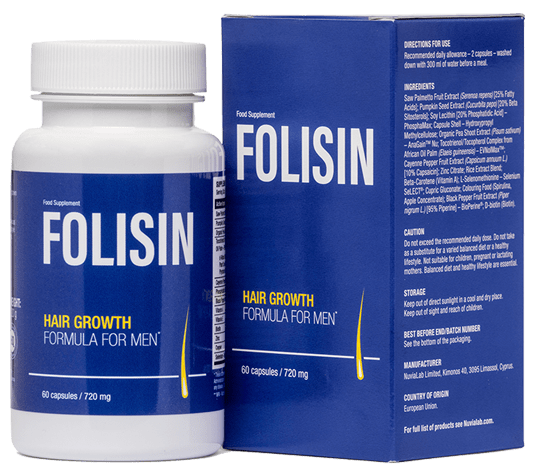
For oral-category safety reading, our saw palmetto side effects guide applies the same standard to a supplement: the label's cautions outrank the marketing's reassurance, every time.
Our Verdict
Hair loss shampoos are, as a class, low-risk products whose realistic harms are irritation, contact allergy and the occasional reaction-triggered shed — manageable, diagnosable, and rarely dangerous. That is a reassuring verdict, and it still contains no room for the phrase "100% safe".
The safety failure in this category is not dangerous formulas; it is paperwork that teaches buyers to ignore cautions. Folicerin's own modal is a decent document. Its FAQ's absolute claim undermines it. Read the modal, patch-test botanicals, respect broken skin, and stop on the signals above — that routine, not any label's promise, is what makes a shampoo safe enough.
Our Recommendation — Folicerin
Score: 4.6/10 · Best for: men with early thinning who want a botanical, caffeine-based shampoo as a cosmetic add-on alongside whatever else they are doing. Main caution: no money-back guarantee is published, and the label lists ingredient names with no amounts. Fair trial: the three-bottle Standard pack — about three months at directed use, $111.98 with shipping.
Frequently Asked Questions
Can a hair loss shampoo make hair loss worse?
Indirectly, yes. A significant scalp contact-dermatitis episode can trigger shedding two to four months later and can aggravate pattern loss in the area. The shampoo is not poisoning follicles; the inflammation it caused is doing the work. This is why a new shampoo followed by itching and redness should be stopped, not pushed through for a fair trial.
How do I tell irritation from allergy?
Timing and pattern. Irritation burns during or immediately after the wash and tracks with exposure — it is a dose effect from ingredients like SLS, which is an irritant, not an allergen. Allergy is delayed 24–72 hours and follows the drip zone: hairline, ears, neck, upper back. Recurring delayed reactions warrant patch testing rather than more brand-switching.
Is Folicerin really 100% safe, as its FAQ says?
No product is, and Folicerin's own paperwork says so: its caution modal warns hypersensitive users not to use it, restricts it to external use, and excludes damaged skin. The formula also contains wheat and soy proteins — a hard stop for allergic readers. We treat the maker's modal as the honest document and the FAQ's absolute claim as marketing.
What ingredients in shampoo cause the most allergic reactions?
Cocamidopropyl betaine (CAPB) leads the patch-test record, followed by the preservative methylisothiazolinone (MI), formaldehyde-releasers and fragrance components. Notably, the famous name — SLS — is an irritant rather than an allergen, which is why switching to a sulfate-free formula often fails: the replacement may still contain CAPB or MI.
Can I use a hair loss shampoo on a broken or eczema-affected scalp?
No. Folicerin's own caution modal excludes damaged skin, and the logic is class-wide: a broken barrier absorbs more of everything and reacts to ingredients intact skin tolerates. Treat the scalp condition first — unexplained scaling, sores or patchy loss with inflammation deserve a dermatologist, because some of those conditions cause hair loss themselves.
Last reviewed: October 2026. This article is educational and is not medical advice.
