
- Quick Answer
- What a Shampoo Can Actually Do
- Cleanse and calm the scalp
- Support follicles when dandruff or inflammation drives shedding
- Make hair look thicker — coating, not growing
- What No Shampoo Can Do
- Reverse pattern loss
- Reach the follicle's control centre in a 1–3 minute rinse
- What Do Dermatologists Recommend in a Hair Loss Shampoo?
- The Label Test: How to Audit Any Hair Loss Shampoo
- Named actives vs decoration ingredients
- Amounts: printed or absent?
- Claims that can't be checked
- Reading the list in order
- Where a Shampoo Honestly Fits in a Real Routine
- Our Verdict
- Frequently Asked Questions
- Can a shampoo regrow hair?
- What ingredient should I look for in a hair loss shampoo?
- Is a caffeine shampoo a treatment for hair loss?
- How long should I give a hair loss shampoo before judging it?
- When should I see a doctor instead of buying a shampoo?
- Read This Next
Disclosure: This article contains affiliate links. If you buy through them, we may earn a commission at no extra cost to you. It never changes our scores or conclusions.
Quick Answer
No shampoo regrows hair, and no shampoo reverses pattern hair loss. That is not our scepticism; it is the dermatologist consensus. Cleveland Clinic's Dr. Melissa Piliang puts it plainly in the Clinic's guide to hair-loss shampoos: shampoos do not treat hair loss itself.
What a shampoo genuinely does is scalp work: clearing scale and oil, calming dandruff and inflammation, and coating the hair shaft so existing hair looks and feels thicker. Those are real effects. They are also cosmetic and supportive effects, not regrowth.
The product this article audits against those rules is Folicerin, a botanical caffeine shampoo for men. Best for: men with early thinning who want a shampoo as an add-on to a real routine. Its caveat is printed on its own label: an INCI list of names with no amounts, so its formula cannot even be audited.
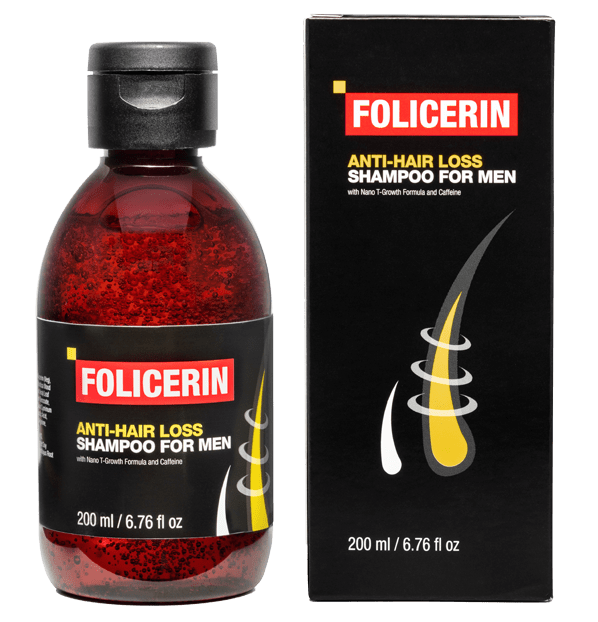
Our Recommendation — Folicerin
Score: 4.6/10 · Best for: men with early thinning who want a botanical, caffeine-based shampoo as a cosmetic add-on alongside whatever else they are doing. Main caution: no money-back guarantee is published, and the label lists ingredient names with no amounts. Fair trial: the three-bottle Standard pack — about three months at directed use, $111.98 with shipping.
What a Shampoo Can Actually Do
Cleanse and calm the scalp
A scalp carrying scale, excess oil and product build-up is a poor environment for hair that is already thinning. Regular, effective cleansing removes that burden. It does not grow hair, but it stops a solvable scalp problem from sitting on top of an unsolvable genetic one.
This is also why dermatologists warn against washing less often to "save" hair. Hair that sheds in the wash was already detached; leaving it longer between washes just makes the eventual shed look bigger. The Well by Northwell's dermatologist Q&A makes the same point: shampoo supports scalp health, and avoiding it does not protect hair.
Support follicles when dandruff or inflammation drives shedding
Some shedding is not pattern loss at all. Seborrhoeic dermatitis and dandruff inflame the scalp, and inflamed scalps shed more. Anti-dandruff actives — ketoconazole, zinc pyrithione, piroctone olamine — are the shampoo ingredients dermatologists actually reach for, because they treat that inflammation.
Cleveland Clinic's guide names exactly those ingredients as the useful contents of a hair-loss shampoo. Note what they are for: scalp health. A calmer scalp can mean less inflammation-driven shedding, which is a genuine, if indirect, contribution.
Think of the scalp as the ground the hair has to stand in. Scale, oil and flaking do not change the genetic programme inside the follicle, but they do change the conditions around it. Hair emerging through an irritated, flaky surface starts at a disadvantage, even before styling or breakage enter the picture.
Seborrhoeic inflammation works in the opposite direction to calm. An itchy, inflamed scalp is scratched, picked at and washed harshly, and inflamed skin around the follicle opening is not a quiet environment. Shedding linked to that irritation is therefore different from pattern shedding: it is added on top, and it can ease when the irritation eases.
That distinction matters for expectations. Removing the inflammation-driven part of shedding can make the shower drain look less alarming and the scalp feel normal again. It does not refill a thinning crown. The follicles that were miniaturising before the dandruff arrived are still miniaturising after the flakes have gone.
This is also why a medicated shampoo can appear to “work” quickly in the right case. The scalp problem it treats responds on a scalp timescale, not a hair-cycle timescale. Comfort, flaking and oiliness can improve while hair density itself has not changed at all, because the two problems were never the same problem.
Keeping that boundary clear protects the win from being oversold. A calm scalp is worth having for its own sake, and it removes one avoidable source of shedding from the total picture. What it cannot do is convert a supportive effect into a treatment effect. The value is real precisely because the claim stays limited.
Make hair look thicker — coating, not growing
Many "thickening" shampoos work on the hair shaft, not the follicle. Proteins and film-formers coat each strand, increasing its diameter slightly and reducing breakage. The hair you have looks fuller, because each strand is temporarily thicker and fewer snap off.
That is a legitimate cosmetic effect, and for early thinning it can be the difference between hair that looks sparse and hair that looks managed. The dishonesty starts only when coating is sold as growth. A strand that looks thicker has not multiplied, and no new follicle has been persuaded to produce anything.
What No Shampoo Can Do
Reverse pattern loss
Pattern hair loss is driven by dihydrotestosterone acting on genetically sensitive follicles over years. The follicles miniaturise: each cycle produces a finer, shorter hair until production effectively stops. Reversing that requires changing the hormonal signal or pharmacologically forcing the growth phase — the job of finasteride and minoxidil, the two treatments with replicated trial evidence.
A shampoo touches none of that machinery for more than a few minutes. The European S3 guideline on androgenetic alopecia (Kanti et al. 2018, Journal of the European Academy of Dermatology and Venereology) builds its recommendations around topical minoxidil and prescription medicines. Shampoo appears in scalp care, not in treatment of the loss itself.
Reach the follicle's control centre in a 1–3 minute rinse
The part of the follicle that decides growth — the dermal papilla — sits roughly 4 mm below the scalp surface, at the base of the follicle. A shampoo is applied, massaged for one to three minutes, and rinsed away. Most of what was applied leaves with the rinse water.
Some ingredients do penetrate the follicle opening, and caffeine's penetration has genuinely been measured — our caffeine shampoo evidence review works through that record. But reaching the follicle is not the same as changing its behaviour, and no rinse-off product has shown it can do the second thing in human trials.
This is the structural reason dermatologists answer the title question the way they do. It is not that every shampoo ingredient is inert. It is that the delivery format — minutes of contact, then rinsing — is mismatched to the biology it claims to change.
What Do Dermatologists Recommend in a Hair Loss Shampoo?
Read the institutional guidance and a consistent set of criteria emerges. First, a proven scalp active: ketoconazole is the recurring dermatologist pick, with zinc pyrithione and piroctone olamine as alternatives, aimed at dandruff and scalp inflammation rather than at the follicle itself.
Second, honesty about status. A shampoo is a cosmetic unless it contains a drug active at a drug strength. Cleveland Clinic's guide notes that regrowth claims in this category have drawn class-action lawsuits — a useful reminder of how often the gap between claim and evidence has had to be closed by lawyers rather than by trials.
Third — and this is the criterion almost no buying guide applies — transparency about what is in the bottle and in what proportions. A formula that names its actives but hides every amount cannot be compared with any study, because no study's dose can be matched to it.
Fourth, diagnosis before product. Hair loss has causes a shampoo cannot touch: thyroid disease, iron deficiency, medication effects, scarring alopecias. Dermatologists consistently warn that months spent trialling shampoos can delay the appointment that would have found a treatable cause. Sudden, patchy or rapidly progressing loss is a doctor's appointment, not a shopping decision.
The Label Test: How to Audit Any Hair Loss Shampoo
Named actives vs decoration ingredients
Start by separating the label into two lists. Actives are ingredients with a plausible scalp or follicle role at a plausible strength: anti-dandruff agents, caffeine, ketoconazole. Decoration ingredients are famous names present to be recognised — a vitamin, a botanical, an oil — with no dose and no rinse-off evidence behind them.
Most botanical hair-loss shampoos are mostly the second list. That does not make them bad shampoos. It makes their labels a marketing document first and a formula second, and they should be priced and judged accordingly.
Amounts: printed or absent?
The decisive question is whether amounts are printed. A medicated shampoo states its strength on the front: ketoconazole 2% is a claim you can check against trials. A cosmetic INCI list, by contrast, names ingredients in descending order without quantities. Order tells you something; it cannot tell you whether the caffeine is 2% or 0.02%.
Folicerin is the worked example on our own shelf. Its label names two branded systems — Nano T-Growth Hair and NV Caffeine ECO — and a supporting cast including caffeine, niacinamide and biotin. It publishes no amount for any of them. Nobody outside the maker can say how much caffeine a wash delivers, so no dose audit is possible, and we score the label on exactly that basis.
Claims that can't be checked
Finally, test the sentences. Folicerin's sales material calls it "the only shampoo that will give you shine, softness and volume." A superlative about every other shampoo on earth is not a claim that can be verified; it is a claim designed not to be. When a label leads with uncheckable sentences, discount the checkable ones too.
The same test catches "clinically proven" without a named trial, percentages without a population, and "dermatologist recommended" without a dermatologist. Each is a sentence built to be believed rather than examined. Labels that survive examination — printed strengths, named studies, stated limits — are rarer and usually quieter.
Reading the list in order
An INCI list is not a random roll-call. Ingredients are listed in descending order of concentration, so the names at the top make up most of what is in the bottle, and the names near the end are present in much smaller proportions. Water and the main cleansing agents ordinarily dominate a shampoo for that reason.
That order is useful, within limits. If a headline ingredient sits far down the list, after fragrances and supporting ingredients, it is reasonable to ask how much of it a wash can plausibly deliver. If it sits high, that is more encouraging — but it still gives no percentage, and no dose can be calculated from position alone.
The order also cannot be compared directly with a study. A trial states a concentration; a label states a ranking. Two products can list the same ingredient in the same position and still contain different amounts. Ranking tells you what the maker put in first, not whether the amount matches the amount that was tested.
Vague quality phrases need the same discipline. “Clinically tested” can mean only that some clinical setting was involved at some stage; without a published trial naming the product, the population and the result, it does not say the finished shampoo was shown to grow hair. The phrase describes an activity, not an outcome.
Similarly, “dermatologist recommended” without a named dermatologist, and a percentage without a stated population, ask to be trusted rather than checked. A label that wants examination gives the checkable version instead: a printed strength, a named study, a stated limit. The absence of those details is itself information about what the label can support.
Where a Shampoo Honestly Fits in a Real Routine
Put together, a hair-loss shampoo has three honest jobs. Keep the scalp clean and calm, especially if dandruff or seborrhoeic dermatitis is part of the picture. Make existing hair look its best while slower decisions are made. And serve as the daily ritual that keeps a man engaged with a routine whose active treatments — if he chooses them — are minoxidil or a prescription.
It also has an honest price logic. A shampoo is consumed monthly and judged over months; our timeline guide sets out why three to six months is the fair judging window. Multiply the bottle price by that window before deciding a premium botanical shampoo is cheap.
What it should never be is the whole plan. The comparison that matters — shampoo vs minoxidil — is not close, and pretending otherwise costs men the window in which real treatments work best. For the one shampoo ingredient with a genuine evidence file of its own, our guide to ketoconazole shampoo and hair loss covers what it is actually for.
A realistic routine therefore has layers, and the shampoo is only one of them. The shampoo layer is used in the shower, does its cleansing and calming work, and is rinsed away. Any treatment layer, if one is chosen, is a separate decision, made separately, with its own evidence and its own commitment.
Putting the shampoo in that place prevents two opposite mistakes. The first is expecting the wash to carry the whole result and then blaming it for not regrowing hair. The second is dismissing it entirely because it cannot regrow hair, when scalp comfort and cosmetic fullness were the honest reasons to use it.
The timeline splits the same way. Cosmetic thickening, if a formula provides it, belongs to the wash itself: coated strands look fuller while the coating lasts. Scalp calm can build over repeated washes as the irritation is kept down. Neither timeline is a growth timeline, and neither should be read as early evidence of regrowth.
A practical way to hold the routine together is to judge each layer by its own test. Judge the shampoo on scalp condition, shedding linked to irritation, and how the existing hair looks and behaves. Judge any treatment decision on the treatment’s own evidence and timescale. Mixing the tests guarantees a confused verdict on both.
That framing also makes the purchase easier to price honestly. You are paying a recurring cost for a recurring cosmetic and scalp benefit, renewed bottle by bottle. If that benefit is worth the price on its own terms, the shampoo earns its place. If it only seems worth it as imagined regrowth, it does not.
Staying engaged matters, but engagement should be attached to the right actions. Washing consistently, keeping the scalp calm and keeping photographs over the judging window are useful habits around a routine. They support a decision; they do not replace the decision about whether to use an evidenced treatment at all.
Our Verdict
Do hair loss shampoos work? As shampoos, yes: they clean, calm and cosmetically thicken, and a medicated one can treat the scalp conditions that add shedding of their own. As hair-loss treatments, no — no rinse-off product has reversed pattern loss in a human trial, and dermatologists do not claim otherwise.
Folicerin sits honestly inside that verdict. It is a well-presented botanical shampoo with a plausible caffeine story, an unauditable label and no published guarantee. Bought as an add-on, with expectations set by this article, it is a defensible purchase. Bought as a treatment, it is money spent avoiding the two interventions that actually have evidence.
Our Recommendation — Folicerin
Score: 4.6/10 · Best for: men with early thinning who want a botanical, caffeine-based shampoo as a cosmetic add-on alongside whatever else they are doing. Main caution: no money-back guarantee is published, and the label lists ingredient names with no amounts. Fair trial: the three-bottle Standard pack — about three months at directed use, $111.98 with shipping.
Frequently Asked Questions
Can a shampoo regrow hair?
No. No shampoo — medicated, botanical or caffeine-based — has regrown hair or reversed pattern loss in a human trial. Shampoos can improve scalp health and make existing hair look thicker by coating the shaft. Regrowth claims in this category have drawn regulatory action and class-action lawsuits.
What ingredient should I look for in a hair loss shampoo?
Ketoconazole is the dermatologist-recommended pick, for scalp health: it treats the dandruff and inflammation that can add shedding. Zinc pyrithione and piroctone olamine serve similar roles. Whatever the ingredient, look for a printed strength — a label that hides every amount cannot be checked against any study.
Is a caffeine shampoo a treatment for hair loss?
No. Caffeine affects hair follicles in laboratory cultures, and it penetrates the follicle when applied — but no randomised human trial shows a caffeine shampoo regrowing hair. It is a plausible cosmetic ingredient, not a treatment. Our caffeine shampoo review grades the full record tier by tier.
How long should I give a hair loss shampoo before judging it?
Three to six months of consistent use, judged on photographs taken under the same light — hair cycles run in months, and stabilisation (nothing visibly happening) is the realistic success state. Judge sooner and you are measuring noise; expect regrowth and you are measuring against a claim no shampoo can meet.
When should I see a doctor instead of buying a shampoo?
When loss is sudden, patchy, rapid, or accompanied by itching, pain, scaling or scarring. Those patterns can signal thyroid disease, iron deficiency, infection or scarring alopecia — causes a shampoo cannot treat and that respond best when caught early. A dermatologist visit precedes product trials in those cases.

Last reviewed: October 2026. This article is educational and is not medical advice.
