
- The 2002 Trial, Exactly as Published
- The Condition Problem
- The Quality Problems
- How the Claim Travelled
- The Proposed Mechanisms, Labelled as Proposals
- Juice vs the "Onion Oil" Products Sold Today
- If You Try It Anyway
- Frequently Asked Questions
- Does onion juice work for male pattern baldness?
- How often did the trial apply it?
- Can onion juice irritate the scalp?
- Why has nobody repeated the study in over twenty years?
- So is the 86.9% figure a lie?
- Read This Next
The 2002 Trial, Exactly as Published
The study is Sharquie and Al-Obaidi, published in the Journal of Dermatology in 2002, from the Department of Dermatology and Venereology at Baghdad Teaching Hospital in Iraq.
Its title already contains the fact the viral claim drops: "Onion juice (Allium cepa L.), a new topical treatment for alopecia areata." The condition under test was areata, from the first line.
The design was simple. Patients with patchy alopecia areata were divided into two groups: one applied crude onion juice, the other applied tap water. Both applied their treatment twice daily for two months.
The abstract's own numbers describe the groups precisely. The onion-juice group consisted of 23 patients — 16 males and 7 females, aged 5 to 42, with a mean age of 22.7 years.
The tap-water control group consisted of 15 patients — 8 males and 7 females, aged 3 to 35, with a mean age of 18.3 years. These are the figures this article uses throughout.
A note on totals: secondary write-ups of this trial cite different overall enrolment numbers — 38, 62 and 69 all circulate. Where sources disagree, the abstract's own group figures are the ones that can be checked.
The results were striking. Regrowth of terminal coarse hairs began after two weeks of treatment with crude onion juice — early enough that the authors reported the timing explicitly.
At four weeks, hair regrowth was seen in 17 of the 23 treated patients: 73.9%. By six weeks, regrowth was observed in 20 of 23: the famous 86.9%.
The effect was not evenly distributed. Regrowth was significantly higher among males, at 93.7%, than among females, at 71.4%, within the treated group.
The control group tells the comparison story. On tap water, hair regrowth was apparent in only 2 of 15 patients — 13% — and that took eight weeks, with no difference between the sexes.
The statistical result was emphatic: onion juice produced significantly higher regrowth than tap water, at P < 0.0001. On its face, this is not a borderline finding.
The authors concluded that crude onion juice could be an effective topical therapy for patchy alopecia areata. Read the conclusion carefully: it names the condition, the preparation and the comparison. So should everyone citing it.
The trial in one view:
| Measure | Onion juice (n=23) | Tap water (n=15) |
|---|---|---|
| Regrowth began | After 2 weeks | — |
| Regrowth at 4 weeks | 73.9% (17 of 23) | — |
| Regrowth at 6 weeks | 86.9% (20 of 23) | — |
| Regrowth at 8 weeks | — | 13% (2 of 15) |
| By sex, treated group | Males 93.7% · Females 71.4% | No sex difference |
One more feature of the study population deserves attention before the critique even begins: the treated group included children as young as five, and the control group children as young as three.
That is normal for areata research — the condition often begins young — but it widens the distance between the trial and its modern audience of adults worried about receding hairlines.
The Condition Problem
Alopecia areata is an autoimmune condition. The immune system attacks hair follicles, and hair falls out in round patches — the 2002 paper itself describes it as a patchy, non-scarring hair loss condition.
Pattern hair loss — androgenetic alopecia — is a different disease. Follicles gradually miniaturise under hormone influence, in a characteristic pattern, over years. Different cause, different course, different treatments.
A result in one condition is not evidence in the other. A treatment that nudges an autoimmune patch back into growth has no demonstrated bearing on hormone-driven follicle shrinkage.
This is the swap the viral claim performs. "Onion juice regrew hair in 86.9% of patients" quietly loses its final clause — "with patchy alopecia areata" — and is then sold to people with receding hairlines and thinning crowns.
The trial also says nothing about stress-related shedding, the diffuse temporary loss that follows illness or upheaval. That is a third condition, with its own course, and it was not studied either.
Areata has one more feature that matters for reading this trial: it can remit on its own. Patches of areata sometimes regrow without any treatment, which is precisely why a control group was necessary.
The tap-water group's 13% regrowth shows that background effect operating inside the trial itself. Some regrowth happens anyway; the question a trial answers is how much more happens with the treatment.
To the trial's credit, it had that control group, and the gap between 86.9% and 13% is large. The condition problem is not that the trial was meaningless — it is that its meaning stops at areata.
The Quality Problems
Start with size. Twenty-three treated patients is a very small base for a number that now anchors thousands of videos and product pages. Small trials produce unstable percentages: each patient here is worth over four points.
Then there is who is missing. The trial suffered heavy dropout before completion — a substantial share of the people who started did not finish, and the published percentages describe the people who remained.
Dropout is not neutral. People who stay in a demanding twice-daily routine for weeks may differ from people who quit — in motivation, in early response, in how much the smell and effort bothered them.
Blinding was effectively impossible. Onion juice announces itself; tap water does not. Participants knew what they were applying, and expectation — theirs and potentially the assessors' — was free to influence the outcome.
The paper is indexed as a controlled clinical trial, not a double-blind randomised trial. That is not a criticism of 2002 Baghdad; it is a description of how much weight the design can carry.
The deepest problem is the silence afterwards. This intervention is cheap, available in every kitchen, and reported an enormous effect. Interventions like that normally attract replication attempts quickly.
None has appeared in more than twenty-three years. No larger trial, no second centre, no confirmation — and onion juice appears in no major alopecia-areata guideline.
Systematic reviewers who have graded this literature rate the study's quality poorly. One small, unblindable, high-dropout trial from 2002 is where the entire evidence base for onion juice begins and ends.
None of this proves onion juice does nothing in areata. It proves the claim is unsettled — one promising, fragile result that medicine has never been able to build on.
It is worth spelling out what settling it would take, because the standard is not exotic. A larger trial, at more than one centre, with regrowth assessed by people who do not know which treatment was applied.
Outcome assessment can be blinded even when a smell cannot: photographs of patches, scored by independent assessors, would remove the expectation problem that the original design could not.
Full reporting of everyone who enrolled — not only those who finished — would fix the dropout problem. Pre-registered outcomes would fix the flexibility problem. Ordinary methods, all of them available since 2002.
And for the claim actually sold today, a different trial is needed altogether: onion juice, or an onion preparation, tested in androgenetic alopecia. No amount of areata data substitutes for that study.
How the Claim Travelled
The journey from paper to product page follows a reliable sequence. First, the number is kept and the condition is dropped, because "86.9% regrowth" travels and "in patchy alopecia areata" slows it down.
Second, the preparation is upgraded. Crude juice, with its smell and its twice-daily burden, becomes a pleasant oil or shampoo — and the number quietly moves house onto the new product.
Third, the caveats are reclassified as fine print. Dropout, the missing replication and the authors' own uncertainty about mechanism rarely survive into a caption, a label or a thirty-second video.
Each step is small, and each is individually deniable. Nobody has to invent a study; they only have to keep retelling the real one with a little less of it attached.
The result is a claim that feels sourced — it cites a journal, a year, a percentage — while asserting something the source never tested, for a condition it never studied, with a preparation it never used.
Learning to spot that pattern is worth more than the verdict on this one ingredient. The same three steps power most viral hair-growth claims; onion juice is simply the clearest documented example.
The Proposed Mechanisms, Labelled as Proposals
Ask why onion juice might work and you will meet confident answers: sulphur feeds keratin, antioxidants protect follicles, irritation wakes the scalp. Each is a proposal. None was tested by the 2002 trial.
The sulphur story runs like this: onions are rich in sulphur compounds, and hair is made of keratin, a sulphur-containing protein. Therefore, the pitch concludes, onion juice supplies building material to growing hair.
The gap in that logic is delivery. A compound present in a juice, spread on skin, is not thereby shown to reach a follicle, be used by it, or change its behaviour. Presence is not mechanism.
Quercetin, an antioxidant flavonoid found in onions, is the second proposal. Antioxidant effects measured in laboratory settings are a reason to hypothesise, not evidence of regrowth on a human scalp.
The third proposal is the most interesting, because it fits the observed side effect. Deliberate mild irritation — sometimes called antigenic competition — might redirect immune attention in an autoimmune patch.
That idea has a real history in areata treatment, where controlled irritant therapies exist. But for onion juice it remains an after-the-fact explanation, not a demonstrated pathway.
The trial did record irritation. Mild redness developed in 60.8% of the treatment group — most of the people using the juice. That is consistent with an irritant effect; it does not prove irritation caused the regrowth.
Most honest of all are the authors themselves. Sharquie and Al-Obaidi stated that the mechanism behind their result was difficult to explain. The people who ran the trial claimed less certainty than the people now selling it.
That asymmetry is the pattern to learn from this ingredient. The further a claim travels from the 2002 paper, the more confident it becomes — and the less of the paper survives the trip.
Juice vs the "Onion Oil" Products Sold Today
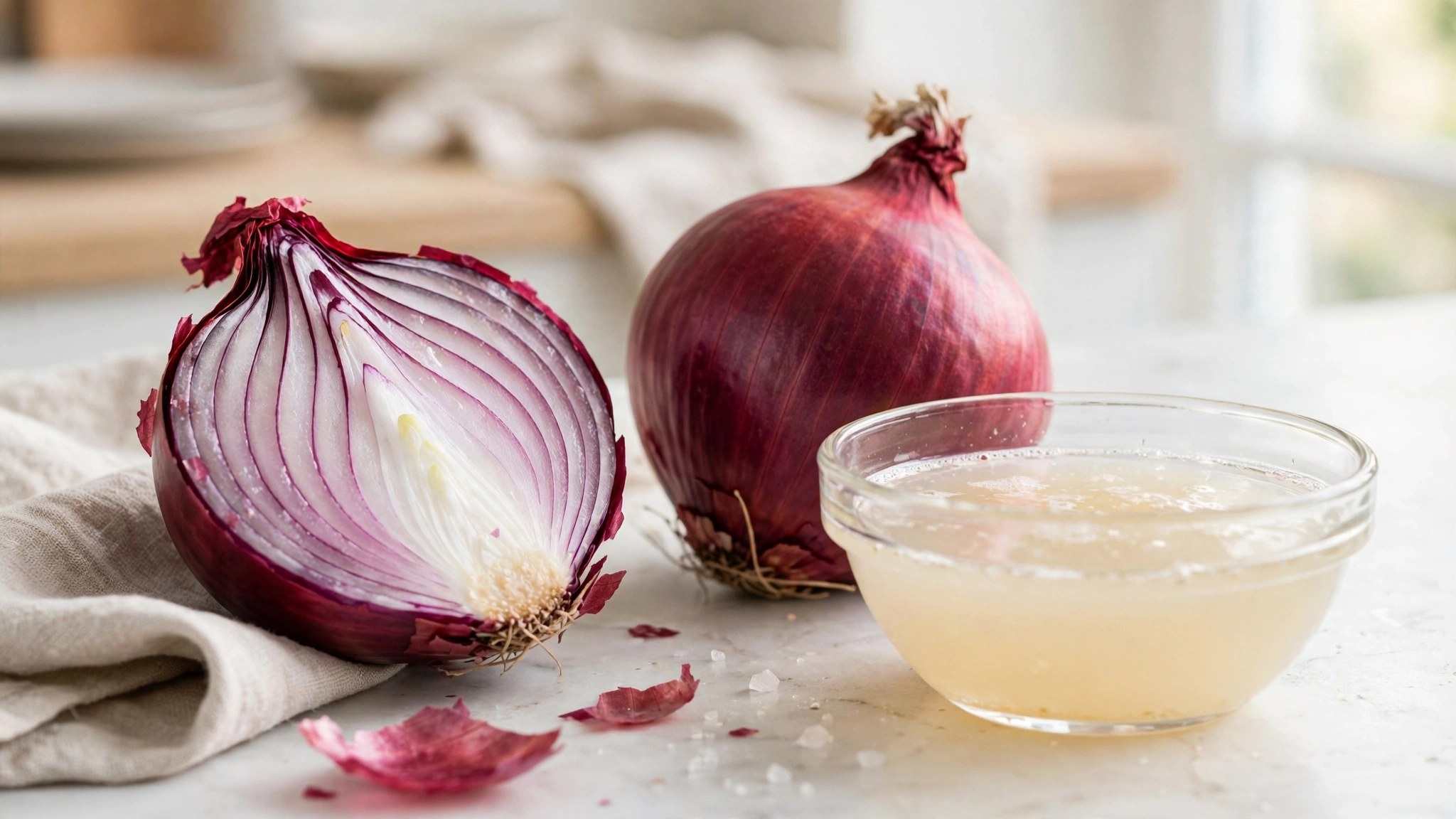
Even if the 2002 result is taken entirely at face value, it belongs to a specific preparation: freshly extracted crude onion juice, applied to the patches twice a day.
The products now sold as onion oil, onion shampoo and onion serum are different preparations. They are processed, diluted, fragranced and formulated for shelf life — chemically a different thing from juice pressed that morning.
Application differs too. A shampoo is a rinse-off product with minutes of scalp contact. The trial's juice was a leave-on application, twice daily. Contact time is part of the intervention that was tested.
No commercial onion oil or shampoo has been tested in a trial for alopecia areata. None has been tested for pattern hair loss either. The 86.9% figure cannot be transferred onto their labels.
This is a general rule worth keeping beyond this ingredient: a trial result attaches to the preparation, dose, schedule and condition studied. Change any one of them and you have a new, untested claim.
Onion products change all four at once. What they are selling is the number from the paper, detached from everything that produced it.
If You Try It Anyway
Some readers will try onion juice regardless, and it is a low-cost kitchen experiment. If so, run it the way the trial did, and protect your skin while you learn nothing the trial didn't already say.
Patch-test first. Apply a small amount to a discreet area and watch for reaction before treating a whole patch. Most users in the trial developed mild redness; stronger reactions are a stop signal.
Expect the practical realities the percentages omit. Fresh juice must be prepared repeatedly, it smells, the smell lingers on hair and skin, and applying it twice daily for weeks is a genuine commitment.
Keep it out of your eyes, and stop if you get burning, blistering or a spreading rash rather than mild redness. Irritation beyond what the trial reported is not a sign it is working harder.
Judge it on the trial's clock, not the internet's. Regrowth in the study began at two weeks and was assessed at four and six. Photograph the patch, in the same light, before you start.
And hold one line firmly: do not let the experiment delay real care. Patchy hair loss deserves a clinician's diagnosis, because patchy loss has other causes that need different treatment entirely.
Alopecia areata itself has effective medical options now, including approved systemic treatments for severe disease. A person with spreading patches who spends a year on juice is spending time, not just money.
Our verdict: one small 2002 trial reported a large effect in patchy alopecia areata, under conditions that make the result fragile. For pattern hair loss — the claim actually being sold — onion juice is simply untested.
Frequently Asked Questions
Does onion juice work for male pattern baldness?
It has never been tested for it. The only trial studied patchy alopecia areata, an autoimmune condition with a different cause from pattern hair loss. Any pattern-loss claim for onion juice is extrapolation, not evidence.
How often did the trial apply it?
Twice daily, for two months. The treated group applied crude onion juice on that schedule; the control group applied tap water on the same schedule. Regrowth was assessed at two, four and six weeks.
Can onion juice irritate the scalp?
Yes. Mild redness developed in 60.8% of the treatment group in the 2002 trial — a majority of users. Patch-test before wider use, and stop if irritation goes beyond mild redness to burning or blistering.
Why has nobody repeated the study in over twenty years?
Nobody can say for certain. A cheap, unpatentable kitchen ingredient offers no commercial sponsor for a large trial, which is a plausible part of the explanation. The verifiable fact is simpler: no replication has appeared.
So is the 86.9% figure a lie?
No — it is a real figure from a real abstract: 20 of 23 treated areata patients regrew hair by six weeks. The dishonesty enters when the condition, the dropout and the missing replication are stripped away.
Last reviewed: October 2026. This article is educational and is not medical advice.
