
- Quick Answer
- How Caffeine Is Supposed to Help Hair Follicles
- Countering testosterone's suppression in cultured follicles
- Extending the growth phase: what was actually measured
- Tier One: The Laboratory Evidence
- Why the dish flatters a rinse-off product
- Tier Two: Does Caffeine Even Reach the Follicle?
- Tier Three: The Human Trials — and Their Limits
- Dhurat 2017: a leave-on liquid, not a shampoo
- Celleno 2025: a two-active shampoo
- The 2025 systematic reviews: mostly low or very low quality
- Does Caffeine Shampoo Block DHT?
- The Regulator's Verdict
- Encapsulated Caffeine: What a Delivery Claim Would Need
- The Supporting Cast Nobody Should Pay For
- Our Verdict
- Frequently Asked Questions
- Does caffeine shampoo actually regrow hair?
- What did the Fischer 2007 study actually prove?
- Is encapsulated caffeine better than regular caffeine in a shampoo?
- Why did the UK regulator ban Alpecin's hair-loss claim?
- How does a caffeine shampoo compare with a medicated one?
- Read This Next
Disclosure: This article contains affiliate links. If you buy through them, we may earn a commission at no extra cost to you. It never changes our scores or conclusions.
Quick Answer
Caffeine genuinely does something to hair follicles — in a laboratory dish. In cultured human follicles, caffeine counteracted testosterone's suppressive effect and supported growth measures. That finding is real, and it is also where the strong evidence ends.
No randomised human trial shows a caffeine shampoo regrowing hair. The human studies are a leave-on liquid trial without a placebo, one two-ingredient shampoo trial with company co-authors, and systematic reviews that grade the base as mostly low quality. A UK regulator has already banned the category leader's hair-loss claim once.
Folicerin's caffeine arrives as NV Caffeine ECO — encapsulated caffeine in branded particles — at an amount the maker does not publish, with no retention data for a rinse-off product. The idea is plausible. The proof, for this product and this category, is not there.
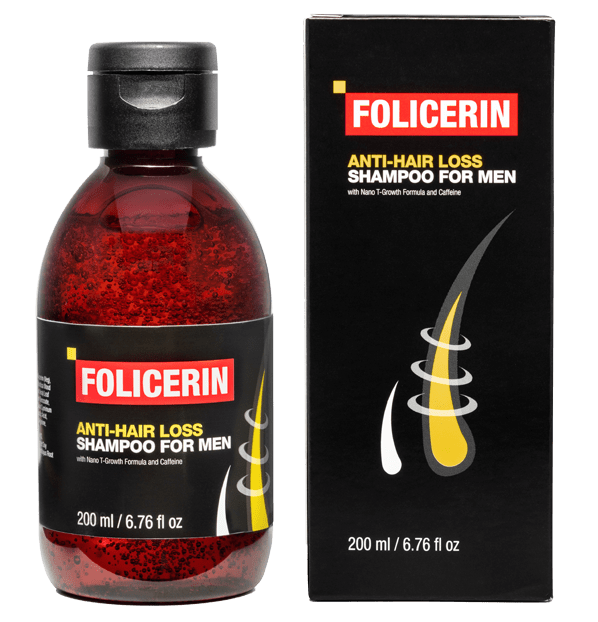
Our Recommendation — Folicerin
Score: 4.6/10 · Best for: men with early thinning who want a botanical, caffeine-based shampoo as a cosmetic add-on alongside whatever else they are doing. Main caution: no money-back guarantee is published, and the label lists ingredient names with no amounts. Fair trial: the three-bottle Standard pack — about three months at directed use, $111.98 with shipping.
How Caffeine Is Supposed to Help Hair Follicles
Countering testosterone's suppression in cultured follicles
The founding experiment is Fischer et al. 2007 in the International Journal of Dermatology. The researchers took hair follicles biopsied from the vertex scalps of 14 men with pattern loss and grew them in organ culture — alive, but outside a body, bathed directly in the test solutions.
Testosterone suppressed the follicles' growth, as the DHT theory predicts. Adding caffeine at 0.001% and 0.005% counteracted that suppression. In that model, caffeine behaved like a stimulant for follicles being hormonally slowed — the result every caffeine shampoo advertisement is ultimately built on.
Extending the growth phase: what was actually measured
Follow-up laboratory work, including Fischer et al. 2014 in the British Journal of Dermatology, measured hair shaft elongation in follicles grown outside the body and found caffeine supported the elongation process. Again: a real measurement, in a dish.
What has never been measured is the endpoint buyers care about — more hair on a human head, from a shampoo, against a placebo. The distance between "caffeine stimulates cultured follicles" and "this shampoo regrows hair" is the distance this article exists to map.
Tier One: The Laboratory Evidence
Grade the lab record honestly and it is the strongest tier of the three. The follicle organ-culture model is a respected screening tool: it uses real human follicles from balding scalps, and the testosterone-suppression effect it reverses is the actual mechanism of pattern loss.
Its limits are structural, not incidental. In culture, follicles sit in caffeine solution continuously for 120–192 hours. A shampoo delivers caffeine for about two minutes, diluted, then rinses most of it away. The concentrations that worked in the dish (0.001–0.005%) are also uncheckable against any retail label, because cosmetic INCI lists do not publish percentages.
So Tier One proves a mechanism is possible. It cannot prove a shampoo delivers it. Any page that quotes Fischer 2007 as evidence that a shampoo works has skipped two tiers of the record — and those tiers are where the claim goes to be tested.
Why the dish flatters a rinse-off product
Organ culture removes almost every obstacle a real product faces. The follicle is placed directly in the solution, so there is no need to cross skin, find the follicle opening, or survive dilution in shower water. What reaches the follicle in the dish is simply what the researchers put in the dish.
There is also no rinsing in that world. In ordinary use, rinsing is the defining step: it ends the contact and carries most of the product away. In culture, contact continues for the full exposure period already described. A model without the step that limits a shampoo will naturally flatter a shampoo.
Nor is there blood flow clearing substances away or a living scalp renewing its surface between applications. The cultured follicle sits in a stable bath at a chosen concentration. A scalp is not a stable bath: it is washed, dried, exposed to air and products, and then washed again on a different day.
None of this makes the model dishonest. It makes it a screening tool, designed to ask whether an ingredient can affect a follicle under ideal conditions. Failing that test would be damning. Passing it only earns the harder question: whether a brief, diluted, rinsed application can reproduce enough of those ideal conditions to matter.
That is why laboratory results systematically read better than product results in this category. Every simplification in the model points the same way, towards more exposure at a known dose. The real product removes those simplifications one by one. Expecting the headline to survive that process unchanged is the core marketing leap.
Tier Two: Does Caffeine Even Reach the Follicle?
Penetration is the one question with a genuinely good answer. Otberg and colleagues (2008) tracked caffeine applied to the scalp and found it in the blood within 5 minutes when the follicles were left open — versus around 20 minutes when the follicular openings were blocked. The follicle is a real, fast route into the skin.
The same research programme tested a 2-minute shampoo application — the realistic use case — and still detected follicular delivery. So "caffeine can't get there in a rinse" is not a fair dismissal. It gets there.
What penetration studies cannot tell you is dose at the target. Detecting caffeine in blood after scalp application shows absorption happened; it does not show the follicle's growth centre received a concentration comparable to the organ-culture experiments, for long enough to matter. Delivery is necessary for the claim. It is nowhere near sufficient.
The follicular route deserves a precise description. The opening of a follicle is a channel into the upper part of the follicle, and a substance entering that channel has genuinely entered further than one sitting on the surface. That is a real delivery achievement, and the penetration research earns the point it makes.
But the opening is not the control centre. The growth centre sits at the base of the follicle, and reaching the entrance of the channel is not the same event as arriving at that base in a useful concentration. A study that detects entry has answered the first question, not the last one.
Detection adds another source of confusion. A sensitive measurement can find a substance after application without showing how much arrived, how long it stayed, or whether the amount resembled the concentrations used in culture. “Detected” is a yes-or-no answer to a dose question that is really about quantity and time.
Blood detection makes the point from the other direction. Finding caffeine in blood shows it crossed into the body, which confirms absorption. It does not show that the follicle’s growth centre was the place it acted, or that enough remained there between washes to reproduce the laboratory effect on growth.
So the penetration tier narrows the uncertainty without closing it. It rules out the lazy dismissal that nothing gets in during a short application. It leaves open the questions that decide the claim: dose at the target, duration at the target, and whether that exposure changes hair on a living head.
Keeping those open questions visible is not a technicality. They are the difference between caffeine arriving somewhere in the skin and caffeine doing the specific job the advertisement describes, at the specific place pattern loss is decided. Until a study connects those steps in people using a shampoo, penetration remains supporting evidence, not the conclusion.
Tier Three: The Human Trials — and Their Limits
Dhurat 2017: a leave-on liquid, not a shampoo
The most-cited human study, Dhurat et al. 2017, randomised 210 men to a 0.2% caffeine liquid or 5% minoxidil over six months and compared anagen (growth-phase) hair ratios. The caffeine arm's results were presented as comparable on that endpoint.
Read the design before the headline. The trial was open-label — participants knew what they were using — and there was no placebo arm, so neither treatment was tested against doing nothing. The product was a leave-on liquid, left on the scalp for hours, not a two-minute rinse. And the endpoint was a hair-phase ratio, not visible regrowth. It is a real trial; it is not evidence about shampoo.
Celleno 2025: a two-active shampoo
The closest thing to a shampoo trial is Celleno et al. 2025: a double-blind, placebo-controlled study of a shampoo combining caffeine with a second active (DMG-Na) in 154 men over 24 weeks. A placebo-controlled shampoo trial existing at all is progress for this category.
Two limits keep it from settling the question. The formula pairs caffeine with another active, so any effect cannot be credited to caffeine alone. And the author list includes company co-authors connected to the product — disclosed, common in cosmetic research, and a reason to want independent replication before treating the result as the category's verdict.
The 2025 systematic reviews: mostly low or very low quality
Systematic reviews published in 2025 that gathered the caffeine-for-hair-loss literature rate most of the underlying trials as low or very low quality — small samples, short durations, interested sponsors, surrogate endpoints. That is the pooled judgement of reviewers who read everything in Tiers One to Three: a plausible mechanism resting on a thin human base.
Does Caffeine Shampoo Block DHT?
The claim that caffeine blocks DHT borrows Fischer's framing and stretches it. In the organ-culture work, caffeine counteracted the effect of testosterone on follicles. That is not the same as inhibiting 5-alpha-reductase — the enzyme that makes DHT — and it is certainly not a measured reduction of DHT in a human scalp.
No study has measured scalp DHT in people using a caffeine shampoo. The "natural DHT blocker" sentence on caffeine products is a mechanism discussed in laboratories, promoted to a result. We test the black-pepper version of the same claim in Can a Shampoo Block DHT? — the pattern, and the missing human measurement, are identical.
The Regulator's Verdict
In 2018 the UK Advertising Standards Authority ruled on Alpecin, the caffeine shampoo that leads this category. The claim under review — that the shampoo could help reduce hair loss — was judged not adequately substantiated and misleading, and it was withdrawn from UK advertising.
Regulators do not rule on whether an ingredient is interesting. They rule on whether the evidence substantiates the claim made to buyers. On that standard, the category's flagship claim failed — with the same Fischer record behind it that every competitor still cites. When a marketing department and a regulator read the same studies and reach opposite conclusions, the regulator's reading is the one with no product to sell.
Encapsulated Caffeine: What a Delivery Claim Would Need
Folicerin's answer to the delivery question is NV Caffeine ECO: caffeine encapsulated in biopolymer particles larger than 200 nanometres, presented by the maker as helping the ingredient stay on the scalp. Encapsulation is a legitimate formulation technology — in leave-on products. In a rinse-off shampoo, the claim needs a specific kind of proof: retention data showing the particles remain on the scalp after rinsing, at a quantity that matters.
No such data is published for Folicerin. The maker publishes neither the caffeine amount nor any post-rinse retention measurement. So the delivery claim currently rests on the same foundation as the category's: a plausible mechanism, an unmeasured dose, and a branded name. A delivery claim that cannot state what is delivered, or how much stays, is a label decoration until the numbers exist.
The Supporting Cast Nobody Should Pay For
Caffeine shampoos rarely travel alone, and Folicerin's INCI list includes biotin — an ingredient worth a paragraph precisely because its evidence is so often mis-sold. Patel et al. 2017, in Skin Appendage Disorders, reviewed biotin for hair and nail and found its benefit confined to deficiency states. In a rinse-off product, biotin is not even swallowed: it is washed over the scalp and away.
If biotin interests you, the honest version of the topic is about blood tests and true deficiency — covered in our articles on biotin and blood tests and collagen vs biotin. In a shampoo, treat it as label furniture: harmless, recognisable, and not a reason to choose one bottle over another.
So what is a caffeine-shampoo buyer actually purchasing? At present, a plausible mechanism at an unknown scalp dose. The laboratory part of that sentence is genuinely supported. The dose part is not published for the finished product, and the human shampoo result that would settle it has not been produced for caffeine alone.
That description can still justify a purchase, if the buyer prices it correctly. A shampoo that cleans well, suits the scalp and carries a plausible ingredient story may be worth its price as a shampoo. It becomes a poor purchase only when the price is paid for regrowth that the evidence has not promised.
A practical test before buying is to ask what would remain if the regrowth hope were removed entirely. Would the bottle still be chosen over an ordinary shampoo, at its price, for its washing and cosmetic qualities alone? If yes, the purchase rests on solid ground. If no, the gap is being filled by hope.
The same test helps after buying. Judge the product first on what a shampoo can be judged on: scalp comfort, how the hair looks and feels, and whether the routine is sustainable. Treat any change in density as a question for standardised photographs over months, not as a promise the bottle has already made.
Keeping the claim in that form also leaves room to change course. A buyer who knows he has bought a cosmetic bet can still make a separate, informed decision about evidenced treatments. A buyer who believes he has already bought treatment may delay that decision while pattern loss continues on its own schedule.
None of this requires dismissing caffeine as an ingredient. It requires holding two facts at once: the follicle biology is interesting, and the finished shampoo is unproven. Products in this category ask buyers to collapse those facts into one. Keeping them separate is the whole skill this evidence record teaches.
Our Verdict
Caffeine is the rare shampoo ingredient with a real laboratory story: it stimulates cultured follicles, it demonstrably penetrates the follicle, and its mechanism touches the actual biology of pattern loss. It is also, on the human record, unproven as a shampoo — no placebo-controlled trial of caffeine alone in a rinse-off product shows regrowth, and the category's lead claim has already failed a regulator's substantiation test.
That makes caffeine shampoo a reasonable cosmetic bet and an unreasonable treatment claim. Folicerin, with its unpublished amount and unmeasured encapsulation claim, is the category in miniature: the idea is plausible, the proof is not there, and the label gives you no numbers to close the gap yourself.
Our Recommendation — Folicerin
Score: 4.6/10 · Best for: men with early thinning who want a botanical, caffeine-based shampoo as a cosmetic add-on alongside whatever else they are doing. Main caution: no money-back guarantee is published, and the label lists ingredient names with no amounts. Fair trial: the three-bottle Standard pack — about three months at directed use, $111.98 with shipping.
Frequently Asked Questions
Does caffeine shampoo actually regrow hair?
No trial shows that. Caffeine stimulates hair follicles in laboratory culture and penetrates the follicle when applied to the scalp, but the human shampoo evidence is one two-ingredient trial with company co-authors and reviews grading the base as low quality. Regrowth from a caffeine shampoo is a claim, not a finding.
What did the Fischer 2007 study actually prove?
That caffeine at 0.001% and 0.005% counteracted testosterone's suppression of human hair follicles grown in organ culture from 14 men's scalp biopsies, over 120–192 hours of continuous exposure. It proved a mechanism in a dish. It did not test a shampoo, a rinse, or hair growth on a person's head.
Is encapsulated caffeine better than regular caffeine in a shampoo?
Unknown. Encapsulation is meant to help an ingredient stay on the scalp, but for Folicerin's NV Caffeine ECO no post-rinse retention data is published, and the caffeine amount itself is unpublished. A delivery claim without retention numbers or a stated dose cannot be graded better than the plain ingredient — only better branded.
Why did the UK regulator ban Alpecin's hair-loss claim?
The Advertising Standards Authority ruled in 2018 that the claim caffeine shampoo could help reduce hair loss was not adequately substantiated by the evidence and was misleading, and it was withdrawn from UK advertising. The ruling judged the claim made to buyers, on the same laboratory record the category still cites today.
How does a caffeine shampoo compare with a medicated one?
Different jobs. Ketoconazole shampoo treats dandruff and scalp inflammation — a scalp-health role with dermatologist backing; our ketoconazole guide covers it. Caffeine shampoo aims at the follicle with laboratory evidence and no human regrowth trial. Neither reverses pattern loss; only one of them has a defined, provable task.

Last reviewed: October 2026. This article is educational and is not medical advice.
