
- Quick Answer
- Vitamin E Is Eight Molecules, Not One
- The Beoy 2010 Trial, Read Closely
- The design
- The result
- The result nobody prints: strand weight did not change
- The authorship line
- Why Has Nobody Replicated It?
- The Dose Audit
- Reading a tocotrienol label
- Can Too Much Vitamin E Harm Hair?
- Food Sources and Realistic Expectations
- Frequently Asked Questions
- Do tocotrienols grow hair?
- Are tocotrienols the same as vitamin E?
- How much tocotrienol did the trial use?
- Can too much vitamin E be harmful?
- Who Should Buy Folisin — and Who Should Skip It
- Read This Next
Disclosure: This article contains affiliate links. If you buy through them, we may earn a commission at no extra cost to you. It never changes our conclusions.
Quick Answer
Tocotrienols rest on one trial: 100 mg/day of mixed tocotrienols for 8 months in 38 volunteers with hair loss, whose hair count rose 34.5% from baseline versus a 0.1% fall on placebo (Beoy et al. 2010). It was published in 2010 and has never been replicated.
Two audits decide what that means for a buyer. Most "vitamin E" products contain tocopherols — a different branch of the family that was never trialled for hair. And the formula audited here, Folisin, delivers 12.10 mg of tocotrienols inside a 100 mg complex: about an eighth of the trialled dose.
Best for: men with early, diffuse thinning who read panels down to the sub-ingredient level. Folisin scores 5.9/10 — credited for printing the breakdown that exposes its own shortfall.
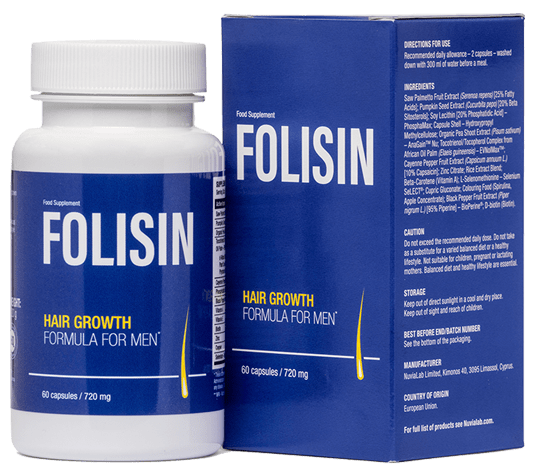
Our Recommendation — Folisin
Score: 5.9/10 · Best for: men with early, diffuse thinning who want a fully disclosed nutritional formula — it supports hair; it does not regrow it. Main caution: the saw palmetto is standardised at 25% fatty acids against 85–95% in the trial extracts, and no money-back guarantee is published. Fair trial: the three-bottle pack at $46.66 a bottle — a fair trial of Folisin is a three-bottle commitment; the six-bottle pack is the cheapest continuation, after a completed trial.
Vitamin E Is Eight Molecules, Not One
"Vitamin E" is a family name for eight related compounds: four tocopherols (alpha, beta, gamma, delta) and four tocotrienols (the same four, with unsaturated tails that change how they behave in tissue). Human nutrition runs mainly on alpha-tocopherol — it is the form the body preferentially retains, the form in the reference intakes, and the form in almost every supplement on the shelf.
Tocotrienols are the family's scarce branch. They occur in palm oil, rice bran and annatto, barely in a normal diet, and in few supplements. They are potent antioxidants, and the scalp rationale for them runs through oxidative stress: scalp tissue in people with alopecia shows lower antioxidant levels and higher lipid peroxidation than in controls, per the background literature Beoy's group cites.
The preference for alpha-tocopherol is mechanical, not a quality judgement: the liver runs a transfer protein that selectively loads alpha-tocopherol into the lipoproteins that distribute vitamin E around the body. The other seven forms circulate at lower levels and clear faster — one reason researchers argue tocotrienols' effects, where they exist, are about local potency rather than whole-body vitamin status.
Here is why the taxonomy decides purchases. The single human hair trial in this whole area tested tocotrienols. A shelf of products labelled "vitamin E" contains, almost without exception, alpha-tocopherol — a molecule the hair trial never tested, from the branch the body handles differently.
That is not a subtle distinction being weaponised; it is the distinction the ingredient's own evidence draws. A buyer who purchases "vitamin E for hair growth" on the strength of the tocotrienol trial has bought the wrong half of the family — and nothing on a typical front label will tell them so.
The reverse error exists too. Because tocotrienols are scarce and fashionable, some products print the word prominently while delivering a token amount inside a mostly-tocopherol blend. The only defence, in both directions, is the panel: which forms, and how many milligrams of each. The dose audit below shows what that defence finds in a real formula.
The Beoy 2010 Trial, Read Closely
The design
Beoy, Woei and Hay (2010), in Tropical Life Sciences Research, recruited 38 male and female volunteers, aged 18 to 60, with hair loss. Twenty-one were randomised to 100 mg/day of mixed tocotrienols; seventeen received a placebo capsule. The trial ran for eight months — a serious duration by this category's standards.
Two outcomes were tracked: the number of hairs in a predetermined scalp area, and the weight of standardised hair clippings (20 strands of 1 cm), measured at baseline, four months and eight months. The design was randomised and placebo-controlled — the strongest design in this set of ingredient articles, and we say so plainly.
The result
At eight months, hair number in the tocotrienol group had increased by 34.5% from baseline, versus a 0.1% decrease in the placebo group over the same period — a statistically significant difference between the groups. One volunteer in the tocotrienol group lost hair; eight recorded growth above 50%.
Those numbers deserve their full framing. Thirty-eight volunteers is a small trial. The population was mixed — men and women, various presentations of hair loss rather than a single diagnosed pattern. And the result appeared at eight months, not four: at the midpoint the separation had not yet declared itself, which is itself a lesson about timelines.
The result nobody prints: strand weight did not change
The trial's second endpoint is the one marketing leaves behind. The cumulative weight of the hair clippings — the measure of how much hair substance each strand carries — did not differ meaningfully from baseline in either group at the end of the study.
Read together, the endpoints say: more hairs were counted in the measured area; the hairs were not shown to be thicker or heavier. "Increased hair number without demonstrated thickening" is the accurate summary. It is a real, positive result — and a narrower one than "34.5% more hair" sounds when quoted alone.
The authorship line
Disclosure, as we apply it to every trial in this set: the capsules used were a commercial tocotrienol complex, and one of the three authors was affiliated with Hovid Bhd, the company associated with supplying the trialled preparation. Industry involvement does not invalidate a randomised design, but it raises the value of independent replication — which, fifteen years on, has never arrived.
That absence is the trial's true weakness. A single small positive trial, unreplicated since 2010, from an interested source, is a promising lead. Categories get built on it anyway; buyers should know the difference between a lead and a literature.
Why Has Nobody Replicated It?
Fifteen years is a long silence for a positive, placebo-controlled result, and the reasons are structural rather than mysterious. Tocotrienols are off-patent commodity ingredients. No company can own the result of a confirmatory trial, so no company has the incentive to fund the large, long, expensive study that would settle the question.
Academic groups, for their part, rarely spend scarce grant money confirming a supplement finding with no drug-development path behind it. The trial that would answer the question — several hundred participants, diagnosed pattern loss, twelve months, the full 100 mg dose — sits in the gap between commercial and academic incentives.
The practical consequence for readers: the evidence will probably look exactly like this in another fifteen years. Decisions have to be made on the file as it stands — one small trial, honestly weighed — rather than on the comforting assumption that better evidence is on its way and will vindicate the purchase later.
Compare the ingredients elsewhere in this set. Saw palmetto accumulated trials because the prostate market funded them for decades. AnaGain has a supplier actively generating studies. Tocotrienols have neither engine, which is why their file froze in 2010.
The Dose Audit
Now apply the trial to the shelf. The trialled intervention: 100 mg/day of mixed tocotrienols, for eight months. Three purchasing cases follow.
Case one: ordinary vitamin E products. Alpha-tocopherol only; tocotrienol content zero milligrams. The trial is simply not about these products, at any dose of them. This is most of the market.
Case two: dedicated tocotrienol products. A minority of supplements do deliver mixed tocotrienols at or near 100 mg/day. Those products can legitimately claim to match the trialled dose — while inheriting every other caveat in this article: one small trial, mixed population, no replication, no thickening endpoint. Matching the dose makes the bet coherent; it does not make the evidence bigger than it is.
Case three: Folisin. Its panel lists a 100 mg EVNolMax tocotrienol/tocopherol complex per daily serving — a figure engineered to be read as the trialled 100 mg. The panel then does something almost no competitor does: it breaks the complex down. Tocotrienols: 12.10 mg. The rest is squalene, phytosterols and tocopherols.
Twelve milligrams against a trialled 100 mg is about an eighth of the dose. We credit the maker for printing the breakdown — it is what makes this audit possible, and the formula scores better for its transparency than silent competitors do. But transparency about a shortfall is not the same as closing it, and no reader should leave this page believing Folisin's vitamin E complex replicates Beoy's intervention.
The general rule, applicable across this category: whenever a panel leads with a complex or blend weight ("100 mg EVNolMax", "500 mg proprietary complex"), the dose that matters is the named active inside it. If the maker does not print that number, assume it is small. Makers with a full dose to advertise print it in the headline, not the footnote.
Reading a tocotrienol label
Three checks separate a real tocotrienol product from a relabelled tocopherol one. First, the ingredient list should name tocotrienols — ideally the individual forms or a branded complex with a published specification. Second, the milligrams should refer to the tocotrienols themselves, not to a blend they sit inside.
Third, beware the unit swap: vitamin E is also declared in IU and as alpha-tocopherol equivalents, which describe the tocopherol branch's activity. A panel can look generous in IU while containing almost no tocotrienols. The milligram line for the named tocotrienol fraction is the only figure comparable with Beoy's 100 mg.
Run all three checks on any product before paying a tocotrienol premium. Most labels fail at the first.
Can Too Much Vitamin E Harm Hair?
The mirror question deserves a section, because this family's marketing treats vitamin E as incapable of excess. Two cautions are documented; one is old and thin, the other is official.
The old one: a decades-old report linked sustained high-dose vitamin E intake to worse hair growth — the reverse of the supplement claim. We could not verify that report's citation to the standard this site requires, so we print it as what it is: an old, small, unverified counter-signal. It is a reason the "more is better" assumption deserves scepticism, not a finding to quote.
The official one is solid. The NIH Office of Dietary Supplements' vitamin E fact sheet sets the adult upper limit at 1,000 mg/day for supplemental vitamin E, because high doses increase bleeding risk — including serious bleeding in the brain — and it warns that vitamin E can add to the effect of anticoagulant and antiplatelet medicines such as warfarin.
Contextualise before worrying: hair-formula doses, Folisin's 3.36 mg of vitamin E activity included, sit far below that limit. The bleeding caution bites at high-dose standalone vitamin E supplementation, and for anyone on blood thinners stacking several products. It is a stacking and megadose warning, not a reason to fear a multivitamin-level amount.
The same fact sheet carries one more finding worth knowing in a men's-health context: in a large trial it summarises, men taking 400 IU of synthetic vitamin E daily for several years had an increased risk of prostate cancer. That result belongs to high-dose, years-long supplementation — again, not to formula-level amounts — but it completes the picture of a nutrient whose high-dose record argues against the megadose instinct.
Food Sources and Realistic Expectations
Could diet do this instead? Tocotrienols concentrate in palm oil and rice bran oil, with annatto the richest known source; a normal Western diet delivers very little. Reaching 100 mg/day from food alone is unrealistic without deliberately restructuring cooking oils around tocotrienol-rich sources — a change with its own trade-offs, and untested for hair in any case.
Food-first logic works better for the deficiency nutrients in our Set R guide to vitamin deficiencies that cause hair loss, where correcting a measured shortfall is the intervention. Tocotrienols are not a deficiency story: nobody's hair loss is attributed to low tocotrienol status, and no test for it exists in clinical practice.
So the expectation to set is the trial's own: in a small group of volunteers, eight months at the full trialled dose produced more counted hairs, of unchanged weight, versus placebo. Anything beyond that sentence — faster, thicker, at a twelfth of the dose, from the tocopherol branch — is decoration added by people selling something.
A last route deserves a sentence: topical tocotrienol preparations exist in the research literature, including animal work on hair-growth signalling pathways. Mouse skin is not a human scalp, no topical human trial exists, and oils marketed for the scalp today are trading on the oral trial's reputation — a trial about swallowing the ingredient, not applying it.
Our Recommendation — Folisin
Score: 5.9/10 · Best for: men with early, diffuse thinning who want a fully disclosed nutritional formula — it supports hair; it does not regrow it. Main caution: the saw palmetto is standardised at 25% fatty acids against 85–95% in the trial extracts, and no money-back guarantee is published. Fair trial: the three-bottle pack at $46.66 a bottle — a fair trial of Folisin is a three-bottle commitment; the six-bottle pack is the cheapest continuation, after a completed trial.
Frequently Asked Questions
Do tocotrienols grow hair?
In the only trial, hair count rose 34.5% from baseline versus a 0.1% fall on placebo after 8 months at 100 mg/day in 38 volunteers with hair loss (Beoy et al. 2010). Strand weight did not change, and the trial has never been replicated — a genuine but narrow and lonely result.
Are tocotrienols the same as vitamin E?
They are half of the vitamin E family — four of its eight forms. Most supplements contain alpha-tocopherol, a different form that the hair trial never tested. Buying "vitamin E" for the tocotrienol result buys the wrong branch.
How much tocotrienol did the trial use?
100 mg/day of mixed tocotrienols for eight months. For scale: Folisin's complex delivers 12.10 mg of tocotrienols per daily serving — about an eighth of the trialled dose, printed openly on its panel.
Can too much vitamin E be harmful?
At high supplemental doses, yes: the NIH fact sheet sets an upper limit of 1,000 mg/day over bleeding risk, and warns about combining it with anticoagulants. Formula-level amounts like Folisin's are far below that zone; the warning targets megadoses, stacking and blood-thinner use.
Who Should Buy Folisin — and Who Should Skip It
Buy it if you are choosing the formula for its whole panel — AnaGain at its studied dose, a fully disclosed nutrient base — and you treat its tocotrienol line as a minor supporting ingredient honestly labelled, not as Beoy's intervention in a capsule. The score of 5.9/10 rewards the disclosure, not the dose.
Skip it if tocotrienols are the reason you are buying. On the arithmetic above, this product delivers an eighth of the one trialled dose, and a dedicated tocotrienol supplement is the purchase that matches the study — with all the study's own caveats (small, mixed, unreplicated) still attached. Skip it also if you take anticoagulants and have not cleared vitamin-E-containing products with your clinician.
Last reviewed: October 2026. This article is educational and is not medical advice.
