
- Quick Answer
- What AnaGain Is
- How It's Meant to Work
- What the Study Actually Found
- The oral trial's anatomy
- The gene-expression study
- The endpoint drift problem
- Side Effects: the Honest Answer Is "Unstudied"
- The Dose Match — and What It Doesn't Prove
- Frequently Asked Questions
- Does AnaGain work for hair loss?
- What dose of AnaGain was studied?
- Is AnaGain safe?
- How is AnaGain different from regular pea extract?
- Who Should Buy Folisin — and Who Should Skip It
- Read This Next
Disclosure: This article contains affiliate links. If you buy through them, we may earn a commission at no extra cost to you. It never changes our conclusions.
Quick Answer
AnaGain has exactly one oral study behind it: 100 mg/day of pea-sprout extract for 8 weeks in 21 participants, whose average hair loss fell 33.9% from baseline (Grothe et al. 2020). The study was small, short and run by the ingredient maker's own scientists, with no placebo group.
What makes it interesting anyway: the dose in Folisin — the formula this set audits — matches the studied dose exactly, at 100 mg. Best for: men with early, diffuse thinning who want the one hair-specific ingredient in the formula at its real dose. Folisin scores 5.9/10.
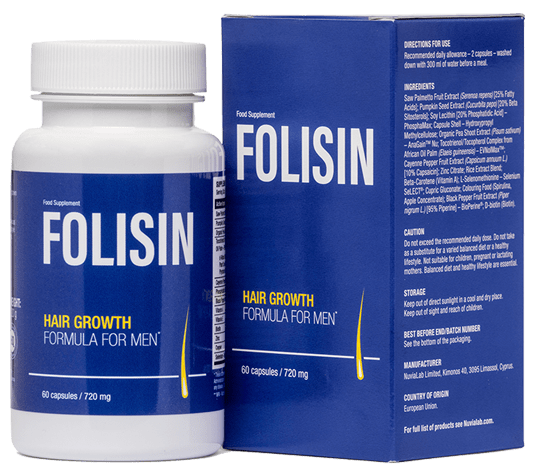
Our Recommendation — Folisin
Score: 5.9/10 · Best for: men with early, diffuse thinning who want a fully disclosed nutritional formula — it supports hair; it does not regrow it. Main caution: the saw palmetto is standardised at 25% fatty acids against 85–95% in the trial extracts, and no money-back guarantee is published. Fair trial: the three-bottle pack at $46.66 a bottle — a fair trial of Folisin is a three-bottle commitment; the six-bottle pack is the cheapest continuation, after a completed trial.
What AnaGain Is
AnaGain is a branded extract of organic pea sprouts (Pisum sativum), made by Mibelle Biochemistry, a Swiss supplier of cosmetic and nutraceutical actives. It is produced from sprouted peas — the young shoots, not the mature seed — concentrated into an extract.
Two grades circulate. The original AnaGain was developed for topical, cosmetic use; AnaGain Nu is the food-grade version intended for supplements taken by mouth. The distinction matters because the research splits along the same line: a topical gene study and an oral pilot, testing different routes in different ways.
Unlike most ingredients in this set, AnaGain was designed for hair from the start. Saw palmetto and pumpkin seed arrived from prostate formulas with a theory attached; this one began as a hair active and has a hair study — a small one — of its own. That is the strongest thing in its file, and the rest of this article is about how much weight it can bear.
How It's Meant to Work
The proposed mechanism concerns the hair cycle's two key phases. Follicles cycle between anagen (growth) and telogen (resting, after which the hair sheds). Pattern loss and stress shedding both involve follicles spending too little time growing and too much time resting.
Mibelle's work focuses on two signalling molecules. FGF7 (fibroblast growth factor-7) supports the growth phase; noggin is a protein that helps trigger resting follicles back into growth. The supplier's model is that pea-sprout extract raises both signals — prolonging anagen, shortening telogen, and so reducing the number of hairs shed on any given day.
Hold the framing precisely: this is supplier mechanism work. It is a plausible, published account of how the ingredient is intended to act, generated by the company that sells it. Mechanism plausibility is the beginning of an evidence case, not the end of one — the history of this category is full of beautiful mechanisms that did not survive a controlled trial.
What the Study Actually Found
The oral trial's anatomy
The oral evidence is one short communication: Grothe et al. (2020) in Phytotherapy Research, authored by three Mibelle scientists. Its oral arm enrolled 21 healthy adults, aged 22 to 63, with mild-to-moderate hair loss — entry required losing at least 100 hairs a day.
Each participant drank 100 mg of AnaGain Nu dissolved in liquid, once daily, for 8 weeks. The design, stated exactly as reported: an open pilot study. There was no placebo group and no blinding — every participant knew they were taking the ingredient, and so did the researchers.
The result: hair loss was significantly reduced after 28 days of treatment (p < 0.002, in the authors' analysis), and by the end of the 8 weeks the participants' average hair loss was 33.9% lower than at baseline. Ninety-five percent of the 21 participants reported reduced hair loss themselves.
Now weigh it. Twenty-one people is a pilot, not a verdict. Shedding fluctuates naturally — people enrol in hair studies when shedding is at its worst, and some improvement would be expected with no intervention at all, which is exactly what a placebo arm exists to measure. Without one, the 33.9% figure is the change observed while taking the extract, not the change caused by it.
None of that makes the study worthless. It makes it a first step: a real, peer-reviewed signal, at a defined dose, on the right endpoint — awaiting the controlled trial that would tell us how much of it is the ingredient.
The gene-expression study
The same paper reports the topical work: a fluid containing 2% pea-sprout extract applied to a defined scalp area in 10 volunteers for two weeks. Expression of FGF7 rose by 56% and noggin by 85% in the treated skin, in the supplier's measurements.
Those percentages describe gene expression in a small topical experiment — not hair growth, not shedding, and not the oral product. They belong in the mechanism section of an honest account, which is where we keep them, and any page quoting "+85%" as a hair result has moved them somewhere they do not belong.
The endpoint drift problem
A live example of why we are this careful: a 2025 paper in the Journal of Microbiology and Biotechnology (Kim et al. 2025), studying the extract's mechanisms, describes Grothe's pilot as a randomised clinical trial that "significantly increased hair density" in patients.
It was not randomised, there was no control group, and the endpoint was shedding, not density. In one retelling, an open pilot about hair fall became a controlled trial about hair growth. This is how ingredient reputations inflate — each citation slightly firmer than the last — and it is why this site prints endpoints, designs and sample sizes instead of adjectives.
Side Effects: the Honest Answer Is "Unstudied"
Grothe's pilot reported no adverse events among its 21 participants over 8 weeks. That is the entire formal safety record of oral AnaGain: 21 people, two months, nothing reported.
Treat that sentence precisely. "No adverse events in a 21-person pilot" is reassuring about common, immediate effects and silent about everything else — rarer reactions, longer use, interactions, pregnancy, people with medical conditions. The participants were healthy adults; the study was not designed to find harm.
Pea sprouts are a food, and a food-derived extract carries a reasonable prior of tolerability. But "no known side effects" on this data means "barely studied", and the two phrases should never be swapped. If a page tells you AnaGain is "proven safe", it is telling you more than the record contains.
The Dose Match — and What It Doesn't Prove
Here is the genuinely unusual part. Supplement formulas routinely contain a fraction of the dose their headline ingredient was studied at — this set's own audits found a tocotrienol complex delivering an eighth of the trialled dose, and a saw palmetto extract at a third of the trialled standardisation.
Folisin does not do that with AnaGain. Its panel lists AnaGain Nu at 100 mg per daily serving — the exact dose Grothe's participants took, of the exact oral grade they took it as. Whatever else the formula gets wrong, this ingredient is present at full studied strength.
What the dose match does not prove is that the study's result transfers. The evidence being matched is a 21-person open pilot run by the ingredient's maker. A full dose of a weakly evidenced ingredient is still a weakly evidenced ingredient — the match removes the commonest excuse for failure, it does not manufacture proof of success.
It also cuts the other way for the buyer: if you take Folisin for three months and shedding does not change, you cannot blame an underdose. The experiment was run at the studied specification and it failed for you — useful information, cleanly obtained, which is more than most formulas in this category can offer.
Our Recommendation — Folisin
Score: 5.9/10 · Best for: men with early, diffuse thinning who want a fully disclosed nutritional formula — it supports hair; it does not regrow it. Main caution: the saw palmetto is standardised at 25% fatty acids against 85–95% in the trial extracts, and no money-back guarantee is published. Fair trial: the three-bottle pack at $46.66 a bottle — a fair trial of Folisin is a three-bottle commitment; the six-bottle pack is the cheapest continuation, after a completed trial.
Frequently Asked Questions
Does AnaGain work for hair loss?
One open pilot study found hair loss fell by an average of 33.9% from baseline after 8 weeks at 100 mg/day in 21 adults with mild-to-moderate hair loss (Grothe et al. 2020). There was no placebo group and the authors work for the ingredient's maker — a promising signal, not proof.
What dose of AnaGain was studied?
100 mg/day of AnaGain Nu, taken orally for 8 weeks. It is also the dose in Folisin — an exact match, which is uncommon in this category.
Is AnaGain safe?
No adverse events were reported in its one small study, but the total human record is 21 people for 8 weeks. "Unstudied" is the accurate description; a food-derived extract is a reasonable tolerability bet, not a demonstrated safety profile.
How is AnaGain different from regular pea extract?
It is a branded extract of pea sprouts — the germinated shoots — standardised by its maker for hair use, with an oral grade (AnaGain Nu) for supplements. Generic pea protein or pea extract has no hair study behind it at all.
Who Should Buy Folisin — and Who Should Skip It
Buy it if shedding is your main complaint, you want the one ingredient in this category with a hair-specific study at its exact studied dose, and you can hold the evidence at its true size: a 21-person open pilot. Judge on shed counts and photographs at three months.
Skip it if you need controlled-trial evidence before spending — AnaGain does not have it, and waiting for the ingredient's first placebo-controlled trial is a legitimate position. Skip it, too, if your loss is patterned and advancing: a shedding signal in mild-to-moderate loss is not a treatment for miniaturisation, whatever the dose match.
Last reviewed: October 2026. This article is educational and is not medical advice.
