
- Quick Answer
- Can a deficiency really make your hair fall out?
- Which deficiency has the strongest case — iron and ferritin?
- What ferritin number should you actually aim for?
- Why does the men's case need extra honesty?
- What about vitamin D — how strong is the link, really?
- Does a zinc deficiency cause shedding?
- What about B12, folate, protein and the rest?
- And biotin — why is the most famous hair vitamin the rarest deficiency?
- What does Profolan actually contain against this list?
- Should you get blood tests before buying any hair supplement?
- How long does correcting a deficiency take to show in your hair?
- Can taking too much actually make hair loss worse?
- What if all your blood tests come back normal?
- Who Should Buy Profolan — and Who Should Skip It
- Frequently Asked Questions
- Which deficiency causes hair loss most often?
- What ferritin level is best for hair growth?
- Can vitamin D deficiency cause hair loss?
- Should I take iron for hair loss without a blood test?
- Does Profolan contain iron or vitamin D?
- Why is the zinc and copper pairing in Profolan a good thing?
- Do I need to stop biotin before hair-loss blood tests?
- How long after correcting a deficiency will my hair improve?
- Read This Next
Disclosure: This article contains affiliate links. If you buy through them, we may earn a commission at no extra cost to you. It never changes our conclusions.
Quick Answer
Yes, deficiencies can cause hair loss — but only a short list has serious evidence behind it, and the pattern is almost always diffuse shedding rather than a receding hairline or a thinning crown. Iron, measured as ferritin, has the strongest case. Vitamin D has a strong association and much weaker proof that it causes the loss.
Zinc sits in the middle: a real deficiency can drive shedding, and correcting it helps the deficient. Biotin deficiency, despite biotin's fame as the hair vitamin, is rare. The practical consequence comes before any product recommendation: test first, then fill the actual gap you find.
That order matters doubly for the product in this set, because Profolan contains neither iron nor vitamin D — the two strongest-evidence deficiencies — so a man who buys it to fix either gap is buying the wrong tool for that job. Best for: men with new, diffuse, whole-scalp shedding who are willing to run a small blood panel first and supplement only what the results show is missing.
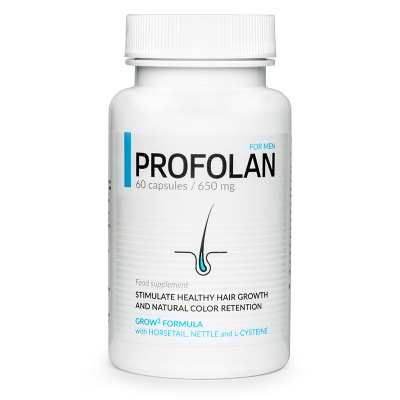
Our Recommendation — Profolan
Score: 5.7/10 · Best for: men with early thinning or increased shedding who want to test the nutritional angle for a full 90 days, photos in hand. Main caution: no ingredient in the bottle has a human trial for male hair loss, and the formula contains neither iron nor vitamin D. Fair trial: the three-bottle pack at $46.66 a bottle — it sits exactly inside the published 90-day money-back guarantee window.
Can a deficiency really make your hair fall out?
Start with the type of loss, because deficiency does not explain every kind. A follicle needs energy, protein, iron-dependent enzymes and hormonal signals to stay in its growth phase.
When the body is short of something it treats as essential, hair is a rational thing to economise on: it is not vital tissue, its growth can be paused, and the follicles can be pushed early into their resting phase. Two to three months later those hairs shed together.
Clinicians call that pattern telogen effluvium — diffuse shedding across the whole scalp, including the sides and back, rather than loss confined to the temples and crown. Male pattern loss is different. It is driven by genetic sensitivity to dihydrotestosterone, it miniaturises follicles in a pattern over years, and no vitamin corrects the underlying sensitivity.
A deficiency can coexist with pattern loss, and it can make pattern loss look suddenly worse by adding shedding on top of it, but correcting the deficiency does not reverse miniaturisation. That distinction decides what any supplement can honestly promise in this article: at best, it can remove a nutritional brake on normal growth. It cannot rewrite the pattern.
The most useful single review to anchor that framing is Almohanna et al. 2019, which surveyed the role of vitamins and minerals in hair loss and concluded that micronutrients play an important, but not entirely clear, role in non-scarring alopecia, and that a deficiency may represent a modifiable risk factor. Read that sentence at the temperature its authors wrote it.
Modifiable risk factor is not the same as proven cause, and important but not entirely clear is not a licence to supplement everything on the list. The same review ends with the caveat competitors routinely drop when they quote it: "large double-blind placebo-controlled trials are required" before firmer conclusions can be drawn.
That caveat is still the honest state of the field. Almost everything below rests on association studies — people with hair loss were tested and, on average, had lower levels of something — plus smaller repletion reports in people who were deficient to begin with. Association can point to a cause.
It can also reflect diet, illness, inflammation, sun exposure, or the stress that caused the shedding in the first place. Grading each nutrient separately, instead of treating "deficiencies" as one lump, is how you avoid spending money on the weakest items as if they were the strongest.
One more framing point belongs here, because it shapes the blood-test protocol later. Lab-normal and hair-optimal are not always presented as the same thing in clinic practice. A ferritin result can sit inside a laboratory's broad reference range and still be the level at which a dermatologist who treats shedding every week starts asking questions.
This article will name those working targets where clinicians use them — and will label them every time as working targets and clinical assumptions, not as thresholds a trial proved. Inventing precision the evidence does not contain is the central dishonesty in this category, and it appears on both sides: sellers who promise growth from a capsule, and guides who print a target number as if a randomised trial had established it.
Which deficiency has the strongest case — iron and ferritin?
Iron is first for a reason that is biological as well as statistical. Ferritin is the protein that stores iron, and a ferritin blood test is the standard proxy for how much iron the body has in reserve. Hair-matrix cells divide rapidly, and iron is a cofactor for enzymes involved in DNA synthesis.
When reserves fall, the body prioritises essential systems, and follicles are among the tissues that feel the shortage early. Of all the nutrients in this article, low ferritin is the finding most consistently reported alongside increased shedding.
The review most often cited for that link is Trost et al. 2006 in the Journal of the American Academy of Dermatology, which examined the diagnosis and treatment of iron deficiency in relation to hair loss and found the association worth taking seriously while stopping well short of a proven causal threshold.
Around it sits a wider observational literature: Rushton 2002 reported lower ferritin in women with chronic telogen effluvium, and Rasheed 2013 found both vitamin D and ferritin lower in women with female pattern loss and telogen effluvium than in controls.
Those studies matter, and their shared limitation matters just as much: they are case-control and observational work, and they are largely studies of women. They show that women who are shedding are more likely to have low ferritin than women who are not. They do not show, in a randomised design, that pushing ferritin to a particular number regrows hair — in women, and still less in men.
What ferritin number should you actually aim for?
This is where precision is most often faked, so the wording here is deliberate. You will see hair clinics and evidence guides quote ferritin above 50 ng/mL, and ideally above 70 ng/mL, as the zone to aim for when shedding is the complaint.
Those figures are clinical assumptions — working targets experienced clinicians use when they decide whether to treat — not trial thresholds. No trial randomised shedding patients to ferritin 40 versus 70 versus 100 ng/mL and measured who regrew hair. Treating 50 or 70 as a pass-fail line a study proved would be exactly the error this article exists to correct.
The defensible version is narrower: clearly low ferritin deserves correction on general-health grounds alone; ferritin in the low-normal grey zone, in a person with unexplained diffuse shedding, is a reasonable subject for a clinician conversation; and a man with a ferritin comfortably in the middle of the range should not assume iron is his answer and keep pushing it higher.
Why does the men's case need extra honesty?
Men have a lower baseline risk of iron deficiency than premenopausal women, for an obvious reason: they do not lose iron through menstruation. That single fact changes the pre-test probability of the whole workup. A shedding woman with heavy periods, a recent pregnancy, or a restrictive diet is a plausible iron story before a tube is drawn.
A healthy adult man eating a mixed diet is a less plausible one — which does not make testing pointless, but does make it a test-once-and-rule-it-out exercise rather than an assumption to supplement on.
Vegetarian and vegan men, endurance athletes, frequent blood donors, men with gastrointestinal disease or unexplained fatigue, and men who have had bariatric surgery sit in a different risk group and should read the iron section as applying to them more directly.
For everyone else, the honest sentence is the one most men's hair content omits: iron is the strongest-evidence deficiency in the literature and, at the same time, statistically less likely to be your primary issue. Both halves are true, and a guide that prints only the first half is selling something.
The corollary is a safety rule with no exceptions in this article: never supplement iron blind. Iron is not a harmless just-in-case nutrient.
Taken without a demonstrated need it causes gastrointestinal side effects in the short term, it can mask the investigation of why iron was low, and in excess it accumulates — the body has no efficient route for excreting it — with harm to the liver and other organs, and particular danger in people with undiagnosed iron-overload conditions.
If ferritin is low, the follow-up question is why it is low, and in an adult man a new iron deficiency without an obvious dietary explanation deserves medical investigation in its own right, not just a supplement order. Test once. Treat a confirmed deficiency under guidance, with a recheck. Do not take iron because a hair article ranked it first.
What about vitamin D — how strong is the link, really?
Vitamin D is the second name on every serious list, and it needs a different grade from iron: strong association, weak causation. Vitamin D receptors are present in the follicle and play a role in hair cycling, which gives the association biological plausibility.
Study after study finds vitamin D deficiency more common in people with alopecia areata, telogen effluvium and pattern loss than in matched controls. A 2024 meta-analysis of women with hair loss put deficiency prevalence at roughly 50% — about half the women with hair loss in the pooled studies were vitamin D deficient.
That is a striking figure, and it still does not prove that the deficiency caused the loss. Vitamin D status tracks sunlight exposure, outdoor activity, body composition, skin pigmentation, season, chronic illness and general health, all of which can travel with the conditions and life events that trigger shedding.
Correcting a low level and watching hair improve over the following months is also compatible with the shedding episode simply ending on its own schedule, which telogen effluvium usually does.
None of that makes testing a waste of time — quite the opposite. A 25-hydroxyvitamin D result below 20 ng/mL is a deficiency worth correcting for bone and general health regardless of what it does for hair, and a man who discovers one during a hair workup has gained something real from the test even if his hairline never notices.
What the evidence does not support is the stronger commercial claim: that vitamin D is a hair-growth treatment for men whose levels are already sufficient, or that pushing levels ever higher produces ever more hair. There is no dose-response regrowth trial behind that claim.
Grade it as this article does throughout — test it alongside ferritin because it is common, cheap to measure and worth fixing in its own right; credit it with a plausible supporting role in shedding; do not credit it with proven regrowth.
Note, too, who generated that roughly 50% figure: women with hair loss. As with ferritin, the vitamin D and hair literature leans heavily female, and a men's article that imports the prevalence number without naming its population is borrowing confidence it has not earned.
Vitamin D deficiency itself is common in men too, especially in northern winters and in men who work indoors — which is an argument for the test, not for assuming the result in advance.
Does a zinc deficiency cause shedding?
Zinc earns the grade moderate, and the word moderate is doing real work. Zinc is involved in protein synthesis, cell division and the enzymes of the follicle, and a genuine zinc deficiency is a recognised cause of telogen effluvium-type shedding — the diffuse kind, often alongside skin changes, poor wound healing, altered taste, or a diet or gut condition that explains why zinc ran low in the first place.
Repletion in a person who is demonstrably deficient is sensible and can be part of why shedding settles.
What the evidence does not show is a meaningful benefit from extra zinc in men whose status is already normal, and the population data underline how small the average gap is: in one very large comparison cited across the evidence guides, mean serum zinc in people with hair loss sat only a few micrograms per decilitre below controls — a difference far too small to treat every shedder as zinc-deficient by default.
That is why zinc belongs on the test panel in this article's protocol, but below ferritin and vitamin D in emphasis, and why its supplement story has a built-in limit the label rarely prints. Zinc and copper compete for absorption.
Push zinc high for months and you can induce a copper deficiency — which itself causes anaemia, immune problems and, in a neat illustration of why more is not better, hair problems of its own.
Responsible repletion respects that pairing: keep supplemental zinc in the modest range unless a clinician directs otherwise, and prefer a formula that includes a small amount of copper alongside it when zinc is taken daily. Hold that thought, because it becomes a genuine point in Profolan's favour in the label audit below — one of the few places in this set where the formula does something competitors often get wrong, and does it correctly.
Who should suspect zinc at all before a test? Men with very restrictive diets, heavy alcohol use, chronic gastrointestinal disease or malabsorption, bariatric surgery, or long-term use of medicines that affect mineral absorption have a plausible route to deficiency. A man eating a varied diet with meat, seafood, dairy, legumes and whole grains has a much weaker prior case.
As with iron, the test is cheap relative to months of guessing; as with iron, the result — not the marketing — should decide the purchase.
What about B12, folate, protein and the rest?
Beyond the big three, the honest grades fall quickly, which is why this section is deliberately compressed. These nutrients matter to hair in the way foundations matter to a house — a genuine shortage can undermine growth — but in men eating enough food, most of them are uncommon causes of shedding, and none of them has hair-regrowth evidence in people who were not deficient.
| Nutrient | Evidence for hair loss | Who is actually at risk? | Honest verdict |
|---|---|---|---|
| Vitamin B12 | Weak — deficiency can accompany shedding; no regrowth trial in the replete | Vegans without fortified foods or supplements, older men, men on metformin or long-term acid suppression, pernicious anaemia | Test if your diet or medicines put you at risk; do not assume it |
| Folate | Weak — travels with B12 and general undernutrition | Very poor diet, heavy alcohol use, malabsorption | Usually measured alongside B12; correct a confirmed low |
| Protein / total energy | Moderate by mechanism — crash dieting and rapid weight loss are classic telogen effluvium triggers | Crash dieters, men eating far too little after illness, surgery or intense training blocks | Often the real trigger behind "deficiency shedding" — fix intake, not just capsules |
| Vitamin A | Deficiency is rare in this context; excess is the hair-relevant problem (see the harm section) | Deficiency: severe malnutrition only. Excess: men stacking high-dose supplements | Do not add high-dose vitamin A for hair |
| Selenium | Deficiency can affect hair; excess reliably harms it | Deficiency: very restricted diets, specific low-soil regions. Excess: supplement stacking | A narrow-window nutrient — food first, no megadoses |
| Vitamin E | One small tocotrienol trial is the outlier, not the rule | Genuine deficiency is rare outside fat-malabsorption disorders | Interesting footnote; not a buying reason |
| Essential fatty acids / omega-3 | Thin for male shedding; often listed by competitors without male trial support | Extremely low-fat, very restricted diets | Eat oily fish if you like it; do not buy it as a hair treatment on this evidence |
The vitamin E row deserves its footnote in full, because it is the one place a placebo-controlled trial with a positive hair-count result exists in this long tail.
Beoy et al. 2010 gave a tocotrienol preparation — a specific form of vitamin E, not the alpha-tocopherol on most labels — to a small group of volunteers with hair loss and reported an increase in hair number over eight months against placebo. It is a real trial and this article does not hide it.
It is also small, it used a specific tocotrienol mixture, it has not been robustly replicated, and it does not transfer to the ordinary vitamin E dose in a general hair formula. Treat it the way the grading system treats every single small positive trial in this set: as a reason for a better trial, not as a settled benefit.
Protein deserves one plain paragraph of its own, because it is the deficiency-adjacent cause men most often miss while shopping for micronutrients. Hair is keratin — protein.
A period of eating far too little, whether through crash dieting, illness, surgery recovery, or an aggressive cut for sport, is one of the best-documented triggers of telogen effluvium, with the shedding arriving two to three months after the shortfall, when the diet may already have improved and the connection is easy to miss.
No capsule in this article fixes an energy and protein deficit; eating enough does, over the same months-long timescale as every other correction here. If your shedding followed a rapid loss of body weight, start the investigation there before you start it in a supplement aisle.
And biotin — why is the most famous hair vitamin the rarest deficiency?
Biotin gets a short section here because this set gives it a full article of its own, and because its verdict can be stated without hedging: biotin deficiency in a healthy adult eating a normal diet is rare, and the reviews agree that supplementation helps hair where a deficiency or a specific underlying pathology exists — not in healthy, non-deficient people.
Patel et al. 2017, reviewing the reported cases of biotin supplementation for hair and nail growth, found that in all cases an underlying pathology was present, and concluded there was a lack of sufficient evidence for supplementation in healthy individuals.
Yelich et al. 2024 reached the same destination from the trial side: no study demonstrates supplement benefit in healthy, non-deficient individuals, and the best randomised trial found no difference from placebo.
Biotin is also rarely the right test to order — clinicians do not routinely measure it in a standard shedding workup, because the pre-test probability is so low outside specific risk settings such as prolonged raw egg-white consumption, certain genetic disorders, long-term parenteral nutrition, or particular medicines.
Why, then, does biotin dominate hair labels, including — at 900 µg per daily serving — Profolan's? Because it is inexpensive, familiar, and safe enough at ordinary intakes to include without much downside for most buyers, and because its name is the one shoppers recognise. Recognisable is not the same as needed.
The one biotin fact that genuinely changes behaviour is not about hair at all: at high supplemental doses biotin interferes with common laboratory assays, which is why it reappears in the blood-test protocol below as a warning rather than a benefit.
If you read only the cross-reference, read it as this: biotin is the weakest-evidence headline nutrient in the deficiency story, and its presence at a large multiple of daily requirement is not evidence that a formula covers the deficiencies that matter.
What does Profolan actually contain against this list?
Here is the audit no competitor in this set performs: the graded deficiency list, laid directly against one real product's label. The product is Profolan (our score: 5.7/10) — 60 capsules, 2 a day preferably 30 minutes before a meal, built on the maker's Grow3 complex.
Its full panel per daily serving is horsetail extract standardised to 7% silica at 400 mg, taurine 200 mg, nettle leaf extract 100 mg, L-cysteine 100 mg, biotin 900 µg, vitamin E 24 mg, thiamin 20 mg, zinc 15 mg, vitamin B6 10 mg, vitamin A 800 µg and copper 1 mg. There is no iron in it.
There is no vitamin D in it. There is also no saw palmetto and no minoxidil — relevant to the companion comparison article, and worth stating here so no reader mistakes this for a drug or a DHT product.
| Deficiency | Evidence grade | Test | In Profolan? |
|---|---|---|---|
| Iron | Strongest | Ferritin | NO |
| Vitamin D | Strong association | 25-OH vitamin D | NO |
| Zinc | Moderate | Serum zinc | YES — 15 mg, plus copper 1 mg |
| Biotin | Rare | Rarely tested | YES — 900 µg |
State the headline finding as plainly as the table does: Profolan contains neither iron nor vitamin D — the two strongest-evidence deficiencies in this article — so it cannot fill either gap, and no honest reading of its label claims otherwise once the label is actually read.
What it supplies generously is biotin, the rarest deficiency on the list, and what it supplies well is zinc at 15 mg paired with copper at 1 mg. That pairing deserves explicit credit: as the zinc section explained, sustained zinc without copper invites a copper problem, and a surprising number of men's formulas make exactly that mistake.
Profolan is one of the few formulas that pairs them correctly, and in an audit that has been hard on this product, that line is a genuine positive — the panel's most defensible nutritional decision after the guarantee discussed below.
The rest of the panel should be read for what it is: nutritional support ingredients — horsetail as a traditional silica source, cysteine as a keratin building block, taurine, nettle leaf and a B-vitamin and antioxidant spread — none of which substitutes for a missing ferritin or vitamin D correction, and none of which has a human trial for male hair loss behind it. The commercial facts complete the audit rather than softening it.
A single bottle costs $69.99, the buy-2-get-1 pack is $139.98 ($46.66 per bottle) and the buy-3-get-3 pack is $209.97 ($35.00 per bottle), with shipping at $12 per order. Unusually for this category — and uniquely among the six products in this wave — the maker publishes a real 90-day money-back guarantee.
That guarantee does not change the label audit by one milligram. What it changes is the risk of testing the nutritional-support hypothesis after your blood results are in: if your panel is normal, or your only gap is one this formula actually covers, a 90-day trial has a defined exit.
If your gap is iron or vitamin D, the correct purchase is not this product at any discount — it is the specific repletion your clinician recommends, which is usually inexpensive, targeted and testable again in a few months.
Should you get blood tests before buying any hair supplement?
Yes — and the panel is smaller than the internet makes it look. For unexplained diffuse shedding in a man, the consensus core is four lines: ferritin with a complete blood count, 25-hydroxyvitamin D, thyroid-stimulating hormone with free T4 if the first result or your symptoms call for it, and serum zinc.
Add B12 and folate if your diet, medicines or history put you in the risk groups named above.
That panel answers the graded questions in this article in the right order: the strongest-evidence deficiency, the strongest-association deficiency, the great non-nutritional mimic — thyroid disease, which causes shedding that no hair vitamin touches and which belongs in every serious workup — and the moderate-evidence mineral the leading product in this set actually contains. It also produces a baseline.
Without a before number, a recheck three months later is just another number; with one, it is evidence about whether the correction worked.
| Test | What it answers | What to do with the result |
|---|---|---|
| Ferritin + CBC | Are iron stores low, and is there anaemia alongside? | If low: find the cause with a clinician, replete under guidance, recheck. If normal: do not take iron for hair |
| 25-OH vitamin D | Are you below 20 ng/mL (deficient) or in the insufficient grey zone? | If deficient: correct it for general health, then judge hair over 3–6 months. If sufficient: more vitamin D is not a hair plan |
| TSH (± free T4) | Is thyroid disease driving or contributing to the shedding? | Any abnormality goes to medical management — supplements are not the treatment |
| Serum zinc | Is there a demonstrable zinc gap? | If low: modest repletion, copper-aware, recheck in 2–4 months. If normal: extra zinc adds risk, not evidence |
One instruction can invalidate the whole panel if it is skipped, and it concerns the product in this very set. Disclose biotin before the draw — and pause it as your laboratory or clinician directs — or the panel itself is unreliable.
Profolan delivers 900 µg of biotin a day, and high-dose biotin distorts immunoassay results: the FDA Safety Communication 2017/2019 warned that biotin can produce falsely low troponin on susceptible assays and falsely low TSH with falsely high free T4 and T3, a pattern that mimics hyperthyroidism, with distortions also reported for ferritin and other hormones.
Picture the trap concretely: a man takes a biotin-heavy hair formula for two months, then orders the responsible blood panel — and the biotin in his system bends his ferritin and thyroid results, the two most important lines on it. He has paid for certainty and manufactured confusion instead.
The fix costs nothing: tell the laboratory and the ordering clinician everything you take, follow their pause instruction for your dose and your tests — guidance varies by assay, from hours to days, and there is no single universal stop time to print responsibly — and never delay an urgent heart test to wash out a supplement; in an emergency, disclosure, not delay, is the rule.
A second, broader review supports that test-first posture from the supplement side. Drake et al. 2023, in a JAMA Dermatology systematic review of nutritional supplements for hair loss, found a literature of small, heterogeneous studies — enough to justify correcting demonstrable problems, nowhere near enough to justify supplementing blind and hoping.
That is the whole protocol in one sentence: the tests are the diagnosis, the supplement is only ever the answer to a specific result, and Almohanna et al. 2019's closing call for large double-blind placebo-controlled trials is the reason the burden stays on the blood work rather than on the capsule.
How long does correcting a deficiency take to show in your hair?
Slower than any product page wants to admit, and for a structural reason: blood levels recover first, follicles respond second, and visible hair changes last. A follicle pushed into its resting phase does not restart because this week's ferritin is better; it completes its cycle, re-enters growth, and then produces a hair that grows at roughly a centimetre a month.
Every timeline below is therefore two timelines — the laboratory one and the mirror one — and confusing them is how honest corrections get abandoned at week six as failures.
Iron. With effective repletion, ferritin typically rises by roughly 10–30 ng/mL per month, though the rate varies with the cause, the dose, absorption and adherence. Judge the blood result at about three months. Judge the hair no earlier than three to six months after levels have normalised — shedding easing first, then density and texture recovering as new growth lengthens.
Vitamin D. Levels respond over weeks to a few months of correction; any hair effect belongs on a three-to-six-month horizon, and it will be entangled with the natural end of the shedding episode, which is precisely why vitamin D's causation grade stays weak. Zinc.
The fastest of the three: recheck and early hair signals on a two-to-four-month horizon in a genuinely deficient man. In all three cases, photograph the hairline, crown and parting on day one, in the same light, angle and styling, and re-shoot monthly.
Memory is a hopeless measuring instrument for a process this slow; a dated photo series is a good one. And hold the stopping rule from the start: if levels have been normal for six months and standardised photos show no change in shedding or density, the cause was probably never nutritional — continuing to buy nutritional products after that point is not persistence, it is a misdiagnosis you are paying for monthly.
Can taking too much actually make hair loss worse?
Yes, and this is the section the deficiency story most often omits. The dose-response for several hair-relevant nutrients is a hill, not a staircase: too little can contribute to shedding, enough supports normal growth, and too much can cause shedding or wider harm. Four excess risks deserve names.
Vitamin A: chronic high intake is a documented cause of telogen effluvium-type shedding, alongside liver and bone concerns and serious pregnancy risks at high doses — note that Profolan itself contains a modest 800 µg, which is not the problem; the problem is stacking multiple high-dose products on top of each other without ever adding up the labels.
Selenium: excess produces brittle hair and nails and can increase shedding — the harm looks like the complaint, which makes self-treatment loops genuinely treacherous. Zinc: as established above, sustained excess depletes copper; nausea and immune effects join the list at high intakes, and the copper pairing that protects against one of those outcomes only works at sane zinc doses.
Iron: the blind-supplementation warning bears repeating in the harm box, because it is the excess risk with the least forgiving physiology — iron accumulates, and a man who takes it for months without a deficiency to correct is running an experiment with no upside arm.
The general rule that covers all four, and every nutrient not named here, is the protocol rule restated: a blood result is the permission slip for a supplement, and a normal result is the instruction to stop adding more.
What if all your blood tests come back normal?
Treat that as a useful answer, not a failed shopping trip. Normal ferritin, vitamin D, thyroid and zinc results, in a man whose shedding is diffuse, redirect the investigation where it should go next: recent triggers in the two-to-four months before shedding began — illness, fever, surgery, rapid weight loss, a new medicine, a period of severe stress — because telogen effluvium is more often an event echo than a nutrient shortage.
Normal results in a man whose loss follows the temples-and-crown pattern point to pattern loss itself, which has its own evidence-backed conversation, covered in this set's comparison of supplements against minoxidil and finasteride.
And normal results alongside red flags — patchy loss, scalp pain, burning, scaling or inflammation, eyebrow or body-hair loss, or shedding that continues beyond six months — point to a dermatologist, promptly, because areata, scarring alopecias and scalp disease are diagnoses, not deficiencies. The worst outcome of a normal panel is not the panel's cost.
It is ignoring it — deciding the tests must be wrong and buying the broad-spectrum formula anyway, at $69.99 a bottle, to correct gaps you have just paid to prove you do not have.
Who Should Buy Profolan — and Who Should Skip It
Buy it if you have run the panel first — or are running it now — and your picture fits what the formula actually is: normal iron and vitamin D, or those gaps being corrected separately and specifically, with a zinc or general nutritional gap left that a daily formula covering zinc 15 mg with copper 1 mg, cysteine and B-vitamins plausibly addresses, and early diffuse shedding you want to judge over a full 90 days with dated photos. On that plan the three-bottle pack at $46.66 per bottle fits the guarantee window the maker publishes, and day 90 is a real decision point: visible improvement in shedding or texture, or use the 90-day money-back guarantee. Skip it if your ferritin or vitamin D is low and uncorrected — this product contains neither nutrient, and buying it instead of repletion is the exact error this article was written to prevent — if you intend to take iron or any other single nutrient blind alongside it, if your loss is advanced pattern loss rather than shedding, or if you have blood tests coming up and have not planned around its 900 µg of biotin. A score of 5.7/10 means a mid-pack nutritional formula with an unusually fair trial window, not a deficiency treatment. Buy it, if at all, as the second step. The blood test is always the first.
Our Recommendation — Profolan
Score: 5.7/10 · Best for: men with early thinning or increased shedding who want to test the nutritional angle for a full 90 days, photos in hand. Main caution: no ingredient in the bottle has a human trial for male hair loss, and the formula contains neither iron nor vitamin D. Fair trial: the three-bottle pack at $46.66 a bottle — it sits exactly inside the published 90-day money-back guarantee window.
Frequently Asked Questions
Which deficiency causes hair loss most often?
Iron deficiency, measured by ferritin, has the strongest evidence — but the studies are largely in women, and men have a lower baseline risk. Strongest in the literature is not the same as most likely in you, which is why the answer is a ferritin test rather than an iron supplement.
What ferritin level is best for hair growth?
No trial has established one. Clinicians who treat shedding often work to targets above 50 ng/mL, ideally above 70 ng/mL, but those are working clinical assumptions, not proven thresholds. Clearly low ferritin should be corrected and its cause investigated; chasing ever-higher numbers in the normal range has no evidence behind it.
Can vitamin D deficiency cause hair loss?
It is strongly associated with hair loss — roughly half the women in a 2024 meta-analysis of women with hair loss were deficient — but causation is weakly proven. Correct a level below 20 ng/mL for your general health regardless, and judge any hair effect over three to six months.
Should I take iron for hair loss without a blood test?
No. Never supplement iron blind. Excess iron accumulates and can cause real harm, and a new iron deficiency in an adult man needs its cause investigated. Test ferritin with a blood count first, treat only a confirmed deficiency, and recheck.
Does Profolan contain iron or vitamin D?
No — neither. Its panel is horsetail 400 mg, taurine 200 mg, nettle leaf 100 mg, L-cysteine 100 mg, biotin 900 µg, vitamin E 24 mg, thiamin 20 mg, zinc 15 mg, vitamin B6 10 mg, vitamin A 800 µg and copper 1 mg per daily serving of 2 capsules, taken preferably 30 minutes before a meal. If your gap is iron or vitamin D, this product cannot fill it.
Why is the zinc and copper pairing in Profolan a good thing?
Because zinc and copper compete for absorption, and sustained zinc intake without copper can induce a copper deficiency. Profolan pairs zinc 15 mg with copper 1 mg — one of the few men's formulas that pairs them correctly — which is the panel's most defensible nutritional decision.
Do I need to stop biotin before hair-loss blood tests?
You need to disclose it, and pause it as your laboratory or clinician directs. Profolan's 900 µg of biotin can distort ferritin and thyroid results — the tests at the centre of a hair workup — as the FDA Safety Communication 2017/2019 warned for high-dose biotin generally. There is no single universal stop time; the laboratory's instruction for your dose and assays governs.
How long after correcting a deficiency will my hair improve?
Expect shedding to ease before density visibly changes. Working horizons after levels normalise: hair effects at three to six months for iron, three to six months for vitamin D, and two to four months for zinc. Photograph monthly in the same light, and if nothing has changed six months after normal results, the cause is probably not nutritional.
Last reviewed: October 2026. This article is educational and is not medical advice.
