
- Quick Answer
- The Cho 2014 Trial, Read Closely
- Who was in it
- What improved
- The fine print
- Correcting the Record: "+40% More Than Placebo" Is Not What It Says
- Oil ≠ Extract ≠ Seeds
- The seed-extract null in prostate research
- What Folisin actually contains
- How Much the Study Used
- Women and Pumpkin Seed Oil
- Frequently Asked Questions
- Does pumpkin seed oil really grow hair?
- Is pumpkin seed extract the same as pumpkin seed oil?
- How much pumpkin seed oil did the study use?
- Can women use pumpkin seed oil for hair loss?
- Who Should Buy Folisin — and Who Should Skip It
- Read This Next
Disclosure: This article contains affiliate links. If you buy through them, we may earn a commission at no extra cost to you. It never changes our conclusions.
Quick Answer
One trial supports pumpkin seed oil for hair loss: 76 men with mild-to-moderate pattern loss took 400 mg/day of pumpkin seed oil capsules for 24 weeks, and their mean hair count rose 40% from baseline versus 10% on placebo (Cho et al. 2014). It has never been replicated.
And the result belongs to the oil. Seed extract — the form in the formula audited here, Folisin — is a different preparation that this trial says nothing about. Best for: men with early, diffuse thinning reading labels closely. Our score for Folisin: 5.9/10.
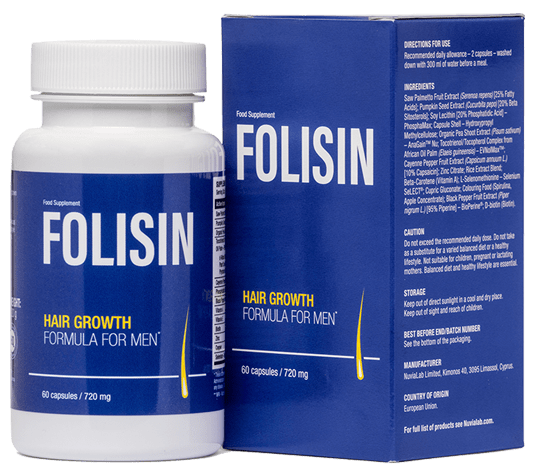
Our Recommendation — Folisin
Score: 5.9/10 · Best for: men with early, diffuse thinning who want a fully disclosed nutritional formula — it supports hair; it does not regrow it. Main caution: the saw palmetto is standardised at 25% fatty acids against 85–95% in the trial extracts, and no money-back guarantee is published. Fair trial: the three-bottle pack at $46.66 a bottle — a fair trial of Folisin is a three-bottle commitment; the six-bottle pack is the cheapest continuation, after a completed trial.
The Cho 2014 Trial, Read Closely
Who was in it
Cho et al. (2014), published in Evidence-Based Complementary and Alternative Medicine, randomised 76 men with mild-to-moderate androgenetic alopecia — Norwood stages II to V — at a Korean university hospital. Half received pumpkin seed oil, half a placebo, for 24 weeks.
That population bounds the claim before we reach the results. Mild-to-moderate loss, in men, over six months. Nothing in this trial speaks to advanced loss, to women taking it orally, or to any timeline shorter than 24 weeks.
What improved
The headline endpoint was hair count, measured by phototrichogram. At 24 weeks, mean hair count had increased by 40% from baseline in the men taking pumpkin seed oil, versus a 10% increase from baseline in the men taking placebo — a statistically significant difference between the groups.
The men on the oil also rated their own improvement and satisfaction higher than the placebo group (P = 0.013 and P = 0.003 respectively, in the trial's published abstract). Self-ratings in a trial of a visible condition are worth something; they are also the easiest endpoint to inflate, which is why the counted hairs carry the argument.
The fine print
Three qualifications belong next to the result wherever it is quoted. First, hair thickness did not differ significantly between the groups — the trial found more hairs counted, not thicker ones. A count gain without a thickness gain is a thinner kind of improvement than the headline suggests.
Second, the trial did not measure DHT. The proposed mechanism — that pumpkin seed oil's phytosterols inhibit 5-alpha-reductase — comes from animal and laboratory work cited in the paper's introduction. The human trial measured hair, not hormones, so "blocks DHT" is not something this study showed.
Third, it stands alone. Published in 2014, small and single-centre, it has never been replicated by an independent group in the decade since. In a category where the first trial of an ingredient is usually its best trial, a lone unreplicated positive result is a reason for interest, not confidence.
Correcting the Record: "+40% More Than Placebo" Is Not What It Says
The version of this result that circulates on product pages — including, in the competitor set we audited, a claim of "40% more hair than placebo" — misstates the arithmetic, and the correction is worth printing as its own section.
The 40% is the oil group's increase from its own baseline. The placebo group also increased — by 10% from baseline, because hair counts fluctuate and trial participants are, on average, carefully groomed and measured. The trial's actual finding is a 40%-from-baseline rise against a 10%-from-baseline rise.
That is still a real, significant between-group difference, and we are not correcting it into nothing. But "40% more hair than the placebo group ended with" would describe a far larger effect than a 30-point gap between two from-baseline changes. Whenever you see this trial quoted, check which of those two sentences the page is actually saying.
The same discipline applies to our own set: our natural DHT blockers article flags this trial's result as never having measured DHT, for the same reason — the correction culture has to apply to claims we like, or it is not a culture.
Oil ≠ Extract ≠ Seeds
Pumpkin reaches hair formulas in three forms that marketing treats as interchangeable and evidence does not. The oil is the pressed lipid fraction of the seed — fatty acids, phytosterols and fat-soluble compounds together. An extract is a concentrated preparation, standardised to a marker compound. The whole seeds are the food.
Cho's trial used the oil, in capsules, at 400 mg/day. Its result cannot be transferred to an extract standardised to something else, any more than a trial of olive oil would validate an olive-leaf extract capsule.
The seed-extract null in prostate research
The one place an extract has been tested head-to-head against its source food, the extract came off worse. In a 12-month prostate trial comparing whole pumpkin seeds, a pumpkin seed extract capsule and placebo, the whole seeds improved symptom scores against placebo while the extract arm did not separate significantly from it.
That is prostate research, a different condition and a different endpoint, and we cite it for one narrow point: "pumpkin seed" on two labels can describe preparations with measurably different behaviour. Form is not a detail.
What Folisin actually contains
Which brings the audit home. Folisin contains pumpkin seed extract, 250 mg per daily serving, standardised to 20% beta-sitosterols. It contains no pumpkin seed oil.
To the maker's credit, the panel says exactly that — extract, amount, standardisation, all printed. A buyer who has read this article can see the gap for themselves: the studied form is absent, the dose of the present form has no hair trial behind it, and the beta-sitosterol standardisation, while honestly declared, is a marker the hair evidence never used.
How Much the Study Used
The only dose with evidence is 400 mg/day of the oil, taken as capsules across 24 weeks. That is the whole of the dosing literature for this ingredient in hair.
Dosage ranges elsewhere — "400–1,000 mg is typical" and similar — are invented padding around a single data point. There is no dose-response study, no comparison of 200 against 400 against 800 mg, and no evidence that more oil does more. When a guide prints a range, it is describing what products happen to contain, dressed as what trials found.
For the extract form, the honest dosing statement is shorter: no dose has been studied for hair at all.
Eating the seeds themselves is the third case. Pumpkin seeds are a reasonable food with a long prostate folk history, but no trial has fed men pumpkin seeds and counted their hair — and matching 400 mg of pressed oil through diet would mean eating a substantial daily quantity of seeds, untested as a hair intervention either way.
Women and Pumpkin Seed Oil
The oral trial studied men only. For women, the one relevant study is a 2021 randomised comparative trial in the Journal of Cosmetic Dermatology, in which 60 women with female pattern hair loss applied topical pumpkin seed oil or minoxidil 5% foam.
A topical comparison against an active drug, in women, is a different claim from an oral supplement result in men — it cannot be used to sell capsules to anyone. It does suggest the ingredient is being taken seriously beyond one Korean trial, which is worth recording; it does not widen what Cho 2014 supports.
Our Recommendation — Folisin
Score: 5.9/10 · Best for: men with early, diffuse thinning who want a fully disclosed nutritional formula — it supports hair; it does not regrow it. Main caution: the saw palmetto is standardised at 25% fatty acids against 85–95% in the trial extracts, and no money-back guarantee is published. Fair trial: the three-bottle pack at $46.66 a bottle — a fair trial of Folisin is a three-bottle commitment; the six-bottle pack is the cheapest continuation, after a completed trial.
Frequently Asked Questions
Does pumpkin seed oil really grow hair?
One trial says it increased hair count: +40% from baseline versus +10% on placebo over 24 weeks in 76 men with mild-to-moderate pattern loss taking 400 mg/day of the oil (Cho et al. 2014). Hair thickness did not differ between groups, and the result has never been replicated.
Is pumpkin seed extract the same as pumpkin seed oil?
No. The oil is the seed's pressed lipid fraction; an extract is a concentrated preparation standardised to a marker such as beta-sitosterols. The hair trial used the oil. In prostate research, an extract capsule failed to separate from placebo in a trial where whole seeds did — form changes behaviour.
How much pumpkin seed oil did the study use?
400 mg/day, in capsules, for 24 weeks. It is the only dose ever trialled for hair; wider "typical ranges" on dosage pages are not from studies.
Can women use pumpkin seed oil for hair loss?
The oral evidence is in men only. A 2021 trial in 60 women tested it topically against minoxidil 5% foam — a different route and claim. There is no oral trial in women to base a recommendation on.
Who Should Buy Folisin — and Who Should Skip It
Buy it if you are choosing Folisin for its whole disclosed panel — saw palmetto, AnaGain at its studied dose, a full nutrient base — and you understand the pumpkin line contributes a prostate-shelf extract, not the trialled oil. On those terms the formula is a reasonable support purchase, scored 5.9/10 for its transparency.
Skip it if the pumpkin seed oil trial is what brought you here. The product that matches Cho 2014 is a 400 mg/day pumpkin seed oil capsule, and Folisin is not one. Skip it, too, if a single unreplicated trial is not enough evidence for your money — that is a defensible reading of this ingredient's file, and no honest page should talk you out of it.
Last reviewed: October 2026. This article is educational and is not medical advice.
