
- Quick Answer
- What Is Biotin — and Why Did It Become the Hair Vitamin?
- Does Biotin Help Hair Loss Without a Deficiency? The Evidence, Study by Study
- Patel et al. (2017): 18 cases, all of them with underlying pathology
- Yelich et al. (2024): the best trial found no difference
- Moltó-Balado et al. (2026): the systematic review that closes the combination loophole
- How Much Biotin Do You Actually Need? The Dose Maths
- What Is the Blood-Test Warning — in Full?
- How Long Before a Blood Test Should You Stop Biotin?
- Who Genuinely Benefits From Biotin?
- Can Biotin Cure Baldness?
- Who Should Buy Profolan — and Who Should Skip It
- Frequently Asked Questions
- Does biotin help hair loss if you are not deficient?
- How much biotin is in Profolan, and how does it compare?
- Can biotin affect blood-test results?
- How long should I stop biotin before a blood test?
- Who actually needs biotin supplements?
- Can biotin cure baldness?
- Read This Next
Disclosure: This article contains affiliate links. If you buy through them, we may earn a commission at no extra cost to you. It never changes our conclusions.
Quick Answer
No — biotin does not help hair loss unless you are actually deficient in biotin, and genuine deficiency in an adult eating a normal diet is rare. That verdict has now been reached independently three times, in 2017, 2024 and 2026, by reviewers who looked specifically for a benefit in non-deficient people and did not find one.
Biotin is essential for normal hair — a true deficiency does cause hair loss, skin problems and brittle nails — but essential is not the same as dose-responsive: once you have enough, taking 30, 167 or 333 times the requirement has never been shown to grow, thicken or save a single hair.
What large doses demonstrably do is distort common blood tests, including a heart-attack marker where a falsely low result has been linked to a reported death. Best for: men who want the study-by-study evidence and the dose maths before paying for any biotin-led formula — and a clear warning to disclose biotin use before every blood draw.
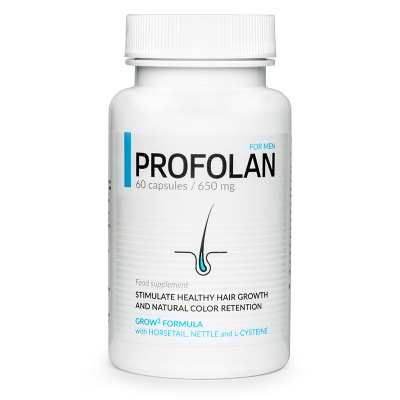
Our Recommendation — Profolan
Score: 5.7/10 · Best for: men with early thinning or increased shedding who want to test the nutritional angle for a full 90 days, photos in hand. Main caution: no ingredient in the bottle has a human trial for male hair loss, and the formula contains neither iron nor vitamin D. Fair trial: the three-bottle pack at $46.66 a bottle — it sits exactly inside the published 90-day money-back guarantee window.
What Is Biotin — and Why Did It Become the Hair Vitamin?
Biotin is vitamin B7, a water-soluble B-vitamin that acts as a cofactor for enzymes involved in energy metabolism and in processing fats, carbohydrates and amino acids.
Because it supports keratin infrastructure — keratin being the protein hair is made of — and because the rare people who are genuinely deficient do lose hair, biotin acquired a marketing identity far larger than its evidence: the hair vitamin. The logic error is simple and worth naming, because the whole category rests on it.
"Deficiency causes hair loss" does not imply "extra prevents hair loss", any more than "dehydration causes headaches" implies that drinking ten litres of water prevents them.
In medicine this pattern recurs constantly — iron, vitamin D and zinc all behave the same way in hair, helping the deficient and doing nothing measurable for the replete — but biotin is the extreme case, because deficiency is rarer, the doses sold are more extravagant, and the blood-test interference at those doses is better documented and more dangerous than for any other ingredient in a typical hair formula.
If you take one distinction from this article, take that one: biotin is a nutrient you need enough of, not a treatment whose effect scales with dose.
How rare is rare? Severe biotin deficiency has essentially never been reported in a healthy adult eating a normal, varied diet. The vitamin is widespread in food — eggs, nuts, seeds, legumes, some vegetables and meats all contribute — and gut bacteria produce some as well.
The typical Western diet supplies roughly 35–46 µg a day, which brackets the official requirements discussed below.
Documented deficiency arises in specific circumstances: inherited enzyme disorders such as biotinidase deficiency, prolonged consumption of large amounts of raw egg white (whose avidin protein binds biotin and blocks absorption), malabsorption conditions, long-term parenteral nutrition without adequate biotin, and certain medications taken over long periods.
Outside those situations, a man losing his hair in a pattern at the temples and crown is not looking at a biotin problem — he is looking at genetics and DHT — and no quantity of B7 changes that mechanism.
Does Biotin Help Hair Loss Without a Deficiency? The Evidence, Study by Study
Rather than summarise this literature in a sentence, we lay it out the way a buyer should see it: chronologically, review by review, with each one's methods and exact finding. Three major assessments, nine years, one consistent answer. The newest of them is cited here in full for the first time in this article set — most competitor pages still stop at 2024.
| Year | Review | What it examined | Verdict for non-deficient people |
|---|---|---|---|
| 2017 | Patel et al. (2017), Skin Appendage Disorders | All published cases of biotin used for hair and nail conditions — 18 cases in total | Every case had an underlying pathology causing the deficiency or the hair condition. The authors found a lack of sufficient evidence for supplementation in healthy individuals. |
| 2024 | Yelich et al. (2024), Journal of Clinical and Aesthetic Dermatology | Studies of biotin supplementation for hair loss meeting inclusion criteria | No study demonstrated benefit in healthy, non-deficient individuals. The best double-blind, placebo-controlled trial found no difference from placebo. |
| 2026 | Moltó-Balado et al. (2026), Dermato systematic review | 10 human studies, reviewed under PRISMA systematic-review methods | Biotin monotherapy showed no consistent benefit on objective hair-growth outcomes. Reported improvements typically occurred in combined regimens, where biotin's own contribution cannot be isolated. Routine supplementation without documented deficiency is not supported. |
Patel et al. (2017): 18 cases, all of them with underlying pathology
The foundational review is Patel et al. (2017) — and its journal matters, because it is persistently miscited online as a JCAD paper. It was published in Skin Appendage Disorders. Patel's team gathered every reported case in which biotin had been used for hair or nail conditions and found just 18.
In all 18 cases — every single one — there was an underlying pathology: an inherited deficiency disorder, a medication effect, or another medical reason the person was biotin-deficient or unable to use biotin normally. In those patients, biotin helped, sometimes strikingly.
In healthy people, the cupboard was bare: the review concluded there was a lack of sufficient evidence for supplementation in healthy individuals. That is the entire clinical foundation beneath a billion-dollar marketing category — 18 patients who were medically deficient, generalised without warrant to millions of men with pattern baldness who are not deficient at all.
When a product page says biotin is "clinically shown" to help hair, this is the paper it is ultimately leaning on, and the paper does not say what the page claims.
Yelich et al. (2024): the best trial found no difference
Seven years later, Yelich et al. (2024) revisited the question in the Journal of Clinical and Aesthetic Dermatology — this is the actual JCAD paper, separate from Patel.
Applying stricter criteria, only a small number of studies qualified at all, and in the best-designed of them — a double-blind, placebo-controlled trial of high-dose biotin in women with diffuse shedding — there was no significant difference between biotin and placebo.
Yelich's review also captured the sociology of the myth: a physician survey within its discussion found that 43.9% of surveyed doctors recommended biotin anyway, despite the evidence — a reminder that a recommendation repeated often enough starts to feel like a finding.
For a male reader, the population point cuts the same way it does throughout this literature: even the best trial was conducted in women with shedding, not in men with pattern loss, so the case for biotin in male pattern baldness rests on a null result borrowed from a different population and condition. There is no stronger version of this evidence waiting somewhere else. This is the ceiling.
Moltó-Balado et al. (2026): the systematic review that closes the combination loophole
The most recent word is Moltó-Balado et al. (2026), a PRISMA systematic review in Dermato that identified 10 human studies of biotin for alopecia. Its contribution is precision about a loophole sellers exploit — the combination product. Biotin alone, the review found, did not show consistent benefit on objective hair-growth outcomes.
Where improvements were reported, they typically occurred in combined regimens — formulas or treatment plans containing multiple active ingredients — which means the improvement, if real, cannot be credited to biotin rather than to everything taken alongside it.
The review's conclusion deserves quoting in substance: current evidence does not support routine biotin supplementation for alopecia in the absence of documented deficiency. Three reviews, three methods, three decades-spanning searches of the literature, one conclusion.
At some point the burden of proof moves: it is no longer the sceptic who must explain the absence of an effect — it is the seller who must produce a trial, in non-deficient people, with an objective hair outcome, showing one. As of the 2026 review, that trial does not exist.
How Much Biotin Do You Actually Need? The Dose Maths
If the evidence says benefit stops at sufficiency, the next question is what sufficiency is — and how the doses on shop shelves compare with it. Two authorities set the reference figures, and honest pages print both, labelled, rather than silently picking the one that flatters their product.
In the United States, the National Institutes of Health adequate intake for adults is 30 µg per day. In Europe, the European Food Safety Authority sets its adequate intake at 40 µg per day. The difference is small and methodological; both describe the same reality, that a few dozen micrograms a day is enough. A typical diet already provides about 35–46 µg a day. Now place the products on that scale.
| Source | Biotin per day | Multiple of US adequate intake (30 µg) | Multiple of EFSA adequate intake (40 µg) |
|---|---|---|---|
| Typical diet | ~35–46 µg | ~1.2–1.5× | ~0.9–1.2× |
| US adequate intake (requirement) | 30 µg | 1× | 0.75× |
| EFSA adequate intake (requirement) | 40 µg | 1.3× | 1× |
| Profolan (per 2 capsules) | 900 µg | 30× | 22.5× |
| Typical hair gummy | 5,000 µg | 167× | 125× |
| High-dose hair gummy | 10,000 µg | 333× | 250× |
Read Profolan's row honestly, in both directions, because both directions are true. At 900 µg, it sits well below the gummy megadoses — roughly a fifth of a 5,000 µg gummy and a ninth of a 10,000 µg product — and any page that lumps it in with the most extreme products on the shelf is being careless.
It is a mid-spectrum dose. And it is still thirty times the US requirement and twenty-two and a half times the European figure, in a nutrient where no dose — not 900 µg, not 5,000 µg, not 10,000 µg — has demonstrated a hair benefit in a non-deficient person.
There is no dose at which the evidence turns positive; there are only doses at which the laboratory-interference risk, covered next, grows. Because biotin is water-soluble, the excess is largely excreted, which is why these products are not acutely toxic in the ordinary sense.
"Not acutely toxic" is, however, a remarkably low bar for something sold as a treatment, and it ignores the one harm that is thoroughly documented: what circulating biotin does to the blood tests your doctor orders.
What Is the Blood-Test Warning — in Full?
This is the section most biotin articles shorten into a single sentence, and it is the section that matters most. Many modern laboratory tests use biotin-streptavidin technology — biotin is built into the assay itself as a capture mechanism.
When a patient's blood carries large amounts of free biotin from a supplement, that biotin competes inside the test and distorts the result.
The direction of distortion depends on the assay design, which is why the errors are so treacherous: some results come back falsely low, others falsely high, and a clinician who does not know about the supplement has no reason to doubt either.
The US Food and Drug Administration issued a Safety Communication on this interference in November 2017 and updated it in November 2019 — we name that communication here in full, and note that Health Canada has published its own advisory warning that biotin in supplements can cause falsely low or falsely high results across a range of laboratory tests. The catalogue below is the full picture, not the abbreviated version.
| Test | How biotin can distort it | Why it matters |
|---|---|---|
| Troponin (heart-attack marker) | Falsely low | A heart attack can be missed. The FDA communication records that one patient death was reported in a person taking high-dose biotin whose troponin result was falsely low. |
| TSH (thyroid-stimulating hormone) | Falsely low | Together, these mimic hyperthyroidism — an overactive thyroid the patient does not have — and can trigger unnecessary investigation or treatment while masking the real picture. |
| Free T4 / free T3 | Falsely high | |
| Ferritin (iron stores) | Falsely low | Particularly cruel in a hair workup: the test most relevant to shedding can itself be corrupted by the hair supplement, suggesting an iron deficiency that is not there. |
| Vitamin D, vitamin B12, folate | Falsely high | Real deficiencies can be hidden behind reassuring numbers — again, in the very panel a hair-loss patient is most likely to have drawn. |
| Testosterone, DHEA-S, estradiol | Distorted (direction is assay-dependent) | Hormone panels — central to any male hair-loss assessment — cannot be trusted at face value while high-dose biotin is in circulation. |
| PTH (parathyroid hormone) | Distorted | Can misdirect calcium and bone investigations. |
| PSA (prostate marker) | Distorted | A falsely reassuring or falsely alarming prostate result carries consequences well beyond hair. |
Two features of that table deserve emphasis. The first is the irony at its centre: a man who follows good advice — get blood tests before supplementing — can have those tests corrupted by the supplement he started while waiting for the appointment.
Ferritin reads falsely low, vitamin D reads falsely high, testosterone is distorted, and the thyroid panel imitates a disease. The investigation this site recommends in its companion articles only works if biotin is disclosed or paused first. The second is the troponin row. This is not a cosmetic-lab-value problem.
Troponin is the test an emergency department uses to decide whether chest pain is a heart attack, a falsely low result can send a heart-attack patient down the wrong pathway, and the regulator's communication records a reported death in exactly that scenario. No hair claim — and biotin, remember, has no proven hair claim in non-deficient people at all — justifies adding noise to that test unannounced.
How Long Before a Blood Test Should You Stop Biotin?
Honestly: nobody can give you a single universal number, and any page that states one with confidence is oversimplifying. The FDA's position is that the available data are insufficient to set a universal stop time — clearance depends on the dose, the individual's kidney function, and the specific assay's susceptibility. What exists instead is a range of guidance.
The American Thyroid Association advises stopping biotin 2 days before thyroid-function tests. Laboratory guidance more broadly ranges from 8 hours to 72 hours or more, varying with dose and test — a short pause may suffice for a standard multivitamin dose, while megadose products warrant the longer end or beyond. Two practical rules cut through the uncertainty.
First, disclose biotin use every time blood is drawn — to the clinician ordering the test and, where possible, directly to the laboratory — stating the dose; disclosure costs nothing and lets the lab choose a resistant assay or advise on timing. Second, never delay an emergency troponin test to wash out biotin.
If you arrive with chest pain, the test happens immediately; what must happen alongside it is you telling the team you take high-dose biotin, so a low troponin is interpreted with that interference in mind. The washout conversation is for scheduled panels; the disclosure rule is for every occasion, emergencies included.
One regulatory threshold puts Profolan's dose in a sharper frame than any competitor we found has managed. In January 2019, the European Medicines Agency's Pharmacovigilance Risk Assessment Committee concluded that oral products containing 150 µg of biotin or more per dose unit carry laboratory-interference potential warranting a warning.
Profolan's daily serving delivers 900 µg — six times that threshold across its two capsules, and above it on any reading. That does not make Profolan uniquely dangerous; interference risk is dose- and assay-dependent and is highest at the 5–10 mg megadoses of dedicated biotin products.
It does mean the product sits firmly on the side of the line where European regulators say a warning belongs — which is why this site prints one wherever the product is discussed, and why the correct response is disclosure and sensible timing, not panic.
Stop before scheduled bloods on your clinician's or laboratory's advice, disclose always, and treat any biotin product above a few hundred micrograms as a medication-list item: something every doctor you see should know you take.
Who Genuinely Benefits From Biotin?
A narrow, specific list — and for the people on it, biotin is not a myth at all, but a genuinely effective correction. Documented biotin deficiency, confirmed clinically or by history, is the core case: hair loss, skin rash, brittle nails and neurological symptoms can all improve when the deficiency is treated.
Biotinidase deficiency and related inherited disorders of biotin metabolism, usually identified in childhood, require lifelong biotin — for those patients it is essential medicine, not a supplement experiment. Malabsorption — after bowel surgery, or in conditions that impair nutrient uptake — can produce a real shortfall that diet alone cannot fix.
Long-term parenteral nutrition (intravenous feeding) without adequate biotin is a classic, well-documented cause. Certain long-term medications, notably some anti-seizure treatments, can lower biotin status over time, as can the unusual dietary pattern of consuming large quantities of raw egg white over months.
If you recognise yourself in that list, biotin belongs in a conversation with your clinician, at a dose set by the clinical picture — not in a gummy chosen by an algorithm. If you do not recognise yourself in it, the probability that biotin is the missing piece in your hair loss is, on the evidence above, very low.
Can Biotin Cure Baldness?
No, and the claim deserves its own short section because it is still made, in those words, across shopping platforms and social media. Male pattern baldness is follicles progressively miniaturising under genetic sensitivity to DHT.
Biotin has no anti-androgen activity, no follicle-protective trial, and no mechanism by which it could interrupt that process — and in the one setting where its hair effects have been properly tested, non-deficient people, it performed no better than a placebo capsule. A nutrient cannot cure a hormonal-genetic condition it does not touch.
What biotin marketing does, at its most sophisticated, is borrow the genuine drama of deficiency recovery — children with biotinidase deficiency regrowing hair on treatment is a real and moving clinical story — and imply the same recovery is available to a 35-year-old with a receding hairline who buys a large enough dose.
It is not the same condition, not the same patient, and not the same result. The word "cure" attached to any supplement in this category is a reliable signal to close the page. Our companion hub article applies the same test to every other ingredient class in men's hair formulas, and biotin is not the only one that fails it — it is simply the one with the largest gap between fame and evidence.
Who Should Buy Profolan — and Who Should Skip It
Buy it if you are considering Profolan for its whole formula rather than for its biotin — for the nutritional-support trial described in our review, with eyes open: two capsules a day, preferably 30 minutes before a meal, photographs from day one, a decision inside the maker's published 90-day money-back guarantee, and the discipline to disclose the 900 µg biotin dose before every blood test and pause it ahead of scheduled panels on professional advice.
The pricing is $69.99 for one bottle, $139.98 for buy 2 get 1 free ($46.66 a bottle), and $209.97 for buy 3 get 3 free ($35.00 a bottle), plus $12 shipping. On those terms you are paying for a transparent panel and a guarantee-backed experiment, and our score of 5.7/10 reflects exactly that balance. Our full assessment is in the Profolan review.
Skip it if biotin is your reason for buying — this article is the receipt for why that reason fails: no benefit without deficiency at 900 µg, at 5,000 µg, or at any other dose yet tested.
Skip any dedicated high-dose biotin product for the same reason, and skip Profolan too if you are facing imminent blood work — cardiac, thyroid, hormone or fertility panels — that you cannot schedule around a disclosure and washout conversation, or if the idea of managing that conversation feels like more administration than a hair supplement should require.
That instinct is correct: a product that obliges you to warn every laboratory you meet should have to earn its place with evidence, and biotin, uniquely among famous hair ingredients, has had three systematic chances to produce that evidence and has not.
Our Recommendation — Profolan
Score: 5.7/10 · Best for: men with early thinning or increased shedding who want to test the nutritional angle for a full 90 days, photos in hand. Main caution: no ingredient in the bottle has a human trial for male hair loss, and the formula contains neither iron nor vitamin D. Fair trial: the three-bottle pack at $46.66 a bottle — it sits exactly inside the published 90-day money-back guarantee window.
Frequently Asked Questions
Does biotin help hair loss if you are not deficient?
No study has shown that it does. Patel et al. (2017) found all reported improvement cases had underlying pathology; Yelich et al. (2024) found the best double-blind trial showed no difference from placebo; and Moltó-Balado et al. (2026), reviewing 10 human studies, found no consistent benefit from biotin alone on objective hair outcomes.
How much biotin is in Profolan, and how does it compare?
900 µg per daily serving of two capsules. That is 30× the US adequate intake of 30 µg/day and 22.5× the EFSA figure of 40 µg/day — well below 5,000–10,000 µg hair gummies (167–333×), but still far above requirement, with no demonstrated benefit at any of those doses in non-deficient people.
Can biotin affect blood-test results?
Yes — this is its best-documented effect. High-dose biotin can cause falsely low troponin (a reported patient death is recorded in the FDA's safety communication), falsely low TSH with falsely high free T4/T3 mimicking hyperthyroidism, falsely low ferritin, falsely high vitamin D, B12 and folate results, and distortions in testosterone, DHEA-S, estradiol, PTH and PSA assays.
How long should I stop biotin before a blood test?
There is no universal time — the FDA states the data are insufficient to set one. The American Thyroid Association advises 2 days before thyroid tests, and laboratory guidance ranges from 8 hours to 72 hours or more depending on dose and test. Always disclose your dose to your clinician and laboratory, and never delay an emergency troponin test — disclose instead.
Who actually needs biotin supplements?
People with documented deficiency: inherited disorders such as biotinidase deficiency, malabsorption, long-term parenteral nutrition, certain long-term medications, or prolonged heavy raw-egg-white consumption. For them, biotin is effective treatment, arranged with a clinician — a different situation from pattern hair loss in a man eating a normal diet.
Can biotin cure baldness?
No. Pattern baldness is genetic and DHT-driven; biotin does not block DHT, has no trial evidence in pattern loss, and matched placebo in the best trial in non-deficient people. Any product promising a biotin cure for baldness is making a claim the 2017, 2024 and 2026 reviews all contradict.
Last reviewed: October 2026. This article is educational and is not medical advice.
