
- Quick Answer
- The Dose the Trials Actually Used
- The Standardisation Trap
- The arithmetic: mg × standardisation % = the dose you actually get
- Worked table: trial extract vs typical retail extract vs Folisin
- Why 960 mg Is Not a Hair Dose
- Form and Timing
- How Long at That Dose
- Frequently Asked Questions
- How much saw palmetto should I take for hair loss?
- Does the fatty-acid percentage really matter?
- Is more saw palmetto better?
- When should I take it, and with food?
- Who Should Buy Folisin — and Who Should Skip It
- Read This Next
Disclosure: This article contains affiliate links. If you buy through them, we may earn a commission at no extra cost to you. It never changes our conclusions.
Quick Answer
The hair trials used 160–320 mg/day of saw palmetto extract — of extracts standardised to 85–95% fatty acids. Milligrams alone are the wrong unit: a 320 mg capsule at 25% standardisation delivers roughly a third of the fatty-acid fraction the trials tested.
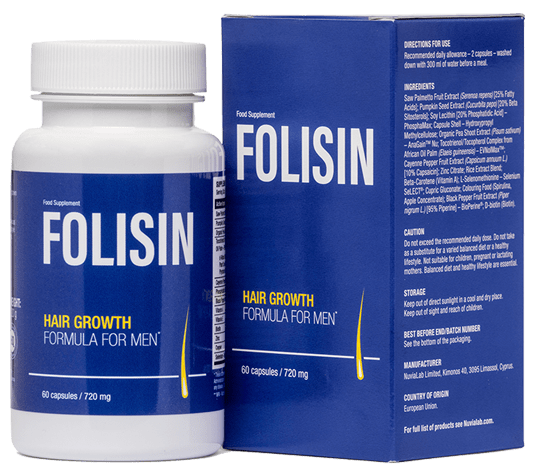
Folisin, the formula we audit here, matches the trialled 320 mg exactly and discloses its 25% standardisation on the panel. Best for: men with early, diffuse thinning who read labels before they buy. Our score: 5.9/10.
Our Recommendation — Folisin
Score: 5.9/10 · Best for: men with early, diffuse thinning who want a fully disclosed nutritional formula — it supports hair; it does not regrow it. Main caution: the saw palmetto is standardised at 25% fatty acids against 85–95% in the trial extracts, and no money-back guarantee is published. Fair trial: the three-bottle pack at $46.66 a bottle — a fair trial of Folisin is a three-bottle commitment; the six-bottle pack is the cheapest continuation, after a completed trial.
The Dose the Trials Actually Used
Start with the hair evidence itself. Evron et al. (2020), reviewing saw palmetto in alopecia for Skin Appendage Disorders, found the included studies used between 100 and 320 mg/day of saw-palmetto-containing supplements, in oral and topical forms.
The most rigorous of them, the two-year head-to-head by Rossi et al. (2012), used 320 mg/day — the figure most dosage guides quote. The earliest trial, Prager et al. (2002), used a blend whose saw palmetto component was 200 mg twice a day, alongside beta-sitosterol and other botanicals.
The prostate literature, where this ingredient's dose conventions were set, uses the same anchor: 320 mg/day, given as 160 mg twice a day in Bent et al.'s (2006) New England Journal of Medicine trial. Hair and prostate research converged on 320 mg independently, which is why it reads like a settled standard.
What the quoting usually drops is the second half of the specification. The extracts in these trials were standardised — manufactured to a verified fatty-acid content of 85–95%. The dose that was tested is not "320 mg of saw palmetto". It is 320 mg of an extract that is almost all fatty acids and sterols.
The review's range also included topical products, which are dosed in percentages of a lotion rather than milligrams. Those studies cannot be converted into an oral dose, and guides that merge them into one "effective range" are mixing two different questions.
The Standardisation Trap
The arithmetic: mg × standardisation % = the dose you actually get
Fatty acids are the fraction of saw palmetto extract believed to carry its anti-androgen activity. If that is right, then the meaningful dose of any product is its extract weight multiplied by its standardisation percentage — the delivered fatty acids.
Run the multiplication on the trial specification. At 320 mg and 85% standardisation, the delivered fraction is about 272 mg. At 95%, it is about 304 mg. That 272–304 mg band is what "the trialled dose" actually consisted of.
Now run it on a 25% extract at the same 320 mg: 80 mg of fatty acids. The capsule matches the trial on the scale and misses it by a factor of roughly three and a half where the activity is supposed to live.
This is not a technicality invented to fault one product. Standardisation is how the prostate field made its extracts reproducible enough to trial at all, and it is the reason a result from a standardised extract cannot be assumed for an unstandardised or weakly standardised one.
Worked table: trial extract vs typical retail extract vs Folisin
| Product type | Extract per day | Standardisation | Fatty acids delivered |
|---|---|---|---|
| Trial extracts (Rossi 2012; prostate trials) | 320 mg | 85–95% fatty acids | ~272–304 mg |
| Pharmacy-grade prostate extracts | 320 mg | 85–95% fatty acids/sterols | ~272–304 mg |
| Folisin | 320 mg | 25% fatty acids | ~80 mg |
| Unstandardised berry powder capsules | varies, often 500+ mg | not stated | unknown — cannot be audited |
Read the last row carefully, because it is the most common case on the market. A large milligram figure with no standardisation printed is not a strong dose; it is an unauditable one. Berry powder is mostly berry — fibre, carbohydrates and a small fatty-acid fraction the maker has not measured or will not print.
Folisin sits in an unusual middle position. Its 25% standardisation is weak against the trial specification, and we score it accordingly. But the figure is printed, in the open, next to the amount — which is what allows this table to exist. Most of its competitors cannot be placed in the table at all.
One labelling subtlety to watch when you run this check yourself: some panels print "fatty acids and sterols" as a combined percentage, others fatty acids alone. The trial specifications are usually quoted the combined way. Either is auditable; what defeats the audit is a percentage that never appears at all.
Why 960 mg Is Not a Hair Dose
Dosage guides sometimes cite 960 mg/day, as if a bigger number from a bigger trial must be the serious dose. That figure comes from CAMUS (Barry et al. 2011, JAMA), and it has been borrowed into hair advice by mistake.
CAMUS was prostate research. In 369 men aged 45 and older with urinary symptoms, the dose escalated from 320 to 640 to 960 mg/day across 72 weeks to test whether more extract would finally beat placebo on symptom scores. It did not, at any dose level.
What CAMUS actually contributes to a hair buyer is a safety finding: doses up to three times the standard were tolerated about as well as placebo over 18 months. That is useful reassurance about the standard dose. It is not evidence that 960 mg grows hair, and no hair trial has ever used it.
The general principle is worth stating plainly, because supplement marketing inverts it: when a dose-response trial finds no effect at one, two and three times the standard dose, the conclusion is not "take more".
Form and Timing
Form matters less than standardisation, but it is not nothing. The trial extracts are lipid extracts, usually delivered in softgel capsules, because the active fraction is fat. Dry extracts and raw powders sit at the other end of the concentration scale.
Fat-soluble compounds are generally absorbed better alongside dietary fat. No trial has tested saw palmetto taken with food against saw palmetto taken fasting, so what follows is reasoning, not evidence: a standardised softgel taken with a meal containing some fat is the closest match to how the trial products were designed to be used.
Folisin's own directions illustrate the gap between panel logic and formula logic. The maker directs two capsules a day with 300 ml of water, preferably 30 minutes before a meal — an instruction written for the formula as a whole, not for its fatty-acid ingredient. We follow the panel when we describe the product, and flag the reasoning above for what it is.
Timing within the day has no evidence behind it at all. Consistency — the same dose, daily, for months — is the only scheduling variable the trials actually imposed.
Splitting the dose, as the prostate trials did with 160 mg twice a day, versus taking 320 mg at once has also never been compared for hair. It is a routine-fit choice, not an efficacy one.
How Long at That Dose
Duration is the forgotten half of dosage. The hair trials ran 16 weeks at the shortest (the 2023 RCT), about six months for the early blend trial, and two full years for Rossi's comparison. Nobody has tested whether a few weeks at 320 mg does anything, because hair cycles do not turn over in a few weeks.
Practically: a fair trial of any saw palmetto product is three months before the first judgement and six months before a final one, judged on shedding and photographs. Our full timeline for the category is in how long hair supplements take to work.
Our Recommendation — Folisin
Score: 5.9/10 · Best for: men with early, diffuse thinning who want a fully disclosed nutritional formula — it supports hair; it does not regrow it. Main caution: the saw palmetto is standardised at 25% fatty acids against 85–95% in the trial extracts, and no money-back guarantee is published. Fair trial: the three-bottle pack at $46.66 a bottle — a fair trial of Folisin is a three-bottle commitment; the six-bottle pack is the cheapest continuation, after a completed trial.
Frequently Asked Questions
How much saw palmetto should I take for hair loss?
The trialled dose is 320 mg/day of an extract standardised to 85–95% fatty acids. If a product's standardisation is lower, matching the milligram figure does not match the trial — at 25%, 320 mg delivers about 80 mg of fatty acids versus roughly 272–304 mg in the trials.
Does the fatty-acid percentage really matter?
It is the only strength measure the trials themselves used. The prostate and hair studies were run on extracts standardised to 85–95% fatty acids; results from those extracts cannot be assumed for a 25% extract or for unstandardised berry powder. Milligrams without the percentage are an incomplete dose.
Is more saw palmetto better?
There is no evidence for that. The one dose-escalation trial, CAMUS, tested 320, 640 and 960 mg/day in 369 men over 72 weeks and found no benefit over placebo at any level (Barry et al. 2011). It supports the standard dose's safety, not megadosing.
When should I take it, and with food?
No trial has tested timing or food. The trial extracts are fat-based softgels, so taking a standardised extract with a meal is the reasonable default; beyond that, daily consistency matters more than the clock. Follow your product's printed directions — Folisin's panel says two capsules with water, preferably 30 minutes before a meal.
Who Should Buy Folisin — and Who Should Skip It
Buy it if you want saw palmetto as part of a broader nutritional formula and you value being able to audit the label: 320 mg at a printed 25% standardisation, every other ingredient amount disclosed, no proprietary blend. You are accepting a fatty-acid delivery well below the trial specification in exchange for that transparency and breadth.
Skip it if matching the trial dose is your deciding criterion — on the arithmetic above, this panel does not match it, and a pharmacy-grade 85–95% standardised extract is the product built for that purpose. Skip it, too, if you want a published money-back guarantee behind a six-month trial: Folisin's maker publishes none, only a 10-day withdrawal for unused goods.
Last reviewed: October 2026. This article is educational and is not medical advice.
