
- Quick Answer
- What Is DHT, and Why Does It Shrink Hair Follicles?
- What Would "Blocking" DHT Actually Require?
- Does Saw Palmetto Work for Hair Loss — and How Does It Compare With Finasteride?
- Why Does the "66%" Figure Keep Circulating — and Why Is It Wrong as a Headline?
- What Did the Wider Saw Palmetto Literature Find?
- If Saw Palmetto Affects Androgens, Why Did It Fail Its Best Prostate Trials?
- Does Pumpkin Seed Oil Block DHT?
- Does Beta-Sitosterol Work on Its Own?
- Does Nettle Block DHT?
- Does Profolan Contain Any of the Studied DHT Ingredients?
- How Should You Grade a "Natural DHT Blocker" Claim?
- What Actually Blocks DHT?
- Who Should Buy Profolan — and Who Should Skip It
- Frequently Asked Questions
- What is the best natural DHT blocker?
- Is the finasteride figure 66% or 68%?
- Does pumpkin seed oil block DHT?
- Does nettle block DHT?
- Does Profolan block DHT?
- Can a natural DHT blocker replace finasteride?
- How long would a natural DHT blocker take to show anything?
- Read This Next
Disclosure: This article contains affiliate links. If you buy through them, we may earn a commission at no extra cost to you. It never changes our conclusions.
Quick Answer
"Natural DHT blocker" is a marketing category, not a medical one. Of the ingredients sold under that label, only saw palmetto has a head-to-head human trial against a real DHT-lowering drug — and in that trial it was clearly weaker, helped mainly at the crown, and was never tested against a placebo.
Pumpkin seed oil's best result came from a proprietary blend, not from pumpkin seed oil alone, and DHT was never measured in that trial. Beta-sitosterol has never been tested alone for hair in humans at all.
Nettle has no human evidence that taking it by mouth blocks DHT — and the nettle research that does exist is on the root, for the prostate, not on the leaf, for the scalp. That leads to the conclusion this article will state plainly at the start and again at the end: Profolan is NOT a DHT-blocking product.
It contains none of saw palmetto, pumpkin seed oil or beta-sitosterol, and its nettle is 100 mg of leaf, not root. If you are buying a supplement specifically to lower DHT, Profolan is not that product, whatever other websites claim about it.
Best for: readers who want the "natural DHT blocker" category graded ingredient by ingredient — what was actually studied, in what form, at what dose, and with what result — before they spend money on any product in it, including ours.
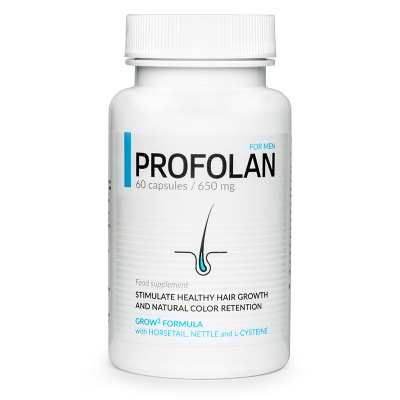
Our Recommendation — Profolan
Score: 5.7/10 · Best for: men with early thinning or increased shedding who want to test the nutritional angle for a full 90 days, photos in hand. Main caution: no ingredient in the bottle has a human trial for male hair loss, and the formula contains neither iron nor vitamin D. Fair trial: the three-bottle pack at $46.66 a bottle — it sits exactly inside the published 90-day money-back guarantee window.
What Is DHT, and Why Does It Shrink Hair Follicles?
DHT — dihydrotestosterone — is an androgen made from testosterone. An enzyme family called 5-alpha-reductase converts testosterone into DHT in tissues including the prostate, the skin and the hair follicle. DHT binds to androgen receptors more strongly than testosterone does, and in men who are genetically sensitive to it, that binding gradually changes what a scalp follicle produces. This process, called miniaturisation, is the engine of male pattern hair loss, also called androgenetic alopecia.
Miniaturisation is slow and specific, and understanding its shape explains almost every honest and dishonest claim in this category. A sensitive follicle does not die overnight.
Over successive hair cycles its growth phase shortens, the shaft it produces becomes thinner, shorter and less pigmented, and the coverage it provides thins — first visibly at the hairline and the crown (the vertex), the zones where sensitivity is usually highest, while the sides and back of the scalp, whose follicles are typically less sensitive, are spared.
That patterned distribution is itself a diagnostic clue: diffuse shedding all over the scalp, including the sides and back, points to a different cause, such as telogen effluvium after illness, stress or a deficiency, and DHT is not the mechanism there.
The nutritional frame matters here too, because it is easy to confuse two separate problems. As Almohanna et al. 2019 set out in their review of vitamins and minerals in hair loss, micronutrients play an important — but not entirely clear — role in non-scarring hair loss, and a deficiency may be a modifiable risk factor.
That is a statement about deficiency and shedding. It is not a statement that a nutrient lowers DHT, blocks an androgen receptor, or reverses miniaturisation. A man can have perfect iron, vitamin D and zinc status and still lose patterned hair, because his follicles are androgen-sensitive.
A man can also shed diffusely because he is deficient, with no DHT problem at all. Products and articles that blur those two situations can make a nutritional supplement sound like an anti-androgen. It is not, and keeping the two mechanisms separate is the discipline this whole article follows.
One further point belongs at the foundation: once a follicle has fully miniaturised, no treatment in this article — drug or supplement — reliably brings it back. The realistic goal of any DHT-directed treatment is to slow or partly reverse miniaturisation in follicles that are still producing hair. That ceiling applies to the prescription drug discussed below first, and it applies with even greater force to everything sold as its "natural" alternative.
What Would "Blocking" DHT Actually Require?
The phrase "DHT blocker" sounds simple, so it is worth spelling out what a product would have to demonstrate before the phrase was earned. There are, in principle, three places an intervention could act. It could reduce DHT production, by inhibiting 5-alpha-reductase — that is what the prescription drug finasteride does, measurably, in blood and tissue.
It could interfere with DHT binding to the androgen receptor. Or it could, in theory, affect how much DHT is free and available, for example by changing the proteins that carry it in the blood. Each of those is a testable claim — but only if someone actually tests it, in humans, at the dose sold, and ideally measures DHT itself.
That last condition is where the natural category most often fails, and it is the single most useful question a reader can ask of any claim in this space: was DHT ever measured? A study can show a change in hair count without showing why it changed.
Hair counts move for many reasons — shedding cycles, seasonal variation, the other ingredients in a blend, expectation and careful photography among them. If DHT was not measured, the study may be interesting hair research, but it is not evidence of DHT blocking. As you will see below, that is not a pedantic distinction.
In the pumpkin seed oil trial, DHT was never measured. In the nettle literature, the human prostate trials that did measure hormones found DHT did not fall. And for beta-sitosterol, there is no standalone human hair trial in which anything was measured at all.
There is also a gap between the laboratory and the scalp that recurs throughout this category. Many plant extracts inhibit 5-alpha-reductase, bind a hormone carrier, or change a gene's expression in a dish, at concentrations chosen by the researcher, applied directly to cells or enzymes.
A capsule taken by mouth faces digestion, absorption, liver metabolism, dilution into the whole circulation, and finally delivery to a follicle. An in-vitro result is a reason to run a human trial. It is not a substitute for one, and any page that moves directly from "inhibited the enzyme in vitro" to "blocks DHT in you" has skipped the step that decides whether the claim is true.
Finally, dose and form are part of the claim, not fine print. Saw palmetto was studied as a standardised extract at 320 mg a day. A product containing a small amount of unstandardised berry powder has not inherited that trial. Nettle root and nettle leaf are different preparations from different parts of the same plant, with different chemistry.
A blend containing an ingredient has not tested that ingredient. The label audit near the end of this article applies exactly those rules — studied ingredient, studied form, studied dose — to the product this set is built around, and the result is deliberately unflattering. That is what an audit is for.
Does Saw Palmetto Work for Hair Loss — and How Does It Compare With Finasteride?
Saw palmetto, an extract of the berries of Serenoa repens, is the strongest ingredient in this category — which is a relative statement, and the comparison that proves it is also the comparison that limits it. The decisive study is Rossi et al. 2012, the only head-to-head trial of a "natural DHT blocker" against finasteride for hair.
Rossi and colleagues enrolled 100 men with mild-to-moderate androgenetic alopecia and treated them for 24 months — a properly long duration for hair — with either saw palmetto 320 mg a day or finasteride 1 mg a day, the standard prescription dose.
The headline result, printed accurately, is this: 38% of the saw palmetto group had increased hair growth, compared with 68% of the finasteride group. Finasteride was superior at every timepoint assessed.
The pattern of improvement differed as well as the rate: finasteride improved hair at both the front of the scalp and the vertex, while saw palmetto's improvement was mainly at the vertex — the crown — with much less to show at the frontal hairline, which is where many men notice their loss first and care about it most.
The rest of the saw palmetto group largely stabilised rather than improved, which is not nothing — holding ground matters in a progressive condition — but stabilisation is a different promise from regrowth, and it should be sold as what it is.
Now the limitations, because they are structural, not incidental. Rossi 2012 was open-label: the participants and investigators knew who was taking what. It was not double-blind, despite frequent secondary claims that it was. Open-label design matters especially for an outcome that includes photographic and clinical assessment, because expectation can lean on judgement at the margins.
There was also no placebo arm. We therefore cannot tell from this trial how saw palmetto compares with doing nothing over two years — only that it did worse than finasteride in a study where everyone knew their treatment.
A hundred men is a reasonable size for this field, 24 months is a good duration, and the comparison drug was the right one. Those are genuine strengths. But "open-label, no placebo, inferior to the drug at every timepoint" is the complete sentence, and any summary that shortens it to a percentage has removed the parts a buyer most needs.
What, then, is the fair verdict on saw palmetto itself? It is the one natural ingredient with human hair data suggesting a real, modest effect — concentrated at the crown, over a long timeframe, at a standardised 320 mg daily dose.
It is not a finasteride equivalent, it is not a finasteride substitute for a man whose priority is the frontal hairline, and the size of its effect against placebo remains unmeasured by its best trial.
A reader who understands all of that and still prefers to try the plant extract — for example because he will not take a prescription anti-androgen — is making a legitimate, informed choice. A reader who was told it works "just like finasteride, naturally" was misled.
Why Does the "66%" Figure Keep Circulating — and Why Is It Wrong as a Headline?
Search this topic and you will meet a version of Rossi 2012 that reads "38% for saw palmetto versus 66% for finasteride." That second number needs correcting explicitly, because it illustrates how a true figure becomes a misleading one. The 66% is not the trial's overall finasteride result.
It is a subgroup figure: among the men with level II–III pattern loss — the milder half of the severity range — 33 of 50, or 66%, improved on finasteride. The overall finasteride improvement rate across the whole group was 68%. So the circulating comparison takes the overall saw palmetto rate and sets it against a severity subgroup's finasteride rate. It mixes two different denominators in one sentence.
Does a two-point difference — 66 versus 68 — change the conclusion? No. Finasteride wins either way, comfortably. But the error is diagnostic of the whole category's information quality, for three reasons. First, it proves the writer did not read the paper: anyone who had would know which population each number described.
Second, it travels: one page copies another, the subgroup figure hardens into "the result," and soon it is the number in roundups, videos and product comparisons, none of which cite the subgroup it came from. Third, it points in a convenient direction for sellers of the natural alternative, narrowing the apparent gap between the plant and the drug.
Percentage discipline is this site's house rule for exactly this reason: a figure appears only with its trial, its population, its dose and its endpoint attached. "38% versus 68%, open-label, 100 men, 24 months, saw palmetto mainly at the vertex" is the Rossi result. Anything shorter is advertising copy wearing a citation.
The same discipline should be applied in the other direction. Saw palmetto's defenders sometimes answer the Rossi result by pointing to percentages from smaller, shorter or combination-product studies that look better.
A percentage from a 16- or 24-week study of a blend is not comparable to a 24-month head-to-head, and stacking favourable percentages from unlike trials is the mirror image of the 66% error. The category does not need better spin, in either direction. It needs its few real trials read whole.
What Did the Wider Saw Palmetto Literature Find?
Rossi is one trial. The broader picture comes from Evron et al. 2020, a systematic review of saw palmetto-containing products for hair loss. Evron and colleagues gathered five randomised controlled trials and two prospective cohort studies.
Across that literature, the direction of effect was generally favourable: improvements in hair quality were commonly reported, total hair count rose in a majority of the assessed groups, density increased in some, and about half of patients stabilised. Reported hair-count changes across the wider set of studies the review discusses run from small single figures up to the high twenties in percentage terms — a wide range that itself signals inconsistent products, doses and methods.
The review's own caution is the part to carry away. Many of the products studied were combination products — saw palmetto alongside other botanicals, vitamins or topical agents — so even a positive result cannot be credited to saw palmetto alone. Preparations and doses varied, study sizes were small, and durations were usually far shorter than Rossi's two years.
The authors state that robust, high-quality data are lacking. That sentence, from the researchers who collected the most favourable available evidence, is the correct temperature for the entire ingredient: promising signals, weak foundations. A systematic review that finds favourable directions and still concludes the data are not robust is telling you the difference between "something may be happening" and "we know this works." Saw palmetto sits in the first of those two categories.
It is also worth noticing what kind of evidence is missing, because absence is information. There is no large, double-blind, placebo-controlled, independently funded trial of a standardised saw palmetto extract for male pattern loss, run for a year or more, with hair counts and DHT both measured.
That trial is entirely feasible — the design is standard, and the ingredient is cheap and widely sold. Decades into the product's commercial life, it has not been done, or has not been published. Until it is, every honest grade for saw palmetto must carry the same discount Rossi and Evron both impose: the best-studied natural in the category is still, by drug standards, barely studied at all.
If Saw Palmetto Affects Androgens, Why Did It Fail Its Best Prostate Trials?
Saw palmetto arrived in hair marketing from prostate medicine, where it was sold for the urinary symptoms of benign prostate enlargement — a condition in which DHT also plays a role. That history supplies the category's most uncomfortable evidence, because in prostate research, unlike hair research, saw palmetto was eventually tested properly: in large, double-blind, placebo-controlled trials, with dose escalation. It failed them.
The first landmark is Bent et al. 2006, the STEP trial, published in the New England Journal of Medicine. Men with moderate-to-severe prostate symptoms took saw palmetto extract or placebo for a year, under rigorous blinding — the placebo was even designed to mimic the extract's distinctive taste and smell, closing the loophole that sinks many botanical trials.
Saw palmetto did not beat placebo on symptom scores, urine flow, prostate size or any other measured outcome. The second landmark is Barry et al. 2011, the CAMUS trial in JAMA, which answered the obvious comeback — "the dose was too low" — by escalating saw palmetto to double and then triple the standard dose over 72 weeks. Even at three times the dose, it did not beat placebo.
Why does a prostate result belong in a hair article? Carefully — not as proof about hair. Prostate symptoms and follicle miniaturisation are different outcomes, and a null result for one does not logically settle the other; Rossi's hair data stand or fall on their own design.
The prostate trials matter for a narrower, damaging reason: they test the mechanism story. If a standardised saw palmetto extract, at up to three times the usual dose, produces no detectable clinical effect in another DHT-influenced tissue under the best trial conditions the field has produced, then confident claims that the same extract meaningfully blocks DHT throughout the body should be treated with suspicion. The BPH failures do not prove saw palmetto does nothing anywhere.
They prove that the category's favourite ingredient could not pass the kind of test its marketing implies it has passed, in the one arena where that test was actually run. That is the natural-DHT-blocker category's credibility problem in a single sentence: the better the trial, the weaker the result.
There is a practical consequence for buyers, too. A man taking saw palmetto for prostate symptoms on the assumption it is treating something, while deferring medical assessment, is exposed to the real risk in this category — not usually the extract itself, which was well tolerated even at triple dose, but the delay. The same applies at the scalp.
Time spent on a weak intervention while a progressive condition advances is a cost, because follicles that fully miniaturise in the meantime do not come back. Weak evidence is not a reason for panic, but it is a reason to put a deadline on an experiment — a theme this set returns to in its timeline article.
Does Pumpkin Seed Oil Block DHT?
Pumpkin seed oil is usually the second name on a natural-DHT-blocker list, and its reputation rests almost entirely on one trial: Cho et al. 2014. Read accurately, Cho is a genuinely interesting study.
It was a randomised, double-blind, placebo-controlled trial — a better design than Rossi's — in 76 men with mild-to-moderate androgenetic alopecia, lasting 24 weeks, at 400 mg a day.
The result was striking: hair count rose 40% in the treatment group versus 10% on placebo, a difference that was statistically strong, and 44.1% of treated men rated themselves improved, against 7.7% on placebo. If that result belonged to pumpkin seed oil alone, this section would read very differently.
It does not. The intervention in Cho 2014 was Octa Sabal Plus®, a proprietary blend — not pure pumpkin seed oil. Pumpkin seed was a component of a multi-ingredient preparation, alongside other plant materials.
Crediting the full 40% to pumpkin seed oil is therefore a misattribution of exactly the kind this category specialises in: a blend is trialled, and the best-known ingredient in the blend collects the result. The other ingredients may have contributed some, all, or none of the effect; the design cannot say, because they were never separated.
Three further limits complete the honest read. First, hair thickness did not improve. In a condition defined by shafts getting thinner, a count increase without a thickness increase is a partial result, and it is the half of the outcome that product pages omit. Second, DHT was never measured — not in blood, not in scalp.
Cho 2014 is therefore not, in any strict sense, a DHT-blocker trial at all; it is a hair-count trial of a blend, whose mechanism is unknown. Calling it proof that pumpkin seed oil blocks DHT adds a mechanism the researchers never tested. Third, the trial was industry-funded and has never been independently replicated in the decade since.
A single, small, maker-funded, unreplicated blend trial with a null thickness endpoint is a lead worth following. Sold — as it routinely is — as settled proof for a single ingredient, it is the second-best example in this article of evidence being spent on a product it never touched. The first-best example is nettle, and it is worse.
Does Beta-Sitosterol Work on Its Own?
Beta-sitosterol is a plant sterol — a cholesterol-like compound found in many of the same botanicals — and it appears on DHT-blocker lists with a confidence its evidence does not support in any way.
The position can be stated in one line, and this section will not pretend it needs more space than the evidence provides: there is no standalone human hair trial of beta-sitosterol. Not a positive one, not a negative one — none. No group of men has ever been randomised to beta-sitosterol alone for hair loss and had their hair counted.
Every human number attached to its name comes from a single small pilot in which it was combined with something else.
That pilot is Prager et al. 2002, which tested a combination of saw palmetto extract and beta-sitosterol in men with pattern loss over roughly five months. In the active group, 60% of the men — six out of ten — were rated as improved, versus about 11% on placebo. Those are encouraging proportions, and also almost uninterpretable ones.
Ten men is a pilot, not a proof: move two men from one column to the other and the headline changes completely. The outcome was a rating of improvement, not a hair count.
And because the two ingredients were given together, beta-sitosterol's individual contribution cannot be isolated — it may have added a great deal, nothing at all, or only worked (if it worked) alongside saw palmetto. Prager is a reason someone should have run the standalone trial in the twenty-plus years since. Nobody has.
Why, then, does beta-sitosterol appear in formula after formula and list after list? Partly because it is inexpensive and easy to include, partly because its sterol chemistry makes a 5-alpha-reductase story sound plausible in a laboratory paragraph, and partly because Prager's 60% lends any label it joins a borrowed air of clinical testing.
This is the combination confound operating as a business model: pair an untested ingredient with a partly tested one, trial the pair once in ten men, and market both names as "clinically studied" forever. When you see beta-sitosterol on a label, the accurate translation is not "proven DHT blocker." It is "present in one small combination pilot in 2002."
Keep that translation in mind for the label audit below — where beta-sitosterol's status in Profolan turns out to be simpler still: it is not in the product at all.
Does Nettle Block DHT?
Nettle is where the natural-DHT-blocker story moves from exaggeration into something close to fiction — not because nettle is an uninteresting plant, but because three separate substitutions are needed to get from the research to the marketing claim, and each one is invisible unless you check.
The claim as sold runs: nettle blocks DHT, therefore a product containing nettle blocks DHT. The research, stated in full, runs: certain compounds in nettle root interacted with a hormone transport protein in a laboratory, in studies aimed at the prostate. Every bolded word in that second sentence has been quietly swapped by the time it reaches a product page.
Start with what the evidence actually is. There is no randomised trial of nettle — root or leaf — for scalp hair loss, and no human study establishing that taking nettle by mouth blocks DHT. The research base is root extract used for benign prostate symptoms.
Within that base, the mechanisms proposed are laboratory findings: lignans from nettle root were shown, in work including Hryb et al. 1995 and related binding studies, to attach to sex hormone-binding globulin (SHBG) — the protein that carries testosterone and DHT in the blood in an inactive, bound form.
There are also in-vitro signals around 5-alpha-reductase, and they are weak and inconsistent: the EMA assessment of nettle root concluded that the extract, at concentrations up to 0.5 mg/mL, did not meaningfully inhibit the enzyme in vitro, describing it as a very weak inhibitor. That is the entire scientific foundation under the phrase "nettle, a natural DHT blocker."
Now examine the SHBG finding closely, because it does not even point in the direction the marketing needs. SHBG binding is a competition. If a plant lignan occupies SHBG, it can displace the hormones SHBG was carrying — testosterone and DHT — leaving more of them free and biologically available.
In other words, the one laboratory mechanism nettle root genuinely has could, in theory, raise free DHT rather than lower it. Nobody has shown that this happens to a meaningful degree in men taking nettle, and this article is not claiming it does.
The point is narrower and decisive: "binds SHBG in a dish" is not a synonym for "blocks DHT." It is not even evidence of the same direction of effect.
And the human data that exist lean the same awkward way: in prostate trials, including Fischer & Wilbert 1992, SHBG levels fell while testosterone and DHT did not fall — in that trial DHT rose by roughly 10%, alongside testosterone. A DHT blocker that leaves DHT unchanged or slightly higher in the only human hormone measurements available has not earned its name.
| Question | Nettle root (what was studied) | Nettle leaf (what Profolan contains) |
|---|---|---|
| Traditional / researched use | Benign prostate symptoms — the entire clinical research base | Traditional uses unrelated to the prostate-DHT literature |
| Human hair-loss trial? | None | None |
| Human evidence it lowers DHT? | No — measured DHT did not fall in prostate trials | No human DHT data at all |
| Laboratory mechanism | Lignans bind SHBG in vitro; very weak in-vitro 5-alpha-reductase inhibition (EMA assessment) | Cannot borrow the root's laboratory findings — different plant part, different chemistry |
| Amount in Profolan | Not used | 100 mg leaf extract (4% polyphenols) per daily serving |
The leaf-versus-root distinction in that table is not botanical pedantry, and this set treats it as a hard rule: the leaf must never borrow the root's evidence.
Roots and leaves of the same plant concentrate different compounds — that is why herbal medicine itself distinguishes them, why the prostate products use root, and why a label that lists leaf cannot be defended by studies of root. Profolan's panel is at least honest about which part it uses: it prints "nettle leaf extract" in full.
What is not honest is the third-party copy — on spam and semi-legitimate pages alike — that takes that 100 mg of leaf, attaches it to the root's prostate-and-SHBG literature, and announces that the maker's Grow3 complex "blocks DHT" or "inhibits DHT production." No human evidence supports that sentence for root, leaf, or the complex as a whole.
It is false, and this article debunks it rather than repeating it: Grow3 is the maker's name for its horsetail, nettle and cysteine grouping; a brand name for a blend is not a mechanism, and it is not a trial.
Does Profolan Contain Any of the Studied DHT Ingredients?
This is the audit no competitor in our research performed, and it is the simplest table in the article. Take each ingredient the "natural DHT blocker" category is built on, write down the form and dose that were actually studied, and then check the label of Profolan — the product this article set accompanies — against it.
| Studied ingredient | Studied form and dose | In Profolan? |
|---|---|---|
| Saw palmetto | Standardised berry extract, 320 mg/day (Rossi et al. 2012; Evron et al. 2020) | NO — not in the formula at any dose |
| Pumpkin seed oil | 400 mg/day, but only as one part of the Octa Sabal Plus® proprietary blend (Cho et al. 2014) | NO — not in the formula |
| Beta-sitosterol | No standalone dose has ever been trialled for hair; only combined with saw palmetto in a 10-man pilot (Prager et al. 2002) | NO — not listed in the formula |
| Nettle | Root extract, in prostate research; no human hair trial and no demonstrated DHT lowering | Leaf, not root — 100 mg leaf extract (4% polyphenols) |
Read the right-hand column as a whole. The three ingredients with any human hair data in this category are absent. The one botanical that is present is present as a different part of the plant from the one researched, at 100 mg, with no human DHT evidence behind either part.
The rest of Profolan's panel — horsetail extract 400 mg, taurine 200 mg, L-cysteine 100 mg, biotin 900 µg, zinc 15 mg, copper 1 mg and its B-vitamins — is a nutritional hair-support formula, and our full review grades it as exactly that.
Nothing on the panel was included at a studied DHT-blocking dose, because for this formula, there is no such thing. Profolan is not a DHT product. That was the Quick Answer, and the audit is why it can be stated without qualification in the middle of the article as well.
Two spam claims deserve naming here, because readers will meet them on other pages and should know they are false. The first is that Profolan contains saw palmetto, sometimes dressed up as "clinically proven to inhibit DHT."
It does not contain saw palmetto — check the panel above against the maker's published panel and you will find horsetail, taurine, nettle leaf, cysteine and micronutrients, and no Serenoa repens in any form. The second is that Profolan contains minoxidil. It does not.
Minoxidil is a drug, sold as a regulated topical or prescription product; it is not an ingredient in this food supplement, and a supplement label listing it would be a regulatory event, not a feature. Pages claiming either ingredient is present are not reviewing this product.
They are generating text about a product they have not read the label of — which is, in miniature, how the entire natural-DHT-blocker information ecosystem works, and why the label audit above takes four rows to do what a thousand roundup pages never attempted.
How Should You Grade a "Natural DHT Blocker" Claim?
Because new products will keep arriving with new blends and new brand-named complexes, the most useful thing this article can leave you with — beyond the verdicts on today's four ingredients — is the grading ladder we applied, so you can run any future claim down it yourself. The ladder has five tiers.
A claim earns the tier of the best evidence for that ingredient, alone, in that form, for hair — not the best evidence for anything in the same bottle.
| Evidence tier | What it means | Who sits here |
|---|---|---|
| Tier 1 — Drug-standard proof | Large double-blind placebo-controlled trials, DHT measured, regulator-approved for hair loss | No natural ingredient. Finasteride only (see below) |
| Tier 2 — Human head-to-head, with design flaws | A real hair trial against a proven drug, but open-label and without a placebo arm | Saw palmetto 320 mg/day (Rossi et al. 2012) |
| Tier 3 — Human hair RCT, wrong subject | A placebo-controlled hair trial exists, but it tested a blend, a different form, or an unreplicated proprietary product | Pumpkin seed oil — via the Octa Sabal Plus® blend (Cho et al. 2014) |
| Tier 4 — Combination pilot only | Human hair data exist only inside a small combination pilot; the ingredient has never been tested alone | Beta-sitosterol (Prager et al. 2002) |
| Tier 5 — Laboratory or traditional only | In-vitro mechanisms, animal work or traditional use; no human hair trial, and no human evidence the claimed mechanism occurs | Nettle (root in vitro; leaf not even that), and most of the rest of a typical "DHT blend" label |
Notice what the ladder makes visible. The distance between Tier 2 and Tier 1 — between saw palmetto and finasteride — is not a small step down; it is the difference between one open-label comparison and an entire regulatory evidence programme.
The distance between Tier 3 and Tier 5, meanwhile, is routinely erased on product pages, where a blend result, a ten-man pilot and a test-tube finding are all flattened into the same phrase: "clinically studied ingredients." They are not the same thing, and the phrase is doing the erasing on purpose.
Notice, too, where the category's credibility problem from the prostate section slots in: the ingredient at Tier 2 for hair is the same ingredient that fell to placebo at Tier 1 standards in prostate research (Bent et al. 2006; Barry et al. 2011). Evidence tiers are not pedantry. They are the difference between a measured effect and a story about one.
One more grading rule completes the kit: natural does not mean inert, and weak does not mean risk-free. Ingredients that genuinely interacted with androgen pathways would carry androgen side effects; ingredients that do nothing carry a different cost — money, and the months of progression spent finding out.
Saw palmetto also has a specific, practical caution documented in the wider literature: because it is marketed around the prostate, men have used it in place of assessment for urinary symptoms that needed a doctor, and any supplement that changes hormone-related blood markers can complicate the interpretation of prostate screening.
The safe posture toward the whole category is neither fear nor faith. It is the posture of this article: grade the claim, check the label, set a deadline, and keep the proven route in view.
What Actually Blocks DHT?
After eight sections of qualification, this one is short, because the honest answer is short. The intervention that demonstrably lowers DHT in men and demonstrably affects pattern hair loss is finasteride, a prescription inhibitor of 5-alpha-reductase.
In the pivotal programme represented by Kaufman et al. 1998, finasteride 1 mg a day reduced DHT by roughly two-thirds and, over two years, left 83% of treated men maintained-or-improved at the vertex on photographic assessment, against 28% on placebo — with hair counts up by about 107 hairs versus placebo at 12 months in the measured circle.
Even those numbers deserve their endpoint labels: maintained-or-improved is not the same as regrowth, and a hundred hairs in a one-inch circle is a real but modest change, not a restored hairline. That is what Tier 1 evidence looks like when it is printed honestly — strong, specific, and still limited.
Finasteride also carries real considerations — sexual side effects in a small minority in the trials, a prescription barrier, and effects that reverse within about a year of stopping — which is exactly why the conversation belongs with a doctor, who can weigh pattern, stage, other causes and your own priorities.
Minoxidil, the other proven route, does not block DHT at all. It works by a different, non-hormonal mechanism — prolonging the growth phase — which is itself a useful reminder that "DHT blocker" was never the only legitimate idea in hair medicine; it is simply the idea the natural category chose to borrow.
Our comparison article in this set puts supplements, minoxidil and finasteride side by side with their realistic ceilings. The signpost from this article is deliberately plain: if lowering DHT is your actual goal, the route is a medical conversation about a prescription drug, not a supplement shelf.
If you decline that route — a choice many men make, for defensible reasons — then the honest version of the natural alternative is saw palmetto 320 mg a day of a standardised extract, bought with Rossi's numbers in front of you: 38% improved, mainly at the crown, over two years, untested against placebo. Anything below that on the ladder is not a DHT strategy at all, and should not be budgeted as one.
Who Should Buy Profolan — and Who Should Skip It
Buy it if you have read this article and still want what Profolan actually is: a nutritional hair-support formula — horsetail, cysteine, zinc with copper, and a strong B-vitamin panel led by 900 µg of biotin — for early thinning or increased shedding, tested over a defined period.
The commercial fact that makes that experiment rational is the maker's published 90-day money-back guarantee: at $69.99 for one bottle, or $139.98 for three ($46.66 a bottle) and $209.97 for six ($35.00 a bottle), plus $12 shipping, a three-bottle trial sits inside the guarantee window, so day 90 can be a genuine decision point — photographs in the same light, shedding compared, guarantee claimed if nothing has changed.
Take it as directed — 2 capsules a day, preferably 30 minutes before a meal — and tell any clinician who orders blood tests that you are taking high-dose biotin, because 900 µg can distort common laboratory results.
Skip it if you came to this page looking for a DHT blocker. That is the whole point of the article, so it bears repeating as the closing verdict: Profolan is NOT a DHT-blocking product.
It contains no saw palmetto, no pumpkin seed oil and no beta-sitosterol, and its nettle is leaf, not the root of the prostate literature — a literature that itself never showed DHT falling in humans.
Skip it, too, if your loss is advanced or your hairline has fully receded, if your shedding is sudden or patchy (a pattern that needs a medical workup, not a capsule), or if a page promising that this product "blocks DHT," "contains saw palmetto" or "contains minoxidil" is the reason you are considering it — every one of those claims is false. For DHT, see a doctor about the one route that measurably lowers it.
For nutritional support with a guarantee-backed deadline, Profolan is a fair, honestly labelled option — and on this site, it will never be sold as anything more.
Our Recommendation — Profolan
Score: 5.7/10 · Best for: men with early thinning or increased shedding who want to test the nutritional angle for a full 90 days, photos in hand. Main caution: no ingredient in the bottle has a human trial for male hair loss, and the formula contains neither iron nor vitamin D. Fair trial: the three-bottle pack at $46.66 a bottle — it sits exactly inside the published 90-day money-back guarantee window.
Frequently Asked Questions
What is the best natural DHT blocker?
By the evidence, saw palmetto — with heavy qualifications. It is the only natural ingredient with a head-to-head hair trial against finasteride (Rossi et al. 2012), in which 38% of men on saw palmetto 320 mg/day improved over 24 months versus 68% on finasteride, with saw palmetto's benefit mainly at the crown.
The trial was open-label with no placebo arm, and the systematic review (Evron et al. 2020) concludes robust high-quality data are lacking. "Best in this category" and "proven" are different statements; saw palmetto earns only the first.
Is the finasteride figure 66% or 68%?
68% overall. The 66% figure that circulates online is the subgroup of men with milder (level II–III) pattern loss — 33 of 50 men — not the trial's headline result. Comparing saw palmetto's overall 38% with a finasteride subgroup's 66% mixes two different populations in one sentence.
Does pumpkin seed oil block DHT?
That has never been demonstrated. The famous result — hair count +40% versus +10% on placebo — came from Cho et al. 2014, which tested a proprietary blend called Octa Sabal Plus®, not pumpkin seed oil alone. Hair thickness did not improve, DHT was never measured, and the industry-funded trial has not been replicated.
Does nettle block DHT?
There is no human evidence that oral nettle blocks DHT. The research is on nettle root for prostate symptoms; its laboratory mechanism — lignans binding the transport protein SHBG — could in theory raise free DHT by displacement rather than lower it, the regulator's assessment calls the root extract a very weak enzyme inhibitor in vitro, and human prostate trials found DHT did not fall. Profolan, in any case, contains nettle leaf, not root.
Does Profolan block DHT?
No. Profolan contains no saw palmetto, no pumpkin seed oil and no beta-sitosterol, and its nettle is 100 mg of leaf extract. Claims on other websites that it blocks DHT, or that it contains saw palmetto or minoxidil, are false. It is a nutritional hair-support supplement, and its maker publishes a 90-day money-back guarantee — the basis on which our review recommends judging it.
Can a natural DHT blocker replace finasteride?
On current evidence, no. In the only direct comparison, finasteride was superior at every timepoint and improved both the front and the crown, while saw palmetto improved mainly the crown. Saw palmetto also failed large placebo-controlled prostate trials even at triple dose. A man who prefers not to take finasteride can choose saw palmetto with realistic expectations, but that is a preference, not an equivalence.
How long would a natural DHT blocker take to show anything?
Judge on the trials' timescales, not on marketing ones: Cho's blend trial ran 24 weeks, Prager's pilot about five months, and Rossi's comparison a full 24 months, with finasteride's advantage visible throughout. Any product in this category promising visible regrowth in a few weeks is promising something none of its ingredient trials measured. Our timeline article in this set lays out the month-by-month version of that reality check.
Last reviewed: October 2026. This article is educational and is not medical advice.
