
- Quick Answer
- Why Do Hair Supplements Take Months Instead of Weeks?
- What Should You Expect, Month by Month?
- Month 0: What is happening before you take the first capsule?
- Month 1: Why does nothing look different yet?
- Month 2: When does the first real signal appear?
- Month 3: Why is day 90 the first honest checkpoint?
- Month 4: What changes between months 3 and 4?
- Month 5: Why hold your nerve — or your verdict — for one more month?
- Month 6: When is the trial actually over?
- Which Timeline Applies to You — Shedding Support or Pattern Loss?
- How Do You Track Progress Without Fooling Yourself?
- Is an early increase in shedding normal — or a warning sign?
- Why Is Day 90 Judgement Day for Profolan Specifically?
- Who Should Buy Profolan — and Who Should Skip It
- Frequently Asked Questions
- How long do hair supplements take to work, in one sentence?
- What is the first sign a hair supplement is working?
- Can I judge Profolan in one bottle?
- Is it normal to shed more when I start a hair supplement?
- What if nothing has changed after six months?
- Why do some sites say Profolan has a 60-day guarantee?
- Read This Next
Disclosure: This article contains affiliate links. If you buy through them, we may earn a commission at no extra cost to you. It never changes our conclusions.
Quick Answer
Hair supplements take a minimum of three to six months to judge fairly — and anyone who promises you a visible result in three weeks is selling you something other than hair biology.
The first honest signal is not new growth at all: it is reduced shedding, usually somewhere in weeks four to eight, followed by better texture and less breakage, then — if the supplement is going to show anything visible — early density changes around months three to four.
A full, fair judgement belongs at months five to six, because a hair that starts growing today will not be long enough to change how your scalp looks for months. That slow clock is not a flaw in any particular product; it is the hair cycle itself, and no capsule can shorten it.
Best for: men with increased shedding or early, diffuse thinning who suspect a nutritional gap may be part of the picture, and who are willing to run a disciplined 90-day test — photos included — before deciding. It is not a timeline that helps a man with advancing pattern loss at the hairline and crown, where supplements support hair quality at best and do not reverse the underlying process.
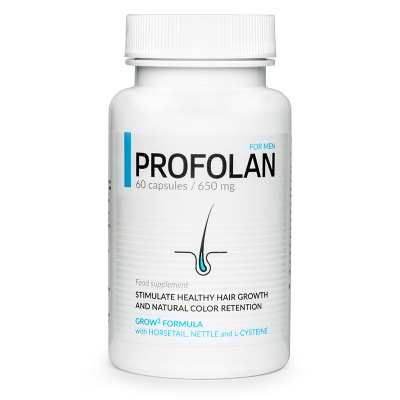
Our Recommendation — Profolan
Score: 5.7/10 · Best for: men with early thinning or increased shedding who want to test the nutritional angle for a full 90 days, photos in hand. Main caution: no ingredient in the bottle has a human trial for male hair loss, and the formula contains neither iron nor vitamin D. Fair trial: the three-bottle pack at $46.66 a bottle — it sits exactly inside the published 90-day money-back guarantee window.
Why Do Hair Supplements Take Months Instead of Weeks?
Start with the machine the supplement is feeding. Each scalp follicle cycles independently through three main phases. In anagen, the growth phase, the follicle is actively producing hair; this phase lasts roughly two to seven years, and at any given moment about 85–90% of your scalp hairs are in it.
In catagen, a short transitional phase of about two to three weeks, growth stops and the follicle shrinks. In telogen, the resting phase of roughly three months, the finished hair sits in the follicle until it is eventually shed and the cycle restarts.
Scalp hair grows at only about 1–1.5 cm per month — roughly a centimetre if you want a single conservative number to plan around. Those four numbers explain almost everything about supplement timelines, and they are worth sitting with for a moment, because every disappointment in this category comes from ignoring one of them.
The telogen figure is the one that defeats most buyers. A follicle that has already entered its resting phase will hold its hair for around three months and then shed it, whatever you swallow in the meantime.
A supplement taken today cannot un-rest a resting follicle, cannot glue a telogen hair back in, and cannot make the next anagen hair grow faster than about a centimetre a month.
What nutritional support can plausibly influence — when a genuine deficiency is part of the problem — is the quality of the environment the next cycle grows in: whether follicles that were pushed into resting early return to a normal rhythm, and whether the new hairs produced are full-calibre and resilient rather than weak and breakage-prone.
The review literature is blunt about how conditional that "can" is. Almohanna et al. 2019 concluded that micronutrients play an important but not fully understood role in non-scarring hair loss, that deficiency may be a modifiable risk factor, and that large double-blind placebo-controlled trials are still required — a considerably more cautious verdict than most product pages quote.
A later systematic review of nutritional supplements for hair loss, Drake et al. 2023 in JAMA Dermatology, worked through the supplement literature ingredient by ingredient and found a record that is mixed, small and heavily dependent on the population studied — again, not the settled "proven to regrow hair" story of the advertising.
There is a second, quieter reason the wait is long: the thing you are watching is replacement, not repair. The hair already on your head is dead keratin. Its condition can be improved cosmetically — less breakage, better feel — but its diameter was decided months ago, deep in the follicle, before you bought anything.
Any genuine change a supplement produces arrives as new hair at the scalp surface, growing at that same centimetre a month, and it has to accumulate for weeks before it registers as coverage, texture or a parting that looks less wide.
That is why every credible guide in this category converges on the same window — a three-to-six-month minimum — and why the honest sequence of signals runs shedding first, texture second, density last. If a review, an advert or a neighbour tells you a supplement transformed their hair in a fortnight, what changed in a fortnight was styling, lighting, expectation or breakage — not follicle output.
What Should You Expect, Month by Month?
Here is the timeline we give readers of this site, built from that cycle arithmetic rather than from any maker's marketing calendar. Read each month for three things: what is happening at the follicle, what you might actually notice, and — just as important — what you should not conclude yet. Individual timing shifts by a few weeks either way; the order of events does not.
Month 0: What is happening before you take the first capsule?
At the follicle: nothing yet — and that is precisely the point of Month 0. Your follicles are distributed across the cycle exactly as they were: most growing, a minority resting, a normal 50–100 hairs a day reaching the end of telogen and shedding.
What you should do, not notice: this is your baseline month, and its only job is measurement. Take your baseline photographs today, before the first capsule — same bathroom, same light, same angle, same parting, hair dry and unstyled — covering the hairline from the front, both temples, the crown from above, and the parting.
Note, roughly, how much hair you are seeing in the shower and on the brush; do not start counting individual hairs, for reasons we explain in the tracking section below.
If you have never had blood work for shedding — ferritin, vitamin D, thyroid function, zinc — Month 0 is also when to arrange it, because a supplement trial run blind, over an uncorrected deficiency the product does not even contain, wastes the whole six months. What not to conclude: nothing.
A man who skips the baseline has not started a trial; he has started an anecdote, and in five months he will be arguing with his own memory about whether anything changed.
Month 1: Why does nothing look different yet?
At the follicle: nutrients from a daily formula — in Profolan's case, two capsules a day taken preferably 30 minutes before a meal — are reaching follicles that are mid-cycle and will mostly stay mid-cycle. Follicles already in telogen continue resting on schedule.
Any follicle-level benefit at this stage is happening invisibly, in the conditions for future growth rather than in today's visible hair. What you might notice: realistically, almost nothing in the hair itself.
Some men report nails feeling stronger or growing faster — nails respond on a shorter cycle and are a common first place people perceive B-vitamin and amino-acid intake — but treat that as a curiosity, not evidence.
Shedding in Month 1 is usually unchanged, and it can even look slightly worse if you have started paying close attention to the shower drain for the first time; attention is not the same as deterioration. What not to conclude: that the supplement has failed.
At day 30, the oldest possible new hair influenced by the product is about a centimetre long and still effectively invisible at the scalp. Judging a hair supplement at one month is like judging a gym programme at one week: the measurement window is shorter than the biology being measured, so the verdict tells you about your patience, not the product.
Month 2: When does the first real signal appear?
At the follicle: this is where the first plausible change lives. If increased shedding was being driven or worsened by a nutritional gap the formula actually covers — zinc is the clearest example in Profolan's panel, at 15 mg with 1 mg of copper paired alongside it — follicles pushed prematurely toward resting may begin settling back toward a normal proportion, and fewer hairs per day reach the shedding end of the cycle.
What you might notice: somewhere in weeks four to eight comes the first signal every credible timeline agrees on — reduced shedding. Less hair in the drain after washing, fewer strands on the pillow and in the brush, a calmer handful when you run your fingers through your hair.
It is a subtraction signal, not an addition signal: nothing new has visibly grown, but less is leaving. Texture may also begin to feel marginally more resilient toward the end of this month, because hairs near the scalp are the youngest and any reduction in breakage shows there first. What not to conclude: two opposite errors are both tempting here.
Do not conclude the product is "regrowing your hair" — reduced shedding is not regrowth, and conflating them sets up a Month 4 disappointment. And do not conclude failure if shedding has not yet moved; week eight is the early edge of the window, not a deadline, and shedding driven by a telogen episode that began before you started has its own three-month clock to run out regardless.
Month 3: Why is day 90 the first honest checkpoint?
At the follicle: a full telogen phase — roughly three months — has now elapsed since you started. Hairs that were already resting on day one have largely completed their cycle, and the follicles behind them have had a genuinely supplemented environment for their return to growth.
New anagen hairs produced under better nutritional conditions are now emerging and accumulating their first two to three centimetres. What you might notice: this is the first month where a visible difference is a fair expectation rather than a hope.
The typical Month 3 picture, when a supplement is helping, is a combination: shedding clearly lower than your Month 0 impression, hair that feels stronger and breaks less, short new hairs visible along the parting and hairline under close inspection, and photographs that — side by side with Month 0, in matched light — show a modest but real difference in how dense the scalp coverage looks.
This is also the month where the texture signal matures: strength and breakage are strand-quality outcomes, and strand quality is the most defensible thing a nutritional formula can influence. What not to conclude: that the story is finished, in either direction.
A good Month 3 is a checkpoint passed, not a final result — density, if it is coming, builds through Months 4 to 6. A flat Month 3 is more informative: it does not yet prove the supplement can do nothing for you, but it moves the burden of proof, and it is exactly the moment the guarantee framework below is designed for.
Month 4: What changes between months 3 and 4?
At the follicle: the cohort of hairs that began growing around Months 1–2 is now three to four centimetres long — long enough to lie with the surrounding hair and contribute to coverage rather than standing as visible stubble. If shedding has normalised, the arithmetic of the scalp quietly turns positive: normal numbers leaving, full-calibre hairs arriving.
What you might notice: this is the "visible density" window the consensus timeline points to — months three to four are when fuller appearance, a parting that photographs narrower, and better coverage at the crown or temples can plausibly appear, always provided the underlying cause was one a supplement can touch.
Men whose problem was shedding-led often describe Month 4 as the month other people notice, because coverage is a social signal in a way that drain counts never are.
What not to conclude: if you are tracking pattern loss — a receding hairline, a thinning crown with miniaturised, progressively finer hairs — do not mistake stable or slightly better-looking hair for reversal. Supplements can support the quality of the hair you still produce; they do not re-widen a miniaturised follicle or restore a hairline that has receded.
A Month 4 photograph that shows the pattern has not worsened is a fine outcome for nutritional support used alongside a real plan; presented as proof the supplement is beating pattern loss on its own, it is a misreading that will cost you the window in which medical options work best.
Month 5: Why hold your nerve — or your verdict — for one more month?
At the follicle: growth continues at its unhurried centimetre a month, and by now every phase of the cycle has turned over at least once under supplemented conditions. The scalp you are looking at in Month 5 is the first one that is substantially "new" — grown, held and shed under the regimen you are actually judging.
What you might notice: consolidation rather than drama. The changes from Months 3–4 either hold and slowly deepen — coverage a little fuller, texture consistently better, shedding stably normal — or they plateau, which is itself information: a plateau at a modest improvement is the realistic ceiling for most nutritional formulas, not a sign that a bigger dose would break through it.
Profolan's panel illustrates the point honestly: horsetail extract at 400 mg (standardised to 7% silica), taurine 200 mg, L-cysteine 100 mg and nettle leaf 100 mg are strand-quality and nutritional-support ingredients, and its biotin — 900 µg — only has a hair rationale where an actual deficiency exists, which the case literature keeps confirming is the exception rather than the rule: Patel et al. 2017 reviewed every reported case of biotin improving hair and found an underlying pathology in all of them. What not to conclude: do not escalate — doubling capsules, stacking a second hair formula, adding megadose gummies — in search of a breakthrough the biology does not offer. More of a nutrient you are no longer deficient in is not more hair; it is more expense and, with fat-soluble vitamins and high-dose biotin, more ways to complicate your next blood test.
Month 6: When is the trial actually over?
At the follicle: six months is two full telogen cycles and half a year of anagen growth — roughly six to nine centimetres on the hairs that began when you did. There is no phase of the hair cycle left that has not had its chance to respond.
What you might notice: whatever the supplement was going to do for you, it has now substantially done.
The realistic best case at Month 6: shedding normal and stable, hair visibly fuller than your Month 0 photographs where shedding or deficiency was the driver, better strength and texture throughout, and a result you can defend because you measured it against a baseline instead of a feeling.
What not to conclude — the month-6 rule: if, after six consistent months, your photographs show no change in shedding, texture or coverage, the honest conclusion is not "try a stronger supplement." It is that the cause of your hair loss is probably not nutritional — and the next step is a doctor, not another bottle.
That rule matters because the two most common male causes a supplement cannot fix — pattern loss progressing on its own genetic schedule, and a medical driver such as thyroid dysfunction — both have real treatments and real diagnostic pathways, and both reward being found early.
The association between low iron stores and shedding, for example, has been in the literature for two decades — Trost et al. 2006 reviewed the evidence linking iron deficiency to hair loss and the case for testing rather than guessing — and iron is a nutrient Profolan does not contain at all. Six flat months plus no blood work is not a supplement failure story; it is an unfinished diagnosis.
| Month | At the follicle | What you might notice | Do not conclude yet |
|---|---|---|---|
| 0 | Baseline — cycle running as it was | Nothing; take photos, arrange bloods if never done | Anything — there is no result to read |
| 1 | Telogen hairs resting on schedule; new growth ≤1 cm | Essentially nothing in the hair | That it has failed — the window is shorter than the biology |
| 2 | Premature resting may begin to settle if a covered gap was driving it | First signal: reduced shedding (weeks 4–8), early resilience | That reduced shedding is regrowth — or that no change yet is final |
| 3 | One full telogen phase elapsed; new anagen hairs emerging | Texture and strength; short new hairs; first fair photo comparison | That the story is finished — density builds to Month 6 |
| 4 | New cohort at 3–4 cm, contributing to coverage | Visible density window opens (months 3–4) | That stable pattern loss equals reversal of miniaturisation |
| 5 | Every cycle phase has turned over under the regimen | Consolidation or an honest plateau | That escalating the dose would break a plateau |
| 6 | Two telogen cycles; 6–9 cm on the earliest new hairs | The full result, for better or worse, against Month 0 photos | That no change means "stronger supplement" — it means see a doctor |
Which Timeline Applies to You — Shedding Support or Pattern Loss?
The month-by-month above describes one track well and the other only partly, and confusing the two is the single most common expectation error in this category. Track one — deficiency and shedding support.
If your problem is increased shedding, diffuse thinning everywhere including the sides and back, and hair that has lost strength and quality — especially after illness, stress, a crash diet or a period of poor nutrition — a nutritional contribution is plausible, the follicles themselves are generally healthy, and the timeline above is your timeline: shedding eases first, quality follows, coverage refills over months as the cycle normalises.
This is the track supplements were, in any honest sense, built for. Track two — pattern loss. If your problem is a receding hairline, thinning concentrated at the temples and crown, and hairs in those zones growing back progressively finer and shorter, the driver is follicle miniaturisation under genetic and hormonal influence.
On this track, a supplement's realistic ceiling is supporting the quality and strength of the hair you still grow and correcting any nutritional gap running alongside — worthwhile, but categorically different from reversing the pattern.
The timeline to judge it by is therefore not "when will my hairline return" (it will not, from a capsule) but "is my remaining hair in better condition, and is my actual treatment plan — the medical one — doing the pattern work."
Men routinely run both tracks at once: pattern loss progressing slowly for years, plus a shedding episode on top. In that common case, judge the supplement only on the shedding and quality half of the picture, and judge anything pattern-shaped with a clinician.
How Do You Track Progress Without Fooling Yourself?
Because every signal in this timeline is gradual, the tracking method decides whether your day-90 and month-6 verdicts mean anything. Use this protocol — it takes ten minutes across six months. Photographs are the primary instrument.
Baseline on day 1, before the first capsule: front hairline, both temples, crown from directly above, and the parting, all in the same room and light you can return to, hair dry, unstyled, and the same length as far as haircuts allow. Re-shoot the identical set at Month 3 and Month 6 — the two checkpoints the timeline actually uses.
Judge the photographs side by side, not your mirror impression on a given morning; mirrors are mood instruments, photographs are records. Shedding is the secondary instrument, and a deliberately rough one. Notice the trend — drain, pillow, brush — in weekly impressions, the way the Month 2 section describes.
What we advise against is daily shed-counting as your sole measure: counts swing wildly with wash frequency, hair length and how long since the last brush, the counting itself focuses anxious attention on the one number with the worst signal-to-noise ratio in the whole process, and a man can talk himself out of a working regimen — or into a failing one — on drain arithmetic alone.
Texture is the third signal, and the easiest to verify honestly: breakage when styling, how the hair feels at the roots versus the ends, whether it snaps or stretches. Write three dated lines a month — shedding impression, texture impression, one sentence overall — and your future self gets a record instead of an argument.
Finally, keep the trial clean: one product, taken as directed, no mid-trial additions. A trial with three variables has no verdict, only a story.
Is an early increase in shedding normal — or a warning sign?
Men starting any hair regimen worry about this, so here is the distinction in one place. Some fluctuation in the first weeks is unremarkable: shedding varies naturally, attention to it has usually just increased, and a telogen cohort that was already due to shed will shed on its original schedule whatever you start taking. That is background noise. The warning signs are different in kind, not just degree:
| Usually normal | Warning sign — get checked |
|---|---|
| Shedding roughly at your usual level in the first 4–8 weeks | Shedding that sharply escalates and stays escalated beyond 8 weeks |
| Day-to-day counts that swing with washing and brushing | Visible bald patches appearing, rather than even thinning |
| Full-thickness hairs with a tiny white bulb at the root end | Scalp pain, burning, heavy scaling, sores or inflammation |
| A flat Month 1 — nothing visible either way | Loss of eyebrow or body hair alongside scalp shedding |
The left column is patience territory. Anything in the right column is not a supplement problem at all — it is a reason to stop self-managing and see a doctor, because patchy, inflamed or rapidly escalating loss has causes (autoimmune, infectious, thyroid) that no nutritional formula addresses and that reward early treatment.
Why Is Day 90 Judgement Day for Profolan Specifically?
Every product in this category asks you to wait three months. Profolan is the rare one whose commercial terms actually respect that wait — and that alignment is, in our assessment, the most useful fact about the product. The maker publishes a 90-day money-back guarantee on its own sales page.
Ninety days is not an arbitrary marketing number here: it is exactly the first visible-difference checkpoint in the timeline above — one full telogen phase, the point by which shedding should have eased and texture should have moved if the formula is going to do anything for you. So run day 90 as a formal decision, using the record you built:
- Shedding: is it clearly down from your Month 0 impression — drain, pillow, brush — sustained over the last few weeks, not one good day?
- Texture: is the hair observably stronger — less breakage in styling, better feel at the roots — than at baseline?
- Photographs: side by side with day 1, in matched light, is there a modest but real difference at the parting, temples or crown — or honestly none?
Two or three yeses: the trial has earned its second half — continue to Month 6 for the full density picture, on the pack economics below.
Mostly noes at day 90, with consistent use behind you: that is what the guarantee exists for — claim it, and put the refund toward the blood work or the dermatology appointment the result is pointing you to. Either way, day 90 stops being a shrug and becomes a decision, which is more than most supplement purchases ever get.
One consumer-protection warning belongs in this section, because it exploits exactly this timeline: spam review sites advertise Profolan with a fake 60-day guarantee.
Sixty days expires before the first credible checkpoint in every honest guide — before the Month 3 photo comparison, before a full telogen phase has even elapsed — which makes it a guarantee engineered to lapse before you can fairly judge the product. The maker's real, published guarantee is 90 days.
If a page selling you this product cannot get its guarantee right, it is telling you how much of the rest of the page to believe.
For completeness, the commercial frame the decision sits in: one bottle (60 capsules, one month) is $69.99; the buy-2-get-1 pack is $139.98 ($46.66 a bottle) and covers the 90-day trial exactly; the buy-3-get-3 pack is $209.97 ($35.00 a bottle) for men who pass day 90 and commit to the full six months; shipping is $12 per order.
Judge the product on the 3-bottle pack's terms, because one bottle is not a trial of anything in this category.
Who Should Buy Profolan — and Who Should Skip It
Buy it if your picture matches track one — increased shedding, diffuse thinning, hair quality in decline, possibly after a rough nutritional or stressful stretch — and you want to run the nutritional experiment properly: one product, baseline photos, a day-90 decision, six months for the full answer.
On those terms Profolan is a rational purchase despite its mid-pack score, because its published panel ( horsetail 400 mg, taurine 200 mg, nettle leaf 100 mg, L-cysteine 100 mg, biotin 900 µg, zinc 15 mg with copper 1 mg, plus vitamins A, E, B1 and B6 per two capsules) is fully disclosed and its maker's 90-day guarantee underwrites exactly the trial the biology requires. Our full audit is in the Profolan review.
Skip it if your loss is pattern-shaped and progressing — hairline and crown, finer regrowth — and a supplement would be your only response; that pattern needs medical options, and six supplement months spent instead are six months those options cannot get back.
Skip it if your shedding comes with any warning sign from the box above, if you have never tested for the big deficiencies — remembering that Profolan contains no iron and no vitamin D, the two gaps with the strongest hair associations — or if you are shopping for a DHT blocker or a minoxidil alternative: this formula contains no saw palmetto and no minoxidil, and it is neither of those things, whatever spam pages claim.
Our Recommendation — Profolan
Score: 5.7/10 · Best for: men with early thinning or increased shedding who want to test the nutritional angle for a full 90 days, photos in hand. Main caution: no ingredient in the bottle has a human trial for male hair loss, and the formula contains neither iron nor vitamin D. Fair trial: the three-bottle pack at $46.66 a bottle — it sits exactly inside the published 90-day money-back guarantee window.
Frequently Asked Questions
How long do hair supplements take to work, in one sentence?
Judge nothing before three months and everything by six: reduced shedding is the first signal (weeks 4–8), texture and strength follow, visible density — if it comes — appears around months 3–4, and the full verdict belongs at months 5–6, because telogen lasts about three months and hair grows only 1–1.5 cm a month.
What is the first sign a hair supplement is working?
Less shedding, not more hair. Fewer hairs in the shower drain, on the pillow and in the brush, typically from weeks 4–8, is the earliest honest signal. New visible growth cannot physically be first — a hair starting today is a centimetre long in a month and contributes nothing to coverage for several months after that.
Can I judge Profolan in one bottle?
No — and the maker implicitly agrees. One bottle is one month, which is shorter than a single telogen phase. The fair trial is 90 days (the 3-bottle pack at $139.98), which is also the exact length of the maker's published guarantee, so day 90 is your decision point: improvement on shedding, texture or photos, or claim the guarantee.
Is it normal to shed more when I start a hair supplement?
Ordinary fluctuation in the first weeks is normal — shedding varies with washing and attention, and hairs already in telogen shed on their original schedule. A sharp, sustained escalation beyond eight weeks, bald patches, scalp pain or scaling, or eyebrow and body hair loss are not normal start-up effects; those need a doctor, not patience.
What if nothing has changed after six months?
Apply the month-6 rule: six consistent months with no change in shedding, texture or photographs means the cause is probably not nutritional. Stop spending on supplements and get the cause identified — blood work (ferritin, vitamin D, thyroid, zinc) if you have never had it, and a clinician's assessment for pattern loss or anything patchy, inflamed or rapidly progressing.
Why do some sites say Profolan has a 60-day guarantee?
Because those pages are spam, and the detail matters: 60 days expires before the first fair checkpoint in any credible timeline, so a buyer relying on it would lose the guarantee before they could judge the product. The maker itself publishes 90 days on its own sales page. Treat any page quoting 60 days — or claiming the product is FDA-approved or contains saw palmetto or minoxidil — as unreliable on everything else too.
Last reviewed: October 2026. This article is educational and is not medical advice.
