
- Quick Answer
- The One Head-to-Head Trial, Fully Labelled
- The "66%" figure, untangled
- Regrowth vs Stabilisation
- Where Each Works: Crown vs Hairline
- The DHT Numbers, Honestly Labelled
- Side Effects and the Prescription Divide
- Finasteride
- Saw palmetto
- Taking Both Together
- What the Head-to-Head Did Not Test
- Cost and Access
- Frequently Asked Questions
- Is saw palmetto as good as finasteride?
- Does saw palmetto work on the hairline?
- Can I take saw palmetto and finasteride together?
- Why do men choose saw palmetto if it is weaker?
- Who Should Buy Folisin — and Who Should Skip It
- Read This Next
Disclosure: This article contains affiliate links. If you buy through them, we may earn a commission at no extra cost to you. It never changes our conclusions.
Quick Answer
Exactly one head-to-head trial exists, and it is not especially close. Over two years, in 100 men with mild-to-moderate pattern hair loss, hair growth improved in 38% of the men taking saw palmetto 320 mg/day versus 68% of the men taking finasteride 1 mg/day (Rossi et al. 2012, open-label).
Finasteride wins every measured contest in that study. Saw palmetto's honest case is narrower: a weaker, slower effect, bought without a prescription, by men who have decided the drug is not for them.
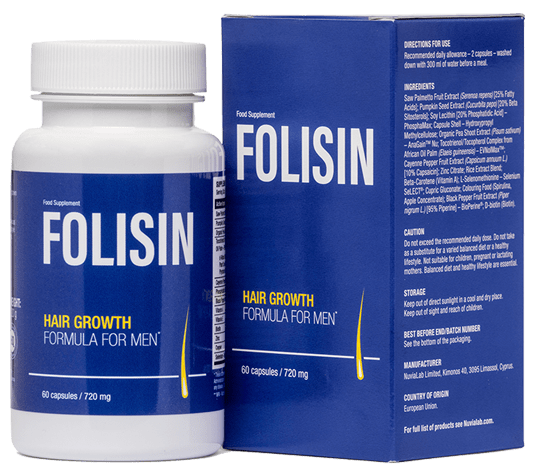
Where the product behind this set fits: Folisin is a saw palmetto formula whose panel lets you check the extract specification the trial used — and find its 25% standardisation wanting. Best for: early, diffuse thinning. Our score: 5.9/10.
Our Recommendation — Folisin
Score: 5.9/10 · Best for: men with early, diffuse thinning who want a fully disclosed nutritional formula — it supports hair; it does not regrow it. Main caution: the saw palmetto is standardised at 25% fatty acids against 85–95% in the trial extracts, and no money-back guarantee is published. Fair trial: the three-bottle pack at $46.66 a bottle — a fair trial of Folisin is a three-bottle commitment; the six-bottle pack is the cheapest continuation, after a completed trial.
The One Head-to-Head Trial, Fully Labelled
Most "versus" content in this category compares two marketing pages. This comparison rests on something rarer: a single study that gave both interventions to comparable men and measured the same outcomes. Rossi et al. (2012) enrolled 100 men with clinically diagnosed mild-to-moderate androgenetic alopecia.
One group of 50 took saw palmetto 320 mg every day for 24 months. The other 50 took finasteride 1 mg every day for the same period. Hair was assessed with standardised clinical scoring at the end of the two years.
The headline result: an increase in hair growth in 38% of the saw palmetto group versus 68% of the finasteride group. In plain terms, about two in three men on the drug improved; about one in three men on the extract did.
Now the labels that must travel with those numbers. The trial was open-label: participants and assessors knew who was taking what, which can tilt subjective scoring in either direction. It had no placebo arm, so it ranks the two treatments against each other but cannot measure either against doing nothing.
And the extract caveat from our dosage audit applies here too: trial-era extracts in this literature were standardised to 85–95% fatty acids, a specification most modern retail products do not meet — so even the 38% figure belongs to a stronger extract than the typical bottle.
The "66%" figure, untangled
Comparison tables on other sites sometimes print 66% next to this trial, usually in a way that flatters one side or the other. Two things are certain about it. First, it is not the saw palmetto arm's result — that is 38%. Second, wherever it comes from, it is a finasteride figure.
Rossi's own text reports that finasteride was more effective for 33 of its 50 men (66%), in the context of the milder level II and III severity grades — a within-trial observation about where the drug worked best. Separately, 66% is also the improvement figure associated with finasteride's much larger pivotal trials, and tables stitching the two studies together borrow it freely.
Either way, if you see 66% presented as the saw palmetto arm's improvement rate, or blended into this trial's headline, the table has mixed its numbers. The figures to hold are the arm-level ones, with their population attached: 38% of 50 men on saw palmetto 320 mg/day improved over two years, versus 68% of 50 men on finasteride 1 mg/day, in an open-label trial of mild-to-moderate pattern loss.
Regrowth vs Stabilisation
The percentages above count men whose hair improved. The more common saw palmetto outcome was quieter: the loss stopped progressing. In Evron et al.'s (2020) systematic-review summary of this trial, disease progression stabilised in 52% of the men taking saw palmetto over the two years.
That distinction decides whether the comparison is even the right one for you. Finasteride's evidence includes regrowth — measurable density gains in its placebo-controlled programme. Saw palmetto's realistic best case, on this record, is holding the line: keeping the hair you have for longer.
A buyer whose hairline is receding and who wants it back is asking for the outcome only one of these two has demonstrated. A buyer whose thinning is early and diffuse, and whose goal is to slow it while avoiding medication, is asking for the outcome saw palmetto's arm actually produced most often.
Neither answer is a sales pitch. They are two different jobs, and the trial lets you see which product class has evidence for which job — the ingredient-level view. The product-class view, supplements against both drugs together, is in our Set R comparison of hair supplements vs minoxidil and finasteride.
One more boundary applies to both arms: improvement percentages in a mild-to-moderate population say nothing about slick, long-bald areas. Neither intervention regrew hair there, and the two-year window is precisely why early action — with whichever option a man actually chooses — outperforms late deliberation.
Where Each Works: Crown vs Hairline
Rossi's group also recorded where the improvement appeared, and the pattern is one of the most useful details in the study. Finasteride acted in both the frontal area and the vertex (the crown). Saw palmetto's effect was concentrated prevalently at the vertex.
Translated into buying terms: for crown thinning, the weaker intervention at least showed its effect in the right place. For a receding hairline — the frontal zone — saw palmetto's arm produced little, and expecting a botanical capsule to rebuild a hairline is expecting the one outcome this trial did not observe anywhere.
This matches the wider pattern across the category. The vertex is where mild interventions show what effect they have; the frontal hairline is the most resistant zone for everything short of surgery. Pages that promise hairline restoration from a supplement are promising against the evidence, not with it.
The DHT Numbers, Honestly Labelled
Mechanism comparisons in this category are usually rigged, so here is the honest version. Finasteride is a drug with a defined action: it inhibits the type II 5-alpha-reductase enzyme, and the resulting fall in DHT was measured directly in the men in its trials — in blood and in scalp tissue. The drug's mechanism is a measured fact, not an inference.
Saw palmetto's mechanism is an inference. Its fatty acids inhibit 5-alpha-reductase in laboratory systems, which is why the comparison gets made at all. But no study has produced an equivalent human measurement — a verified percentage reduction in serum or scalp DHT in men taking oral saw palmetto at supplement doses.
The circumstantial evidence points the same way as the head-to-head gap. Finasteride lowers PSA readings measurably, because PSA tracks androgen activity in the prostate. Saw palmetto at 320 mg/day for a year did not change PSA versus placebo in 225 men in Bent et al.'s (2006) trial — behaviour that sits oddly with strong systemic DHT suppression.
So the accurate comparison is not "68% DHT reduction versus 38%". Those two numbers measure different things in different universes of evidence. It is: a drug whose DHT suppression is directly measured, against an extract whose DHT effect is inferred from test tubes and whose clinical results are consistently weaker.
Side Effects and the Prescription Divide
Finasteride
Finasteride's adverse-effect profile is dominated by sexual side effects — reduced libido and erectile difficulties reported by a small percentage of men in its trials, at rates modestly above placebo. For most men who experience them, they resolve on stopping; a debated minority report persistence after stopping, the so-called post-finasteride syndrome.
We present that as what it is: a genuine, unresolved debate. Regulatory labels carry the trial rates; patient communities report experiences the trials were not designed to capture; the honest position is that the effect is uncommon, usually reversible, and not fully characterised. It is also the single biggest reason men look for an alternative at all.
The drug also changes a number your doctor uses. Finasteride lowers measured PSA substantially, so its label instructs clinicians to correct PSA readings when screening men on it for prostate cancer. That is a manageable detail — provided the clinician knows. A prescription guarantees that conversation happens; it is part of what the gatekeeping is for.
Saw palmetto
Saw palmetto's trial record is milder: mostly digestive complaints, headache and dizziness, at rates close to placebo in the large prostate trials at the same 320 mg/day dose. Sexual side effects are reported uncommonly and without the drug's clear signal. The full picture, including the interactions that matter more than the side effects, is our saw palmetto side effects article.
The trade, stated without decoration: finasteride offers substantially better odds of improvement in exchange for a prescription, a small sexual-side-effect risk and ongoing medical oversight. Saw palmetto offers weaker odds with a gentler record and no gatekeeper. Reasonable men weight those differently; unreasonable pages pretend one side of the trade does not exist.
Taking Both Together
A common question, and an untested one. No trial has examined saw palmetto combined with finasteride — not for added effect, not for safety, not for the popular theory that the extract might let a man use a lower drug dose.
That theory has a superficial logic (two anti-androgens, two mechanisms) and no evidence underneath it at all. Combining them also stacks the uncertainty: if a sexual side effect appears, neither you nor your clinician can tell which agent is responsible, and the supplement is not part of any monitored protocol.
Our position is procedural, not dramatic: if you take finasteride, adding a saw palmetto formula is a conversation to have with the prescriber, who owns the drug half of the experiment and its monitoring. Self-assembling a combination no study has run is not a protocol; it is a guess with two variables.
What the Head-to-Head Did Not Test
Rossi's population bounds the conclusion. The men had mild-to-moderate loss; nothing here speaks to advanced grades, where both interventions are weaker and the drug's advantage is beside the point. There were no women in the trial, and no minoxidil arm — the other standard treatment is outside this comparison entirely.
It was also a single study from a single research group, never replicated at the same duration. Finasteride's own evidence does not rest on one trial: its programme included large placebo-controlled studies. Saw palmetto's comparative claim rests on Rossi alone, which is another reason to hold its 38% as a signal rather than a settled rate.
Cost and Access
Finasteride requires a prescription in most markets, which means a consultation, and in many systems a recurring cost for both the appointment and the generic drug — which itself is inexpensive. The real price of the drug route is friction and medicalisation, not the tablets.
Saw palmetto is over-the-counter everywhere, and a formula like the one audited here costs $69.99 a month at single-bottle pricing — more, per month, than generic finasteride typically costs in many markets, for a fraction of the demonstrated effect.
That inversion is worth sitting with for a moment. The supplement's advantage was never price or power. It is that some men will not take the drug — for side-effect concerns, principle or access — and for them the choice is not finasteride versus saw palmetto. It is saw palmetto versus nothing, which is the comparison its stabilisation numbers should be judged against.
Our Recommendation — Folisin
Score: 5.9/10 · Best for: men with early, diffuse thinning who want a fully disclosed nutritional formula — it supports hair; it does not regrow it. Main caution: the saw palmetto is standardised at 25% fatty acids against 85–95% in the trial extracts, and no money-back guarantee is published. Fair trial: the three-bottle pack at $46.66 a bottle — a fair trial of Folisin is a three-bottle commitment; the six-bottle pack is the cheapest continuation, after a completed trial.
Frequently Asked Questions
Is saw palmetto as good as finasteride?
No. In the only head-to-head trial, hair growth improved in 38% of men on saw palmetto 320 mg/day versus 68% of men on finasteride 1 mg/day over two years in 100 men with mild-to-moderate pattern loss (Rossi et al. 2012). The trial was open-label, but the gap is too wide for blinding alone to explain.
Does saw palmetto work on the hairline?
Rossi's trial found saw palmetto's effect concentrated at the vertex (crown), while finasteride acted at both the front and the crown. There is no good evidence any supplement rebuilds a receded hairline.
Can I take saw palmetto and finasteride together?
No trial has tested the combination, for effect or safety. If you take finasteride, treat adding a saw palmetto formula as a question for your prescriber — stacking two anti-androgens also makes any side effect impossible to attribute.
Why do men choose saw palmetto if it is weaker?
Access and tolerability: no prescription, a milder side-effect record in trials, and a realistic goal — stabilisation rather than regrowth. Judged as a finasteride replacement it fails; judged as the option for men who will not take the drug, its stabilisation signal is the relevant evidence.
Who Should Buy Folisin — and Who Should Skip It
Buy it if you have read this comparison and chosen the botanical side of it with open eyes: early or crown-focused thinning, a stabilisation goal, no interest in a prescription, and a preference for a formula like Folisin whose panel lets you verify the extract specification yourself — even though Folisin's own 25% standardisation falls short of the trial spec, which our review scores openly.
Skip it if improvement, rather than stabilisation, is your goal: on the only direct evidence, that job belongs to finasteride, and no supplement purchase changes the 38-versus-68 arithmetic. Skip it also if a receding hairline is your main concern — neither this formula nor its lead ingredient showed a frontal effect worth buying for.
Last reviewed: October 2026. This article is educational and is not medical advice.
