
- Quick Answer
- What Is Horsetail — and What Does "Silica" Mean on Its Label?
- Strength or Growth: Which Claim Are You Actually Being Sold?
- What Did the Famous Silicon Trial Actually Test?
- What About the Other Silicon Trial?
- Why Does the Form of Silicon Matter So Much?
- Has Horsetail Itself Ever Been Trialled for Hair?
- What Can Horsetail Oils, Rinses and Shampoos Actually Do?
- What Does an Oral Horsetail Supplement Offer — and How Does Profolan Audit?
- How Do Horsetail Articles Misattribute the Silicon Trials?
- How Do You Check the Form of Silica on Your Own Label?
- Is Horsetail Safe to Take — and for How Long?
- Who Should Buy Profolan — and Who Should Skip It
- Frequently Asked Questions
- Does horsetail make hair grow?
- What is the difference between horsetail silica and ch-OSA?
- What did the nine-month silicon study actually find?
- Can horsetail oil or a horsetail rinse help my hair?
- How much silica does Profolan provide?
- Is it safe to take horsetail every day, long-term?
- Bamboo silica, horsetail silica or ch-OSA — which should I choose?
- Read This Next
Disclosure: This article contains affiliate links. If you buy through them, we may earn a commission at no extra cost to you. It never changes our conclusions.
Quick Answer
Horsetail and silica are sold for two different promises that are constantly merged into one, and separating them is the whole point of this article. The first promise is about the hair you already have: stronger strands, more thickness in each shaft, less breakage.
For that promise there is some human trial evidence behind silicon — but the trials used a specific laboratory form called ch-OSA, not horsetail, and their endpoints were strength and shaft shape, never new growth. The second promise is about hair you do not yet have: new growth, higher counts, greater density, reversed loss.
For that promise there is no horsetail evidence at all — no human trial of horsetail extract, in any form, has ever measured a hair-growth outcome. Horsetail (Equisetum arvense) is a traditional plant source of silica, and a capsule can honestly say it supplies silica.
It cannot honestly borrow the ch-OSA trials and call them horsetail results, and it cannot turn a strength rationale into a growth claim.
Profolan, the product this set is built around, contains 400 mg of horsetail extract at 7% silica — about 28 mg of silica per daily serving — and on this article's evidence it belongs firmly on the strength-and-quality side of the line, judged as nutritional support, never as a regrowth product.
Best for: readers whose real complaint is fragile, breaking, thinning-feeling hair — and who want to know exactly which half of the horsetail promise has any evidence behind it before paying for either half.
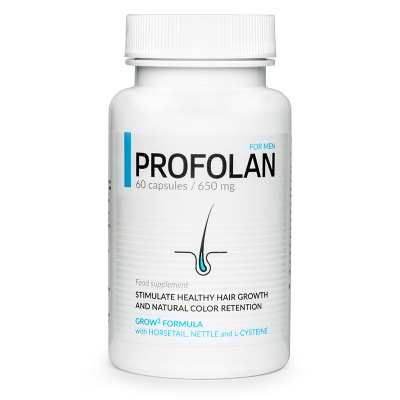
Our Recommendation — Profolan
Score: 5.7/10 · Best for: men with early thinning or increased shedding who want to test the nutritional angle for a full 90 days, photos in hand. Main caution: no ingredient in the bottle has a human trial for male hair loss, and the formula contains neither iron nor vitamin D. Fair trial: the three-bottle pack at $46.66 a bottle — it sits exactly inside the published 90-day money-back guarantee window.
What Is Horsetail — and What Does "Silica" Mean on Its Label?
Field horsetail, Equisetum arvense, is an ancient, reed-like plant — a living relative of the giant horsetails that grew in prehistoric forests — with hollow, jointed, notably rough stems.
The roughness is the story: horsetail accumulates silicon in its tissues at levels unusual among land plants, which is why the dried herb was historically used as a scouring material for metal and wood, and why herbal tradition reached for it wherever strength and structure were the theme — nails, bones, skin and hair.
The sterile stems are the part collected for herbal products, and horsetail appears in modern commerce as a dried herb for teas, a powdered extract in capsules, a liquid extract, and an ingredient in shampoos, conditioners, oils and rinses.
"Silica" is where the labelling gets slippery, so the terms deserve one careful paragraph. Silicon is the element. Silica — silicon dioxide — is the form in which silicon is commonly reported on supplement labels, and orthosilicic acid is the soluble, absorbable form the body can actually take up from the gut.
An extract "standardised to 7% silica" is telling you a proportion of its weight: 7% of the extract's mass is silica, by the maker's assay. That is a real, checkable specification, and a label that prints it is doing better than one that simply names the plant.
But a percentage of silica is not a statement about chemical form, and form — as the next sections show — is the variable the entire evidence base turns on. Two products can carry the same milligram figure for silica and deliver very different amounts of absorbable silicon, because the body does not absorb "silica" in the abstract; it absorbs particular compounds, at very different rates.
The regulatory position matches that caution. The EMA lists horsetail as a traditional herbal product — its recognised traditional uses centre on urinary complaints and minor skin problems — which in regulatory language means long-standing use, not demonstrated efficacy, and notably not a proven hair treatment. Traditional use is a legitimate reason a plant appears in a formula.
It is a starting point for research questions, not an answer to them, and the rest of this article grades horsetail the way the trials require: claim by claim, form by form.
Strength or Growth: Which Claim Are You Actually Being Sold?
Almost every confusion in the horsetail market dissolves if you force each claim into one of two columns and refuse to let it move. The columns are not a rhetorical device; they describe two biologically different processes. Strength claims concern the shaft — the dead, keratinised strand that has already emerged.
A strand can be thicker in cross-section, more resistant to snapping under tension, and less prone to the friction breakage that makes hair look thin at the ends even when the follicle count is unchanged. Growth claims concern the follicle — the living structure in the scalp.
More hairs, hairs in places that had thinned, a reversed pattern of loss: those require a follicle to start a new cycle, extend its growth phase, or escape miniaturisation. Nothing that improves a strand's tensile behaviour has thereby been shown to do any of that.
| Strength claims — the strand you already have | Growth claims — new hair from the follicle |
|---|---|
| Thicker-feeling, less fragile strands | Higher hair count or density |
| Greater tensile strength; less breakage under load | Regrowth in thinning or bald areas |
| Larger shaft cross-sectional area | Longer growth (anagen) phase |
| Less brittleness of hair and nails (often self-rated) | Reduced shedding as a step toward regrowth |
| Evidence status: some human trial support — for silicon as ch-OSA, a different form from horsetail, in women with fine hair | Evidence status: no human trial of horsetail for any growth outcome; the ch-OSA trials never measured growth either |
Keep that bottom row in view for the rest of the article, because it is the finding. The evidence, such as it is, lives entirely in the left column, attached to a form horsetail products do not contain, in a population (women with fine hair) that is not the population most horsetail supplements are sold to.
The right column — the column that matches what most searchers typing " horsetail for hair growth" actually want — is empty. Not contested, not mixed: empty. No trial occupies it.
That does not make horsetail useless; hair that breaks less genuinely looks and feels fuller, and for a person whose problem is breakage rather than follicle loss, the left column may be the relevant one. What it makes horsetail is miscategorised — sold under growth language, supported (partly, in another form) only under strength language.
Every section that follows is an unpacking of that one distinction: what the strength trials really did, why their form matters, what the topical products most searchers are actually asking about can and cannot do, what an oral horsetail capsule like Profolan can honestly claim, and what the safety file — the part competitors underplay — requires you to know before using any of it for long.
What Did the Famous Silicon Trial Actually Test?
The study behind nearly every silica-and-hair claim ever printed is Wickett et al. 2007, and it deserves a full, accurate read, because it is a good trial — for the question it asked. Wickett and colleagues ran a randomised, double-blind, placebo-controlled trial in 48 women with fine hair, 45 of whom completed it.
The intervention was 10 mg of silicon a day, given as choline-stabilised orthosilicic acid — ch-OSA — for nine months. Ch-OSA is a manufactured, stabilised liquid form of silicon designed for absorption: orthosilicic acid, kept from polymerising into unabsorbable forms by choline. It is not a plant. It is not an extract. No horsetail was involved at any point.
The endpoints are the second half of the correction, and they are just as specific. Wickett measured hair morphology and tensile strength only. After nine months, the cross-sectional area of the hair increased in the ch-OSA group and not in the placebo group — strands were, measurably, somewhat thicker in section.
On tensile testing, the load at which hair broke fell in both groups over the study, but it fell far less with ch-OSA: break load declined about 2.2% (not statistically significant) against a significant decline of about 10.8% on placebo.
In plain terms, supplemented hair resisted the passage of nine months better; it kept its breaking strength while placebo hair lost some. That is a real, carefully measured, left-column result — about strand quality, in women who started with fine hair.
And here is the complete list of what Wickett 2007 did not measure: hair count. Hair density. Shedding. Growth rate. Coverage of thinning areas. Pattern loss of any kind. The trial had no growth endpoint, so it cannot support a growth claim even for the substance it actually tested.
When a horsetail page cites this study under a headline about hair growth, it has therefore made two errors at once — it has transferred the result from ch-OSA to a plant the trial never used, and it has transferred the claim from strength to growth, an endpoint the trial never measured. Either error alone would invalidate the citation.
The horsetail literature, as we will see in the misattribution section below, routinely commits both in the same sentence.
What About the Other Silicon Trial?
The second study usually standing behind silica claims is Barel et al. 2005 — and if Wickett is the strength trial, Barel is, primarily, a skin trial. Barel and colleagues randomised 50 women to 10 mg of silicon a day as ch-OSA, or placebo, for 20 weeks.
The primary endpoints concerned the skin: surface roughness and elasticity, measured instrumentally, in women with sun-damaged facial skin. Hair and nails entered the study only as a self-rated brittleness score — participants' own impression that their hair and nails were less brittle. That impression improved. No strand was measured, no count was taken, and again, the supplement was ch-OSA, not horsetail.
Barel still earns its place in this article, for two reasons. The first is completeness: these two studies — Wickett and Barel — are essentially the whole human trial foundation for "silica for hair," and a reader deciding whether to buy a silica product should know the foundation is two studies, in women, of a laboratory form, one measuring strength properly and one asking women how brittle their hair felt.
The second reason is what the pair teaches about reading this market.
Notice how each step away from the original papers degrades the claim: Barel's self-rated brittleness becomes "clinically shown to improve hair" in a roundup, then "proven for stronger hair" on a product page, then — merged with Wickett's tensile numbers, which belonged to a different study of a different design — "clinically proven to grow stronger, thicker hair" in an advertisement for a horsetail capsule that contains neither trial's substance.
Nothing in that chain was invented from nothing. Every link borrowed a real word from a real paper and moved it one column, one form, or one population too far. That is exactly why this standard insists on printing the form, the population and the endpoint next to every number: strip any one of the three away, and the sentence that remains is no longer the study's sentence.
There is a wider nutritional context worth one paragraph, and it cuts in a measured direction.
Reviews such as Almohanna et al. 2019 place silicon among the micronutrients discussed around hair, while concluding that the role of such nutrients in hair loss is not entirely clear and that deficiency correction — not supplementation of the already-sufficient — is the defensible frame. Nothing in that literature upgrades horsetail.
It simply locates the conversation: nutrients matter to hair when they are missing; the trials that exist are about strand quality; and large, rigorous trials are the thing the field itself says it still needs.
Why Does the Form of Silicon Matter So Much?
If one fact explains the distance between the trial results and a horsetail capsule, it is bioavailability — how much of what you swallow the body can actually absorb — and for silicon, bioavailability is overwhelmingly a question of chemical form. Orthosilicic acid, the soluble monomer, is absorbable. As silicon compounds polymerise into larger silica structures, absorption collapses.
Across the forms sold and consumed — from stabilised orthosilicic acid solutions at the top, through the silicon in foods and beer, down to barely soluble mineral silicas at the bottom — measured absorption ranges roughly from 1% to about 64%. A nearly sixty-fold spread, hiding behind one word on a label: "silica."
Ch-OSA was engineered to sit at the favourable end of that range. The choline stabilisation exists precisely to keep orthosilicic acid in its absorbable form until it reaches the gut, and the trials dosed it accordingly — a small, defined 10 mg of silicon a day, in the form most likely to be taken up.
Horsetail extract sits at an unknown point on the same range. Its silica accumulated in the plant's tissues in structural, polymerised forms — the forms that made the stems abrasive enough to scour pans — and an extract's 7% silica figure tells you how much silica is present in the powder, not how much soluble orthosilicic acid your digestion will liberate from it, and not how that liberation compares with ch-OSA. Those are measurable questions.
Supplement labels, with rare exceptions, do not measure them.
This is why the sentence "contains silica, and silica was shown in trials to strengthen hair" fails even before the growth-versus-strength problem is reached. The trials showed that a specific, stabilised, highly available form of silicon, at 10 mg a day for nine months, preserved tensile strength in women with fine hair.
A horsetail extract is a different material with a different, uncharacterised availability profile. It may deliver some absorbable silicon — plant-derived silicon from foods is part of normal dietary intake, and horsetail has been consumed for centuries — but "may deliver some" is the honest claim, and it is materially weaker than "delivers the trialled form."
Silica content on a label is not the trialled form. That sentence is the R6 equivalent of the nettle leaf-versus-root rule in our DHT article: never let one preparation borrow another preparation's evidence because they share an ingredient name.
Has Horsetail Itself Ever Been Trialled for Hair?
No — and because this is the load-bearing fact of the article, it should be stated with its full scope. There is no published human trial of horsetail extract as a sole intervention, with any hair outcome: no growth trial, no count or density trial, no shedding trial, and — just as importantly — no strength trial either.
The left column of our framework, where horsetail's plausible value lives, is supported for ch-OSA and extrapolated to horsetail; it is not demonstrated for horsetail. The same absence covers the other forms readers ask about: no human hair-outcome trial of horsetail tea exists, and none of horsetail-derived silica as an isolated product.
What does exist, around the edges, is combination evidence in which horsetail cannot be separated from its company.
Multi-ingredient oral formulas that happen to include horsetail among many botanicals, vitamins and minerals have reported positive hair results — but a formula result belongs to the formula, and the contribution of any one ingredient inside it cannot be isolated, the same combination confound that limits the pumpkin-seed and beta-sitosterol evidence in our DHT article.
Topical research tells the same story: the studied preparations are multi-botanical mixtures in which horsetail is one ingredient among several, never the isolated variable. A positive mixture result is a reason to trial the ingredient alone.
In horsetail's case, that trial has simply never been run — which is itself worth pausing on, for a plant this old, this cheap and this widely sold. As with saw palmetto's missing placebo trial, the absence of the obvious study, decades into a product's commercial life, is information a buyer is entitled to weigh.
So the complete evidence statement for horsetail and hair is three lines long. One: traditional use exists, and regulators record it as tradition, mainly for other purposes. Two: silicon, in a manufactured form horsetail does not provide, improved strength-related measures in two trials in women. Three: horsetail itself has no human hair-outcome data.
Every horsetail claim you will ever read is a rearrangement of those three lines — and the rearrangements that turn line two into a horsetail growth result are the subject of the section on misattribution below.
What Can Horsetail Oils, Rinses and Shampoos Actually Do?
Most people searching for horsetail and hair are not shopping for a capsule at all.
The majority of the demand is topical: horsetail oil for the hair and scalp, horsetail rinses and teas used as a wash, and shampoos and conditioners with horsetail on the ingredient list, including a large do-it-yourself culture of infusing the herb into carrier oils at home. An honest article has to meet that majority where it is, so here is the topical file, sorted by the same two columns.
What topical horsetail preparations can plausibly do is all strand-level, and some of it does not even require the horsetail to be special. An oil applied to hair reduces friction between strands — strands slide instead of catching, combing forces fall, and the mechanical breakage that thins hair at the lengths is reduced.
Oils and conditioning products also smooth the cuticle surface, which increases shine and the feeling of smoothness, and can reduce the appearance of dryness and frizz. A rinse can leave hair feeling cleaner and lighter.
These are real, worthwhile cosmetic effects, and for someone whose "thinning" is actually breakage at the mid-lengths and ends — hair that never seems to gain length because it snaps as fast as it grows — reducing breakage is not a consolation prize; it is the correct intervention for their actual problem.
But notice the mechanism in each case: it is the oil, the conditioning and the handling doing the work, on the outside of a dead strand. The same effects are available from many oils and conditioners, and no study isolates horsetail, among topical ingredients, as uniquely effective at any of them.
What topical horsetail cannot do is the entire right-hand column. A rinse or oil does not deliver a studied dose of absorbable silicon to a follicle; it is not absorbed in any demonstrated, quantified way into the growth machinery of the scalp; and no topical horsetail preparation has been shown to start a new growth cycle, extend the growth phase, raise hair count or reverse pattern loss.
"Horsetail oil for hair growth" is therefore a phrase to translate on sight: what is on offer is hair care — less breakage, better shine, better feel — wearing a growth claim it has not earned. Two practical cautions complete the topical picture.
Do a patch test first, as with any botanical preparation, since plant extracts can irritate or sensitise some scalps, and treat any DIY preparation's strength as unknown, because it is. And keep the categories separate in your own routine: a topical product you enjoy using for how your hair feels needs no trial to justify itself — it only becomes a problem when its label, or your expectations, bill it as a treatment for loss.
What Does an Oral Horsetail Supplement Offer — and How Does Profolan Audit?
The oral route is the minority slice of horsetail demand, and it is where Profolan sits, so it gets the same label audit this set applies everywhere. Profolan's daily serving is 2 capsules, taken preferably 30 minutes before a meal.
Its full panel is: horsetail herb extract standardised to 7% silica, 400 mg; taurine 200 mg; nettle leaf extract 100 mg; L-cysteine 100 mg; biotin 900 µg; vitamin E 24 mg; thiamin 20 mg; zinc 15 mg; vitamin B6 10 mg; vitamin A 800 µg; and copper 1 mg — grouped by the maker under its Grow3 complex name.
The horsetail arithmetic is simple and worth doing in public: 400 mg of extract at 7% silica is about 28 mg of silica per daily serving.
Set that figure against the trials, carefully, because both the similarity and the difference are instructive. On milligrams alone, 28 mg of silica sounds larger than Wickett's 10 mg of silicon a day — and that comparison is exactly the trap. Wickett's 10 mg was silicon delivered as ch-OSA, a stabilised, highly available form, dosed as the element.
Profolan's 28 mg is silica content in a plant extract, in structural plant forms, with no published absorption figure and no claim by the maker — to its credit — that its form replicates ch-OSA. Milligram comparisons across different chemical forms are meaningless in a field where absorption ranges from about 1% to about 64%.
So the honest audit line is: Profolan supplies a clearly labelled amount of horsetail-derived silica, more by weight than the ch-OSA trials dosed, in a form whose delivery to the body has never been measured against the trialled form, for endpoints (strength) that were measured for ch-OSA and never for horsetail, and not for endpoints (growth) that were measured for neither. That sentence is long because accuracy here is long.
Every shorter version of it that appears on a sales page has deleted one of its qualifications.
The rest of the panel explains what Profolan actually is, once the horsetail headline is graded: a nutritional hair-support formula. L-cysteine is a building block of keratin, the protein hair is made of. Zinc at 15 mg is a full daily amount, correctly paired with copper 1 mg, since sustained zinc intake can deplete copper.
Biotin at 900 µg is well above requirement and helps only where a deficiency exists — uncommon — while carrying the practical warning that high-dose biotin can distort common blood tests, which anyone taking it should disclose before laboratory work.
None of that is a growth mechanism; it is gap-covering nutrition, and our full review scores the product 5.7/10 on exactly those terms.
The commercial terms complete the audit: $69.99 for a one-month bottle, $139.98 for three bottles ($46.66 each), $209.97 for six ($35.00 each), plus $12 shipping — and, unusually for this category, a maker-published 90-day money-back guarantee, which matters to how a trial of it should be run, as the verdict section below sets out.
How Do Horsetail Articles Misattribute the Silicon Trials?
It is time to name the pattern directly, because you will meet it on the next horsetail page you open, and it is more often a sin of omission than of invention. The pattern is misattribution by omission.
An article about horsetail describes the nine-month silicon study — accurately, as far as it goes: women, fine hair, improved strength and thickness measures. What it omits is the single fact that decides the citation's honesty: the supplement in that trial was ch-OSA, and horsetail was not involved. Nothing in the paragraph is false.
The paragraph is nevertheless a falsehood, because a reader who finishes it believes — as the writer intended — that horsetail was tested and worked. No lie was told; the truth was edited.
Once you can see the omission, you will see its variations everywhere in this niche. The trial's endpoints quietly migrate from tensile strength to "hair growth." Its population of women with fine hair becomes an implied population of men with pattern loss. Its nine months shrink, in retelling, into an expectation of results in weeks.
A second study — Barel's skin trial, with its self-rated brittleness score — is promoted into a hair trial. And a claim with a genuinely unknown form comparison hardens, headline by headline, into " horsetail: clinically proven."
The most honest competitors in our research file state the ch-OSA distinction in plain words; the worst never mention the form at all, and at least one widely read page manages to leave a reader believing the opposite of what its own cited trial tested.
The defence against all of it is the three-word check this article has applied throughout: form, population, endpoint. If a horsetail claim cannot tell you all three for the study behind it, it is not a summary of evidence. It is an advertisement with a reference section.
How Do You Check the Form of Silica on Your Own Label?
Because form decides what the evidence can say about your product, form-checking is a skill worth more than any single product verdict in this article. Work through this checklist on any "silica for hair" label — including, as we have done above, the one this set accompanies.
- What is the named source? "Horsetail extract," "bamboo silica," "ch-OSA / choline-stabilised orthosilicic acid" and "silica" from a mineral source are four different materials. If the label names only "silica" with no source or form, you know the least a label can tell you.
- Is a standardisation printed? A percentage — horsetail extract at 7% silica, bamboo extract at a stated silica percentage — at least fixes the content per serving. No percentage means the silica amount is unknown, whatever the capsule weight says.
- Do the milligrams describe content or the trialled dose? 10 mg of silicon as ch-OSA is the trialled specification (Wickett et al. 2007; Barel et al. 2005). A larger milligram number for a plant extract's silica content is not a larger trialled dose; it is a different material, and the comparison should not be made.
- Is it a tea, a powder, an extract or a stabilised liquid? Horsetail tea delivers an unmeasured, variable amount; a standardised extract fixes content but not absorption; a ch-OSA liquid is the only form on this list with hair trial data behind it. Match the claim to the row your product actually occupies.
- Does the marketing cite the trial's form — or hide it? A page that names ch-OSA when citing Wickett is grading honestly, even if it then sells something else. A page that cites the trial inside a horsetail article without naming the form is committing misattribution by omission. You now know how to tell them apart in one glance at the references.
Run Profolan back through its own checklist, as a worked example: source named ( Horsetail herb extract), standardisation printed (7% silica), content calculable (about 28 mg silica a day), form honestly a plant extract rather than the trialled ch-OSA, and trial citations — on this site, at least — printed with their real form attached.
That is a better-labelled horsetail product than most. It is still, on the evidence, a strength-rationale nutritional supplement, and no checklist result changes that underlying fact.
Is Horsetail Safe to Take — and for How Long?
The safety file is the part of the horsetail story that competitor pages most consistently underplay, usually reducing it to "natural and generally well tolerated." Horsetail has a generally gentle reputation at ordinary doses and durations — but it carries specific cautions that are directly relevant to a supplement a man might take daily for months, and an honest article prints them in full.
The most distinctive is thiaminase. Horsetail contains thiaminase, an enzyme that breaks down thiamine — vitamin B1.
With prolonged oral use, that activity can work against the body's B1 status, which is one reason traditional and regulatory guidance puts duration limits on continuous oral horsetail use rather than treating it as an indefinite daily supplement, and why horsetail is a poor choice for anyone whose B1 status is already at risk, including heavy alcohol users.
It is a notable irony, and a credit to Profolan's formulator, that the formula itself contains thiamine 20 mg alongside its horsetail — but a formula detail is not a licence for unlimited use of horsetail generally, and the duration caution stands for the herb in teas, powders and other products that carry no such pairing.
Second, horsetail has a mild diuretic effect — increased urine output is, indeed, the basis of its traditional urinary use.
A diuretic herb can interact with medication: it may add to the effect of prescribed diuretics, and by increasing fluid and electrolyte loss it is a recognised caution alongside medicines whose safety depends on stable potassium and fluid balance, such as lithium and certain heart and blood-pressure drugs.
Anyone on prescription medication should clear regular horsetail use with their clinician or pharmacist rather than assuming a "hair herb" is inert. Third, pregnancy and breastfeeding: horsetail supplements are not recommended in pregnancy, and Profolan in any case is a men's formula whose maker directs pregnant and breastfeeding women not to use it; it is also not intended for children.
Fourth, the ordinary botanical cautions: products vary in strength and purity, the herb should not be gathered or substituted casually (a toxic look-alike species, marsh horsetail, exists, which is one more reason to buy identified, manufactured product rather than forage), and topical preparations warrant a patch test. None of this makes horsetail frightening.
It makes it a real herbal medicine with a real profile — which is precisely how it should have been presented all along, and the correct frame for the verdict that follows.
Who Should Buy Profolan — and Who Should Skip It
Buy it if your problem matches the left-hand column of this article: hair that feels fragile, breaks at the lengths, and lacks the strength and quality it had — and you want to test the nutritional angle with a clearly labelled formula ( Horsetail at a printed 7% silica standardisation, cysteine, zinc correctly paired with copper) over a defined period.
Judge it by strength-column outcomes only: less breakage, better feel, photographs of condition rather than promises of coverage. The maker's published 90-day money-back guarantee gives that test a clean deadline — at $69.99 for one bottle, $139.98 for three ($46.66 a bottle) or $209.97 for six ($35.00 a bottle), plus $12 shipping, the three-bottle pack sits inside the guarantee window.
Take 2 capsules a day, preferably 30 minutes before a meal, disclose the 900 µg biotin before any blood tests, and respect the horsetail cautions above — this is a 90-day experiment, not an indefinite daily habit to drift into without thought.
Skip it if what you want is the right-hand column: new growth, higher counts, regrowth at a receding hairline or a thinning crown.
No horsetail product has evidence for any of that, the ch-OSA trials this category borrows never measured growth even for ch-OSA, and Profolan will not be the exception — if pattern loss is the problem, the proven conversations are about minoxidil and a doctor, as this set's comparison article sets out.
Skip it, too, if you are pregnant, on diuretic or lithium-type medication you have not discussed with your clinician, or if a page sold you this product by citing "the nine-month horsetail trial" — there is no such trial, and a purchase made on a misattribution should be unmade on the correction.
Our Recommendation — Profolan
Score: 5.7/10 · Best for: men with early thinning or increased shedding who want to test the nutritional angle for a full 90 days, photos in hand. Main caution: no ingredient in the bottle has a human trial for male hair loss, and the formula contains neither iron nor vitamin D. Fair trial: the three-bottle pack at $46.66 a bottle — it sits exactly inside the published 90-day money-back guarantee window.
Frequently Asked Questions
Does horsetail make hair grow?
There is no human evidence that it does. No trial of horsetail — extract, tea or horsetail-derived silica — has measured hair growth, count, density or shedding as an outcome. The growth reputation is borrowed from trials of a different substance, ch-OSA, which themselves measured only strength-related endpoints (Wickett et al. 2007).
What is the difference between horsetail silica and ch-OSA?
Ch-OSA is choline-stabilised orthosilicic acid: a manufactured form designed to keep silicon in its absorbable state, and the form used at 10 mg/day in the human hair trials.
Horsetail silica is silicon accumulated in a plant's tissues in structural forms, sold as an extract standardised by silica content — Profolan's is 400 mg at 7%, about 28 mg of silica a day. Silicon absorption varies from roughly 1% to 64% depending on chemical form, so the two are not interchangeable, and ch-OSA results cannot be transferred to horsetail.
What did the nine-month silicon study actually find?
Wickett et al. 2007 gave 48 women with fine hair 10 mg of silicon a day as ch-OSA for nine months. Hair cross-sectional area increased in the supplemented group only, and break load fell much less than on placebo (about −2.2% versus −10.8%). The trial measured morphology and tensile strength only — no hair count, shedding or growth endpoint — and it did not use horsetail.
Can horsetail oil or a horsetail rinse help my hair?
As hair care, plausibly: oils reduce friction between strands, so combing causes less breakage, and conditioning effects add shine and smoothness — worthwhile if your problem is breakage at the lengths. As a growth treatment, there is no evidence: no topical horsetail preparation has been shown to affect the follicle, hair count or pattern loss. Patch-test any botanical preparation first.
How much silica does Profolan provide?
About 28 mg of silica per daily serving — 400 mg of horsetail herb extract standardised to 7% silica, in 2 capsules taken preferably 30 minutes before a meal. That is a content figure for a plant extract, not the trialled ch-OSA form or dose, and this article grades it accordingly.
Is it safe to take horsetail every day, long-term?
Caution is warranted. Horsetail contains thiaminase, which breaks down vitamin B1, and traditional-use guidance puts duration limits on continuous oral use; it also has a mild diuretic effect that can interact with prescribed diuretics and medicines sensitive to fluid and potassium balance, and it is not recommended in pregnancy.
Treat a horsetail supplement as a defined trial — Profolan's 90-day guarantee window is a sensible frame — rather than an indefinite daily habit, and clear regular use with a clinician if you take prescription medication.
Bamboo silica, horsetail silica or ch-OSA — which should I choose?
Choose by the claim you are actually buying. If you want the form with human hair data, that is ch-OSA, and its data cover strength and strand quality in women with fine hair — not growth.
Bamboo and horsetail extracts are plant sources standardised by silica content, with no hair-outcome trials of their own; between them, prefer whichever label prints its source, its standardisation and its per-serving content most clearly — and buy either as a strength-rationale supplement, not a regrowth product.
Last reviewed: October 2026. This article is educational and is not medical advice.
