
- Quick Answer
- What can each option realistically do?
- How does finasteride work — and what did its biggest trial actually show?
- What are finasteride's side effects, stated at trial size?
- How does minoxidil work — and how much regrowth is realistic?
- Is using both drugs together stronger than either alone?
- Where do supplements fit — if you are deficient, and if you are not?
- What exactly is Profolan in this comparison?
- Can anything regrow hair where the scalp is completely bald?
- Can you take a supplement alongside minoxidil or finasteride?
- Who Should Buy, Who Should Skip
- A Stronger Alternative in This Category
- Frequently Asked Questions
- Are hair supplements as effective as minoxidil?
- Are hair supplements as effective as finasteride?
- Can I take a supplement instead of minoxidil or finasteride?
- Is saw palmetto a natural finasteride?
- What if I am deficient — should I still consider a drug?
- How long before I can judge each option fairly?
- What happens if I stop each treatment?
- Read This Next
Disclosure: This article contains affiliate links. If you buy through them, we may earn a commission at no extra cost to you. It never changes our conclusions.
Quick Answer
These are not three versions of the same treatment, and ranking them as if they were is the category's founding error.
Finasteride and minoxidil are drugs with placebo-controlled trials in male pattern loss: finasteride lowers dihydrotestosterone and, in its largest trial, kept hair maintained or improved in 83% of men versus 28% on placebo at two years — maintained or improved, not regrown — while topical minoxidil adds a net 8 to 15 hairs per square centimetre over placebo.
A hair supplement does neither job. If you are deficient in a nutrient your follicles need, correcting that deficiency can remove a cause of shedding; if you are not deficient, the trial record shows no consistent benefit at all.
The product in this set, Profolan, states that distinction on its own label if you read it: no minoxidil, no finasteride, and no saw palmetto — it is not a natural version of either drug, and it is never a replacement for them.
Best for: men with early pattern loss who want the drug evidence stated plainly first, and who are considering a supplement only as nutritional cover alongside — never instead of — the treatments with trials behind them.
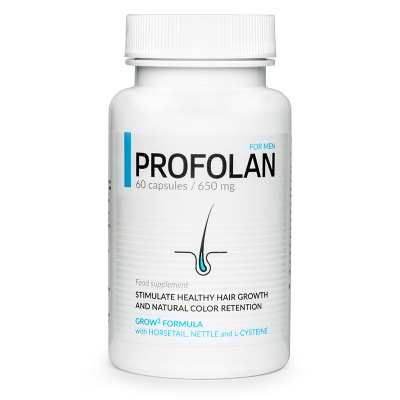
Our Recommendation — Profolan
Score: 5.7/10 · Best for: men with early thinning or increased shedding who want to test the nutritional angle for a full 90 days, photos in hand. Main caution: no ingredient in the bottle has a human trial for male hair loss, and the formula contains neither iron nor vitamin D. Fair trial: the three-bottle pack at $46.66 a bottle — it sits exactly inside the published 90-day money-back guarantee window.
What can each option realistically do?
Every number in this article is printed with its endpoint named — what was actually counted, in whom, over how long — because the comparison genre's favourite trick is to strip numbers of their endpoints and stack them. Maintained-or-improved is not regrowth. A hair count in a one-inch circle is not a percentage of your head.
A responder rate is not an average gain. When a page adds finasteride's 83% to a minoxidil figure of about 60% and announces a combined success rate of 94.1%, it has not discovered synergy; it has added two measurements of different things, in different trials, in different men, and produced a number no study ever reported.
This article debunks that pattern generically and never reproduces its arithmetic as a finding: percentages from different endpoints cannot be added, averaged, or multiplied into a combined claim. Read the table below the way it was built — row by row, endpoint by endpoint — and treat any source that will not tell you what its percentages are percentages of as advertising, not evidence.
| Option | Mechanism | Best trial number (endpoint named) | Time to judge | What it cannot do | What happens on stopping |
|---|---|---|---|---|---|
| Finasteride 1 mg (oral, prescription) | Blocks 5-alpha-reductase, lowering scalp and serum DHT | Hair count +107 hairs vs placebo at 12 months in a 1-inch circle (baseline 876, ≈ +12%); maintained-or-improved 83% vs 28% placebo at 2 years | 6–12 months; peak effect at 1–2 years | Cannot regrow hair from a fully miniaturised follicle or a slick bald area; cannot fix deficiency or thyroid shedding | Gains reverse; return toward baseline within ~12 months |
| Minoxidil (topical) | Non-hormonal: prolongs the growth phase and enlarges miniaturised follicles | Net +8 to +15 hairs/cm² over placebo; ~40–60% of men respond with some regrowth | 4–6 months minimum; judge at 6 months | Cannot block DHT or stop the underlying pattern process alone; cannot revive dead follicles | Benefits last only while used; gained hair is shed after stopping |
| Combination (finasteride + minoxidil) | DHT reduction plus growth-phase support, simultaneously | +9.22 hairs/cm² vs minoxidil alone (2025 meta-analysis, 7 RCTs, 396 men) | 6–12 months | Cannot exceed the follicles that remain viable; cannot restore a bald crown without transplant | Stopping either arm loses that arm's contribution; stopping both reverses gains |
| Supplement — if you are deficient | Corrects a demonstrated nutrient gap (e.g. iron, vitamin D, zinc) that is driving shedding | No regrowth percentage exists; benefit is measured as shedding normalising after levels correct — 3–6 months after normalisation for iron, 3–6 months for vitamin D, 2–4 months for zinc | Judge the blood result at ~3 months; judge hair at 3–6 months | Cannot block DHT, cannot reverse follicle miniaturisation, cannot treat pattern loss itself | If the deficiency recurs, shedding can recur; if diet sustains levels, no drug-style reversal occurs |
| Supplement — if you are not deficient | Provides nutrients you already have enough of | No consistent benefit in trials of non-deficient people; the best randomised biotin trial found no difference vs placebo | Any fair trial is 3–6 months on standardised photos — then stop if nothing changed | Cannot do any of the drug jobs: no DHT effect, no growth-phase drug effect, no regrowth evidence | Nothing to lose, because nothing was gained — which is the point of judging on a deadline |
| Profolan specifically | Nutritional support: Grow3 complex ( horsetail, taurine, nettle leaf, L-cysteine) plus zinc, copper, biotin and B-vitamins; no drug mechanism, no DHT mechanism | No human trial of the formula or its headline ingredients for male hair loss exists; no trial number can honestly be printed | 90 days — the maker's published guarantee window — on monthly photos | Cannot block DHT, cannot replace minoxidil or finasteride, cannot regrow bald areas; contains no iron and no vitamin D, so cannot correct the two strongest-evidence deficiencies | No reversal risk of the drug kind; equally, no drug-style gains to protect — stop at day 90 if photos show nothing and use the guarantee |
Two rows in that table do most of the work. The supplement-if-deficient row is a real, worthwhile intervention with no quotable regrowth percentage, because its outcome is the removal of a cause, measured in normalised bloods and settling shedding. The supplement-if-replete row is where almost all supplement marketing actually lives, and its trial number is a null.
Any comparison that gives those two rows the same expectations — or that borrows the drug rows' numbers to decorate either of them — has failed before its second paragraph.
How does finasteride work — and what did its biggest trial actually show?
Male pattern loss is follicle sensitivity to dihydrotestosterone, or DHT, made from testosterone by the enzyme 5-alpha-reductase. In a genetically sensitive follicle, DHT exposure shortens the growth phase cycle by cycle, and the follicle produces progressively finer, shorter hairs until it produces none that are visible. Finasteride inhibits that enzyme.
At the 1 mg hair-loss dose it lowers serum DHT by about 68–70%, which does not restore follicles to factory settings; it removes most of the signal that was shrinking them, allowing follicles that are still viable to hold their calibre and, in some cases, partially recover.
That mechanism explains both its strengths and its ceiling, and it explains why nothing in a vitamin panel replicates it: no nutrient in Profolan or any competitor formula inhibits 5-alpha-reductase to a clinically established degree in men, and Profolan does not even contain saw palmetto, the botanical most often marketed — on far weaker evidence — as if it did.
The anchor trial is Kaufman et al. 1998, the Phase III programme for finasteride 1 mg, which enrolled 1,879 men aged 18 to 41 with mild-to-moderate pattern loss. Read its three headline numbers as three different measurements, because they are.
First, the hair count: at 12 months, men on finasteride had gained an average of 107 more hairs than the placebo group in a standardised one-inch-diameter circle at the vertex, against a baseline count of 876 hairs in that circle — an advantage of roughly 12%, meaningful and visible in aggregate, and nothing like a restored head of hair on any individual scalp.
Second, the global assessment: at two years, 83% of finasteride men were rated maintained-or-improved, against 28% on placebo. This is the most quoted number in the category and the most misquoted, because maintained-or-improved combines two outcomes — not getting worse, which is itself a genuine therapeutic success in a progressive condition, and getting visibly better — into one figure.
Eighty-three percent is not a regrowth rate, and a page that prints it as one has misled you whether it did so carelessly or on purpose. Third, what the drug could not do appears in the placebo column as much as the treatment column: pattern loss continued in untreated men, which is why stabilisation counts as winning, and why starting earlier, while more follicles remain viable, beats starting late.
What are finasteride's side effects, stated at trial size?
Honesty about this comparison runs in both directions, so the adverse-event numbers get the same endpoint discipline as the benefits. In the FDA trial data, sexual side effects were uncommon and only modestly above placebo: decreased libido was reported by 1.8% of finasteride men versus 1.3% on placebo, and erectile dysfunction by 1.3% versus 0.7%.
Those gaps are real, they matter enormously to the individual men inside them, and they are also small in absolute terms — both halves belong in any account that claims to be evidence-led rather than sales-led in either direction.
Finasteride is a prescription medicine, it is not for women who are pregnant or may become pregnant, questions about mood, fertility plans and prostate-screening interpretation belong in its prescribing conversation, and none of that is this article's to settle.
What this article can settle is narrower: a man declining finasteride after weighing those numbers with his clinician has made a legitimate choice; a supplement seller who inflates those numbers to frighten him toward a capsule, or deflates the drug's trial results to make the capsule look comparable, has not.
Finally, the stopping rule, because it defines the commitment a supplement never asks for. Finasteride works only while the DHT signal stays suppressed. Stop it, DHT recovers, and the trial follow-up shows the gained ground reversing over roughly the following 12 months.
Peak benefit sits at one to two years, judgement before six months is premature, and the honest description of the drug is a long-term holding treatment with partial regrowth in responders — the strongest single-drug evidence in this entire comparison, and still a holding treatment. That is the bar a "natural finasteride alternative" would have to clear.
Nothing in the supplement rows of the table clears it, approaches it, or has been tested against it in men at all.
How does minoxidil work — and how much regrowth is realistic?
Minoxidil takes the opposite route to the same follicle. It does not touch DHT at all.
Originally a blood-pressure medicine, it is understood to prolong the follicle's growth phase, shorten its resting phase, and increase the calibre of hairs that miniaturised follicles still produce — which is why it can help even where the hormonal driver continues, and why its gains are generally described as thickening and density in thinning areas rather than restoration of a hairline that has already receded.
In the trial literature for topical use in men, the net gain over placebo runs at about 8 to 15 additional hairs per square centimetre after months of twice-daily use.
Convert that out of the unit that flatters it: across a thinning crown, that is a real cosmetic difference for many men, photographed side by side — and it is a density improvement measured in single digits and low teens per square centimetre, not the return of teenage coverage.
The responder framing matters as much as the average. Roughly 40–60% of men are commonly described as responders who get some regrowth; for most of the rest, the realistic benefit is slower loss and better calibre from the follicles that remain.
Averages hide that split — a man budgeting for minoxidil should budget for the responder coin-flip, judged on his own photographs at six months, not for the mean of a trial he was not in. Two practical costs belong in the same paragraph as the benefit.
The first is the initial shed: about 9–16% of men experience increased shedding in the early weeks, as resting hairs make way for the next cycle — alarming if nobody warned you, expected if they did, and a reason men abandon a working treatment at exactly the wrong moment.
The second is permanence of effort, not of result: minoxidil works only while it is used. Stop, and the hairs it was sustaining are shed over the following months.
Scalp irritation from the vehicle is its commonest everyday problem, unwanted facial hair growth and, rarely, cardiovascular symptoms at misuse-level exposure complete a side-effect picture that is usually manageable and should still be read on the product's own labelling, not taken from an article — including this one.
Is using both drugs together stronger than either alone?
Yes — by the most decision-relevant margin in this comparison, and by an amount that can be stated without stacking a single percentage. Because the two drugs attack different parts of the problem — finasteride removes most of the miniaturising signal, minoxidil supports the growth phase of what remains — combining them outperforms minoxidil alone in head-to-head synthesis.
A 2025 meta-analysis pooling 7 randomised trials and 396 men, comparing topical minoxidil combined with topical finasteride against minoxidil alone, found the combination ahead by 9.22 hairs per square centimetre, with a small additional advantage in hair diameter.
Note what that number is: an incremental difference in a named unit, hairs per square centimetre, against an active comparator — not a success rate, not a percentage of anything, and not permission to invent one. Oral finasteride plus topical minoxidil is the more familiar real-world pairing and follows the same logic through the same two mechanisms, under a prescriber's direction.
Hold that paragraph against the genre trick named at the top of this article, because the contrast is the lesson. A legitimate combination claim names its trials, its comparator and its unit.
The fabrication pattern names none of them: it takes finasteride's 83% — which, to repeat the correction until it sticks, is a maintained-or-improved rating, not regrowth — places a roughly 60% minoxidil figure beside it, drawn from a different endpoint in a different population, and adds them into a combined figure above 90% that no trial enrolled, measured or reported.
The resulting number then does commercial work: whatever is being sold next on the page only has to beat a fantasy to look reasonable, or, in the slicker version, a branded natural product is crowned a reasonable first-line alternative against a drug benchmark that was never real.
If a comparison page cannot tell you, for every percentage it prints, percentage of whom, measured how, at what month, against what comparator — close it. That test alone removes most of this category's marketing from your decision.
Where do supplements fit — if you are deficient, and if you are not?
Supplements enter this comparison through a side door, and keeping them there is not an insult to them; it is their actual evidence position. The deficiency door is real.
A man shedding diffusely because his ferritin is low, his vitamin D is deficient, or his zinc status has collapsed under a restrictive diet or gut disease has a cause that neither finasteride nor minoxidil addresses — the drugs do not stock his iron stores — and correcting that cause is legitimate treatment of that shedding.
The review literature frames it at exactly that temperature: Almohanna et al. 2019 concluded that micronutrients play an important, but not entirely clear, role in non-scarring hair loss and that deficiency may be a modifiable risk factor, while explicitly calling for the large double-blind placebo-controlled trials the field still lacks.
Drake et al. 2023, systematically reviewing nutritional supplements for hair loss in JAMA Dermatology, likewise found a small, mixed literature that supports correcting demonstrable problems far more confidently than it supports any branded formula.
Through the other door — the man with normal bloods and pattern loss, which is most men reading a page like this — the record thins to a null. Yelich et al. 2024 found no study demonstrating supplement benefit in healthy, non-deficient individuals, with the best randomised trial showing no difference from placebo.
Patel et al. 2017's case review of the most famous hair nutrient of all, biotin, found an underlying pathology in every reported case where supplementation helped. That pair of findings is the supplement ceiling stated without cruelty and without varnish: nutrients are rate-limiting only when they are missing.
Above sufficiency, more of them does not push follicle biology past its genetic instructions, any more than a second tank of fuel makes a car faster.
A supplement can therefore sit in a pattern-loss plan in exactly two honest roles — as the correction of a tested deficiency running alongside drug treatment, or as a general nutritional safety net a man chooses with his expectations set to hair quality and shedding support rather than regrowth. Sold in any third role — DHT blocker, drug alternative, regrowth system — it has left its evidence behind.
What exactly is Profolan in this comparison?
Place the product on the table with the same discipline as the drugs. Profolan (our score: 5.7/10) is a 60-capsule bottle, taken as 2 capsules a day preferably 30 minutes before a meal.
Per daily serving, its Grow3 complex and supporting panel deliver horsetail extract standardised to 7% silica at 400 mg, taurine 200 mg, nettle leaf extract 100 mg, L-cysteine 100 mg, biotin 900 µg, vitamin E 24 mg, thiamin 20 mg, zinc 15 mg, vitamin B6 10 mg, vitamin A 800 µg and copper 1 mg.
Now the three negatives that define it in this comparison, stated plainly and without softening: it contains no minoxidil, it contains no finasteride, and it contains no saw palmetto. It is not a natural version of either drug. No ingredient in it has a human trial for male pattern hair loss.
Its nettle is leaf at 100 mg — not the root the prostate literature discusses, and with no established human DHT evidence behind either part at this use — so the DHT-blocker costume some spam pages dress this formula in does not survive contact with its own label.
What it does have deserves the same plain statement. The panel is fully published, which in this category is not nothing. Its zinc at 15 mg is paired with copper at 1 mg — the pairing sustained zinc intake requires, and one many formulas omit.
Its prices are $69.99 for one bottle, $139.98 for the buy-2-get-1 pack ($46.66 per bottle) and $209.97 for the buy-3-get-3 pack ($35.00 per bottle), plus $12 shipping per order.
And the maker publishes a genuine 90-day money-back guarantee — the only published guarantee among the six products in this wave — which aligns, unusually and usefully, with the minimum window in which a nutritional trial can be judged at all. None of those facts moves Profolan one row up the ceiling table.
Together, they make it the most honestly testable occupant of the supplement row: a mid-priced nutritional formula whose trial comes with an exit. A man who understands he is testing nutritional cover, photographs his crown monthly, and treats day 90 as a verdict date is using this product exactly as its evidence permits.
A man who buys it instead of the finasteride conversation his pattern loss calls for is not — and no guarantee window fixes a wrong-tool purchase, it only refunds it.
Can anything regrow hair where the scalp is completely bald?
No drug in this article can, no supplement can, and understanding why will save you more money than any other paragraph here. Pattern loss is a process of miniaturisation with an endpoint.
Cycle by cycle, a sensitive follicle produces a finer hair, then a shorter one, then a barely visible vellus wisp, until the follicle has effectively retired and the skin where it sat is smooth and shiny.
The treatments above work on follicles that are still in the game: finasteride protects viable follicles from the signal shrinking them, and minoxidil coaxes better output from follicles that still cycle. A fully miniaturised follicle has nothing left to protect or coax.
That is why the trial populations in this article were men with mild-to-moderate loss, why results concentrate at the crown and mid-scalp rather than on long-bare temples, and why a slick, shiny bald area — the late Norwood stages, where loss has completed at the crown or joined crown to hairline — is outside every non-surgical claim that can honestly be made.
The single intervention that changes a bald area is transplantation, and even it does not create hair: it redistributes it, moving follicles from the DHT-resistant donor zone at the back and sides — the zone pattern loss spares, which is itself the diagnostic tell that separates pattern loss from whole-scalp shedding — into the bald area, where they keep their resistant character.
It is surgery, with a surgeon's price, healing time and judgement about future loss, and it usually still leans on drug treatment to protect the native hair around the grafts. Everything else marketed for a bald crown — every lotion, laser cap, oil and capsule, Profolan emphatically included — is at best protecting or improving the hair that surrounds it.
Judge claims by the follicle, not the photograph: before-and-after images shot at different angles, lengths and lighting can manufacture a crown out of longer neighbouring hair, which is why this article's judgement protocol insists on standardised photos of your own head rather than borrowed ones from a sales page.
If an area has been smooth and shiny for years, your realistic menu is transplant, a hair system, or shaving it — all legitimate choices — and any product that inserts itself onto that menu as a fourth option is asking to be paid for a follicle that no longer exists.
Can you take a supplement alongside minoxidil or finasteride?
Yes — that adjunct role is, in fact, the supplement's most defensible seat at the table — provided it is run as a protocol rather than a pile-up. Four rules govern it. First, test before you stack.
Run the deficiency panel from this set's companion article — ferritin with a blood count, 25-hydroxyvitamin D, thyroid function, serum zinc, with B12 and folate where your diet or medicines suggest risk — so that any supplement you add is answering a measured gap, and so that a thyroid or iron cause of added shedding is not masked by drug treatment aimed only at the pattern.
Second, tell the laboratory about biotin before any blood draw. Profolan carries 900 µg of biotin a day, and the FDA Safety Communication 2017/2019 warned that high-dose biotin distorts common assays — thyroid results that can mimic hyperthyroidism, falsely low troponin on susceptible tests, and interference across hormone panels.
Disclose everything you take, follow the laboratory's pause instruction for your tests, and never postpone urgent testing for a supplement washout. Third, judge each treatment on its own clock.
The drugs get six to twelve months, assessed on standardised photographs — same light, angle, parting, length where possible — taken at baseline and then at intervals, because daily mirror checks cannot resolve changes this slow and shedding counts alone will mislead you through minoxidil's early shed.
The supplement gets its own, shorter verdict date — for Profolan, day 90, inside its guarantee — judged on shedding and hair quality, not credited with regrowth. Fourth, and most ignored: do not credit or blame the supplement for the drug's timeline.
If density improves at month nine of finasteride, the trial-supported explanation is finasteride, which peaks at one to two years; if shedding spikes at week three of minoxidil, the documented explanation is minoxidil's initial shed, which affects 9–16% of users — not the capsule you started the same month. Men who ignore this rule abandon working drugs over supplement-era noise and renew useless supplements on drug-earned results, paying twice for the same confusion.
Two boundaries complete the protocol. Adding a supplement does not license reducing, spacing or pausing a prescribed drug to "let the natural product work" — that experiment trades a measured effect for an unmeasured one, and the reversal clock on finasteride starts the day you stop it.
And any new symptom after starting a combination — scalp inflammation, palpitations, sexual changes, mood changes — goes to the prescriber or clinician, not to a process of elimination conducted by dropping products at random.
Adjunct means the supplement works around the treatment, in a supporting role, with its own modest job description: cover the nutritional gaps the drugs were never designed to cover, support the quality of the hair the drugs are working to keep, and stay out of the way of the endpoints that matter.
Who Should Buy, Who Should Skip
Consider Profolan only if: you have already had the drug conversation with a clinician (whether you chose drugs or declined them on informed grounds), you have tested for deficiency or understand you are adding general nutritional cover rather than treatment, and you will judge it on standardised photographs at day 90 inside its guarantee.
Skip it if: you need DHT blockade or regrowth evidence, you have a fully bald area you expect it to repopulate, you are buying it as a cheaper replacement for a prescription you have not discussed, or you are expecting anything a drug trial number was printed next to — because this product has no such number, and no seller should imply otherwise.
A Stronger Alternative in This Category
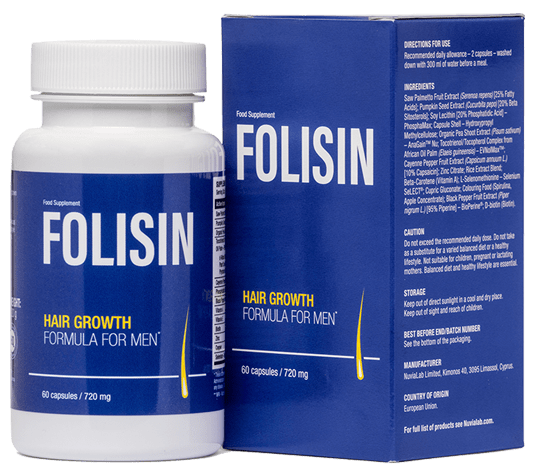
The stronger alternative: Folisin · 5.9/10The other men's hair formula we reviewed publishes every amount — including AnaGain™ Nu at the exact 100 mg dose used in its human study. No Profolan ingredient has a human hair trial behind it.
Our Recommendation — Profolan
Score: 5.7/10 · Best for: men with early thinning or increased shedding who want to test the nutritional angle for a full 90 days, photos in hand. Main caution: no ingredient in the bottle has a human trial for male hair loss, and the formula contains neither iron nor vitamin D. Fair trial: the three-bottle pack at $46.66 a bottle — it sits exactly inside the published 90-day money-back guarantee window.
Frequently Asked Questions
Are hair supplements as effective as minoxidil?
No. Topical minoxidil has a placebo-controlled regrowth record of net +8 to 15 hairs/cm² in men; a supplement in a non-deficient man has no regrowth trial record at all. The two cannot be ranked side by side as alternatives; one is a drug, the other is nutritional cover.
Are hair supplements as effective as finasteride?
Further still from comparable. Finasteride lowers serum DHT by about 68–70% and, in Kaufman et al. 1998 (n = 1,879), kept hair maintained or improved in 83% versus 28% on placebo at two years, with a +107-hair advantage over placebo in a 1-inch circle at 12 months. No supplement ingredient has been shown to reproduce that mechanism or that result.
Can I take a supplement instead of minoxidil or finasteride?
Only if you understand you are not substituting — you are declining the drug evidence and accepting a far weaker position. If the reason for declining is cost, side-effect concern or a genuine preference, discuss it with a clinician rather than quietly swapping a tested treatment for an untested one.
Is saw palmetto a natural finasteride?
That framing is handled in full in this set's DHT-blocker article, but in short: no. Saw palmetto's best trial numbers sit far below finasteride's, its mechanism in men is unproven at supplement doses, and Profolan — the product in this set — does not even contain it.
What if I am deficient — should I still consider a drug?
If you have pattern loss and a deficiency, treat both causes in parallel: correct the deficiency under a clinician's guidance, and separately decide on drugs for the pattern component. A corrected ferritin level will not protect follicles from DHT, and finasteride will not fill an iron store.
How long before I can judge each option fairly?
Minoxidil: six months. Finasteride: six to twelve months, peak at one to two years. A supplement: judge blood levels at about three months and hair at three to six months after normalisation for a true deficiency, or ninety days on photographs for a general formula like Profolan, inside its guarantee. Judging any of them at week four is judging a hair cycle you have not completed.
What happens if I stop each treatment?
Finasteride's gains reverse within roughly twelve months as DHT recovers. Minoxidil's sustained hairs are shed over months. A supplement stopped after correcting a deficiency keeps working only while the deficiency stays corrected by diet; a supplement that was never correcting anything loses nothing, because it gained nothing.
Take 2 capsules a day preferably 30 minutes before a meal, with water, and keep to the same schedule each day so your own 90-day judgement is comparing like with like.
Last reviewed: October 2026.
