
- Quick Answer
- Why Hair Sets the Clock
- The Timelines on Record
- What brand science pages concede
- What retail pages promise
- What the Folicerin maker's own cited regimen assumed
- How to Judge Fairly at Month Three
- Making the photographs do the work
- What Happens If You Stop?
- The Hairline Question
- Our Verdict
- Frequently Asked Questions
- Can a hair loss shampoo work in 4 weeks?
- How long did the studies behind caffeine shampoo run?
- What happens to my hair if I stop using the shampoo?
- Should I judge by shedding or by regrowth?
- Does the hairline respond more slowly than the crown?
- Read This Next
Disclosure: This article contains affiliate links. If you buy through them, we may earn a commission at no extra cost to you. It never changes our conclusions.
Quick Answer
Judge a hair loss shampoo in months, not weeks. The category's honest frame is three to six months of consistent use before any verdict — because that is how long hair biology takes to show a change, and because the trials behind the ingredients measured at sixteen weeks to six months, never at a fortnight.
Retail promises of visible results in four to six weeks are marketing, and we name them as such below. Even the timeline attached to Folicerin's own ingredient system — a maker-cited regimen — ran 56 days of daily application. Nothing in this category has a two-week evidence base.
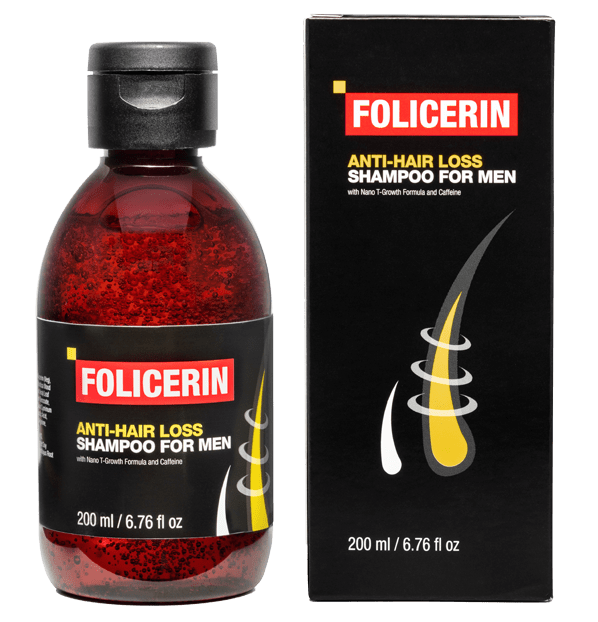
The practical consequence: one bottle is never a trial. At Folicerin's directed five uses a week, one bottle lasts about a month — so an honest test is a three-to-six-bottle commitment, with no money-back guarantee behind it. Price the commitment, not the bottle.
Our Recommendation — Folicerin
Score: 4.6/10 · Best for: men with early thinning who want a botanical, caffeine-based shampoo as a cosmetic add-on alongside whatever else they are doing. Main caution: no money-back guarantee is published, and the label lists ingredient names with no amounts. Fair trial: the three-bottle Standard pack — about three months at directed use, $111.98 with shipping.
Why Hair Sets the Clock
A hair follicle works on a cycle measured in years for the growth phase and months for everything else. A follicle that sheds a hair today does not produce its replacement on demand; it rests, resets, and only then begins growing a new shaft, which itself emerges at roughly a centimetre a month.
That biology imposes two hard limits. First, any genuine effect — more follicles in the growth phase, less shedding — needs at least one full cycle transition to become visible, which is a season, not a month. Second, early "results" people report are almost always the cosmetic tier: cleaner scalp, coated shafts, less breakage. Those arrive in days, and they are real, but they are not the effect the timeline question is asking about.
It also means the success state is easy to miss. For most products in this category, success is stabilisation — shedding slowing, density holding. Nothing visibly happening, sustained over months, is the outcome. A buyer expecting visible regrowth on a deadline will score a working product as a failure and a useless one as a success whenever shedding fluctuates naturally.
Work through that sequence slowly and the delay stops looking like evasion. A follicle first has to leave its resting state, then begin producing a new shaft, then grow that shaft long enough to emerge and contribute to coverage. Each step belongs to a different part of the cycle, and none can be hurried by judging sooner.
A change at the follicle therefore announces itself late at the mirror. By the time a difference could be photographed, the biological event behind it happened well before the photograph. The reverse also holds: a quiet month at the mirror does not prove nothing changed below the surface during that same month.
Shedding complicates the picture further because a shed is not always the end of a story. A hair leaving can be part of a follicle resetting before its next growth phase, so a period of heavier shedding can precede a period of improvement. Counting one alarming week as a final verdict mistakes a transition for an outcome.
That possibility cuts both ways, and it should not be turned into a promise. A shed can precede a gain, but shedding alone is not evidence that a gain is coming. The honest reading is narrower: early shedding is too ambiguous, on its own, to score a product as working or failing.
Pattern loss adds its own slow arithmetic underneath. While a product is being judged, untreated follicles continue their gradual miniaturisation in the background. Holding density steady against that background is therefore a different result from simply staying the same on an unchanging head — another reason stabilisation deserves to be counted as an outcome.
All of this is qualitative on purpose. The exact length of any one person’s cycle is not the point, and it is not something a shampoo label can tell you. The point is the direction of the arithmetic: follicle time is long, visible time is longer, and any honest judging window has to respect both.
The Timelines on Record
What brand science pages concede
Read past the advertisements to the science and FAQ pages, and the category's own brands concede the honest frame. Scandinavian Biolabs, a caffeine-shampoo brand, tells buyers to allow three to six months. Alpecin's FAQ puts first assessment after about three months. Trybello's guidance spans two to six months.
These are competitor statements, quoted as claims — but they are claims made against the brands' own interest in fast promises, which is why we treat them as the category's realistic floor. When the sellers themselves say a season, a four-week promise from a retailer deserves the discount applied below.
What retail pages promise
Retail FAQs are where the timeline shrinks: medino's retail guidance suggests four to six weeks for visible results from caffeine shampoo. Nothing in the trial record supports that number. The caffeine trials ran six months (a leave-on liquid) and twenty-four weeks (a two-ingredient shampoo); the follicle-cycle arithmetic forbids judging regrowth at week five.
Four to six weeks is, not coincidentally, about the length of a first bottle and a returns window. A timeline chosen to fit a purchase cycle rather than a growth cycle is a sales instrument. If a product works, it works on hair's schedule — the seller's schedule is evidence only about the seller.
What the Folicerin maker's own cited regimen assumed
Folicerin's headline ingredient figure — an 8.7% increase in average density of new hair strands, cited by the maker for its Nano T-Growth system — comes from a regimen applied once a day for 56 days. Even taken entirely at face value, the maker's own cited evidence assumed eight weeks of daily use before measuring anything.
Set that beside Folicerin's actual directions — five times a week, not daily — and the honest timeline stretches further: the product is used less often than the regimen behind its only number. A buyer judging this shampoo at week four is judging it before even the maker's cited schedule would have produced its measurement.
How to Judge Fairly at Month Three
Photographs first. Take them before the first wash: same room, same light, same angle, hair dry and unstyled, crown and both temples and the hairline. Repeat monthly under the same conditions. Hair assessment from memory and mirrors is hopeless — lighting and mood move more than density does.
Shedding counts second. A consistent rough count — hairs in the shower drain or on the brush across a week — gives a trend, and shedding trend is the metric this category can plausibly move. Expect noise: shedding varies with season, stress, illness and washing frequency, which is why a trend over weeks beats any single alarming morning.
Third, fix the verdict date in advance. Three months for a preliminary read, six for a decision. Deciding daily invites quitting at week five of a six-month process — or, just as wastefully, continuing for a year past the point where six honest months already gave the answer.
Making the photographs do the work
The photograph method works only if the conditions are boringly identical. Use the same room and the same light source each time, because overhead light, daylight and flash each invent a different density. Stand in the same place, hold the camera at the same angle, and photograph the same areas in the same order.
Hair length and styling need the same discipline. Longer hair covers more scalp, freshly washed hair sits differently from unwashed hair, and product can separate or clump strands. Photograph dry, unstyled hair, ideally at a similar length each month, or the comparison will measure the haircut and the styling rather than the scalp.
Take the set before the first wash and then monthly, even in months when nothing seems to be happening. The uneventful months are the baseline that makes a later change believable. A photograph taken only when you feel hopeful or alarmed is a mood record, not a measurement record.
Mirror checks mislead for almost opposite reasons. You see your hair daily, under changing light, at your most self-critical angle, and gradual change is invisible at that frequency. Memory fills the gaps with how the hair felt last month, which is why two honest people can remember the same head differently.
Shedding counts mislead differently: they feel objective because they are numbers. But the count changes with how often you wash, how you brush, and which hairs were already detached and waiting. A rough weekly trend, recorded the same way, is useful. A single morning’s handful, treated as data, mostly measures anxiety.
What Happens If You Stop?
Whatever a shampoo is doing, it stops doing it when you stop washing with it. Cosmetic coating ends with the next ordinary wash. Any scalp-health benefit persists only while the scalp stays managed. And if an ingredient was genuinely supporting follicles, that support is use-dependent, exactly as minoxidil's is — the follicle returns to its underlying programme.
Nothing is lost that was permanently gained, because nothing permanent was gained. That is not a criticism unique to shampoo; it is the nature of every non-curative hair intervention. But it belongs in the cost arithmetic: a five-times-a-week product is not a course of treatment with an end date. It is a subscription to a routine, priced monthly, indefinitely.
For Folicerin that arithmetic is concrete: $49.99 a bottle, roughly monthly, plus $12 shipping per order. Six months of fair judging costs several hundred dollars at single-bottle pricing — a figure worth comparing, before starting, with six months of the treatments that carry actual trial evidence.
Put the commitment into bottles and the decision becomes clearer. At the directed five uses a week, the article’s own working figure is roughly one bottle a month. A three-month preliminary judgement is therefore about three bottles; the full six-month decision window is about six, bought before a fair verdict exists.
Price those bottles with the numbers already given. Three bottles at $49.99 come to $149.97 before shipping; six come to $299.94 before shipping. Add $12 shipping per order when bottles are ordered singly, and the six-month figure rises by $72. The bottle looks modest; the judging window is the real purchase.
An unjudged quit wastes that arithmetic in a particular way. Stopping at week five has spent one bottle and bought no answer, because the window the product needed was never completed. The same bottle, inside a finished three-to-six-month judgement with photographs, at least purchases information: a decision you do not have to remake.
A judged quit is therefore cheaper in the only sense that matters, even when the verdict is negative. It closes the question. An unjudged quit leaves the question open, inviting the same product — or the next one making the same promise — to be bought again later on the same hope and the same incomplete test.
The indefinite side of the arithmetic belongs in the same calculation. If the verdict at six months is positive, the cost does not end there; it repeats for as long as the routine is kept. Deciding in advance what a positive result is worth, per month and per year, prevents a fair trial becoming an unexamined subscription.
The Hairline Question
Frontal loss is where every topical category is weakest, and shampoo is no exception. The hairline and temples miniaturise early, respond least even to minoxidil, and are the hardest area to photograph consistently — three reasons "it's working at the crown but not the front" is the commonest honest report in this category.
No shampoo has frontal-regrowth evidence of any kind. If your loss is concentrated at the hairline, set the expectation at zero for regrowth from a rinse-off product and judge — if you judge at all — on shedding and the crown. A receding hairline that matters to you is a dermatologist and prescription conversation; our guide to whether hair supplements work for men applies the same triage to the oral side of the shelf.
Our Verdict
The timeline is the claim this category most often lies about, because it is the claim buyers most want shortened. The record says: hair moves in months, trials measure in months, brands' own science pages concede three to six months, and only retail copy promises weeks.
So the answer to the title is a method, not a number: start photographs today, use the product exactly as directed, and deliver a verdict at six months — three at the earliest. Anything a shampoo appears to do before that is cosmetics, and anything it hasn't done by then, it isn't going to. The same discipline governs oral formulas; our guide to how long hair supplements take to work sets the identical rule there.
Our Recommendation — Folicerin
Score: 4.6/10 · Best for: men with early thinning who want a botanical, caffeine-based shampoo as a cosmetic add-on alongside whatever else they are doing. Main caution: no money-back guarantee is published, and the label lists ingredient names with no amounts. Fair trial: the three-bottle Standard pack — about three months at directed use, $111.98 with shipping.
Frequently Asked Questions
Can a hair loss shampoo work in 4 weeks?
Not at anything beyond cosmetics. Cleaner scalp, coated shafts and less breakage can show within days, but follicle-level change needs a growth-cycle transition measured in months. The caffeine category's own trials ran 24 weeks to six months. Retail promises of visible regrowth in 4–6 weeks have no trial behind them.
How long did the studies behind caffeine shampoo run?
Months. The best-known human caffeine study (Dhurat 2017) ran six months — and tested a leave-on liquid, not a shampoo. The two-ingredient shampoo trial (Celleno 2025) ran 24 weeks. Even Folicerin's maker-cited ingredient regimen ran 56 days. Every serious measurement in this category sits between two and six months.
What happens to my hair if I stop using the shampoo?
The effects stop with the use. Coating washes out, scalp benefits fade as the scalp returns to its unmanaged state, and any follicle support was use-dependent. Nothing permanent was built, so nothing permanent is lost — but a five-times-a-week product should be budgeted as an indefinite routine, not a course with an end.
Should I judge by shedding or by regrowth?
By shedding and by photographs. Stabilisation — slower shedding, density holding — is the realistic best outcome for a shampoo, and it is invisible without records. Judge on standardised photos and a rough weekly shed count at three and six months. Judging by expected regrowth scores every product in this category as a failure, including the honest ones.
Does the hairline respond more slowly than the crown?
Yes — frontal loss is the least responsive area for every topical intervention, minoxidil included, and no shampoo has frontal-regrowth evidence at all. If your concern is the hairline specifically, a shampoo trial is the weakest tool available; a dermatologist's assessment and the prescription options are where that conversation belongs.
Last reviewed: October 2026. This article is educational and is not medical advice.
