
- Quick Answer
- Frequency: What the Labels and Studies Actually Use
- Caffeine shampoos: 3–5 times a week
- Alpecin's daily-use position
- Medicated shampoos: 2–3 times a week
- Can You Use a Hair Loss Shampoo Every Day?
- What over-washing actually looks like
- Contact Time: The Two-Minute Question
- The rinse is part of the dose
- Should You Leave It On Longer Than the Label Says?
- A Routine That Matches the Evidence
- Two worked weekly schedules
- Our Verdict
- Frequently Asked Questions
- How many times a week should I use a caffeine shampoo?
- Can I use Folicerin every day instead of five times a week?
- How long should hair loss shampoo stay on my scalp?
- Does leaving shampoo on longer make it work better?
- What should I use on the days I don't use the hair loss shampoo?
- Read This Next
Disclosure: This article contains affiliate links. If you buy through them, we may earn a commission at no extra cost to you. It never changes our conclusions.
Quick Answer
The studied category range is three to five uses a week, with two to five minutes of contact before rinsing. Medicated shampoos sit at the long-contact end — the ketoconazole label specifies three to five minutes and warns against longer. Caffeine shampoos sit at the short end, around two minutes.
Folicerin's directions — five times a week, left on for two minutes — sit inside the frequency range and at the short end of the contact range. Both halves of that sentence matter: the frequency is unremarkable, and the contact time is the minimum the category uses.
And the experiment buyers most often improvise — leaving it on longer to make it work harder — has no study behind it at all. What longer contact demonstrably buys is irritation exposure. The label's two minutes is not a challenge to improve on; it is the only version of the routine anyone has actually specified.
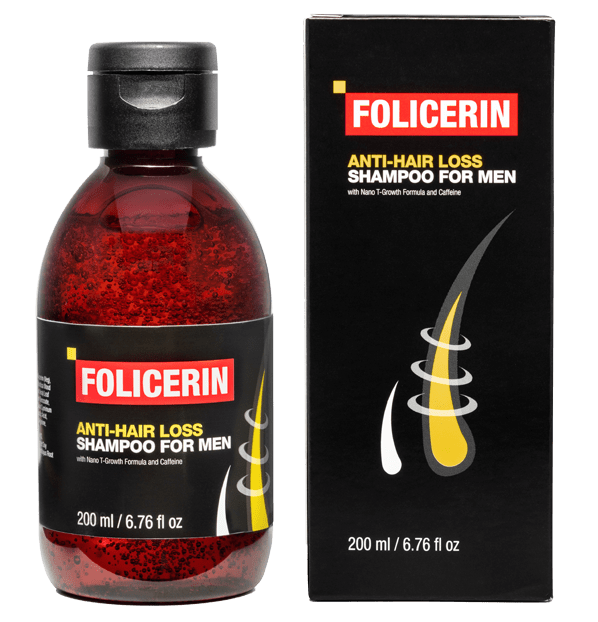
Our Recommendation — Folicerin
Score: 4.6/10 · Best for: men with early thinning who want a botanical, caffeine-based shampoo as a cosmetic add-on alongside whatever else they are doing. Main caution: no money-back guarantee is published, and the label lists ingredient names with no amounts. Fair trial: the three-bottle Standard pack — about three months at directed use, $111.98 with shipping.
Frequency: What the Labels and Studies Actually Use
Caffeine shampoos: 3–5 times a week
Brand guidance for caffeine shampoos converges on consistency over intensity: Scandinavian Biolabs, for example, directs three to five uses a week. The logic is sound for a rinse-off product — the scalp is re-exposed regularly, and the routine survives contact with real life. A schedule a buyer actually keeps beats a heroic one abandoned in week three.
Note what this range is: manufacturer guidance, not trial design. The caffeine shampoo trial on record used its own fixed schedule, and no study has compared three against five against seven uses a week. Frequency within the 3–5 band is a matter of routine design, not a dose anyone has optimised.
Alpecin's daily-use position
The category leader argues the other way: Alpecin positions its caffeine shampoo for daily use, with a two-minute leave-on. Daily washing is tolerated by most scalps, and for men who wash daily anyway, the shampoo simply replaces the ordinary one. It is a defensible routine — and, again, a brand position rather than a studied comparison.
Medicated shampoos: 2–3 times a week
Medicated products run less often and say so on regulated labels. Ketoconazole shampoo is typically used twice a week for dandruff treatment courses, with other washes filled by an ordinary shampoo. The pattern generalises: the stronger and more drug-like the product, the more its label rations frequency and contact — the opposite of the "more is better" instinct.
Our live guide to ketoconazole shampoo and hair loss covers the medicated benchmark in full, including why its contact-time instructions are the category's most honest label.
Can You Use a Hair Loss Shampoo Every Day?
For most scalps, daily washing with a cosmetic shampoo is tolerable — Alpecin's whole position rests on it. Dryness and irritation are the usual costs, and they are scalp-dependent: an oily scalp may prefer daily washing; a dry or reactive one may not.
But tolerable is not the same as better. No study shows daily use of a caffeine shampoo outperforming five-times-a-week use, because the comparison has never been run. Folicerin directs five times a week — not daily — and that direction is the only schedule attached to the product. Using it daily is not "following the evidence more closely"; it is leaving the maker's own instructions for an untested variant that also empties the bottle faster.
The practical rule: follow the label you bought. If the label says five times a week, five times a week is the routine that any later judgement is about. Improvised frequency makes the product unjudgeable — at month three you will not know whether the schedule or the shampoo produced the result.
What over-washing actually looks like
The early signs are unglamorous rather than dramatic. A scalp that feels tight or dry after washing, flakes that appear as the scalp dries, and itching that starts during the wash all point the same way: the cleanser is removing more than the scalp can comfortably replace between washes.
None of those signs means damage has been done. They are exposure feedback, and they arrive early enough to act on. The useful response is the one this article keeps returning to: fewer washes with the active product, shorter contact, or a milder cleanser on the other days.
The opposite sign confuses buyers more: a scalp that feels oilier by the afternoon after a morning wash. That quick return of oil is often read as proof the shampoo is failing, or as a reason to wash harder and longer the next day.
Reason it through before acting on it. Oil returning quickly can simply reflect the scalp's own pattern: an oily scalp stays an oily scalp whether it is washed once or twice a day. Washing more often does not retrain it, and no label in this category promises that it will.
That is why the rebound-oiliness story should not drive the schedule. If oil returns but there is no dryness, tightness or itching, the scalp is tolerating the routine. If dryness and itching arrive alongside the oil, the problem to solve is exposure, not oil — and exposure is reduced, not increased.
Read together, the signs give a simple decision rule. Comfortable scalp and a kept schedule: change nothing. Dryness, tightness or itching that tracks with wash days: reduce exposure first. Oiliness alone, without discomfort: leave the schedule alone, because oiliness by itself is a scalp trait, not a verdict on the shampoo.
Contact Time: The Two-Minute Question
Contact time is where labels quietly disagree. Medicated shampoos specify three to five minutes: the Nizoral (ketoconazole) patient information leaflet instructs users to leave the lather on for three to five minutes and not to leave it on longer than five. That is a regulator-reviewed instruction for a drug-strength product.
Caffeine shampoos specify about two minutes — Alpecin's direction, and Folicerin's. Penetration research gives the two minutes some support: caffeine was detected in blood within minutes of scalp application with follicles open, so delivery begins fast. What no study shows is a contact-time dose-response for shampoo — that four minutes delivers twice the follicle exposure of two, or works twice as well. The curve has simply never been measured for a rinse-off product.
So the honest summary is narrow: two minutes is enough for delivery to start, three to five is the medicated convention, and beyond five there is no evidence at all — only exposure. Contact time is a label specification to follow, not a dial the buyer can tune toward better results.
The rinse is part of the dose
Buyers time the wait and then rush the rinse, as if the two minutes were the whole instruction. Reason about what rinsing does: it ends the contact the label timed. A hurried rinse leaves lather, surfactant and fragrance sitting on the scalp long after the timer stopped, quietly extending exposure the label never authorised.
The same hurried rinse undermines the efficacy side too. Residue left at the hairline and behind the ears is not delivered ingredient working longer; it is cleanser that was meant to leave. Thorough rinsing is the step that makes the stated contact time the actual contact time, in both directions.
Practicalities follow from that reasoning. Rinse until the water runs clear and the hair no longer feels slippery, and pay attention to the edges — hairline, ears and nape — where lather collects and where irritation from residue most often shows itself first.
Water temperature belongs in the same unglamorous category. Very hot water adds its own drying stress to a wash that is already a detergent exposure, while lukewarm water rinses just as completely. Nothing in any label discussed here asks for hot water, and comfort is the only guide the evidence leaves.
One last rinse habit completes the picture. If you wash twice in one shower, the directed contact time applies to the wash you are counting, and the rinse after it still has to be complete. Doubling the wash while halving the rinse is improvisation again — the same unlabelled routine wearing a more thorough disguise.
Should You Leave It On Longer Than the Label Says?
This is the experiment to skip. Folicerin directs two minutes. Leaving it on for ten is an unstudied change with a known cost side: every extra minute is extra exposure for the scalp's surface, and irritation — from surfactants, fragrance and botanicals alike — scales with contact. Our side-effects guide details how contact reactions build exactly this way.
The benefit side, by contrast, is imaginary. There is no retention or efficacy study for this product at any contact time, and its label publishes no ingredient amounts to "deliver more of". You cannot increase a dose that was never stated. Longer contact with an unauditable formula buys risk denominated in a currency — irritation — that is real, for a benefit denominated in one that is not.
If two minutes feels too short to be serious, that instinct is worth listening to — as information about the format, not as a cue to improvise. A rinse-off product's ceiling is set by its format. Buyers who want hours of scalp contact are describing a leave-on product, and should compare those instead.
A Routine That Matches the Evidence
Assembled from the labels and studies above, a defensible routine looks like this. Use the shampoo at its directed frequency — for Folicerin, five times a week; for a medicated shampoo, its label's two or three. Massage it in, leave it for the directed contact time, and rinse fully.
On off days, wash with an ordinary mild shampoo if you wash at all; the active product does not need to attend every shower. Keep everything else constant — no new serums, supplements or treatments in the same month — so that the three-to-six-month judgement described in our timeline guide is about one variable.
And photograph before you start. Frequency and contact discipline are wasted if the verdict at month six rests on memory.
Two worked weekly schedules
Schedule one follows the medicated pattern described earlier. Use the medicated shampoo on two or three set days — Monday and Thursday, for example, or Monday, Wednesday and Friday — leaving it on for its labelled three to five minutes, and use an ordinary mild cleanser on any other wash day.
The rest of that week stays deliberately plain. No second active product joins on the off days, because the point of the alternating pattern is rationed exposure: the active days carry the treatment, and the mild days carry only cleansing. Changing both halves at once destroys the comparison the routine is built to allow.
Schedule two follows the botanical pattern Folicerin itself directs: five washes a week, two minutes of contact each time. A workable shape is Monday to Friday with the weekend off, or five set days spread across the week — the label fixes the count and the contact, not which days carry them.
On the two non-Folicerin days, the choice is the same one the medicated schedule makes: wash with an ordinary mild shampoo if you wash at all, or do not wash. What those days should not carry is a second hair-loss product introduced at the same time, for the one-variable reason given above.
Both schedules share the same closing step, and it is the rinse. Two minutes or five, the contact ends when the water has actually cleared the lather — not when the timer sounds. A schedule written on paper only becomes the directed routine when the rinse finishes the job the label started.
Our Verdict
Frequency and contact time are the two variables buyers can actually control in this category — and the evidence controls them tightly. Three to five uses a week, two to five minutes of contact, exactly as the label directs: that is the whole of what labels, leaflets and studies support.
Folicerin's directions sit inside that frame, at its short-contact edge. Follow them as printed and the product gets the fair trial its evidence deserves. Improvise beyond them and you are no longer testing the product — you are testing an untested routine of your own design, at your own scalp's expense.
Our Recommendation — Folicerin
Score: 4.6/10 · Best for: men with early thinning who want a botanical, caffeine-based shampoo as a cosmetic add-on alongside whatever else they are doing. Main caution: no money-back guarantee is published, and the label lists ingredient names with no amounts. Fair trial: the three-bottle Standard pack — about three months at directed use, $111.98 with shipping.
Frequently Asked Questions
How many times a week should I use a caffeine shampoo?
Brand guidance converges on three to five times a week, and Folicerin directs five. No trial has compared frequencies, so the band is about consistency, not optimisation: a kept schedule within it beats an abandoned heroic one. Follow your own product's label — that schedule is the only one attached to it.
Can I use Folicerin every day instead of five times a week?
You can wash daily with a cosmetic shampoo, and most scalps tolerate it — but Folicerin's maker directs five times a week, and no study shows daily use working better. Daily use is an untested variant that also empties a one-month bottle in about three weeks. The directed schedule is the routine any fair judgement has to be based on.
How long should hair loss shampoo stay on my scalp?
As long as its label says: about two minutes for caffeine shampoos like Folicerin, three to five minutes for medicated ketoconazole — whose leaflet also warns against leaving it on longer than five minutes. No study measures a benefit from exceeding the directed time; irritation exposure is the only thing that reliably increases.
Does leaving shampoo on longer make it work better?
There is no evidence for that in any rinse-off product. Penetration begins within minutes, but no contact-time dose-response has ever been measured for a shampoo, and Folicerin publishes no ingredient amounts that longer contact could "deliver more of". Longer contact is an unstudied experiment whose certain cost is irritation risk.
What should I use on the days I don't use the hair loss shampoo?
An ordinary mild shampoo, or nothing. The active product does not need to attend every wash; medicated labels build their schedules exactly that way, alternating with a plain cleanser. Keep the rest of the routine unchanged so that your three-to-six-month judgement is about the one product you are testing.
Last reviewed: October 2026. This article is educational and is not medical advice.
