
- Quick Answer
- The Structural Difference
- Contact time: minutes vs hours
- Regulation: cosmetic vs approved drug
- What each is claimed to do
- The easier habit, and its limit
- The Two Real Comparisons
- Ketoconazole 2% vs minoxidil 2%
- Zinc pyrithione 1% vs minoxidil 5%
- What hair counts and density actually mean
- Where the Botanical Shampoos Stand
- Can a Shampoo Replace Minoxidil or Finasteride?
- Using a Shampoo Alongside Minoxidil
- Our Verdict
- Frequently Asked Questions
- Can I stop minoxidil if I use a hair loss shampoo?
- Which is better, ketoconazole shampoo or minoxidil?
- Can I use Folicerin and minoxidil together?
- Why do shampoo brands avoid the word "regrowth"?
- How long does minoxidil take compared with a shampoo?
- Read This Next
Disclosure: This article contains affiliate links. If you buy through them, we may earn a commission at no extra cost to you. It never changes our conclusions.
Quick Answer
This is not the same contest. Minoxidil is a leave-on drug with decades of placebo-controlled trials behind it; a hair-loss shampoo is a rinse-off cosmetic that touches the scalp for minutes. They were never competing for the same job, and judging them as rivals is the category's favourite confusion.
The only shampoo ingredients ever trialled head-to-head against minoxidil are the medicated ones — ketoconazole and zinc pyrithione — and they reached roughly half or less of minoxidil's effect in their comparisons. Botanical shampoos, the class Folicerin belongs to, have no head-to-head trial against anything.
So the realistic division of labour: minoxidil is the treatment. A shampoo is the routine around it — scalp care, cosmetic thickening, and the daily habit that keeps the treatment tolerable. Buy each for its own job and neither disappoints; buy a shampoo to do minoxidil's job and it will.
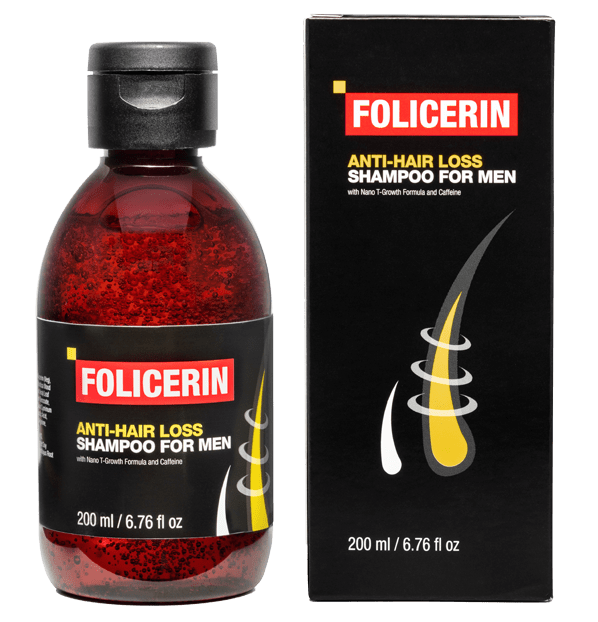
Our Recommendation — Folicerin
Score: 4.6/10 · Best for: men with early thinning who want a botanical, caffeine-based shampoo as a cosmetic add-on alongside whatever else they are doing. Main caution: no money-back guarantee is published, and the label lists ingredient names with no amounts. Fair trial: the three-bottle Standard pack — about three months at directed use, $111.98 with shipping.
The Structural Difference
Contact time: minutes vs hours
Minoxidil is applied to the scalp and left there — typically twice a day, absorbed over hours, every day, for as long as the user wants its effect. A shampoo is massaged in for one to three minutes and rinsed off. Over a month, the drug's scalp contact is measured in hundreds of hours; the shampoo's, in about an hour.
That asymmetry is not a detail. Drug delivery is dose multiplied by time, and the rinse-off format concedes almost all of the time before the comparison begins. Whatever a shampoo ingredient could do in principle, it must do it in the minutes before the shower washes it away.
Regulation: cosmetic vs approved drug
Minoxidil passed through drug approval: defined strengths (2% and 5%), defined indications, trial programmes measured against placebo, and a label that must state its side effects. A botanical shampoo is regulated as a cosmetic. It needs no efficacy trial, proves nothing to anyone before sale, and may not legally claim to treat hair loss — which is why its packaging speaks of "support", "vitality" and "the appearance of thicker hair".
That language gap is the regulation showing through. When a shampoo bottle circles around the word "regrowth" without ever landing on it, you are reading the exact distance between a cosmetic claim and a drug claim.
What each is claimed to do
Minoxidil's claim is specific and modest: it prolongs the growth phase of follicles and can regrow hair in a proportion of users, with results judged over months. It works better at the crown than the hairline, it does not work for everyone, and its effect lasts only while it is used.
A botanical shampoo's claims are atmospheric by comparison: energise the scalp, strengthen the hair, reduce the appearance of thinning. None of those phrases promises a single new hair — which is fortunate, because no trial of a botanical shampoo has produced one.
The easier habit, and its limit
There is one contest a shampoo genuinely wins: adherence. Washing is a habit most men already have, at a frequency they already keep, in a place they already stand each morning. A shampoo asks for no new appointment with a mirror, no waiting for a scalp to dry, and no separate twice-daily ritual.
Minoxidil makes the opposite demand. It must be applied, left on, and repeated, indefinitely, on days when the user is travelling, tired, ill or simply bored with the routine. Every missed application is part of the real-world treatment, because a drug that is not applied cannot deliver the effect its trials measured.
That burden is a legitimate reason some men decline or abandon the drug, and it should be discussed honestly rather than mocked. A routine that fits a life is more likely to be kept than a routine that fights it. Ease is a real property of a product, not a trivial one.
But ease does not transfer efficacy. The easiest habit in this comparison is attached to the product with the weakest evidence, and the hardest habit to the product with the strongest. A shampoo being faithfully used does not borrow the results of a drug that was not used at all.
This is how the adherence argument is often mis-sold. “The best treatment is the one you will actually use” is true only among treatments. A cosmetic used perfectly remains a cosmetic. Perfect adherence improves the shampoo’s scalp and cosmetic effects; it does not promote it into the treatment category.
The honest comparison therefore holds both truths together. If the burden of minoxidil is decisive for you, that is a decision about minoxidil, made with its costs and benefits in view. What it is not is evidence that the easier product does the same job more conveniently. Convenience changes compliance, not capability.
The Two Real Comparisons
Ketoconazole 2% vs minoxidil 2%
The one true head-to-head: Piérard-Franchimont et al. 1998, in Dermatology (PMID 9669136), compared 2% ketoconazole shampoo with 2% minoxidil lotion in men with pattern loss. Hair density and the proportion of growth-phase follicles improved in both groups, to a degree the authors described as almost similar.
Print the authors' own caveat with the result, as they did: the comparison was small and, in their words, awaits further controlled study. It also used the weaker 2% minoxidil, not the 5% most men now use. The fair reading is that a medicated shampoo did surprisingly well in one small trial — not that shampoo equals minoxidil.
Zinc pyrithione 1% vs minoxidil 5%
The second comparison is less flattering and more representative. A 26-week randomised trial of 1% zinc pyrithione shampoo against 5% minoxidil — reported in an evidence review of the category — found the shampoo's hair-count gain was slightly less than half of minoxidil's. Against the full-strength drug, the best medicated shampoo landed under halfway.
Hold both trials together and the pattern is coherent: medicated shampoos can do something real for hair counts, plausibly by treating scalp inflammation, and that something is a fraction of what the drug does. These are also the category's best results — achieved by drug-strength antifungal shampoos, not by botanical formulas.
What hair counts and density actually mean
The endpoints in these trials also need translating. A hair-count study counts hairs in a defined area of scalp under controlled conditions, rather than asking whether a head looks dramatically different in a mirror. A small measured gain can be real in the count and still modest in ordinary appearance.
Density works the same way. It describes how many hairs occupy a given area, so an improvement means that area became somewhat less sparse on measurement. It does not mean lost hairlines were restored or that every participant gained visibly. Group averages can also hide wide differences between individual responders and non-responders.
The proportion of follicles in the growth phase is a further step removed from appearance. It shows the direction follicles are moving, which is biologically informative, but a follicle counted in that phase has not yet produced a visible, mature hair. Surrogate measures are useful in trials precisely because visible change is slow.
That is why the strength of minoxidil used in a comparison matters so much. A result against the 2% lotion describes performance against the weaker drug preparation in that trial. It cannot be carried across, unchanged, to the 5% products most men use, because the comparator itself has changed.
Reading the ketoconazole result fairly means keeping its own limits attached to it: small, against 2%, and described by its authors as needing further controlled study. Stripped of those limits, the same result becomes a marketing sentence. With them attached, it is an interesting finding about a medicated shampoo — nothing more, nothing less.
The zinc pyrithione comparison is the useful corrective because its comparator was the full-strength drug. Against 5% minoxidil, the shampoo’s gain was reported as slightly less than half. Together, the two comparisons show why naming the comparator’s strength is not pedantry: change the strength, and the meaning of “close” changes with it.
Where the Botanical Shampoos Stand
Below the medicated tier there is no head-to-head data at all. No botanical or caffeine shampoo has been trialled against minoxidil, against ketoconazole, or — with one two-ingredient exception covered in our caffeine shampoo review — against placebo. The honest placement for the whole class is add-on: a pleasant, possibly supportive routine with no comparative evidence.
Folicerin is representative. Its label names its ingredient systems and hides every amount; no trial of the finished product exists. Nothing about it is scandalous — it is a normal botanical shampoo. The scandal, if any, is a category that lets buyers believe a contest has taken place when no botanical product has ever entered one.
Can a Shampoo Replace Minoxidil or Finasteride?
No. The two treatments with robust, replicated trial evidence for male pattern hair loss are topical minoxidil and finasteride — the options NHS patient information on hair loss names as the evidenced treatments. Everything else, shampoo included, is support around that core or a substitute for doing anything.
The replacement question matters because of timing. Pattern loss is progressive, and follicles that have fully miniaturised do not come back. Months spent hoping a shampoo will do a drug's job are months subtracted from the window where the drug works best. That — not the bottle's price — is the real cost of the substitution.
Choosing not to use minoxidil or finasteride is a legitimate decision; many men weigh the side effects, the daily commitment, or the indefinite duration and decline. But it should be made as a decision about the drugs, with eyes open — not smuggled in as a belief that a shampoo is the natural equivalent. It is not equivalent, and its own evidence file says so.
Using a Shampoo Alongside Minoxidil
The practical question is usually the reverse: can the two be combined? At class level, yes — there is no known conflict between a rinse-off shampoo and a leave-on topical applied to a dry scalp afterwards. Washing is, if anything, part of minoxidil hygiene: the drug's most common nuisance is scalp irritation and flaking, and a well-kept scalp tolerates it better.
Two honest limits. First, no specific combination has been trialled: Folicerin itself is untested alongside minoxidil, and we will not invent a protocol — sequencing, spacing and frequency — that no study has examined. Ordinary practice is shampoo first, dry scalp, then the topical; that is convention, not evidence.
Second, if irritation appears after combining products, the shampoo is not automatically the culprit — minoxidil's own vehicle is a common cause. Our shampoo side-effects guide sets out how to tell irritation sources apart and when to stop. Change one variable at a time, or you will never know which one mattered.
The absence of a tested protocol is worth stating plainly. No study has examined this specific shampoo used alongside minoxidil, set the spacing between washing and applying, or compared one order of use with another. Ordinary practice can be described, as this article does, but it should not be upgraded into studied advice.
That gap makes a prescriber or pharmacist the right place for personal questions. Useful questions include whether your current scalp condition changes how a topical should be introduced, what irritation is expected from the drug itself, and what should prompt you to pause and seek advice rather than push through.
Also worth asking is how any change should be judged: which product to introduce first, how long to leave between changes, and what records — photographs, notes on irritation, dates — would make a later review useful. Those are questions about your situation, and they are exactly what a general article cannot answer for you.
Ask, too, what stopping or switching would involve if irritation appears, and whether a medicated shampoo for dandruff would suit your scalp better than a botanical one alongside the drug. A pharmacist who knows the drug’s vehicle and your other products can spot conflicts a product page will never mention.
While those answers are individual, the working principle in this article stays general: introduce one change at a time, keep notes, and do not attribute every improvement or irritation to the newest bottle automatically. Without that discipline, a combined routine produces confusion instead of information, however sensible each product seemed alone.
None of these questions requires inventing a protocol to ask them. They turn an untested combination from an assumption into a monitored decision, with a named person to return to if the scalp reacts. That is the most honest version of “using them together” the current evidence allows anyone to offer.
Our Verdict
Minoxidil wins this comparison the way a drug with decades of trials should: on contact time, on regulation, and on the only head-to-head data that exists — data in which even medicated shampoos reached half its effect or less. A shampoo's realistic ceiling is a healthy scalp and better-looking hair around a treatment, or around a decision not to treat.
So buy in the right order. If regrowth is the goal, the treatment decision comes first and the shampoo is chosen to support it. If you have decided against medication, a botanical shampoo like Folicerin is a reasonable cosmetic — bought as one, it is honestly sold. Bought as a replacement, it is the most expensive kind of cheap: it costs you the window.
Our Recommendation — Folicerin
Score: 4.6/10 · Best for: men with early thinning who want a botanical, caffeine-based shampoo as a cosmetic add-on alongside whatever else they are doing. Main caution: no money-back guarantee is published, and the label lists ingredient names with no amounts. Fair trial: the three-bottle Standard pack — about three months at directed use, $111.98 with shipping.
Frequently Asked Questions
Can I stop minoxidil if I use a hair loss shampoo?
Nothing supports that trade. Minoxidil's effect depends on continued use, and stopping it returns the follicles it was sustaining to their previous course. No shampoo has evidence of maintaining minoxidil's gains. If side effects or the routine itself are the problem, that is a conversation for a clinician about alternatives — not a reason to substitute a cosmetic.
Which is better, ketoconazole shampoo or minoxidil?
They do different jobs. Ketoconazole treats dandruff and scalp inflammation; in one small 1998 trial its hair-density improvements looked almost similar to 2% minoxidil, with the authors themselves calling for further controlled study. Minoxidil is the regrowth drug, with the far deeper trial record. Many routines reasonably include both — see our ketoconazole guide.
Can I use Folicerin and minoxidil together?
At class level there is no known conflict between a rinse-off shampoo and a leave-on topical, and ordinary practice is to wash first and apply minoxidil to a dry scalp. But Folicerin itself has never been tested in combination with minoxidil, and no studied protocol exists. Treat the combination as untested, introduce one product at a time, and stop whichever coincides with new irritation.
Why do shampoo brands avoid the word "regrowth"?
Because a cosmetic may not claim to treat hair loss or regrow hair — that is a drug claim requiring drug approval and trial evidence. The circling language ("supports", "energises", "thicker-looking") is the legal boundary made visible. A bottle that could claim regrowth, would.
How long does minoxidil take compared with a shampoo?
Both are judged in months: trials of minoxidil assess at four to six months, and shampoos deserve the same window for their narrower aims. The difference is what the wait can deliver — measurable regrowth for a proportion of minoxidil users, versus scalp health and cosmetic improvement from a shampoo. Our timeline guide sets out the judging method.

Last reviewed: October 2026. This article is educational and is not medical advice.
