
- Quick Answer
- What Is Lion's Mane?
- Hericenones, Erinacines and the Nerve Growth Factor Story
- Does Lion's Mane Improve Memory and Cognition?
- The Anchor Trial: Mori 2009
- The Second Older-Adult Trial: Saitsu 2019
- What About Alzheimer's Disease?
- Does Lion's Mane Help Focus in Healthy Young Adults?
- What About Mood, Anxiety and Sleep?
- The Other Claims: Nerve Repair, Gut, Immune and Heart
- Fruiting Body vs Mycelium vs Myceliated Grain: Why the Label Matters
- Is Lion's Mane Safe?
- How to Judge a Lion's Mane Claim
- Frequently Asked Questions
- Does lion's mane regrow brain cells?
- How long does lion's mane take to work?
- Are the benefits permanent?
- Fruiting body or mycelium — which did the studies use?
- Can lion's mane treat Alzheimer's disease or depression?
- Is lion's mane psychoactive or illegal?
- Who should avoid lion's mane?
- What dose did the studies use?
- Read This Next
Quick Answer
Lion's mane has genuinely interesting biology and a genuinely small human evidence base. Those two facts are often sold as one, and they should not be.
The best human result is a single small trial from 2009: 30 older adults with mild cognitive impairment improved on a cognitive scale over 16 weeks — then declined after stopping.
Everything since is pilot-sized: small studies in older adults, one small trial in healthy young adults, and small mood studies. Results are mixed, not uniformly positive.
The famous nerve growth factor story — the reason for the "regrows brain cells" headlines — comes from cell cultures and animals. No human trial has measured it in the brain.
On safety, lion's mane is generally well tolerated in the short trials done. Allergy is the clearest real risk, and long-term supplement safety is largely unstudied.
What Is Lion's Mane?
Lion's mane is Hericium erinaceus, an edible mushroom that grows on dead or ageing hardwood trees across the northern hemisphere.
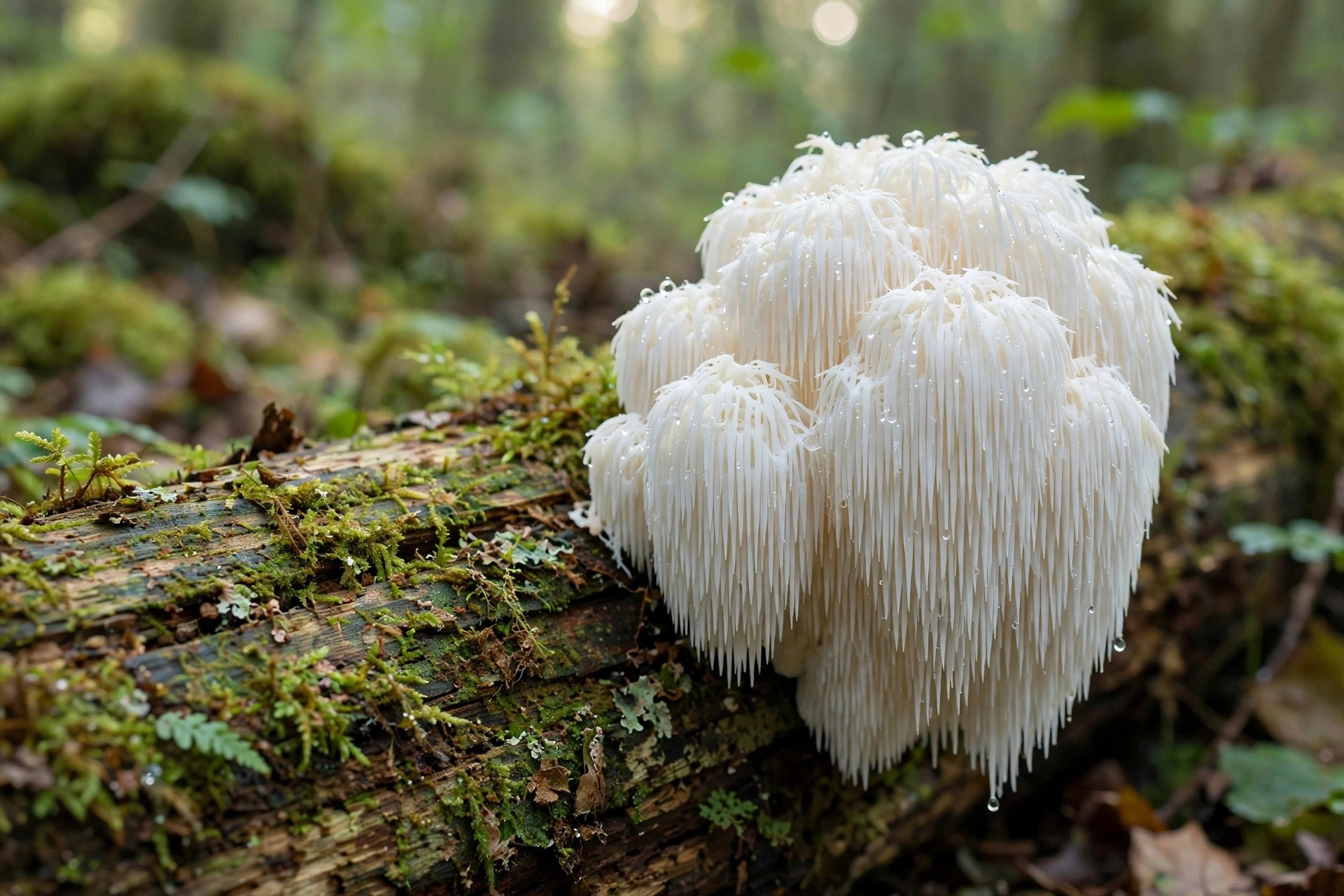
It looks like nothing else in the fungi aisle: a white mass of cascading, icicle-like spines instead of a cap and stem. It is cooked and eaten as food.
In East Asian tradition it has a long history as both a culinary mushroom and a medicinal one, used for digestive complaints and as a general tonic.
That traditional record explains why researchers took an interest. It does not, by itself, establish any modern claim about memory, focus or mood.
Today lion's mane is sold as capsules, powders, extracts, coffees and gummies. The preparation differences between those products turn out to matter a great deal, as a later section explains.
It is not a psychoactive mushroom. It contains no psilocybin, and nothing in its studied chemistry is a controlled substance.
Hericenones, Erinacines and the Nerve Growth Factor Story
Two families of compounds make lion's mane scientifically distinctive. They live in different parts of the fungus, which is the first detail marketing usually drops.
Hericenones are found in the fruiting body — the visible mushroom. Erinacines are found in the mycelium, the root-like network the fungus grows from.
In laboratory studies, both families stimulated production of nerve growth factor, or NGF — a protein that helps neurons survive, maintain themselves and form connections.
The original erinacine work dates to the 1990s, in cultured cells. The hericenone findings are similar: cell systems, not people, did the responding.
Rodent studies extended the story. Lion's mane extracts and erinacines have affected NGF-related pathways, memory behaviour and nerve repair in mice and rats.
That is a real and unusually coherent preclinical record. Reviews of the depression literature, for example, are built mostly on these animal and cell findings (Chong et al., International Journal of Molecular Sciences, 2020).
What has never been shown is the step the adverts skip: that swallowing lion's mane raises NGF in a human brain, or regrows human neurons. Human brains are not measured that way in supplement trials.
So the honest label for the mechanism is: demonstrated in dishes and animals, biologically plausible, unproven in people. Every claim below should be read with that label attached.
Does Lion's Mane Improve Memory and Cognition?
The Anchor Trial: Mori 2009
The trial the whole category stands on was run in Japan and published in 2009. It was double-blind and placebo-controlled, which is the right design.
It enrolled 30 men and women aged 50 to 80, all diagnosed with mild cognitive impairment. Half took lion's mane; half took an identical placebo.
The dose was 3 grams a day of dry fruiting-body powder, in tablets, for 16 weeks. Cognition was scored on a scale based on the Revised Hasegawa Dementia Scale.
At weeks 8, 12 and 16, the lion's mane group scored significantly higher than the placebo group, and scores rose with duration of intake (Mori et al., Phytotherapy Research, 2009).
Then comes the finding most articles omit. Four weeks after the tablets stopped, the lion's mane group's scores had fallen significantly again.
That pattern suggests a real but use-dependent effect in this small group — not a repair, not a cure, and not a result in healthy people of any age.
The trial also reported no adverse effect on laboratory tests. With 30 participants, though, it could only ever detect common, obvious harms.
Independent replication at larger scale has still not arrived. A 2025 systematic review found the entire clinical file amounts to five randomised trials and three pilot trials (Menon et al., Frontiers in Nutrition, 2025).
The Second Older-Adult Trial: Saitsu 2019
A decade later, a second Japanese randomised trial tested fruiting-body supplements for 12 weeks in adults aged 50 and over with normal cognitive function.
Three cognitive tests were used. Only one — the Mini-Mental State Examination — showed significant improvement and protection against deterioration in the lion's mane group.
The other two tests, covering visual retention and verbal paired-associate learning, did not show the effect. The authors speculated hericenones were responsible (Saitsu et al., Biomedical Research, 2019).
One positive test out of three, in another small sample, is a signal worth following. It is not the blanket "improves cognition" that product pages quote.
Read together, the two trials point the same modest way: possible small benefits on screening-scale scores in older adults, over weeks, while taking it. Nothing stronger is licensed.
What About Alzheimer's Disease?
One pilot trial is responsible for most Alzheimer's headlines. It tested a specific preparation — mycelia enriched with erinacine A — in people with mild Alzheimer's disease.
Participants took three 350 mg capsules a day, roughly 1 gram daily, or placebo, for 49 weeks. It is the longest lion's mane trial published (Li et al., Frontiers in Aging Neuroscience, 2020).
After 49 weeks, the placebo group's screening scores had declined, while the treated group improved on the Mini-Mental State Examination, with a difference in daily-living scores between groups.
Now the sizing. This was a pilot study with around 49 participants, testing one maker's specific erinacine-A preparation — and the author list includes staff of the company behind that preparation.
Maker-linked authorship does not invalidate a trial. Under this site's standing rule, it does mean the result needs independent replication before it carries weight.
Four participants also dropped out because of abdominal discomfort, nausea and skin rash — a safety detail the same trial honestly reported, and worth remembering below.
Our verdict: an interesting pilot that justifies a larger, independent trial. It does not establish lion's mane as a treatment or preventive for Alzheimer's disease.
Does Lion's Mane Help Focus in Healthy Young Adults?
This is the market lion's mane is actually sold to — students and workers chasing focus — and it is where the human evidence is thinnest.
The key study is a 2023 double-blind pilot trial in 41 healthy adults aged 18 to 45. They took 1.8 grams a day of lion's mane or placebo.
Sixty minutes after a single dose, the lion's mane group performed the Stroop task — a test of attention and processing speed — significantly faster than placebo (Docherty et al., Nutrients, 2023).
After 28 days, subjective stress showed a trend toward improvement that did not reach statistical significance, at p = 0.051. A trend is not a finding.
The authors were careful: null and limited negative findings were also observed, the sample was small, and results should be interpreted with caution. That caution is the finding's frame.
Other acute-dose work points the other way. A 2025 double-blind trial of a standardised extract in healthy younger adults (Surendran et al., Frontiers in Nutrition, 2025) found no overall cognitive or mood benefit from a single dose.
So the healthy-adult record is: one small pilot with a single-task speed signal, one null acute trial, and no large study. "Focus" claims built on this are running far ahead of it.
Nothing here resembles the evidence base for the boring fundamentals — sleep, exercise and blood-pressure control — which no mushroom supplement outperforms for the brain.
What About Mood, Anxiety and Sleep?
The mood claim rests mainly on one small, unusual trial from 2010, in which lion's mane was baked into cookies.
Thirty Japanese women took cookies containing about 2 grams a day of fruiting-body powder, or placebo cookies, for four weeks. Mood, menopause symptoms, sleep and general complaints were questionnaire-scored.
Depression-scale and general-complaint scores fell significantly within the lion's mane group compared with before intake. Against placebo directly, only some complaint items differed significantly (Nagano et al., Biomedical Research, 2010).
Other items — concentration, irritability, anxiety — tended lower without reaching significance. The authors said the results suggested a possibility, involving a mechanism possibly different from NGF.
Thirty participants, four weeks, one sex, cookies as the delivery form. As a hypothesis it is interesting; as a basis for anxiety or depression claims, it is not enough.
The rest of the mood literature is animal work: reduced anxiety-like and depressive behaviour in mice, hippocampal neurogenesis in rodents. Labelled correctly, that is preclinical only.
Sleep claims are thinner still. Sleep quality was one questionnaire among several in the cookie trial, and dedicated human sleep trials are pilot-level at best.
Lion's mane is not a treatment for depression, anxiety or any sleep disorder, and nothing in the human record supports using it as one.
The Other Claims: Nerve Repair, Gut, Immune and Heart
Beyond brain claims, lion's mane accumulates the usual functional-mushroom list. Each item below is real research — at the level stated, and no higher.
Peripheral nerve repair. Rat studies show faster nerve regeneration after injury with lion's mane extracts. There is no equivalent human trial in nerve-injury patients.
Stomach and gut. Traditional use targeted the digestive tract, and laboratory and animal work covers gastric protection and gut-microbiome changes. Human gut outcomes are essentially untested.
Immune effects. Polysaccharides, including beta-glucans, modulate immune activity in laboratory and animal models. Demonstrated infection or illness outcomes in people do not exist.
Heart and metabolic effects. Cholesterol, triglyceride and blood-sugar findings come from rodent feeding studies. No human trial establishes a cardiovascular or diabetes benefit.
Anti-cancer effects. Extracts have killed or slowed cancer cells in dishes and in mouse models. That is the standard starting point of oncology research, and most such leads go nowhere in humans.
The pattern is consistent: a wide preclinical fan, a narrow human base. Width of animal research is not depth of human evidence, however often the two are blended.
Fruiting Body vs Mycelium vs Myceliated Grain: Why the Label Matters
Even a reader who accepts the small trials faces a second problem: the products on sale are often not the preparations the trials used.
Mori's participants took fruiting-body powder. Saitsu's took fruiting-body supplements. The Alzheimer's pilot used a defined erinacine-A-enriched mycelium, grown and standardised for that compound.
Much of the retail market is none of these. A large share is myceliated grain: mycelium grown through sterilised rice or oats, then dried and milled with the grain still in it.
The grain cannot practically be separated from the mycelium, so it ships in the powder. The result dilutes fungal material with grain starch to a degree the label rarely quantifies.
This is a transparency issue, not a moral one. Pure mycelium grown in liquid culture is a legitimate material — the erinacine research depends on it. Grain-diluted biomass is a different thing wearing a similar name.
Label clues exist. "Mycelial biomass" and "myceliated grain" disclose the format; a stated beta-glucan percentage suggests fungal content, while high alpha-glucan points toward grain starch.
A label that names the part used, the extraction method and a beta-glucan figure can be compared with the trials. A label that says only "lion's mane mushroom powder" cannot.
We recommend no product here. The point is narrower: if a study is your reason for interest, the preparation in the study is the comparison your label has to survive.
Is Lion's Mane Safe?
As a cooked food, lion's mane has a long history of ordinary use. As a concentrated supplement, the safety record is short — because the trials are short and small.
Within trials, tolerability has generally been good. Mori's study found no adverse effect on laboratory tests over 16 weeks at 3 grams a day.
The longest trial adds texture: in the 49-week Alzheimer's pilot, four participants dropped out with abdominal discomfort, nausea and skin rash (Li et al., Frontiers in Aging Neuroscience, 2020).
The 2025 systematic review summarised reported supplement side effects as mainly stomach discomfort, headache and allergic reactions, while noting adverse events were commonly unreported across studies (Menon et al., Frontiers in Nutrition, 2025).
Allergy is the clearest real risk. Lion's mane is a mushroom; people with mushroom or mould allergies should avoid it, in supplement or food form.
One serious case report exists: Nakatsugawa and colleagues (Internal Medicine, 2003) described a 63-year-old man who developed acute respiratory failure after months of taking a lion's mane extract, with laboratory evidence pointing to an allergic mechanism.
A single case report cannot give a frequency, and in over two decades it remains the standout of its kind. It is still why breathing difficulty after any supplement is an emergency, not a wait-and-see.
Interactions are theoretical, not documented. No human study has mapped lion's mane drug interactions; cautions about blood thinners or diabetes medicines are inferences from laboratory activity, and should be treated as reasons to ask a clinician, not as established effects.
Pregnancy and breastfeeding have no meaningful safety data, so the standard position is avoidance. The same applies to long-term daily use beyond the trial durations above.
Overall verdict: low apparent risk for most healthy adults in the short term, a real allergy exception, and a long-term record too thin to certify anyone anything stronger.
How to Judge a Lion's Mane Claim
Four questions will grade almost any lion's mane claim you encounter, in an article, an advert or a podcast.
Human or animal? NGF stimulation, neurogenesis, nerve repair and most mood effects are cell and rodent findings. If the species is not named, assume it was not human.
Which preparation? Fruiting-body powder, erinacine-A-enriched mycelium and myceliated grain are three different materials. Only the first two have human trial data behind them.
How many people, and who? The positive cognition trials enrolled 30 to roughly 49 older or impaired adults. That says little about a healthy 25-year-old chasing focus.
Did it last? The anchor trial's gains faded within four weeks of stopping. A benefit that requires indefinite continued use is a subscription-shaped finding, and should be priced as one.
Claims that survive all four questions are modest: possible small cognitive-score benefits in older adults, over weeks, while taking a fruiting-body preparation. That is the evidence, at full size.
Frequently Asked Questions
Does lion's mane regrow brain cells?
Not that anyone has shown in humans. Hericenones and erinacines stimulate nerve growth factor in cell cultures and animals. No human trial has measured neuron growth or brain NGF after taking lion's mane.
How long does lion's mane take to work?
The older-adult cognition trials ran 12 to 16 weeks, with the anchor trial's differences appearing by week 8. One young-adult pilot found a speed effect 60 minutes after a single dose; another acute trial found none.
Are the benefits permanent?
No evidence says so. In Mori 2009, cognitive scores fell significantly within four weeks of stopping the tablets. Whatever the effect was, in that trial it depended on continued intake.
Fruiting body or mycelium — which did the studies use?
Both, in different trials: fruiting-body powder in the Japanese cognition studies, and a specific erinacine-A-enriched mycelium in the Alzheimer's pilot. Neither matches generic myceliated-grain powder, which much of the market sells.
Can lion's mane treat Alzheimer's disease or depression?
No. Alzheimer's evidence is one small, maker-linked pilot of a specific preparation. Depression evidence is one 30-person, four-week questionnaire trial plus animal studies. Neither supports treatment claims for diagnosed conditions.
Is lion's mane psychoactive or illegal?
Neither. Lion's mane is an ordinary edible mushroom with no psilocybin and no controlled substances. It is sold legally as a food and supplement in most countries.
Who should avoid lion's mane?
Anyone with a mushroom or mould allergy, given a published case of severe respiratory reaction. Pregnant or breastfeeding people lack safety data, and anyone on prescription medication should treat supplement use as a clinician conversation.
What dose did the studies use?
Human trials used roughly 1 to 3 grams a day of a defined preparation — 3 grams of fruiting-body powder in Mori 2009, 1.8 grams in the young-adult pilot. Those are descriptions of studies, not recommendations.
Last reviewed: October 2026. This article is educational and is not medical advice.
