
- Quick Answer
- What Is Cordyceps?
- The Name Problem: Wild Fungus, Cs-4 and C. militaris Are Not the Same Product
- What Is Cordycepin?
- Does Cordyceps Improve Exercise Performance?
- The Positive Pilot: Older Adults, Thresholds, No VO2max Change
- The Null Trials: Trained Athletes
- The Blend Result Behind the VO2max Headlines
- What the Pooled Analyses Say
- What About Energy, Fatigue and "ATP"?
- Does Cordyceps Help the Kidneys?
- What About Libido, Testosterone and Blood Sugar?
- Immune Claims: What Was Actually Measured?
- Is Cordyceps Safe?
- The Quality Problem: Substitution, Contamination and Heavy Metals
- How to Read a Cordyceps Claim
- Frequently Asked Questions
- Is the cordyceps in capsules the wild caterpillar fungus?
- Does cordyceps increase VO2max?
- Does cordyceps raise testosterone or help libido?
- How long does cordyceps take to work?
- Is cordyceps a stimulant?
- Can cordyceps treat kidney disease?
- Who should not take cordyceps?
- Is cordyceps safe to take every day?
- Read This Next
Quick Answer
No cordyceps benefit is proven in humans. The best human evidence is a handful of small exercise trials, and they disagree with each other.
In older, untrained adults, one small pilot trial found modest improvements in two exercise thresholds. In trained athletes, comparable trials found nothing at all.
Most other claims — energy, libido, kidney protection, blood sugar, anti-ageing — rest on animal studies, test-tube work, or traditional use, not on human trials.
And the product matters. Capsules contain cultured fungal material, usually a fermented strain called Cs-4 or cultivated Cordyceps militaris — not the wild caterpillar fungus of tradition.
Short-term use appears generally well tolerated in the trials done so far. The honest cautions are drug interactions, product quality, and how thin the evidence still is.
What Is Cordyceps?
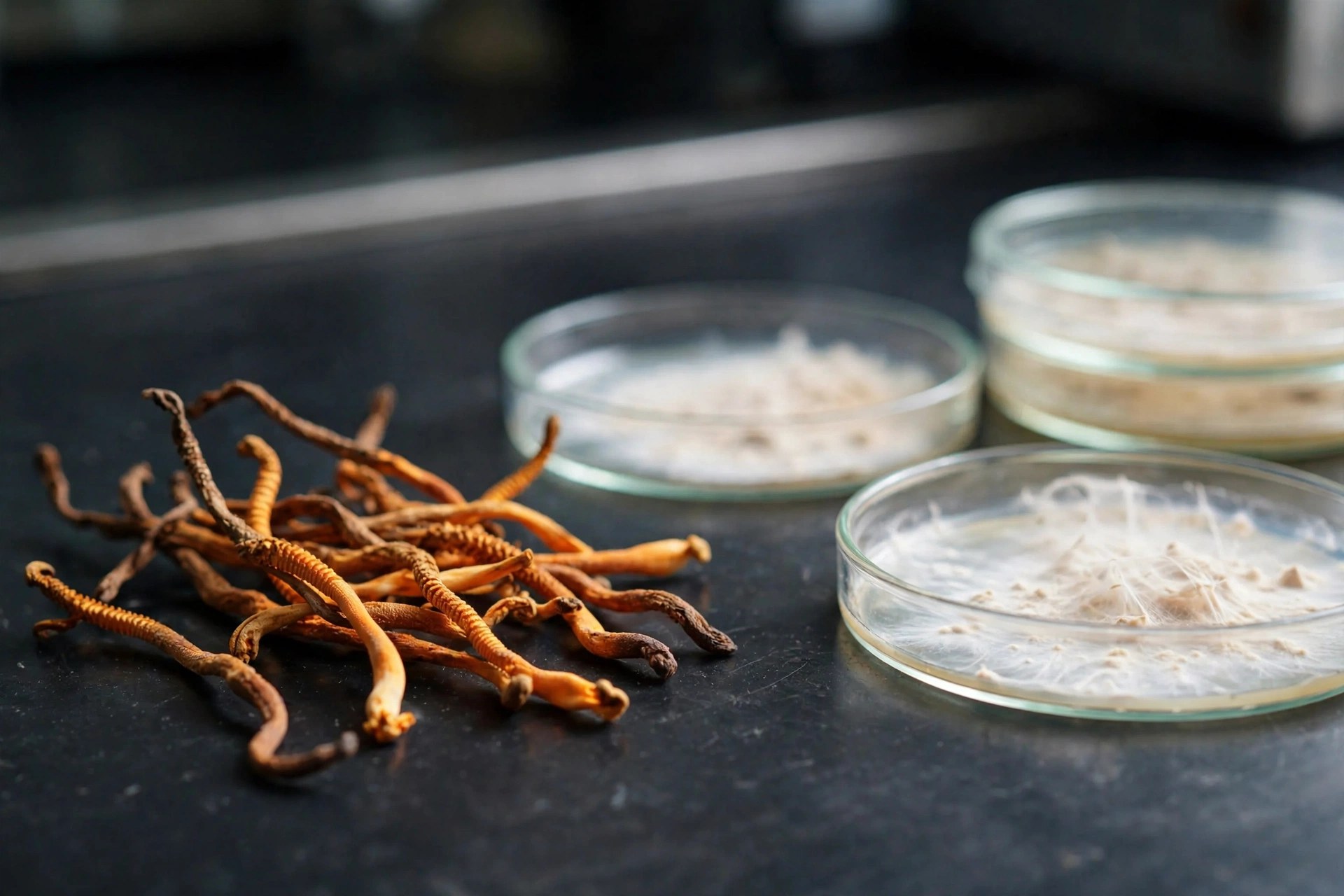
Cordyceps is a genus of fungi that grow on insects. The famous species, now classified as Ophiocordyceps sinensis, infects caterpillar larvae living in high mountain grasslands.
The fungus consumes the larva from inside, then sends a small stalk-like fruiting body up through the soil. The dried fungus-plus-caterpillar is the material prized in traditional Chinese medicine.
That wild material is rare, slow to gather, and extremely expensive. It has never been a mass-market ingredient, whatever supplement marketing implies.
In traditional practice, cordyceps was used as a tonic — for fatigue, recovery after illness, coughs, kidney complaints and low sexual function.
Traditional use is a record of what practitioners believed and prescribed. It is not a clinical trial, and this article keeps the two separate throughout.
Modern interest focuses on two cultivated alternatives. One is Cordyceps militaris, a related species that can be farmed. The other is Cs-4, explained below.
The Name Problem: Wild Fungus, Cs-4 and C. militaris Are Not the Same Product
Almost every misunderstanding about cordyceps starts here. Three different materials share one shelf name, and evidence gathered on one is spent on all three.
Wild Ophiocordyceps sinensis is the caterpillar fungus itself. Supply is limited, prices are very high, and adulteration and substitution in this trade are long-standing problems.
Cs-4 is a cultured mycelium strain, grown by fermentation in tanks. It contains no caterpillar and no wild fruiting body. Most supplement trials used this material.
The best-known exercise trial, for example, tested Cs-4 — described by its authors as cultured Cordyceps sinensis mycelium — not wild fungus (Chen et al., Journal of Alternative and Complementary Medicine, 2010).
Cordyceps militaris is a different species, cultivated on grain or other substrates or in liquid culture. It tends to be richer in cordycepin than Cs-4 preparations.
These materials differ in chemistry, dose and price. A trial of one cannot validate a capsule of another, and a label that just says "cordyceps" tells you little.
So the first question for any claim is not "does cordyceps work?" It is "which cordyceps, in whom, at what dose, measured how?"
What Is Cordycepin?
Cordycepin is the compound researchers study most. Chemically it is 3′-deoxyadenosine — a molecule built almost exactly like adenosine, a normal cellular nucleoside.
That one missing oxygen atom is the whole story. Enzymes that build RNA can mistake cordycepin for adenosine, and the substitution can stop the RNA chain early.
A widely cited review describes cordycepin, isolated from C. militaris, as the main studied constituent behind the fungus's reported laboratory activities (Tuli et al., 3 Biotech, 2013).
In laboratory and animal work, cordycepin has shown anti-inflammatory, antioxidant and anti-tumour-cell effects, among many others. The list is long precisely because the work is preclinical.
A 2024 structural and pharmacological review reaches the same shape of conclusion: broad activity in experimental systems, with delivery and bioavailability still unsolved problems (Frontiers in Pharmacology, 2024).
Two cautions follow. First, effects in a cell culture dish occur at concentrations a swallowed capsule may never reach in human tissue.
Second, Cs-4 products contain little cordycepin compared with C. militaris. Citing cordycepin pharmacology to sell a Cs-4 capsule mixes two different materials again.
Cordycepin is a genuinely interesting molecule. Interesting molecules, however, are the starting point of drug research, not the end of it.
Does Cordyceps Improve Exercise Performance?
This is the one claim with real human trials behind it, so it deserves the closest reading. The pattern is: small studies, short durations, split results.
The Positive Pilot: Older Adults, Thresholds, No VO2max Change
The most-cited positive trial enrolled 20 healthy adults aged 50 to 75. They took Cs-4 capsules, about 1 gram a day in total, or placebo, for 12 weeks.
After 12 weeks, the Cs-4 group's metabolic threshold rose by 10.5% and their ventilatory threshold rose by 8.5%. The placebo group showed no significant change on either measure.
Those thresholds mark the exercise intensity where lactate starts accumulating and breathing is driven harder. Rising thresholds mean working a little longer before that point.
But VO2max — the headline measure of aerobic capacity — did not change in either group. The authors themselves called the study a pilot (Chen et al., 2010).
A pilot with 20 people is a reason to run a bigger trial. It is not a confirmed performance effect, and it has not been robustly replicated.
The Null Trials: Trained Athletes
The picture reverses in people who are already fit. In 22 endurance-trained male cyclists, 3 grams a day of Cs-4 for five weeks changed nothing measured.
VO2peak, ventilatory threshold and time-trial performance were all unaffected, within and between groups. The authors concluded Cs-4 had no effect in trained cyclists (Parcell et al., International Journal of Sport Nutrition and Exercise Metabolism, 2004).
Two further small cyclist trials tested cordyceps combined with rhodiola in multi-ingredient formulas. Both were also null on aerobic outcomes.
Combination formulas cannot isolate cordyceps anyway. If a blend works, you cannot say which ingredient did it — and here, the blends did not work.
The Blend Result Behind the VO2max Headlines
The largest VO2max figure in cordyceps marketing comes from a 2017 trial of a mushroom blend containing C. militaris, at 4 grams a day, in 28 young adults.
After one week, there was no significant treatment effect on VO2max, ventilatory threshold or time to exhaustion. The main analyses were null (Hirsch et al., Journal of Dietary Supplements, 2017).
Only 10 volunteers continued for the extra two weeks. In that small remainder, VO2max rose by 4.8 ml/kg/min in the blend group versus 0.9 on placebo.
That is a finding from 10 people, on a multi-mushroom blend, after most participants had left the analysis. It cannot carry claims made for cordyceps alone.
What the Pooled Analyses Say
A 2025 systematic review and meta-analysis gathered 14 randomised trials of fungal supplements in 528 athletes, pooling eight trials with 288 participants for its main analysis.
It found statistically significant, modest pooled improvements for Cordyceps sinensis preparations in endurance performance, ventilatory threshold and VO2peak (Frontiers in Nutrition, 2025).
Pooling small trials can reveal a real small effect — or average their biases. The underlying trials remain small, short and preparation-mixed, which caps the certainty.
Our verdict: a small endurance-threshold effect in less-trained or older adults is possible. A meaningful VO2max or race-performance effect in trained athletes is not supported.
What About Energy, Fatigue and "ATP"?
Cordyceps is sold first as an energy supplement. Yet no placebo-controlled trial we could find has measured subjective energy, vitality or everyday fatigue as its endpoint.
The ATP story comes from mechanism and animal work: adenosine-like compounds, mitochondrial pathways, and exercise tests in rodents. It is a plausible-sounding chain, not a demonstrated outcome.
Feeling more energetic is also one of the easiest outcomes to imagine and one of the hardest to attribute. Sleep, training load and expectation all move it.
Exercise-threshold changes in a laboratory, even where real, are not the same measurement as a person feeling less tired at work. The trials measured the first, not the second.
Reviews of cordyceps pharmacology list anti-fatigue among its traditional and preclinical actions, while the human trial record stays confined to exercise physiology (Ng & Wang, Journal of Pharmacy and Pharmacology, 2005).
So if a label promises daily energy, the honest translation is: this specific promise has not been tested in a controlled human trial.
Does Cordyceps Help the Kidneys?
Kidney use is the oldest traditional indication, and it is the one area with a large trial pool — though not a high-quality one.
The Cochrane review found 22 studies involving 1,746 people with chronic kidney disease. Cordyceps preparations were used alongside conventional treatment, not instead of it.
As an add-on, preparations were associated with lower serum creatinine, higher creatinine clearance and less protein in the urine in the pooled results (Zhang et al., Cochrane Database of Systematic Reviews, 2014).
The reviewers' own warning is the important part: reporting was suboptimal, methods were flawed, and risk of bias was high in some studies and unclear in the rest.
Their conclusion was that definitive conclusions could not be made because the quality of the evidence was low. That sentence rarely survives into marketing copy.
Most of these trials were conducted in China, used various preparations, and tested adjunctive use in diagnosed patients under medical care. That is a narrow setting.
It does not translate into "supports kidney health" for a healthy supplement buyer, and it is not a reason for anyone with kidney disease to self-treat.
Anyone with chronic kidney disease considering cordyceps belongs in a conversation with their kidney team first — especially given the interaction cautions below.
What About Libido, Testosterone and Blood Sugar?
These three claims share one feature: the evidence behind them is animal evidence, and it is usually printed without that label.
For libido and testosterone, the frequently cited findings are rodent findings — including stimulated testosterone production in mouse cells and animals. No human trial has tested either outcome.
Memorial Sloan Kettering's cordyceps monograph states this plainly: cordyceps stimulated testosterone production in mice, and whether it does anything similar in humans is not known (Memorial Sloan Kettering Cancer Center, Cordyceps monograph).
Sexual-function use in traditional medicine is real as a historical fact. It is a reason researchers got interested, not a result in people.
For blood sugar, laboratory and animal studies suggest glucose-lowering activity. There have been no significant clinical trials of cordyceps and blood sugar in people.
That gap cuts both ways. An unproven glucose effect in animals is exactly why a theoretical interaction with diabetes medicines exists in the safety section.
Heart-health claims follow the same pattern: cholesterol and plaque findings in animals, platelet findings in laboratory work, and no human outcome trials.
Anti-ageing and anti-tumour claims are further out still — lifespan findings in mice and growth inhibition in human cancer cells in dishes. Neither is a human benefit.
A useful rule for this whole category: if the study species is not named in the paragraph you are reading, assume it was not human until proven otherwise.
Immune Claims: What Was Actually Measured?
Cordyceps preparations do measurable things to immune markers in laboratory systems. Reviews describe stimulation of immune cells and signalling molecules in cell and animal experiments.
Small human studies have reported changes in immune blood markers, such as natural killer cell activity, after several weeks of use in healthy adults.
A changed blood marker is not the same as fewer infections, shorter illnesses or better vaccine responses. No cordyceps trial has demonstrated those clinical outcomes.
This distinction matters for safety as much as for benefit. An ingredient promoted as immune-stimulating is, by the same logic, a question mark alongside immune-suppressing medicines.
The evidence-based summary is narrow: immune-marker changes, yes, in small studies; immune protection in people, not demonstrated.
Is Cordyceps Safe?
In the short human trials done so far, cordyceps preparations have generally been well tolerated. Reported effects are mostly mild and digestive: nausea, stomach discomfort, diarrhoea, constipation or dry mouth.
The trial record is short, though — weeks to a few months, in small groups of mostly healthy adults. Long-term safety in general use is simply not well characterised.
Several cautions recur in clinical references, and they are worth listing plainly rather than softening.
Immunosuppressants. Because cordyceps can stimulate immune activity in experimental work, it may theoretically work against medicines that suppress the immune system, such as transplant drugs. This combination is a clinician conversation, not an experiment.
Diabetes medicines. Sloan Kettering advises patients taking insulin or other blood-sugar-lowering medication to talk to their provider, because cordyceps may also lower blood sugar (Memorial Sloan Kettering Cancer Center, Cordyceps monograph).
Blood thinners. The same monograph flags a possible increased bleeding risk with anticoagulants such as warfarin, based on antiplatelet findings in laboratory work.
Pregnancy, breastfeeding and children. There is not enough safety evidence to support use in these groups, so the standard advice is to avoid it.
Allergy. Cordyceps is a fungus. Anyone who reacts to moulds or mushrooms should treat it as a possible allergen and stop if respiratory or skin symptoms appear.
None of these cautions makes cordyceps unusually dangerous. They make it a normal biologically active supplement: tolerable for many, wrong for some, untested in the groups above.
The Quality Problem: Substitution, Contamination and Heavy Metals
With cordyceps, the safety question is partly about the fungus and partly about the market selling it. The two should not be confused.
Wild caterpillar fungus commands extreme prices, which creates a standing incentive to substitute cheaper fungal material, or to sell cultivated product described in wild language.
Species substitution also matters scientifically. A capsule of C. militaris or grain-grown mycelium is a different material from the Cs-4 used in the trials, whatever the front label says.
Heavy metals are the second issue. Fungi can accumulate metals from their growth environment, and wild-harvested material carries the environment it grew in with it.
Arsenic is the documented flag for wild Ophiocordyceps: Guo and colleagues (Molecules, 2018) reported that arsenic content and speciation differ enough between wild and cultivated material to serve as markers distinguishing them.
That does not mean cultivated products are automatically clean. It means testing is the difference between a claim and a fact, for any cordyceps material.
Practical reading of a label, without recommending any product: the species or strain is named, the plant part or mycelium form is stated, and contaminant testing exists. Vagueness on all three is itself information.
How to Read a Cordyceps Claim
Five checks will sort almost every cordyceps claim you meet, in adverts or articles, in under a minute.
Which material? Wild fungus, Cs-4 fermented mycelium and C. militaris are different products. A claim that does not say which one was studied is incomplete.
Which species was the study in? Mouse, rat and cell-culture findings are preclinical. They justify human trials; they do not substitute for them.
How many humans, for how long? The flagship exercise results rest on groups of 10 to 28 people over one to twelve weeks. Size every claim by its n.
What was the endpoint? A threshold, a blood marker and a cell line are not a race time, an infection avoided or a symptom relieved.
Who funded it, and did everyone finish? A result drawn from the 10 of 28 participants who continued is a different result from one drawn from all 28.
Applied consistently, these checks leave cordyceps where the evidence leaves it: an interesting fungus with a thin, mixed human record — not a proven anything.
Frequently Asked Questions
Is the cordyceps in capsules the wild caterpillar fungus?
Almost certainly not. Wild Ophiocordyceps sinensis is rare and extremely expensive. Capsules contain cultured material — usually fermented Cs-4 mycelium or cultivated C. militaris — which is also what most trials studied.
Does cordyceps increase VO2max?
Not convincingly. The positive older-adult pilot found threshold improvements with VO2max unchanged, trained-cyclist trials were null, and the one VO2max rise came from a mushroom blend in the 10 participants who completed three weeks.
Does cordyceps raise testosterone or help libido?
There is no human evidence either way. The testosterone findings are from mouse and animal work, and libido use is a traditional-use claim. Neither has been tested in a controlled human trial.
How long does cordyceps take to work?
The human trials measured outcomes after weeks, not hours: five to twelve weeks in the Cs-4 studies. There is no good evidence for a same-day or pre-workout acute effect.
Is cordyceps a stimulant?
No. Cordyceps contains no caffeine and is not classed as a stimulant. Its studied compound, cordycepin, resembles adenosine — a molecule associated with normal cellular signalling, not stimulation.
Can cordyceps treat kidney disease?
No. A Cochrane review of adjunctive use in chronic kidney disease found possible laboratory improvements but judged the evidence low quality and conclusions impossible. Kidney disease treatment is a specialist matter.
Who should not take cordyceps?
People taking immunosuppressants, insulin or other blood-sugar medicines, or blood thinners should check with their clinician first. Pregnant or breastfeeding people and children lack safety data, and anyone with a mushroom or mould allergy should avoid it.
Is cordyceps safe to take every day?
Short-term daily use at trial-like doses was generally well tolerated in small studies. Long-term daily safety has not been well studied, and product quality varies, so "no problems in short trials" is the strongest statement the evidence supports.
Last reviewed: October 2026. This article is educational and is not medical advice.
